
The Christmas Bird Count is typically one of my birding highlights of the year. This year was no exception.
The Christmas Bird Count is a bird census conducted by volunteers each winter to track bird populations and trends. Keene was one of the original 25 locations in 1900. Now there are well more than 2,000 counts held throughout the United States and beyond.
I did my usual area along a coastal region of southwestern Connecticut. It is a good area to cover as there is a nice variety of habitats, including Long Island Sound, marshes, freshwater ponds, wooded areas and even some patches of open field.
We started, as usual, at a park that has a river on one side and a marina on the other. Long Island Sound is a mile or so to the south, so the river and marina often get winter ducks normally associated with larger bodies of water.
We stepped out of our cars in the parking lot at sunrise to a 13-degree day. Luckily, the wind was surprisingly calm, and the windchill did not make it even worse. But still, 13 degrees is 13 degrees, and it was not pleasant trying to count birds.
I wear contact lenses and had to keep blinking to keep them from freezing. I’m not sure if they actually would have frozen, but it certainly felt that way.
Right away, we spotted peregrine falcons and a bald eagle along with the ducks one would expect to see at the park. Greater scaup, hooded mergansers, long-tailed ducks and bufflehead were the highlight fowl.
The small pond across the street, which usually yields birds such as black-crowned night heron and American wigeon – and the very occasional Eurasian wigeon – was frozen solid and did not hold any ducks or waders.
We moved onto a bigger park/beach on Long Island Sound. The wind that was so calm at the first park was whipping at the new park and not only made conditions almost unbearable, but also stirred up the water to make spotting ducks in the distance nearly impossible. We did get several brant and red-breasted mergansers, as well as a few common loons, but the park was not as fruitful as it has been in past years.
The next stop was an esplanade where warblers have been known to brave the New England winter chill. The path runs adjacent to a water treatment plant and the huge tubs of open water apparently is a draw for the warblers. A row of evergreens separates the path from the treatment plant and we found pine warblers and yellow-rumped warblers among the branches.
A large dog park with a small wooded area and several expanses of grass was the next stop. The freezing temperatures and biting wind kept most of the birds hidden, but there were a few mixed flocks of white-throated sparrows and song sparrows scattered throughout the grassy areas.
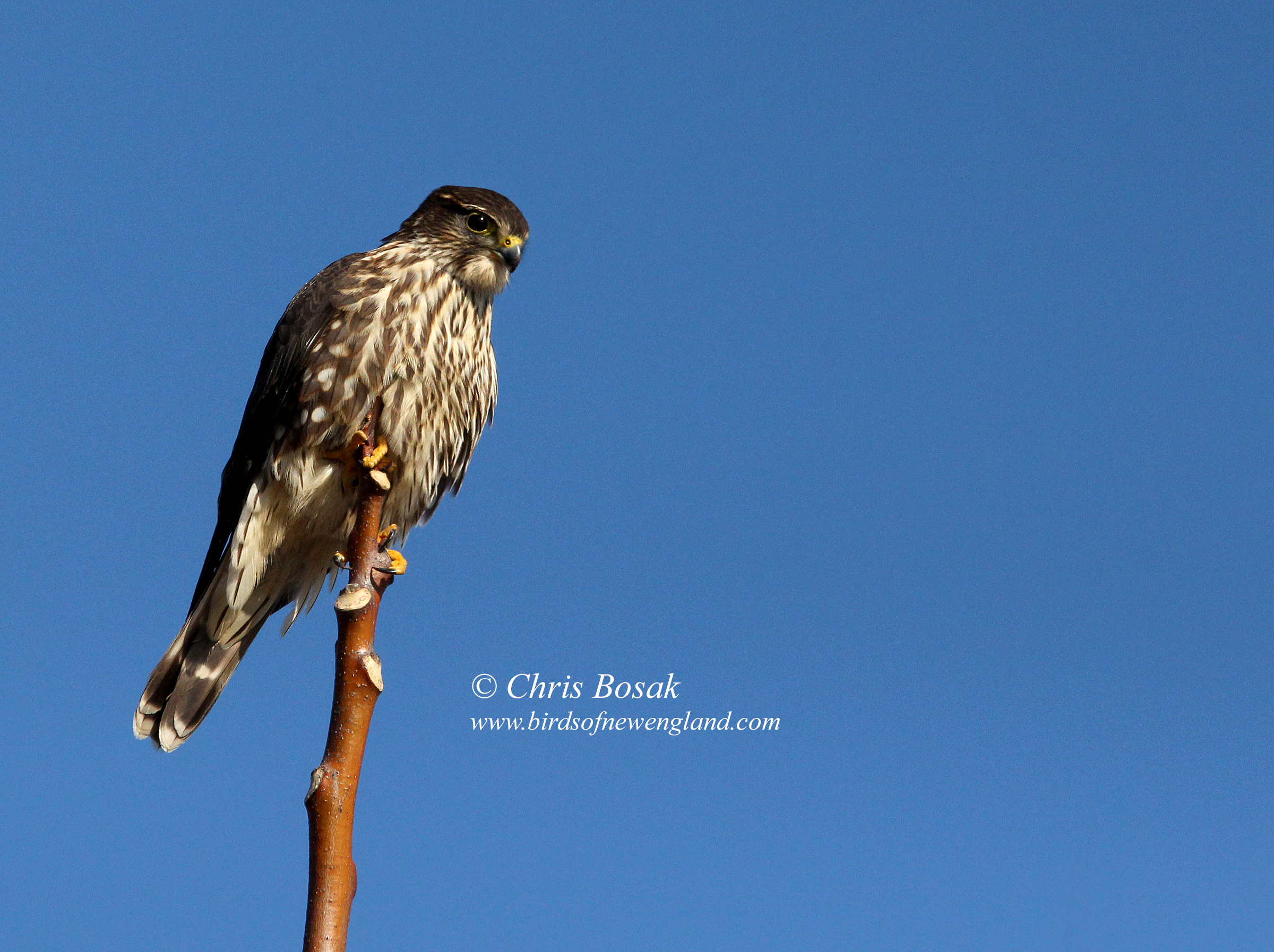
As I was counting the sparrows at one spot, suddenly all the small birds flushed into the nearby brush. Within seconds I discovered why they had left in such a hurry, as a merlin landed on the top of a dead tree almost right above my head. Merlins are small falcons that somewhat resemble sharp-shinned and Cooper’s hawks. So much for getting an accurate count of the sparrows with the merlin keeping watch overhead.
The merlin was one of the highlights for me during the count. It is the first time I could remember seeing a merlin on a Christmas bird count.
The other highlight came at my final stop, which was another park near the river. This park also has some open areas and has been known to attract birds such as warblers, larks, and pipits. There were no larks or warblers to be seen, but a small flock of about a dozen pipits scampered among the grass in search of seeds.
It was another successful count with more than 50 different species spotted in that area alone. I did not get a species total for the entire count area yet, but it typically nets out at about 120 species.
Regardless of the weather – and I have done Christmas Bird Counts in everything from sun to rain to blizzards and in temperatures from single digits to the 50s – the count is always a great, albeit tiring, day of birding.
Happy new year, everyone. Here’s to 2025.
 Birds of New England.com