
What comes to mind when thinking of year-round birds in New England?
My guess is the first species that come to mind are songbirds such as black-capped chickadees, tufted titmice, or white-breasted nuthatches. The next birds that come to mind may be slightly larger, like woodpeckers, cardinals, blue jays, or mourning doves. Then it may eventually get to even larger birds such as red-tailed hawks, barred or great horned owls, mallards or turkey vultures.
Some people’s thoughts may veer off to less obvious year-round species such as eastern bluebirds and American robins, which many people may not realize are found in New England during the winter.
My bet would be that belted kingfisher would not immediately come to mind. It certainly would not have for me. I thought about that when I saw one the other day in a rather surprising place, and it reminded me that they are, indeed, year-round birds in New England.
I was walking to the cafeteria at work when I heard a familiar rattling call off to my right. Along the walkway, two consecutive small bridges span streams, one of which is small and often nothing more than a dried-up bed, and the other is a bit larger and flows meekly in dry times and mightily after heavy rains.
I immediately spotted the kingfisher on a branch overhanging the larger stream, which still flowed despite being icy on the edges. The surface of the smaller stream was frozen over. All of the nearby ponds are frozen as well, which is why the sighting caught me off guard.
Not that seeing belted kingfishers in the winter is anything new. We usually find at least one or two during the Christmas Bird Count each year, but that is along larger rivers that rarely freeze. This mid-winter sighting near a small stream seemed out of place.
To me, the belted kingfisher is one of the more overlooked and underrated birds in New England. Maybe it’s because they aren’t seen as frequently as many birds in our region. Or maybe it’s because when they are seen, it’s usually only one of them. I’ve certainly never seen a flock of belted kingfishers.
I hold kingfishers in high esteem and think of them as being larger birds than they actually are. They have large heads, big bills and oversized personalities, which makes me think of them on par with crows or small hawks in terms of size. In reality, belted kingfishers are about the size of a robin.
While kingfishers are indeed year-round birds in New England, there is a caveat. Not all kingfishers remain in New England, as many fly south for the colder months. The ones we see in New England may very well be birds that spent their summers in Canada, and, for them, New England is south. Many of our breeding kingfishers may indeed be well south of here now.
As was the case for me last week, kingfishers are often heard before they are seen. Their rattling call often gives them away as being present on a pond or river. They likely would have gone unseen if they remained quiet. Often, they combine rattling with a flight to a different nearby perch, further giving away their presence.
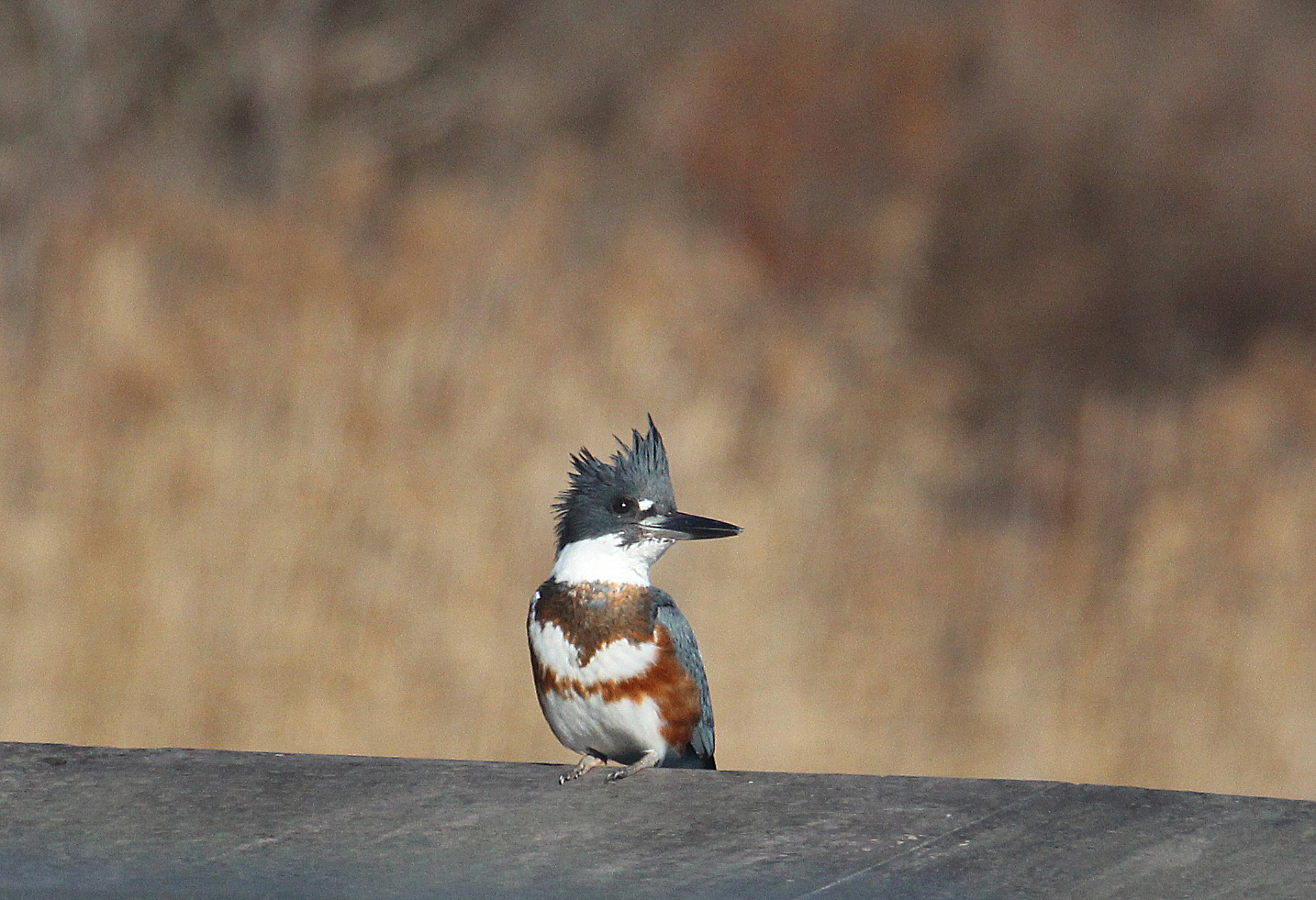
Belted kingfishers, of course, are also unique in that females are more colorful than males. Both sexes are blue-gray and white, but females also have a rust-colored belt on their upper bellies.
Out of the more than 100 species of kingfisher worldwide (mostly in Asia, Africa and Australia), the belted kingfisher is the only one we have in New England. There are three species in the U.S.: belted, green and ringed. Based on photos I have seen, green kingfishers are really cool-looking birds. Maybe one day I’ll get to southern Texas to see one for myself.
Not that I’m disappointed seeing only belted kingfishers. I love their unique looks, sounds and personalities, which makes me even more grateful that they are year-round New Englanders.
 Birds of New England.com