
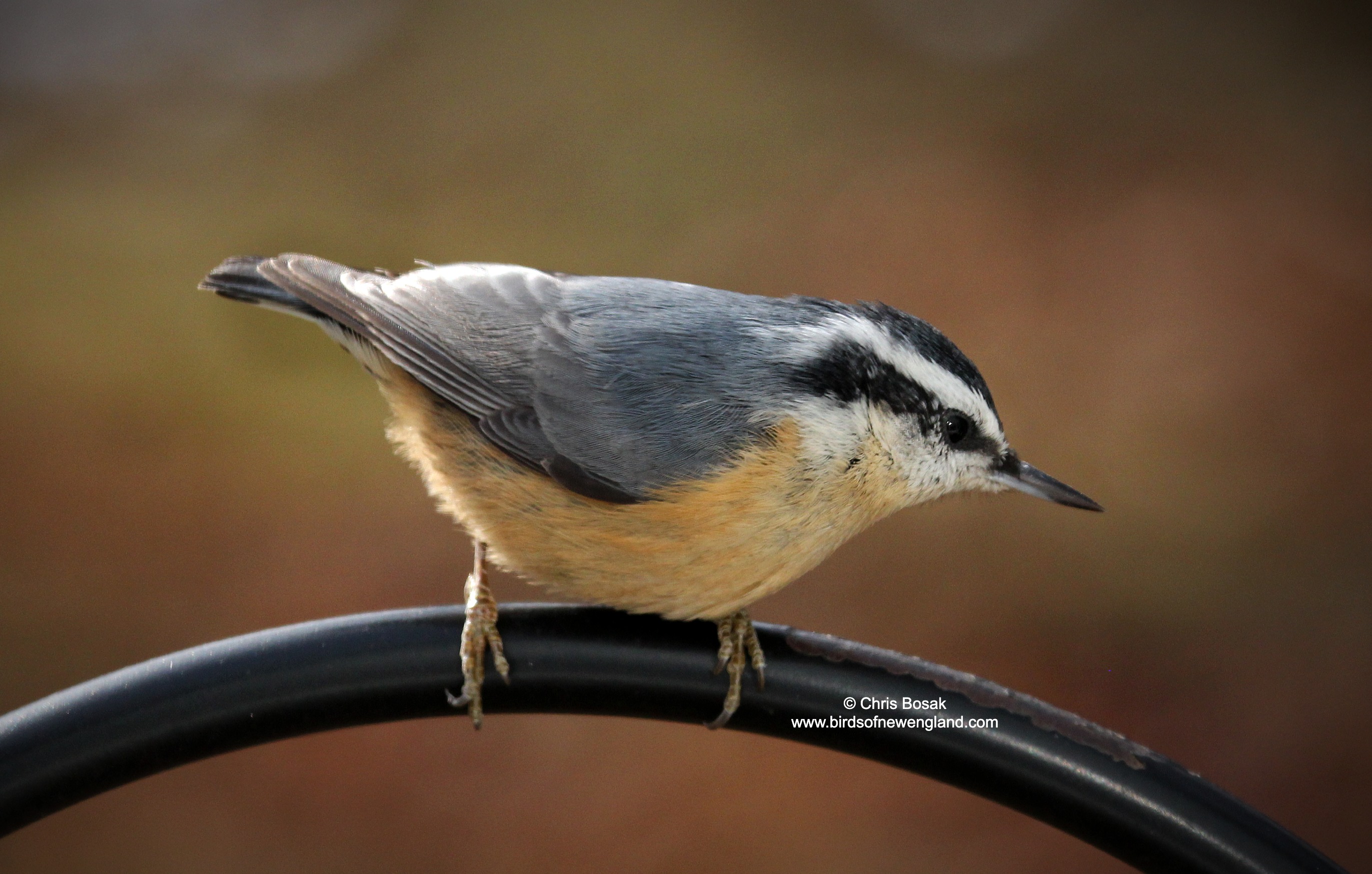
I wrote about the winter finch forecast a few weeks ago. The annual forecast predicts which and how many finches will irrupt into New England from the north each winter. An irruption occurs when birds that are not typically seen in an area appear, sometimes in great numbers, during the winter.
Food, of course, is the main driver of these irruptions. If the seeds of a bird species’ diet are scarce up north, the birds will come south to find a food source.
Just like hawk watches are not restricted to hawks but include eagles, falcons and vultures, the winter finch forecast is not restricted to finches. In addition to purple finches, siskins and redpolls, the forecast includes birds such as evening grosbeaks, red-breasted nuthatches and even blue jays.
So far, I’ve seen two of the birds highlighted by the winter finch forecast. A lone red-breasted nuthatch has visited my feeder for several days now. I’ve also seen a few purple finches “in the wild” on my walks. I’ve seen blue jays too, of course, but they are probably the same ones that visited my feeders year-round.
The red-breasted nuthatch is the first one to visit my feeders in about five years. Some parts of New England are flush with red-breasted nuthatches, and in some parts the white-breasted nuthatch is the dominant nuthatch. I live where white-breasted nuthatches are commonplace and red-breasted nuthatches are cause for great excitement.
There is really no confusing the two nuthatches. Even though the white-breasted nuthatch is a relatively small songbird, it is still noticeably larger than the diminutive red-breasted nuthatch. Both birds have blue-gray backs with their undersides matching their names. The white-breasted nuthatch has a white face and black head that looks to me like a mullet. The red-breasted nuthatch has a black eye stripe. If anything, the red-breasted nuthatch is more likely to be confused with a black-capped chickadee.
As you might imagine, the “yank, yank, yank” call and song of the white-breasted nuthatch is lower in pitch than the red-breasted’s. To me anyway, the red-breasted nuthatch sometimes sounds like the Roadrunner of cartoon fame. The sounds of the red-breasted nuthatch are often ubiquitous in the New England woods, although they can be difficult to find because of the leaf cover and their small size.
Last year I saw three purple finches, two females and one male, in the same park all throughout winter. This year I’ve seen three purple finches, perhaps the same three, in that same park. My first sighting was late November. Hopefully, they will remain there all winter again. It’s a sight to behold to see a male purple finch perched on a branch as a steady snow falls around him.
As for the other finches, it’s been a while since I’ve seen any of them. Siskins invaded my feeders about eight years ago, but nothing since then. Redpolls have been even longer. Evening grosbeaks? The next time one visits my feeders will be the first. I’ve seen them in the wild on occasion, but even that has been a long while.
I have received a few emails, mostly from the Lakes Region, from people who have seen evening grosbeaks this fall, so maybe this will be my year.
Enough about me, though. Drop me a line and let me know what you’ve been seeing at your feeders or in the woods.