A few weeks ago, I wrote about a short walk that I often take at work. It is on my employer’s property and, despite being a small piece of land that takes only five minutes to walk, it has a mix of habitat that includes a meadow, stream, pond and woods.
A few days after I had written that column, I took a walk there and discovered something new. I had noticed on previous walks a Y in a large tree and thought maybe there were some sticks or leaves in the crotch. It was too small for a squirrel’s nest, and it didn’t seem significant enough to be any other type of nest, so I kept on walking. I figured it was just the collection of a few sticks and leaves that had fallen throughout the year.
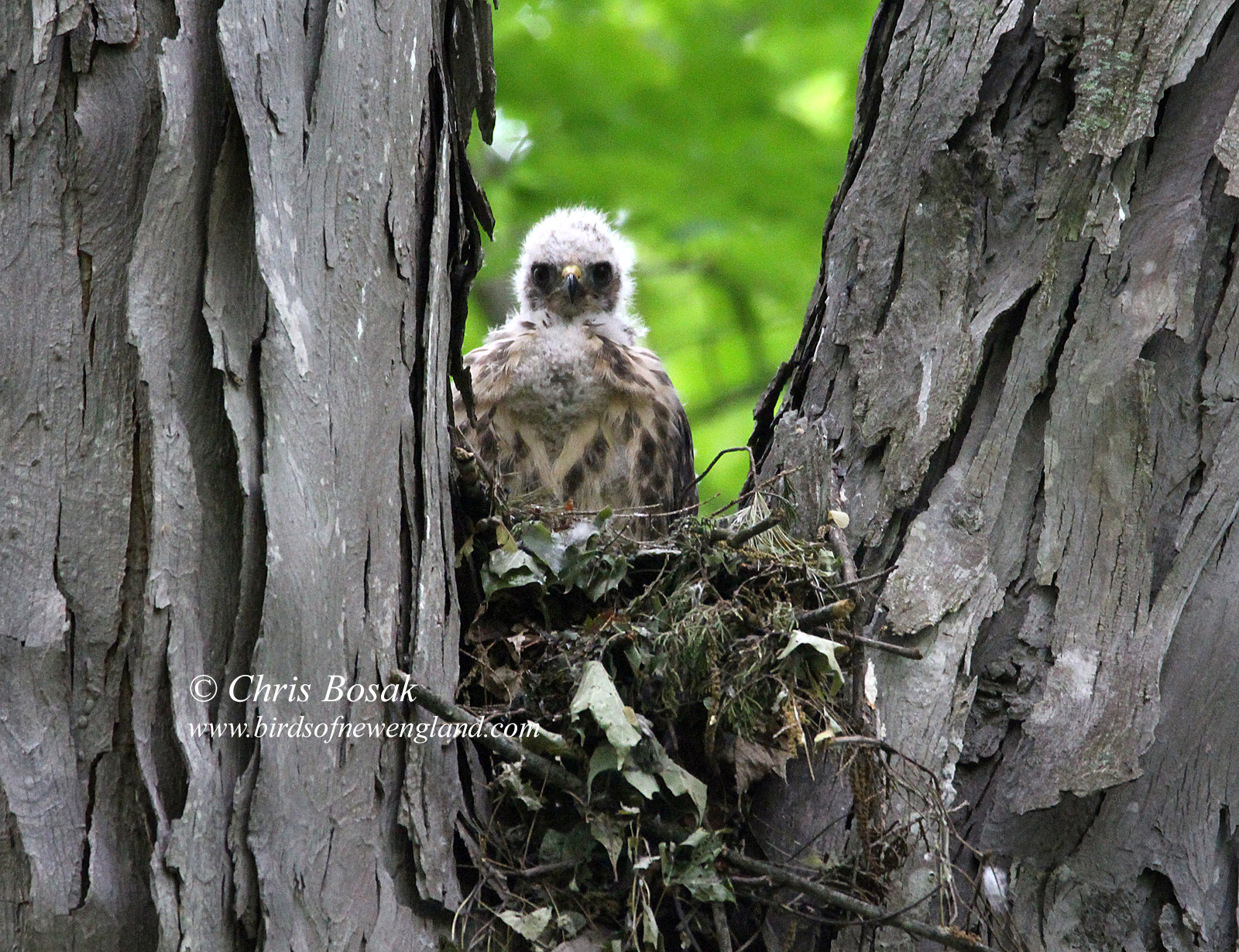
One day, however, I noticed movement in the area. Upon inspection, it turned out to be the nest of a red-shouldered hawk family. Two young birds were eating a squirrel, chipmunk or some other small mammal. No adults were present.
The next day, I took another walk, and an adult bird was tearing apart a meal. I didn’t notice the young birds right away, but when the adult sat upright after picking off a morsel, I saw the young ones to either side behind the adult.
Once I knew the birds were there, it seemed obvious, and I questioned why I had missed it on so many previous walks. The Y in the tree is fairly high up and my guess is that the adult bird was sitting on the eggs, and the steep angle prevented me from seeing inside. It always surprises me how many birds can fit in a nest, be it a hummingbird nest, robin nest or hawk nest.
I have seen red-shouldered hawks on the property before. In fact, they are practically a daily sighting. It’s nice to know they are nesting on the property and that there are now more of the birds to be seen. And heard. Red-shouldered hawks have one of the more distinctive calls, a loud, descending and repeated “kee-aah.”
Red-shouldered hawks range throughout the eastern half of the U.S. They are very common in Florida, and I have noticed more and more in New England over the years. Some red-shouldered hawks overwinter in New England, but most of them migrate to points south.
The nesting season for red-shouldered ranges from April to June. I discovered the nest in early June, and the young birds seemed almost large enough to fledge. In fact, when I checked the nest about 10 days later, it was empty.
Red-shouldered hawks are one of three buteos commonly seen in New England. Buteos are a family of large, soaring hawks with relatively long wings and short tails. The other common buteos are red-tailed hawk and broad-winged hawk. Red-shouldered hawks are 17 to 24 inches in length with a 37- to 43-inch wingspan. They are smaller than red-tailed hawks and larger than broad-winged hawks. They have rusty-red shoulders and rusty-to-orange barring on their chests and bellies.
Young red-shouldered hawks typically remain close to their nesting area for several months. I’ll be sure to keep an eye out for them as they learn to hunt yet continue to be close to their parents. Even small patches of land can hold big surprises.

