
A flock of birds is not always as it appears to be.
No, I am not talking about the silly “birds aren’t real” conspiracy theory. I am talking about rare, or at least less common, birds often mixing in with a flock of common birds.
A common example of this is when a snow goose is found within a huge flock of Canada geese. At first glance, it may look like a run-of-the-mill flock of ultra-common Canada geese, but closer inspection sometimes yields a less common bird, such as a snow goose, among them. Snow geese, of course, are very common in their own right, but not necessarily in New England. Therefore, when one of these bright white geese shows up among a flock of Canada geese, it makes for a good birdwatching experience.
Another example of this is when a rare gull is spotted among a large flock of ring-billed gulls or herring gulls. Sometimes it takes an expert to spot that rare gull, but it happens from time to time.
I was reminded of this the other day when I was visiting my son in Baltimore. A small pond in a park right in the city featured a huge number of mallards. The mallards were everywhere on the pond. Some were in a big group near a small island and some were scattered among the shoreline. There were hundreds of them.
I could have taken a quick look and said to myself “OK, just a bunch of mallards” and moved on to the next part of the park. But something told me to inspect the flock by the island a little more closely.
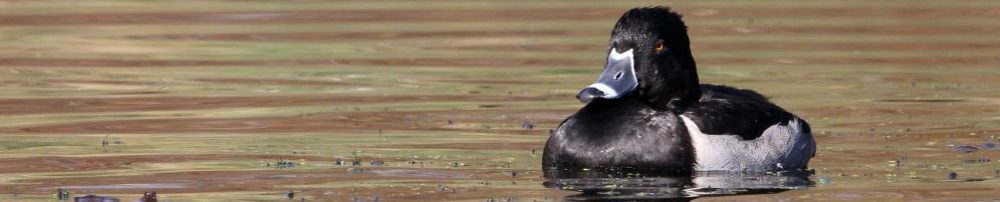
Three of the birds looked a little different than the rest of them, but they were sleeping with their heads turned backward and tucked into the feathers on their back, so I couldn’t get a proper ID right away. Eventually, one of the birds started drifting away from the flock and woke up momentarily to swim back to the safety of the large grouping of birds. With the head now exposed, it was clear that it was a ring-necked duck.
Over the course of the next several minutes, the other birds in question also showed their heads, if only for a moment, to show that they were ring-necked ducks as well.
From where I was sitting on a stone wall, the flock of ducks by the island was a fair distance away, but the ring-necked ducks were on the closer outer edge of the flock, making it possible to get a few photos.
Ring-necked ducks are one of the more common waterfowl we see in New England during migration, so it wasn’t an earth-shattering sighting, but it was nice to see something other than mallards. It was also, as I mentioned earlier, a good reminder to check large flocks of birds to see if anything out of the ordinary is mixed in there.
Waterfowl flocks are always worth checking out as you never know what may be lurking among the predominant birds.
I can recall several times when closer inspection paid off with more memorable sightings. Check that flock of American wigeon as there may be a European wigeon among them. Inspect those ring-necked ducks or scaup as there may be the odd redhead in there. Mallard flocks may have a wood duck or gadwall seeking companionship, refuge and safety.
This applies to smaller birds as well. A mixed flock of blackbirds in New England will likely include grackles, starlings, cowbirds and red-winged blackbirds. Who knows, though? Maybe a stray yellow-headed blackbird will be among the common birds.
A flock of birds is not always just a flock of birds. Sometimes there are surprises hidden among the masses.
 Birds of New England.com