
Late February and early March is somewhat of a transition period for birdwatching in New England.
The highly anticipated spring migration, which won’t hit its peak until late April and early May, starts with a trickle around mid-March, most notably with American woodcocks and eastern phoebes. Some consider the early male red-winged blackbirds the start of spring migration, but many of these blackbirds overwinter in New England so it’s tough to say if they are arriving in February or have been here all along.
On the other hand, a lot of the winter birds we have enjoyed seeing over the last few months have either gone further south, returned north, or, unfortunately for some, perished in the cold New England winter. Many birds that try to stick out a New England winter, either due to getting lost on their migration route or opting to forego migration altogether, underestimate the power and longevity of our winters and don’t make it to spring.
For me anyway, late February and early March is the ideal time to look for ducks. Long-time readers of this column know that ducks are one of my favorite types of birds to watch, so I like to take advantage of this time to get my fill of fowl before they fly off to their breeding places.
By late February, there have been enough prolonged thaws that some lakes and rivers, and even some ponds, are entirely or at least partially open water. Many ducks fly south only as far as they need to for the winter and these waters are like magnets for various types of fowl.
The lake (really a large pond) where I walk frequently was filled with people ice skating and ice fishing only a few short weeks ago. Now there are open areas of water that are holding ducks such as hooded mergansers, ring-necked ducks, American black ducks, and, of course, mallards. The larger bodies of water are host to ducks such as common mergansers. Rafts of common mergansers can number hundreds of individual birds and are quite impressive.
I visited my brother recently in Erie, Pennsylvania, and we took a trip to Presque Isle State Park, a peninsula that juts into Lake Erie. The small and shallow inland waters were frozen solid, but the lake itself and bay were open. After driving around and seeing birds such as bald eagles and screech owls, we parked and took a walk to an area called Gull Point.
After a walk of 20 minutes or so along the frozen dunes, we arrived at a large opening. In the spring and summer, much of this area is closed to protect nesting shorebirds. In the winter, however, it is open and well worth the 20-minute effort it takes to get there. To start with, a mixed flock of snow buntings and horned larks flitted among the open area looking for seeds to pick off the tops of dried weeds and grasses.
The real attraction at Gull Point in the winter, however, is the view of the bay a fairly short distance away. A spotting scope is needed to really appreciate the spectacle, which is a huge raft of ducks that include a wide variety of species.
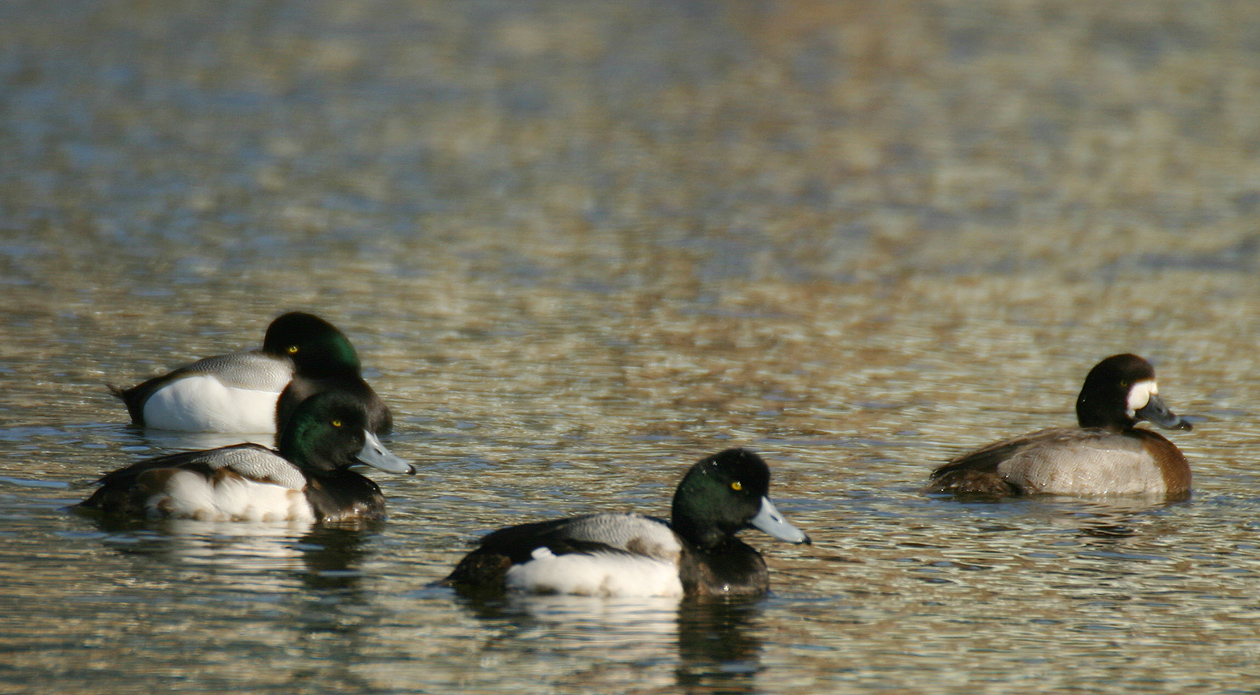
Within two minutes of peering through my scope, I picked out dozens of greater scaup, bufflehead, American wigeon, red-breasted mergansers, canvasback, and a lone redhead. It was an amazing mix of divers and dabblers, telling me that food was available for both types of ducks. A bit further in the distance, a huge raft of American coot bobbed among the rippling waters.
It won’t be long before these ducks head to their breeding grounds. Now is the perfect time to find and admire them.
 Birds of New England.com
Such an interesting walk you enjoying PA. I frequent our NH beach areas this time of year along with wooded paths in the state looking for the early migration friends
LikeLike