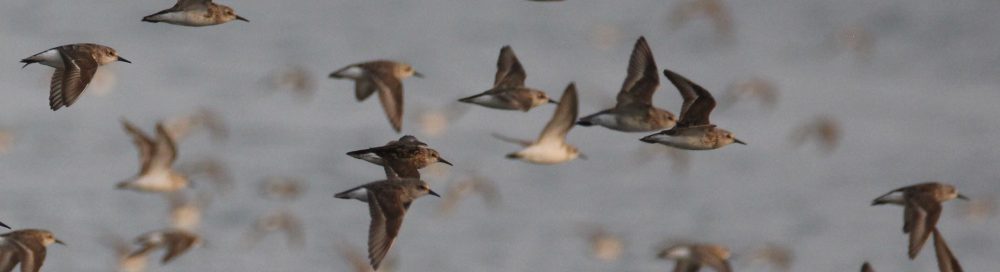

Birdwatching can be a roller coaster at times with next to nothing happening for long stretches and then, seemingly out of nowhere, short bursts of activity will lift your spirits and make it all worthwhile.
When the birdwatching is slow, particularly in the winter, birdwatchers always hold out hope for that flurry. While spring offers a more consistent level of sightings, summer can be similar to winter on that roller coaster ride.
In the winter, the flurry usually consists of a mixed flock of titmice and chickadees with perhaps other species such as nuthatches and goldfinches joining in. In the summer, the flurries may consist of robins, catbirds, blue jays, cardinals and other New England nesting birds.
I had a flurry like nothing I’ve ever experienced the other day. I had trouble believing what I was seeing myself. The funny thing is, I wasn’t even birdwatching at the time. I had neither my binoculars nor my camera. Rather, I was in a park picking wild berries for homemade jam when I heard the unmistakable call of an eastern towhee. (While its song says “drink your teeeea,” the call is quick “tow-hee,” hence the name.)
I have seen dozens upon dozens of towhees this spring and summer so, while I was happy to hear the bird, I was in no rush to try to find it. As I continued along the trail finding red and black berries, I noticed that the calls did not stop. In fact, they increased in intensity and frequency.
Eventually, I found where the towhee was and it was a female calling most frequently. A male towhee and an immature towhee sat on a nearby branch.
Another bird flew onto the scene and landed on a different nearby branch. It took me a second to identify the bird because the lighting was poor, but I discovered it was a female scarlet tanager. I grabbed my phone to try to get a photo even though I knew the quality would be extremely poor, but could not relocate the bird immediately.
Finally, farther down on the branch where I had originally seen the tanager, I saw a similar-sized bird, but it looked different this time. That bird turned out to be a wood thrush, and I questioned my initial identification of a female tanager. Sure, the lighting was poor, I didn’t have my binoculars and female scarlet tanagers are rather dull in color, but would I really mistake a wood thrush for a scarlet tanager?
After a few more seconds of searching, I did find the female tanager again and clicked off a few really terrible photos with my phone. Within a few more seconds, the female tanager’s mate flew in and landed in an adjacent tree.
I thought that the spectacularly red bird would be the icing on the cake of this incredible flurry of birding activity, but there was more to come. A catbird and Carolina wren quickly joined the list of concerned birds. I also spotted a brown thrasher in the same tree as the wood thrush and female scarlet tanager, but on a much lower branch.
I was happy nobody else walked by because I was staring into the woods with my mouth agape and audibly uttering things like “what the heck is going on here,” “a thrasher too,” and “wow, look at all this.”
While winter birding flurries tend to center around groups of birds finding food together, this summer flurry, quite likely, involved a predator. The birds, all of which likely had young birds in proximity, joined together to check out the threat level of the lurking predator. I never did spot the predator, but it certainly turned that little area of the woods in a flurry of activity for a few moments.
I’m thankful that I was in the right place at the right time. Only this time I didn’t have to go through any slow periods to experience the flurry.
 Birds of New England.com