
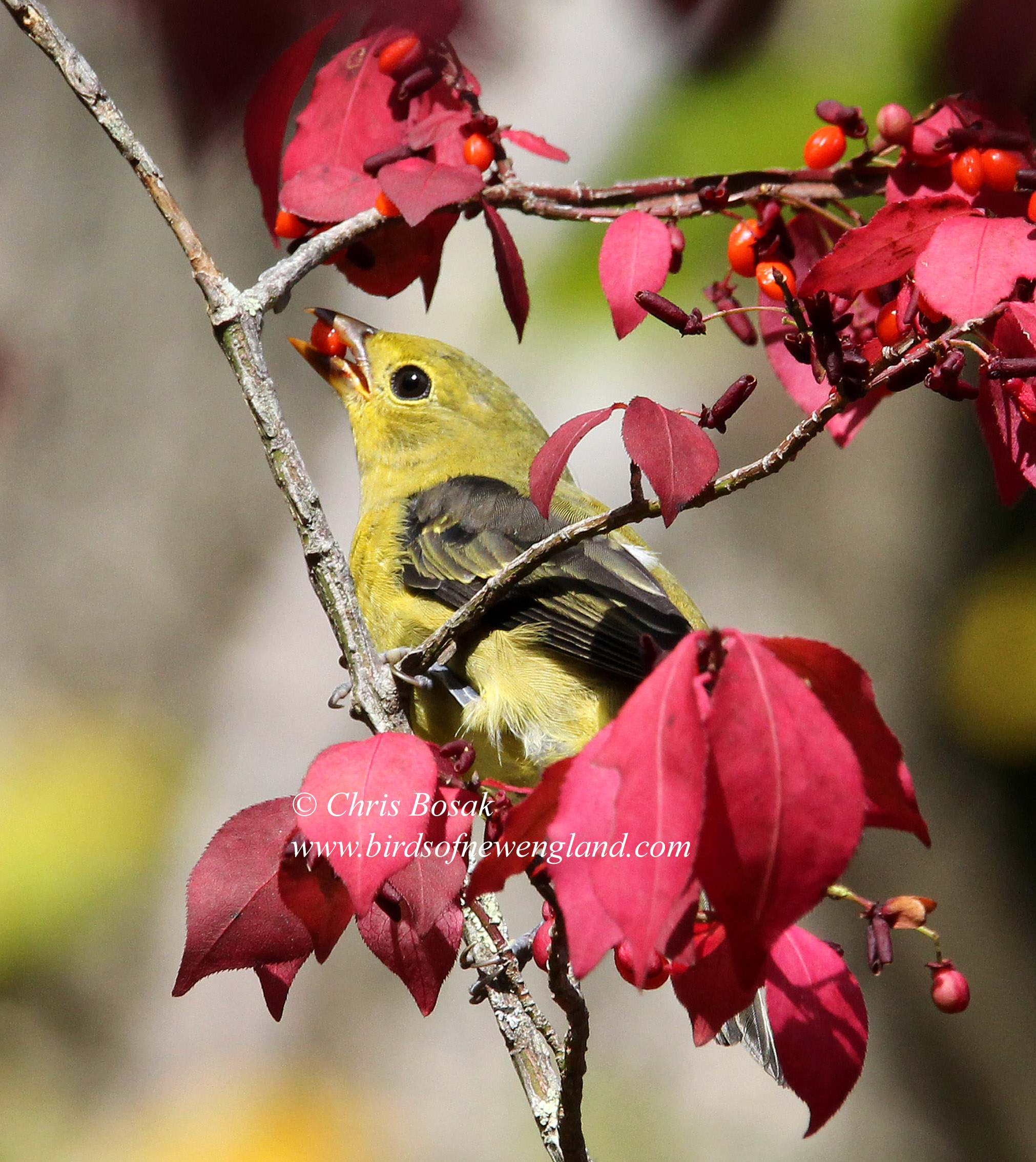
One of my favorite parts of birdwatching in the fall is trying to find birds eating berries. Many New England plants, bushes and trees bear fruit in the fall, and birds fuel up on this vital food source.
The only skill involved in finding birds eating berries is either knowing where the berries are and keeping an eye on that area or getting out there and discovering the plants with berries while exploring. The rest is timing — in other words, luck. There’s no telling exactly when a bird will land on a bush and start eating the berries. You just have to be looking at the right time.
The odds of coming across a bird eating berries are fairly low, but fall is when the chances are greatest. Berries are all over the place in the fall. Even plants such as poison ivy, which are rightfully vilified for the most part, produce berries that birds love. Not by coincidence, the fall berry season is timed perfectly with the southward migration of songbirds.
I was on the lookout for birds eating berries while I was on a walk last week. For the first hour or so, there was nothing. Many of the bushes along the trail were bursting with bright red berries, but no birds were feasting. Man, if I were a bird, I’d be all over those berries, I grumbled to myself as I walked past the bounty.
Eventually, I reached a crossroads on my walk. I could take a left and check out a field, or I could remain in the woods and continue straight. I caught a glimpse of yellow in the field out of the corner of my eye. A female common yellowthroat had scurried out from among the tall grasses, weeds and flowers and took a perch on a goldenrod stalk.
She left her flimsy perch and alighted on a much sturdier branch of a dogwood tree that grows in the middle of the field. A few other birds flitted among the branches of the dogwood, but I could not tell what they were from my vantage point. I guess I’m going through the field, I told myself as I walked toward the dogwood.
The other birds in the tree turned out to be another female yellowthroat and two song sparrows. I walked across to the other edge of the field and noticed movement in a burning bush that grew along the brushy area buffering the field and woods. I could immediately see that the bush was covered in small, red berries.
Just a gray catbird, I said to myself when I spotted the source of the movement. Not that I have anything against catbirds. In fact, I love catbirds and appreciate that they stay with us deep into fall, but I had seen dozens of catbirds already on this walk and was hoping for something different.
I turned to walk back into the woods when I noticed more movement at the top of the same burning bush. What do we have here? I asked myself as I noticed a more colorful and slightly smaller bird picking berries.
The leaves and branches finally parted enough to show a fall-plumaged scarlet tanager. Awesomely bright red and jet black in the spring and summer, male scarlet tanagers molt into a more subdued, but still awesome, yellow and black plumage in the fall. After the breeding season, male scarlet tanagers resemble the females but with black wings and tail.
I must have watched this bird for a good half hour and saw him eat berry after berry. Burning bush is invasive and not native, and I wouldn’t recommend planting it, but this particular plant was busy that day with the tanager picking away at the top branches and at least two catbirds working the bottom branches.
The scarlet tanager will migrate out of New England soon and eventually end up in South America for the winter. The catbirds will stick around a little longer. While many songbirds have already left the region, many more will be seen over the next few weeks, and they will need the berries that grow in abundance in our woods and fields. Here’s hoping you are lucky enough to catch them in action.


i just saw a scarlet tanager in Salisbury, Massachusetts on November 17th
LikeLiked by 1 person