If it weren’t for the American robin running away with the Bird of Winter title, the dark-eyed junco would be a serious contender.
The Bird of Winter is my very unofficial contest for the bird species seen in unusually high numbers during the winter. As I wrote a few weeks ago, the American robin is far and away the leader this winter, and I continue to see great numbers of robins nearly everywhere I go these days.
The dark-eyed junco, which has won the Bird of Winter title in years past, is making a strong case for honorable mention this year. I see them in my yard, at work, on my walks and all along the roadsides.
The other day, when it was three degrees when I arrived at work in the morning, I spread some sunflower seeds on the ground at the far end of the parking lot in direct line of sight from my office window. Beyond the parking lot is a large swath of woods where all sorts of New England birds can be seen. It’s a great view. That is until someone parks right in front of my window. Then I look out onto the grill of a Subaru or Jeep for the rest of the day.
Within minutes of throwing down the seed, birds started coming to the spot. They were mostly juncos. In fact, by my count, of the 20 birds that arrived almost immediately, 18 of them were juncos. The other two were white-throated sparrows. Throughout the day, cardinals, blue jays, song sparrows and even eight wild turkeys showed up.
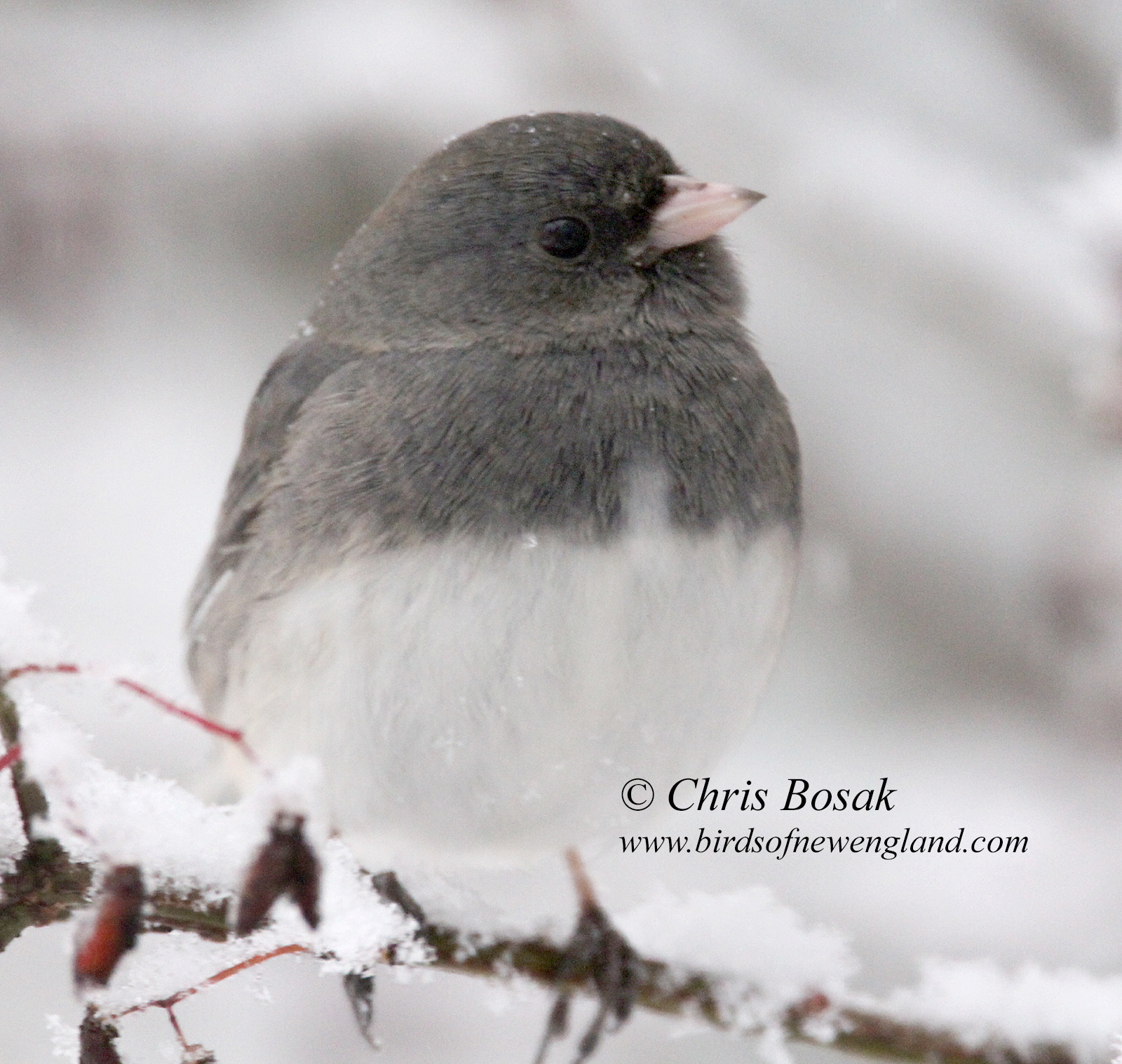
Although they may not look the part, juncos are sparrows. Males are conspicuous with black or dark gray bodies, white bellies and pink bills. Females and immatures have a similar pattern but are lighter gray or brownish. Juncos are easily identifiable when they scatter away from roadsides by their white outer tail feathers.
Juncos are common feeder birds but are most often found under the feeders picking up seeds off the ground. They are year-round residents in New England, although in southern New England, they are typically seen only in the winter. Some migrate as far as the Carolinas and Georgia.
The dark-eyed junco consists of six (or more, depending on which source you read) forms or subspecies, which formerly were considered separate species. The only one that occurs regularly in New England is the slate-colored junco. If you see a junco in New England, it is correct to call it either a dark-eyed junco or a slate-colored junco. The other forms are found mostly out west, although the dark-eyed junco is widespread and common throughout North America.
I was surprised when I learned that juncos build their nests on the ground, most often under shrubs or otherwise well hidden. Then again, I’m always surprised when I hear of a small bird that builds its nest on the ground. With so many predators lurking in the woods and suburbia, you’d think a nest above ground would be safer, but I have faith that these birds know what they are doing.
As I observed at work the other day, juncos are often seen in the winter with other sparrows, most often white-throated sparrows. I see them fairly often with song sparrows as well. Although juncos are seen on the ground most of the time, it is not uncommon to see them in trees as well. I’m often surprised to see juncos through my binoculars when I’m looking to identify a bird I spot in a tree. I guess I’m accustomed to seeing them on the ground.
It’s not shocking that juncos would be a candidate for the Bird of Winter. They are one of the more common birds seen throughout the country, with an estimated population of 200 million to 600 million. That’s a wide range, as getting an accurate count of such a common bird is a tough, if not impossible, task. Wherever the real number falls, I’m glad it’s a high number. Juncos never fail to brighten up even the grayest of days.
 Birds of New England.com