
I was walking along a short but windy trail in southern New England the other day in search of overwintering warblers. This short path is known for harboring these tiny songbirds during the winter, as it is adjacent to a water treatment center that features open water on even the coldest days.
I came around one of the many bends and jumped back as I flushed a large bird that was on the ground next to the trail. With my heart racing from the surprise, my immediate reaction was that it was a ruffed grouse. It flushed with the familiar exuberance and noise of a grouse, so my mind immediately went there. Ruffed grouse, however, do not live in that area of New England any longer, and the habitat wasn’t right for the popular game bird.
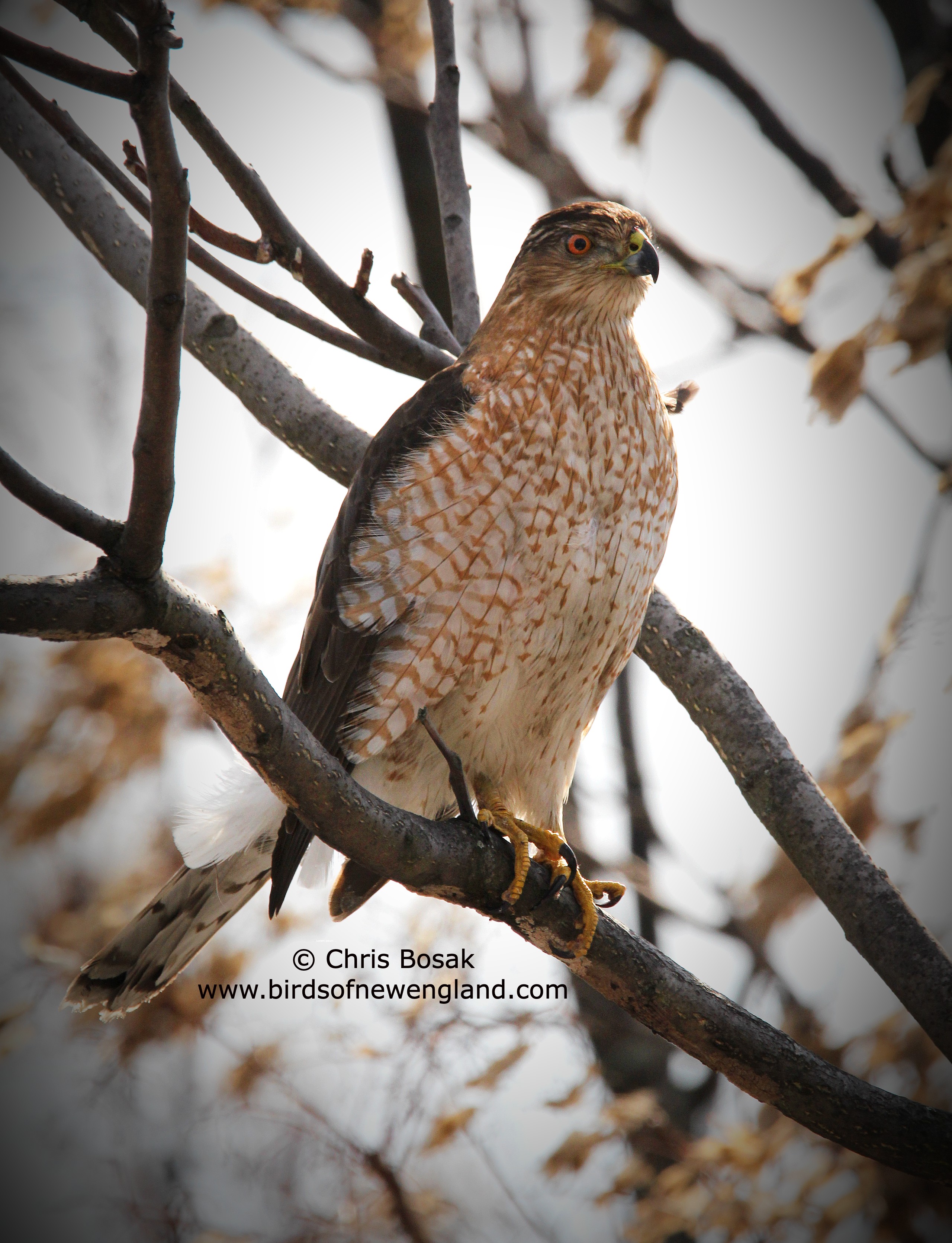
Luckily, the bird perched in a nearby tree, allowing for a close inspection. It was an adult Cooper’s hawk, likely a female based on its size. Like most birds of prey, the female is larger than the male. I must have disturbed the bird’s hunt, although I don’t believe it had been successful yet, as there weren’t any feathers or a carcass to be found.
When my heart stopped racing, I realized what a fortunate sighting it was. It’s not every day you walk around a corner and almost step on a Cooper’s hawk.
Cooper’s hawks are one of the three accipiters that live in New England. Accipiters are a group of hawks that include Cooper’s hawk, sharp-shinned hawk, and northern goshawk. Cooper’s hawks and sharp-shinned hawks (often referred to as sharpies) are commonly seen around bird feeders scoping out the small birds eating seeds. The impressive goshawk is seen more rarely, mostly in the woods or forests.
For the most part, accipiters are more sleek and, in my opinion, more fierce-looking than the buteos (a group of hawks that includes red-tailed, red-shouldered and broad-winged).
A birder can’t bring up a Cooper’s hawk sighting without mentioning how difficult it is to differentiate them from sharp-shinned hawks. The accipiters are nearly identical in most ways. Yes, the Cooper’s hawk is larger, but that’s not always a good way to make a positive ID. Female sharp-shinned hawks are roughly the same size as a male Cooper’s hawk, and without reference in the field, it can be nearly impossible to determine the ID based on size.
In my case the other day, size was a good determining factor, as it was a very large bird, likely a female Cooper’s hawk. A sharp-shinned hawk would never be that large, and, as you recall, I got a good, close look at it. On the other hand, a few weeks ago I saw a sharpie that I initially thought may have been a blue jay as it swooped across the scene so fast I couldn’t tell what it was until it landed in a nearby tree. A Cooper’s hawk would not be mistaken for a blue jay.
But what about the ones in which size is not a determining factor? Head and tail shape are the best things to look at when size doesn’t help. Cooper’s hawks have a more squarish head compared to the rounder head of the sharp-shinned hawk. Cooper’s hawks also have a dark cap that is lacking in the sharpie. Conversely, the Cooper’s hawk’s tail appears more rounded than the square tail of the sharp-shinned.
With all that said, judging by head and tail is still extremely difficult and often a crapshoot. Throw in the fact that size is not always a determinant, and separating a Cooper’s from a sharpie is not for the faint of heart. In some cases, even experts have trouble determining one species from the other with 100 percent certainty.
It is, however, easy to determine if an accipiter is an immature or adult. Immature birds of both Cooper’s and sharpies are brown with white chests and bellies streaked with brown. Adults are bluish gray with white chests and bellies streaked with rusty red. Interestingly, immatures of both species have yellow eyes, while the adults have red eyes.
While differentiating between a Cooper’s hawk and a sharp-shinned hawk may be difficult and frustrating at times, it’s also a reminder of one of the things that makes birdwatching such a great endeavor. No matter how good you get or how long you do it, there’s always more to learn.


I used to watch Coopers and Sharp-shinned Hawks a lot when I lived in SE Wisconsin. Great runners and acrobatic flyers. The males are beautiful.
LikeLiked by 1 person