
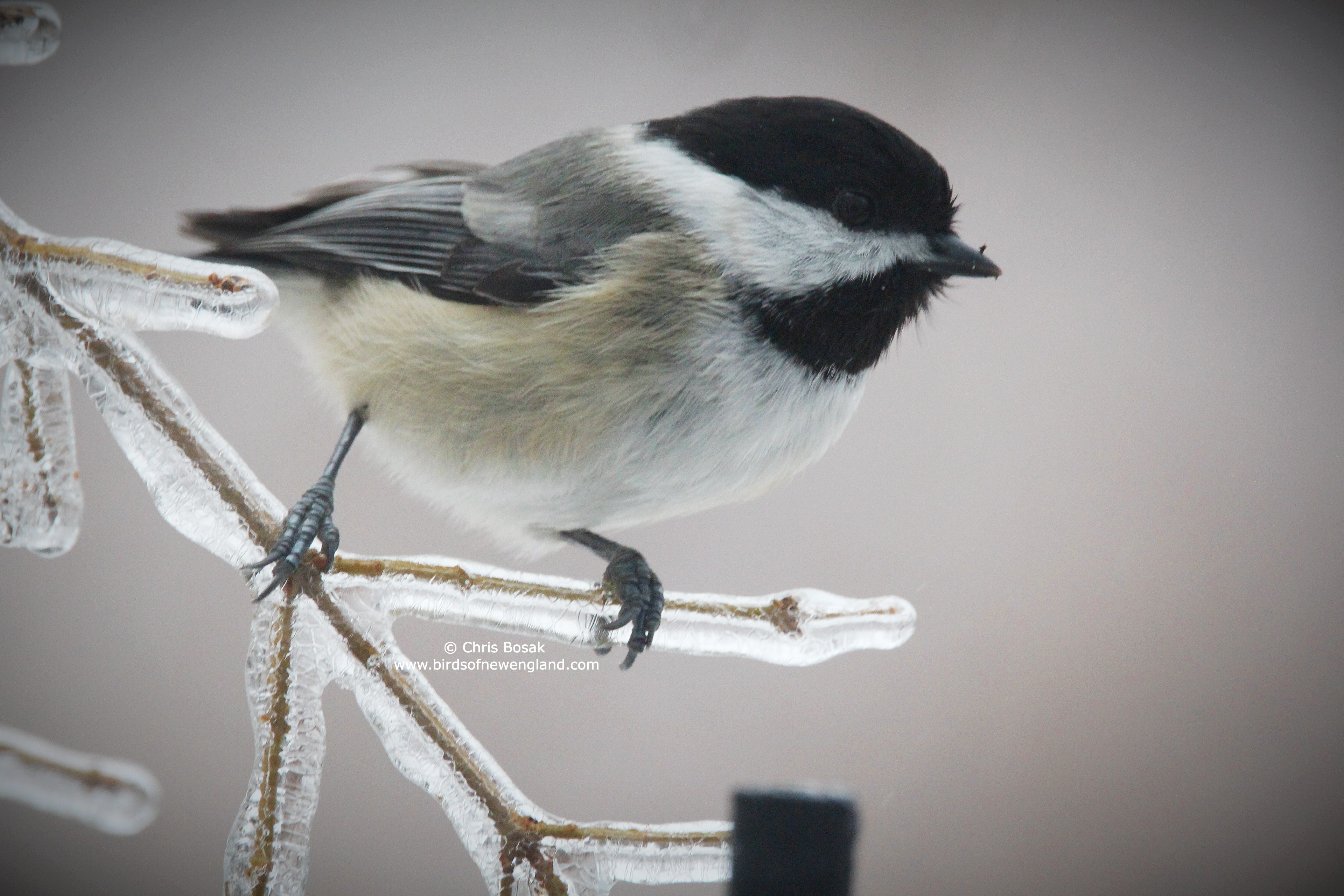
Every so often in New England, everything is covered in ice. I’m not talking about lakes and rivers freezing or icicles dangling from the edge of roofs. I’m talking about when literally everything outside is covered in ice. Every branch, every leaf, every pine needle, every blade of grass is sheathed in its own covering of ice.
It doesn’t happen often. Sometimes it’s once or twice a winter. Sometimes it’s once every couple of years. The conditions have to be just right.
The other week, the conditions were just right. A near-freezing rain fell hard in the evening, and, when the temperature dropped just a bit after the sun went down, it turned into freezing rain. By morning, everything was ice, including a slick covering on the remaining snow.
When it happens, it is a spectacle to admire. It is not fun if you have to drive or walk somewhere, but it’s beautiful. A rare treat from nature.
It also poses a challenge for birds. Bitter cold temperatures and snow are tough on New England birds, but the birds have adapted to handle those harsh conditions. When ice covers everything, however, no natural food sources are available for the birds that eat things such as berries, seeds and insects. Berries are ensconced in a layer of ice. Wild seeds are inaccessible. Insects and larvae are now guarded by bark and ice.
What do the birds do? For many, they rely more than usual on bird feeders, assuming, of course, the feeders and seed or suet are not covered in ice. Studies show that birds, even in winter, get a small percentage of their food from bird feeders, and wild sources make up the bulk of their diet. When those natural sources are shrouded in an impenetrable coating of ice, bird feeders are key.
When I woke up to the icy spectacle, the first thing I did was check the feeders. Sure enough, the exposed seeds were covered with ice. I brought those feeders inside to thaw and filled two other feeders with fresh seeds. I also poured some water into the birdbath to create a layer of unfrozen water for the birds.
The chickadees, titmice, nuthatches and cardinals came almost immediately to the new seeds. White-throated sparrows and juncos arrived in no time to the seeds I had tossed onto the iced-over snow on the ground. There were few takers on the birdbath. Perhaps the thin coatings of ice were already starting to melt, meaning drinking water was otherwise accessible. Or, perhaps food was the greater priority at the moment.
Nothing unusual showed up at the feeder either. When other food sources are covered, birds that typically do not utilize feeders will sometimes visit. Robins, for example, are not common feeder birds, but when winter berries are not accessible, they may show up at feeders for mealworms or suet.
The icy fantasyland made for an interesting morning of photography. The precipitation had stopped, but the sky remained dark gray. There was not a lot of natural light to work with, so I did my best shooting the birds as they perched on icy branches near the feeders. The birds’ extraordinarily adapted feet allowed them to retain a tight grip, and their countercurrent heat exchange kept their feet warm. Humans would have a much more difficult time trying to hold onto an icy perch. My hands are cold just thinking about it.
Other birds likely fled the area in search of food. They probably did not have to go far to find food sources that weren’t covered in ice. This type of weather phenomenon is usually not very widespread. It is also not usually very long-lasting. In this case, the sun came out around noon, and by 2 or 3 in the afternoon, all was back to normal.
It was beautiful and fun while it lasted, though. For me, anyway. I’m not sure the birds thought so.
 Birds of New England.com
I keep a heated bird bath/waterer going in intemperate seasons. Ignored initially once they are used to it being out in Fall though you can’t get them out of it…
LikeLiked by 3 people
I do as well. Every bird in my area stops so I fill it 2 to 3 times a day even in the dead of winter. I wonder if I can write their care off with the IRS 🙂
LikeLiked by 1 person