
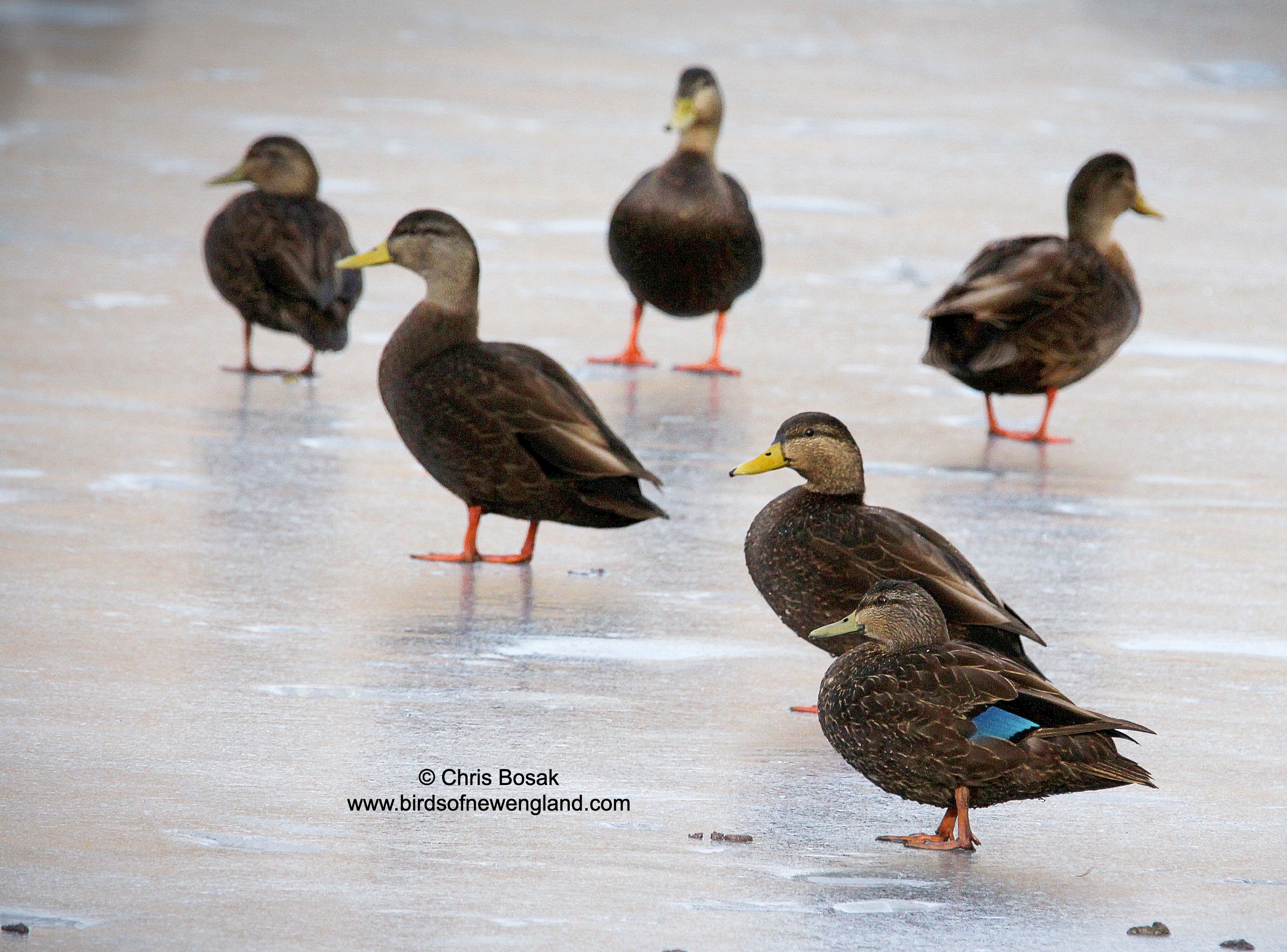
The American black duck is, in my opinion, one of the more underrated birds in New England.
While it is true that black ducks are not the most exciting or colorful ducks in New England, I think the black duck is often overlooked because a lot of people assume it is a mallard. Mallards, of course, are extremely common and tame. Black ducks are not as common and certainly not as tame.
Differentiating an American black duck from a female mallard is one of the more common difficult identifications to make. It is up there with the house vs. purple finch and the sharp-shinned vs. Cooper’s hawk.
I will admit that it took me years and years to be confident in my identification of black ducks. Even then, I still struggle at times, as a lot of factors come into play. A male mallard in breeding plumage vs. black duck is pretty easy. Just look for the bright green head of the mallard. Female mallard, immature male mallard, or male mallard in molt vs. black duck is much more difficult.
To add to the confusion, black ducks and mallards are similar in size, shape and habitat. There is also tremendous plumage variation among mallards. They even “hang out” together sometimes at ponds or lakes. If you walk up to a pond where they have congregated together, the black ducks will fly away long before mallards.
To make it really confusing, black ducks and mallards often interbreed, making a hybrid species that looks like a cross between the already similar-looking species. For now anyway, we’ll forget about the hybrids and focus on the ducks in question.
The main thing to look for is overall coloration. Black ducks are darker overall, hence the name. Female and immature mallards are more of a brown or light brown as opposed to the dark brown, almost black, of a black duck. Even that, though, is hard to tell without both species there to make a comparison. Light is a big factor as well. Seeing these ducks at dawn, dusk or otherwise dark conditions makes color an unreliable field mark.
For me, the best differentiator is the speculum. The speculum is the patch of colorful feathers on the wing. It is often displayed by a bird while at rest or in flight. For mallards, the blue or purple speculum is bordered at the top and bottom with a white stripe. Black ducks lack the white borders.
Easy, right? Well, only if you can see the speculum clearly. They are not always visible if the duck is not displaying them or if it is too dark or far away. It’s really only useful if the birds are close or if you are looking at a photo.
The Bedford (N.Y.) Audubon Society has a nice article on the differences between mallards and black ducks. Aside from the overall coloration and the color of the speculum, other differences include: “Though both species are a finely streaked light brown on the head and neck, the black duck’s coloration here is somewhat darker and grayer than the mallard’s. The hen mallard also has an unstreaked whitish throat where the black duck’s throat is finely streaked with grayish-brown. Bill color is another clue—with a good view, one can observe that the hen mallard’s bill is orange and black, where the black duck’s bill ranges from a dusky greenish yellow to a drab olive color.”
Black ducks should be more popular than they are. They are not the most exciting ducks out there with their drab plumage and similarities to the common mallard, but they are a native duck that lives in New England year-round. I love my native birds, so that’s good enough for me.
 Birds of New England.com