
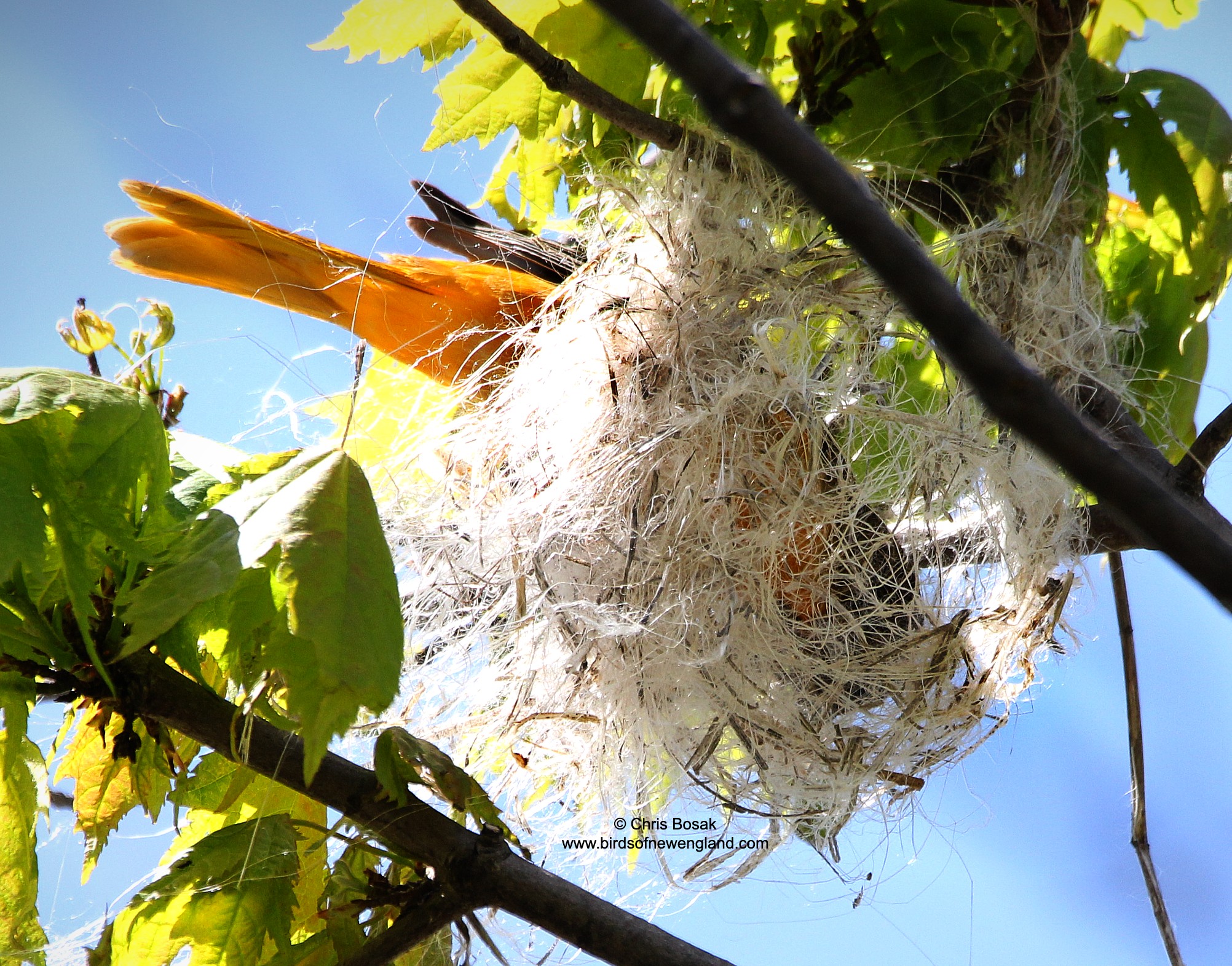
Everything about a Baltimore oriole nest is ingenious. From the design and materials to the location selection, the nest is a perfect haven to raise young birds safely from predators (for the most part).
Fall is the best time to find oriole nests, after the leaves have fallen. Of course, by that time, the orioles are long gone, and the nest is a mere relic of the past breeding season, but it’s still interesting to see one of the pouch-like nests dangling from the end of a branch.
The other week, I was lucky enough to watch a female oriole build one of those remarkable nests. I was walking along a trail that was teeming with yellow warblers, catbirds, and Baltimore orioles when I glanced up and saw an oriole perched at the end of a branch overhead.
The female oriole manipulated some nesting material into place and then took off to gather more material. She returned to the nest every minute or so with more material. A male oriole visited the nest less frequently to drop off material but left the building and design to the female. An oriole nest is made up of fibers from grasses, strips of bark, wool and hair. String, yarn, or fishing line can also make their way into the nest.
I watched the process for 10 minutes or so, took a few photos and went on my way. I returned the next day and stopped to check on the orioles’ progress. I was amazed at how much larger and fuller the nest was just 24 hours later.
On the first day, the nest did not have a bottom and was merely a few lengths of stringy material dangling from the end of a branch. On the second day, the nest was taking shape, although it was still enough of a work in progress that I could see through the bottom of the nest into where the oriole was weaving her magic.
I’ve read that orioles take about a week to build a nest. This one seemed to be moving along quickly. (Additional photos of the building process may be seen at www.birdsofnewengland.com)
The basket, pocket or pouch shape of the nest makes it difficult for predators to get inside to find eggs or young birds. Orioles build their nests toward the end of branches to deter larger predators like raccoons. To further discourage raccoons and other large predators, orioles often build their nests overhanging hazards such as ponds or roads.
Orioles are bright orange (even the females are colorful) and relatively large songbirds of the blackbird family. However, they are nearly impossible to spot in or near the nest as the leaves and height at which the nests are built keep them well concealed.
To me, the most startling thing about oriole nests is that they remain in place through the most severe storms. They look so delicate and the connection to the branch seems so precarious that it would appear as if anything above a light breeze would knock it to the ground. Obviously, that is not the case and even the harshest wind and driving rain is no match for the nest. Female orioles weave and tangle long fibers of material around the branch to make a strong attachment.
Despite the strength of the nests, orioles rarely reuse a nest from the previous year. They do, however, sometimes reuse material from old nests.
I never did return for a third day, and I won’t be back in that area until long after the breeding season. I have faith, though, that the female oriole built a nest that will be a perfect place to raise a healthy brood of young orioles.
 Birds of New England.com
found one last year, what an awesome moment!!!
LikeLike