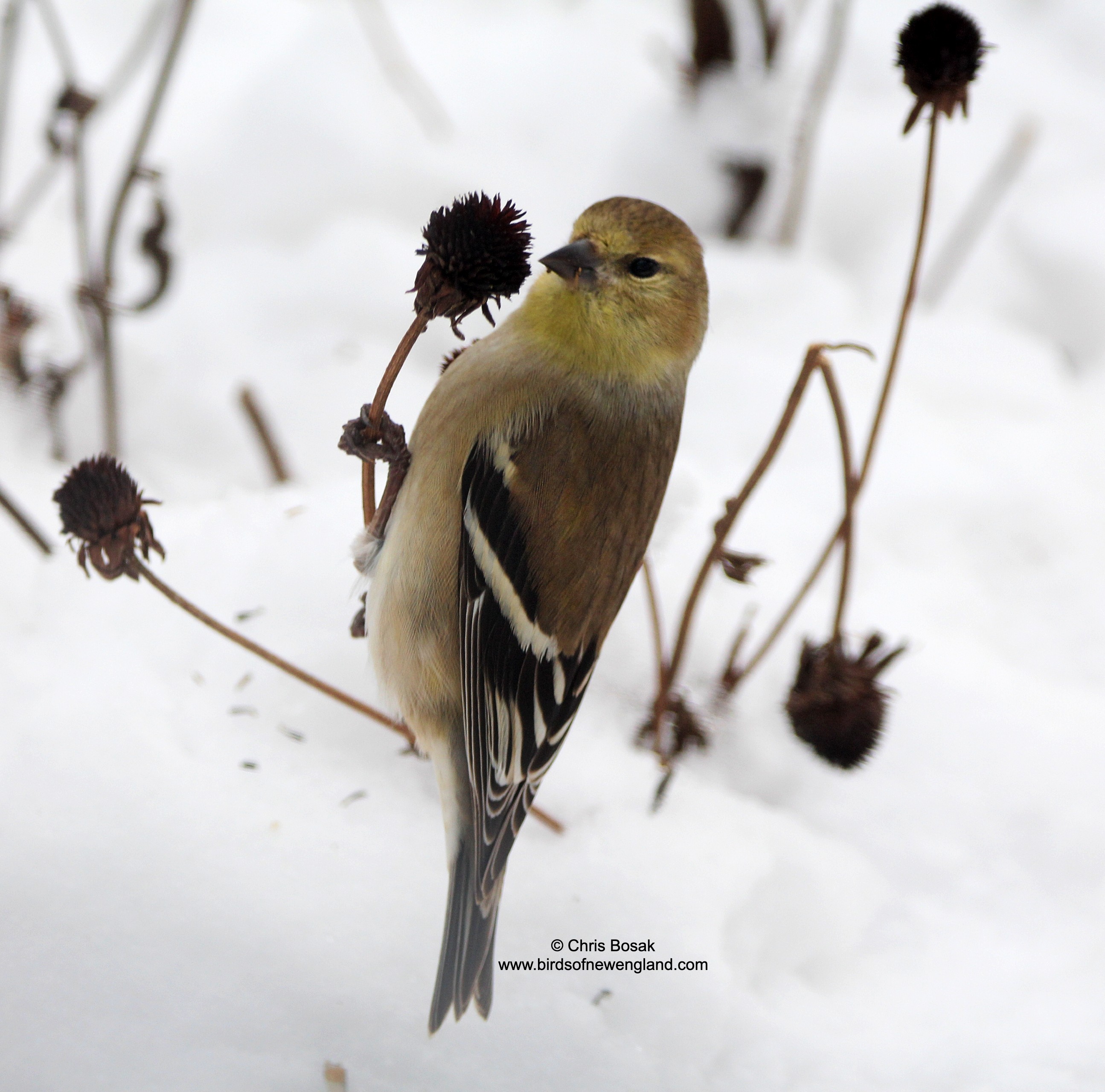
American goldfinch eats seeds from a spent flower in New England, January 2026.
A ton of snow followed by prolonged freezing temperatures can spell disaster for birds. Luckily, birds have developed several survival strategies to cope with such conditions.
There are several factors at play in these conditions. I will focus mostly on finding food but will address some of the others quickly.
First, there is the cold. Birds survive freezing temperatures through adaptations that conserve heat and energy. Feathers provide excellent insulation, and many birds maximize this by fluffing their feathers to trap warm air close to their bodies. Birds also have a high metabolic rate, which is fueled by energy-rich foods such as seeds and fat commonly found at feeders.
At night, birds will roost in sheltered locations out of the wind, and some species will huddle together for warmth. That’s why it’s important to clean out birdhouses after the nesting season so birds have a place to go in extreme conditions. Other birds will simply fly to where it is warmer.
Birds need water to survive as well. In extreme cold temperatures, they will visit birdbaths, unfrozen bodies of water like streams or rivers, or take advantage of sunny days by drinking from melting icicles and snow. On days when I am home all day, I frequently pour warm water into the birdbath to provide a drinking source. They can also safely get water from snow.
Food can be tricky under these conditions, especially for birds like sparrows that find most of their food on or near the ground. All those food sources are now unavailable and have been for many days. I was thrilled a few weeks ago when I saw a goldfinch eating seeds from the dead coneflower heads in my garden. The coneflower stems and heads are completely buried now and have been since that big storm.
That’s why bird feeders are particularly helpful in the winter. With most of the seeds buried, feeders become an important resource for birds. Studies have shown that bird feeders comprise a small portion of a bird’s diet, but I would guess that it becomes a larger portion in weather like this. My feeders have been extra busy since the storm, especially with Carolina wrens and tufted titmice. I haven’t seen a ton of juncos or white-throated sparrows, however.
Just like birds will leave a region to escape the cold, they will also move far from home to look for food. This sometimes brings unusual feathered visitors to our parts. In the days following the storm, I had a red-breasted nuthatch, fox sparrow, and yellow-bellied sapsucker visit my feeders. The nuthatch has been here for several weeks, assuming it’s the same bird, but the sparrow and sapsucker may have been happily lurking deep in the woods somewhere prior to the storm. The snow forced them to search for food and they ended up in my yard.
I got a message from Dan in Keene last week letting me know that a red-headed woodpecker made a brief visit to his feeder. (He assured me it wasn’t a red-bellied woodpecker.) Perhaps that bird was previously in a place where food was scarce, and its search for food brought it to Keene.
I didn’t even mention red-headed in my column last week when I referred to all the woodpeckers that live in New England because they are not typically found here. Red-bellied woodpeckers are becoming increasingly common, but the red-headed woodpecker is still somewhat rare. Just as the red-bellied woodpecker is expanding its range northward, perhaps the red-headed will expand eastward.
Sustained deep snow and freezing temperatures is not a great scenario for birds. Much of the food is buried under several inches of snow, and the cold will keep it that way for days on end. The birds have survived these conditions for centuries and have the tools to survive. That said, I’m sure a feeder here and there doesn’t hurt.
 Birds of New England.com
I must say it NEVER occurred to me to leave my nest boxes out after Fall…we’ve always cleaned them out, repaired any problems and stored them in our shed for Spring….we’ll be keeping them out from now….THX!!!
They do love our heated waterer, just recently upgraded from a 75 watt to a 100 watt, stays much warmer + it no longer freezes over from the rim a good 2″ toward the center…didn’t buy expensive but it is a good one! Yesterday the mourning doves were actually splashing about in it!
LikeLiked by 1 person