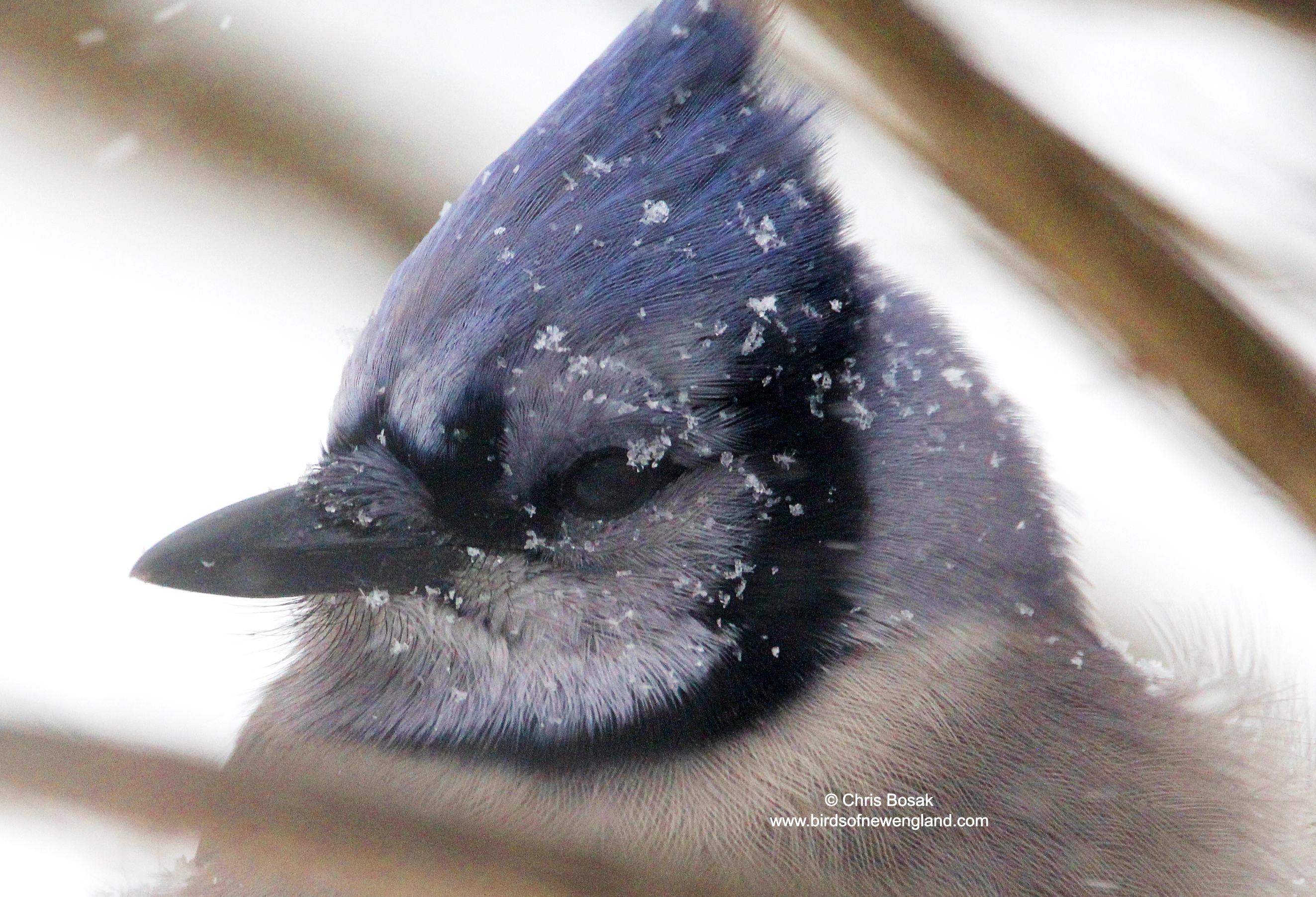
Snow gathers on a blue jay’s face during a snowstorm, January 25, 2026, New England. Blue jays, like all corvids, are highly intelligent.
We’ve all heard the expression “birdbrain” to describe someone lacking intelligence or prone to doing dumb things. The definition that pops up when doing an internet search is “a silly or stupid person.”
Birdbrain, of course, is a misnomer because birds are actually very smart.
While everyone has heard of birdbrain, how about birderbrain? I’d be willing to bet not many people have heard that one before. That would be understandable because I just made up the expression for this column.
The inspiration for the new term comes from an article I read recently. The link to the article came from a sponsored post that popped up on one of my social media accounts. I guess it shouldn’t be surprising that bird and nature content floods my social media feeds.
Anyway, the article is from Science Focus, a publication of the BBC. The article, “Birdwatching could help slow ageing, breakthrough study finds,” summarizes a study published in Journal of Neuroscience by scientists from Baycrest Hospital in Toronto.
The article includes a link to the study itself, but I quickly returned to the summarized BBC version, as the study was a bit over my head. And by a bit, I mean a lot. The title of the study is “The tuned cortex: Convergent expertise-related structural and functional remodeling across the adult lifespan,” if that gives you an idea.
So it was back to the article. Thank goodness for journalists for making studies like this comprehensible.
The study, which compared the brain structures of 29 expert birdwatchers and 29 beginners, found that birders were more perceptive, had a greater memory and could pay attention for longer periods of time.
“And, crucially, honing these skills could literally reorganise the structure of your brain and improve cognition,” the Science Focus article states. “Learning of any kind (such as a new instrument or language) is great for your brain, but the research argues that birding skills are particularly good because of their complexity.”
Remember, it’s a BBC publication, so it spells reorganize and aging (among other things) a little differently.
The study itself found that “Compared to novices, experts showed lower mean diffusivity in frontoparietal (SFG, IPS) and posterior cortical (AG, precuneus, LOC, fusiform) areas, along with a trend for more gradual increases in age-related MD.”
Sorry, let’s let the BBC journalist explain: “Scans revealed that the parts of the brain associated with attention and perception were more compact in the expert birders, and these structural changes made them better at identifying birds. Specifically, the water molecules in these brain regions were able to move more freely, seeming to boost their identification abilities, making them better at detecting less familiar or less local birds.”
I still can’t claim to fully understand the study, scientifically, but it certainly seems like a good thing for your brain to go birdwatching and become good at it through practice and perseverance.
One source in the article who was not associated with the study itself noted that perhaps it wasn’t the birdwatching that strengthened perception, attention and memory, but rather people with “stronger cognitive abilities” are more likely to take up birding and become good at it.
No one has ever accused me of being the smartest person in the room, but heck, I’ll take that explanation as a possibility.
Either way, the next time someone calls me “birderbrain” or even “birdbrain,” I’ll just say “thank you.”
 Birds of New England.com