Last week I wrote about an adventure my son Will and I had freeing an eastern kingbird from fishing line. Will was fishing with some friends when he noticed a bird struggling frantically and dangling underneath a branch.
He ran to get me and we worked together to free the bird. There was still a lot of energy in the bird’s struggle, so I am guessing it wasn’t tangled for too terribly long. Otherwise, its struggling would have been less frequent and less energetic. Or even worse, it could easily have died if it had been there long enough without being noticed.
Unfortunately, death is an all-too-frequent result for birds that either become tangled, hooked or snagged by discarded fishing line. I recall years ago coming across the pathetic scene of a belted kingfisher dangling lifelessly above a small stream. Abandoned fishing line had snared the bird and no one found it until it was too late.
I also recall a few years ago seeing a red-throated loon with fishing line around its bill and head in Long Island Sound. This bird, however, was still alive and I even saw it catch a fish, so perhaps this bird’s situation had a better outcome. I had no way of catching the loon; I could only watch — hopelessly — from the shore.
Birds have a tough row to hoe to begin with in nature without having to deal with so many man-made obstacles. Windows, wind turbines, cell towers, cats, cars, and pesticides pose significant obstacles to birds worldwide. Loss of habitat, of course, is perhaps the most serious challenge we throw at birds. Add discarded fishing line to the mix and it’s yet another hindrance we add to decrease a bird’s odds of survival.
There are measures we can take to lessen this bird mortality. Decals on windows, keeping cats indoors, using only natural pesticides, and picking up discarded fishing line can all go a long way toward helping birds survive longer and increase their populations.
So, the next time you are out walking along a lake, river, or pond, and you see fishing line dangling from a nearby branch, grab it if it is in reach and discard of it properly. Whether it is your fishing line or not, go ahead and remove it and potentially save a bird from a horrible, slow death.
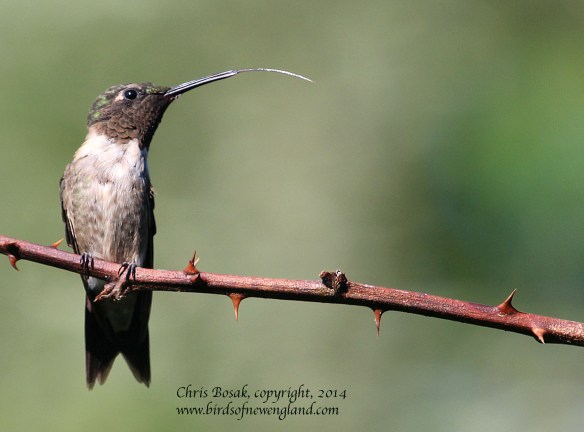
Photo by Chris Bosak A ruby-throated hummingbird perches on a thorny branch.
I’ll be venturing out of New England for a few days and don’t want the birds here to think I forgot about them so I’m instituting my own Hummingbird Week. Each day this week I’ll post a new or old photo of a ruby-throated hummingbird, the only hummer that occurs regularly in New England. There is no such thing as too many hummingbird photos, after all. Each day will also include a joke or fun fact about hummingbirds. This post will wrap up Birds of New England’s Hummingbird Week.
Fun Fact: Ruby-throated hummingbirds spend their winters in Central America or southern Mexico.
Photo by Chris Bosak
A Ruby-throated Hummingbird sips nectar from Canna flower in Danbury, Conn., summer 2016.
I’ll be venturing out of New England for a few days and don’t want the birds here to think I forgot about them so I’m instituting my own Hummingbird Week. Each day this week I’ll post a new or old photo of a ruby-throated hummingbird, the only hummer that occurs regularly in New England. There is no such thing as too many hummingbird photos, after all. Each day will also include a joke or fun fact about hummingbirds.
Fun Fact: On average, hummingbirds beat their wings about 50 times per second.
Photo by Chris Bosak A Ruby-throated Hummingbird hovers near a feeder at the Errol (N.H.) Motel in the summer of 2015.
I’ll be venturing out of New England for a few days and don’t want the birds here to think I forgot about them so I’m instituting my own Hummingbird Week. Each day this week I’ll post a new or old photo of a ruby-throated hummingbird, the only hummer that occurs regularly in New England. There is no such thing as too many hummingbird photos, after all. Each day will also include a joke or fun fact about hummingbirds. This is one of my favorites because of its patriotic feel.
Fun Fact: There are more than 300 species of hummingbirds, all occurring in the Western Hemisphere. About 12 species may be found in the U.S. with the ruby-throated hummingbird the only one regularly occurring east of the Mississippi River.
Photo by Chris Bosak A Ruby-throated Hummingbird perches on a branch in Brookfield, Conn., summer 2016.
I’ll be venturing out of New England for a few days and don’t want the birds here to think I forgot about them so I’m instituting my own Hummingbird Week. Each day this week I’ll post a new or old photo of a ruby-throated hummingbird, the only hummer that occurs regularly in New England. There is no such thing as too many hummingbird photos, after all. Each day will also include a joke or fun fact about hummingbirds.
Photo by Chris Bosak
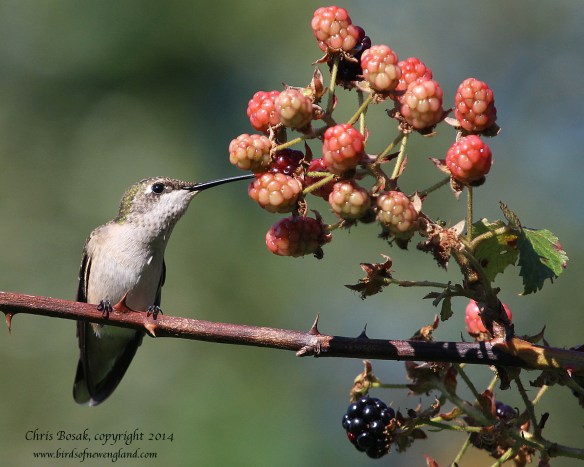
A female Ruby-throated Hummingbird sips juice from a berry in Norwalk, Conn., summer 2014.
I’ll be venturing out of New England for a few days and don’t want the birds here to think I forgot about them so I’m instituting my own Hummingbird Week. Each day this week I’ll post a new or old photo of a ruby-throated hummingbird, the only hummer that occurs regularly in New England. There is no such thing as too many hummingbird photos, after all. Each day will also include a joke or fun fact about hummingbirds.
Fun fact: Their wings aren’t the only things that move fast as a hummingbird’s tongue can sip from a feeder at 13 times per second.
Photo by Chris Bosak A ruby-throated hummingbird visits fuschia blooms in Danbury, Conn., May 2019.
I’ll be venturing out of New England for a few days and don’t want the birds here to think I forgot about them so I’m instituting my own Hummingbird Week. Each day this week I’ll post a new or old photo of a ruby-throated hummingbird, the only hummer that occurs regularly in New England. There is no such thing as too many hummingbird photos, after all. Each day will also include a joke or fun fact about hummingbirds.
Fun fact: Hummingbirds are the only birds that can fly backwards.
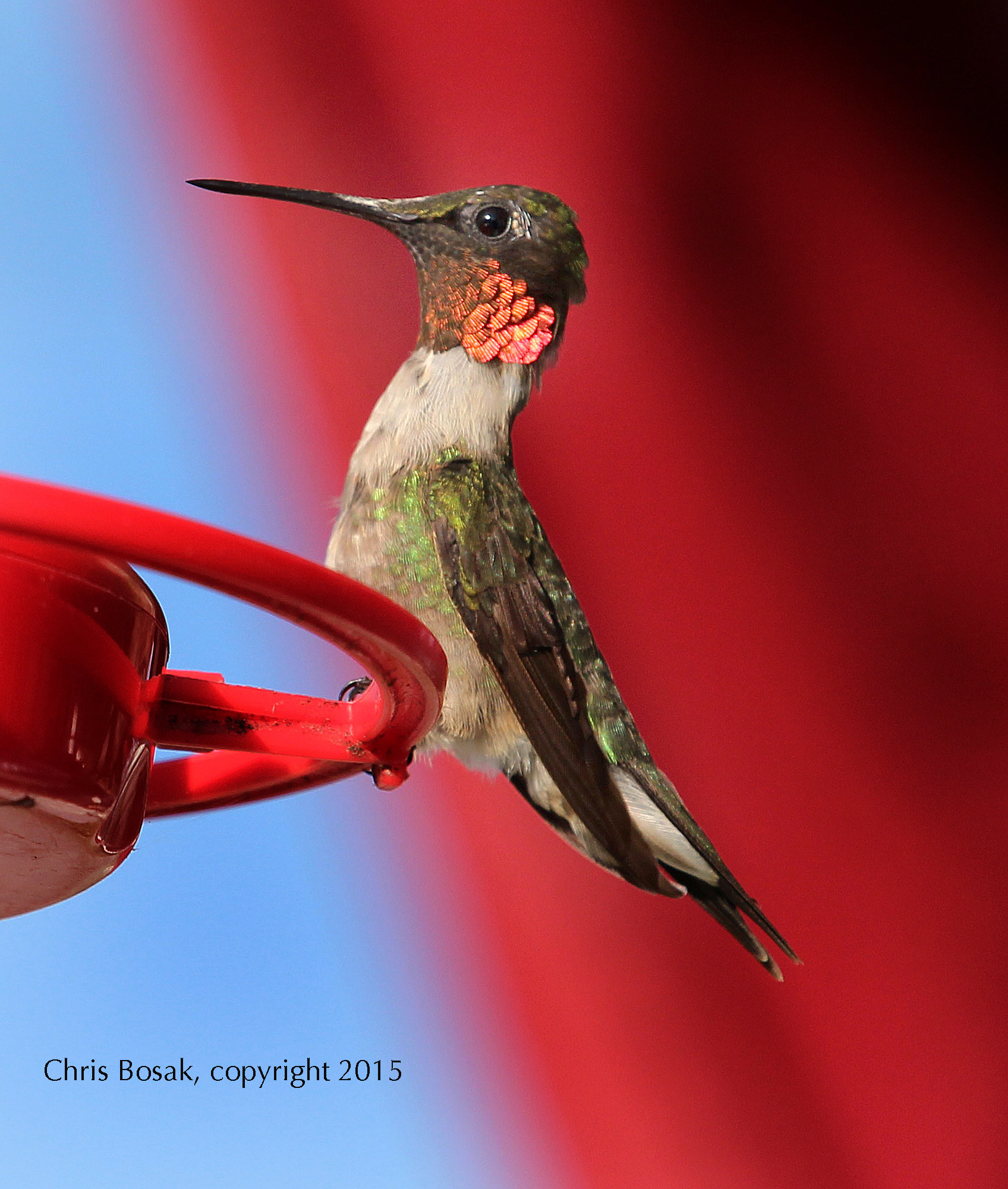
Photo by Chris Bosak A Ruby-throated Hummingbird perches on a feeder at the Errol (N.H.) Motel in the summer of 2015.
I’ll be venturing out of New England for a few days and don’t want the birds here to think I forgot about them so I’m instituting my own Hummingbird Week. Each day this week I’ll post a new or old photo of a ruby-throated hummingbird, the only hummer that occurs regularly in New England. There is no such thing as too many hummingbird photos, after all. Each day will also include a joke or fun fact about hummingbirds. Let’s kick it off with this classic …
Photo by Will Bosak Kingbird rescue, Danbury, CT, 2019.
It started with a bird pooping on my forehead and finished with me tipping over the canoe in a mucky, heavily vegetated part of the lake. The adventure was well worth it, however, as we successfully untangled and freed an eastern kingbird from the death grip of abandoned snagged fishing line.
Photo by Will Bosak Kingbird rescue, Danbury, CT, 2019.
I was sitting in my home office writing away about something or another when I saw out the window my 12-year-old son sprinting up the road and turning onto the driveway. He was fishing with two of his friends at the nearby fishing hole so I briefly panicked that someone had gotten hurt; perhaps a barbed hook embedded in a thumb or something like that.
I opened the window and yelled down: “What’s wrong Will?”
“There’s a bird stuck on fishing line dangling from a tree,” he said. “Come help it. It’s freaking out. I feel so bad for it.”
I rushed to the car and drove to the spot, even though it’s literally only a few hundred yards away. Nagging tendonitis in my foot has prevented me from making that walk — or any other walk for that matter — for weeks now.
“I think if we go through the woods we can get to it,” Will said as he pointed out the bird.
I recognized the bird as an eastern kingbird. The white band at the tip of its tail gave it away.
“I don’t think so, Will. All that vegetation is growing from the water so we’ll never reach it from land. We can probably get it with the canoe.”
I hobbled back to the car as quickly as possible and fetched the canoe. I used only one strap around the middle of the canoe to fasten it to the car since I was going such a short distance.
Back at the fishing hole, Will hustled to help me get the canoe off the car and to the shore.
“I’ll sit up front, you sit in the back and paddle us to the bird,” I told Will.
“I’ll take photos, too, dad. Where’s your phone?”
Will got us into the weeds and immediately the frantic bird crapped right on my forehead above my left eye. I didn’t even notice it, but Will let out a huge laugh to let me know.
“Guys! The bird pooped on my dad’s head!” he called excitedly to his friends.
I didn’t care about it at the moment. I just wanted to help the bird, which was now even more frantic with us closing in on it.
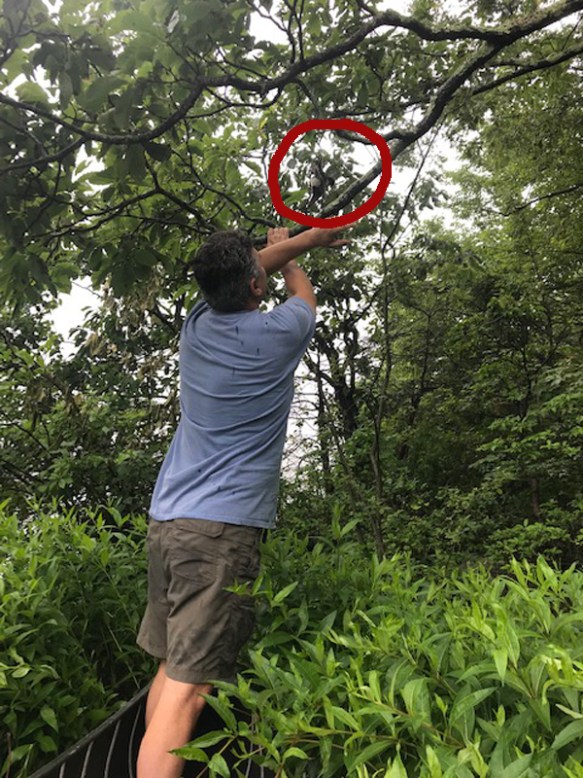
I grabbed some sturdy stems and pulled us into the vegetation even more to prevent us from drifting as I was soon to have a knife and, hopefully, a bird in my hands. We stopped right below the bird. I stood up carefully and extended for the bird. It was just out of reach.
“Give me the paddle, Will.”
I used the paddle to pull down the branch a few inches. I grabbed it and pulled the branch, bird, and tangled mess of fishing line toward me. Wow, that’s a lot of fishing line, I thought to myself. With my free hand I used the knife of my trusty Leatherman to cut the line above the bird’s wing. I closed the knife, tossed it on the floor of the canoe, and sat down with the highly agitated kingbird in my hand. It bit at my hand and made me thankful that it wasn’t a great blue heron.
A length of fishing line immediately came free but there was still line wrapped tightly around the wing. I held the bird and pulled gently on the end of the line. Will used the knife to cut the line as close to the wing as possible.
I dug in a little more to make sure there wasn’t a hook stuck in the wing. The kingbird obliged by extended its wing to expose the wound. Thankfully, there was no hook and the remaining piece of fishing line that had held the bird captive fell to the floor of the canoe. The wound did not look serious and I breathed a sigh of relief that a hook was not involved.
Satisfied that the bird was free from all fishing line I opened my hand to see if it was able to fly. In about half a second the kingbird burst out of my hands and disappeared into the woods.
The kingbird was lucky. Lucky that Will went fishing that afternoon and was able to spot it. Lucky that we had a canoe handy to access the water. Lucky that it was tangled relatively close to the water instead of higher up and out of reach. Lucky it was only tangled and not hooked.
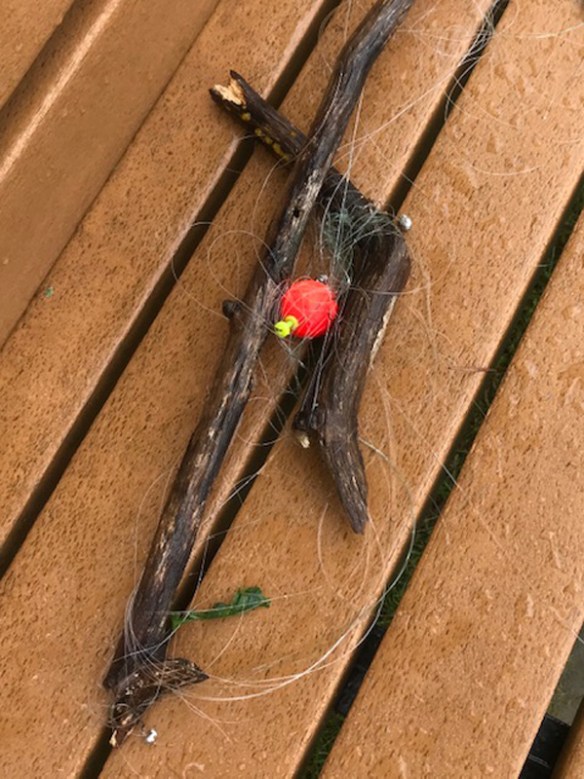
I looked around and noticed that the trees in the area were riddled with abandoned lines, bobbers, hooks, sinkers, and lures. Will steered me to them and I pulled down the ones that were in reach. I pulled down the tangle that had snared the kingbird and noticed the bird’s nest was in a branch about a foot above the twisted line.
Thankfully we were only a few feet from shore when I got a little too confident in my reaching and swamped the canoe. Swamped is a good term because we tipped over in thick, slimy aquatic vegetation. My legs felt for the bottom of the lake but only dug themselves deeper into a spaghetti bowl of slippery stems, roots and goodness knows what else.
Will, thankfully, had the wherewithal to immediately take my phone out of his pocket and toss it onto the shore. The phone was fine and Will scored points with his father for acting so quickly despite being dumped into a mucky mess.
We lumbered onto shore — me very gingerly on the uneven terrain — and dragged the half-full canoe onto land. Our legs were blacked by bits of partially decomposed leaves that fell into the water over the last several years.
Once on land we had little laugh and rejoiced as two kingbirds flew and chattered among the trees just off the shore.











 Birds of New England.com