Photo by Chris Bosak
A ruby-throated hummingbird visits a flower basket in New England, summer 2025.
Other than a few sightings while on walks at local parks, I hadn’t seen a single hummingbird all spring and most of the summer.
It wasn’t for lack of trying. I put out the same feeders and filled them with the same liquid I always do: four parts water, one part sugar. They never came. Not in April or May. Not in June or July.
August was headed toward a shutout as well until one day late in the month, it all changed. And it changed in a big way. Not only did a few hummingbirds show up, but they were around constantly. They visited the feeder one at a time, of course, because god forbid they’d actually share a feeder with four ports.
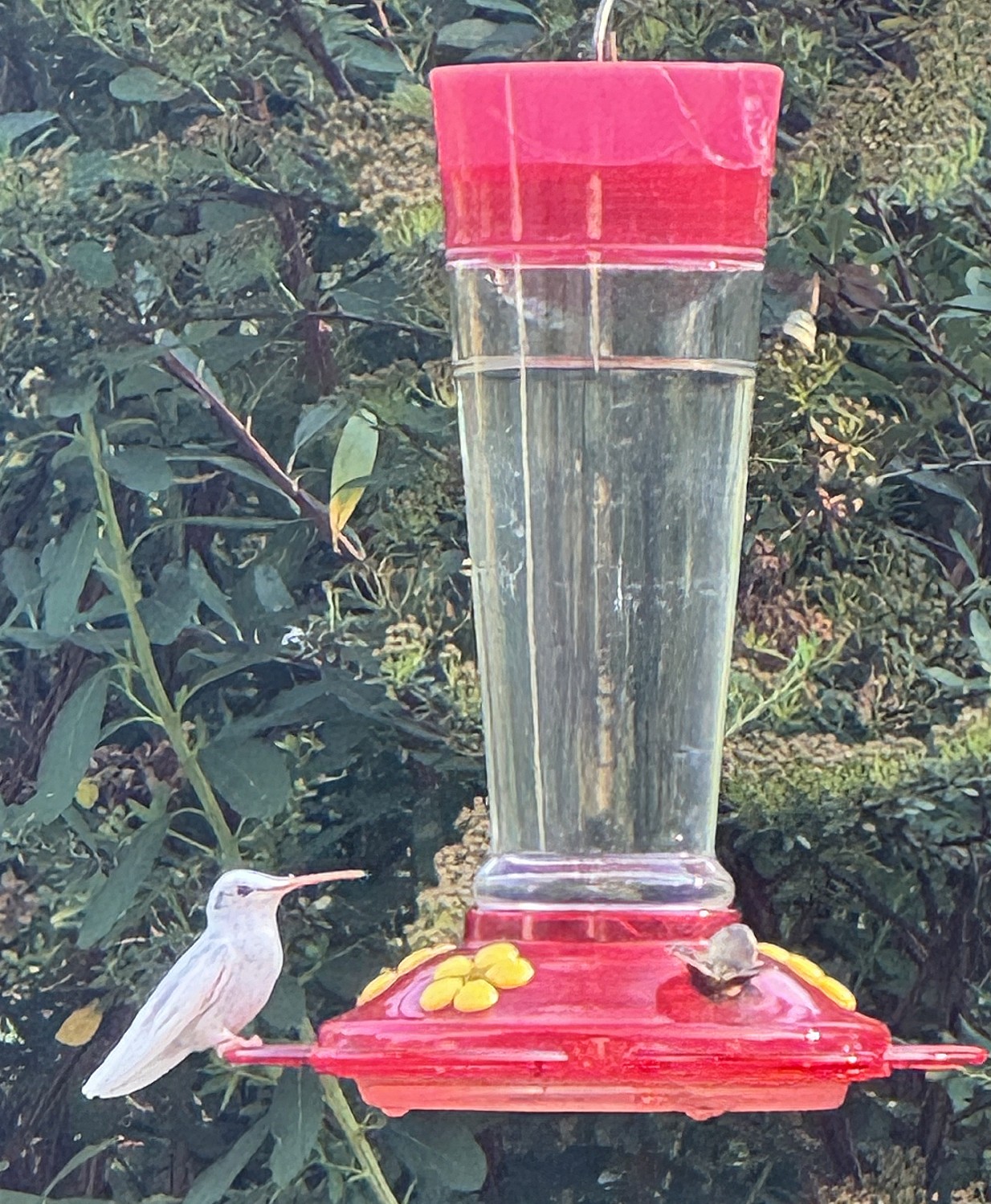
A reader from Langdon, N.H., sent in this photo of an albino or leucistic hummingbird, summer 2025.
Thank you to the readers from Langdon, N.H., who sent in this photo of an albino or leucistic hummingbird. I’m guessing albino because of the pink eyes and feet, but declaring anything albino invariably brings about debate. Either way, a very cool and rare sighting.
A reader from Langdon, N.H., sent in this photo of an albino or leucistic hummingbird, summer 2025.
Photo by Chris Bosak
Hummingbirds are migrating now and will be throughout the rest of the month.
The hummingbird season got off to a slow start for me this year.
I didn’t see a single hummingbird at my feeder in April or May. I saw a few in the backyard in June, but they zipped by my feeding station like it wasn’t even there. That contrasts with last year when a few hummingbirds visited daily from spring through fall.
This year’s fortunes have changed, thankfully, as hummingbirds became a regular occurrence once August hit. I believe the visits are coming from a combination of a hummingbird family that nested nearby and some southward migrants.
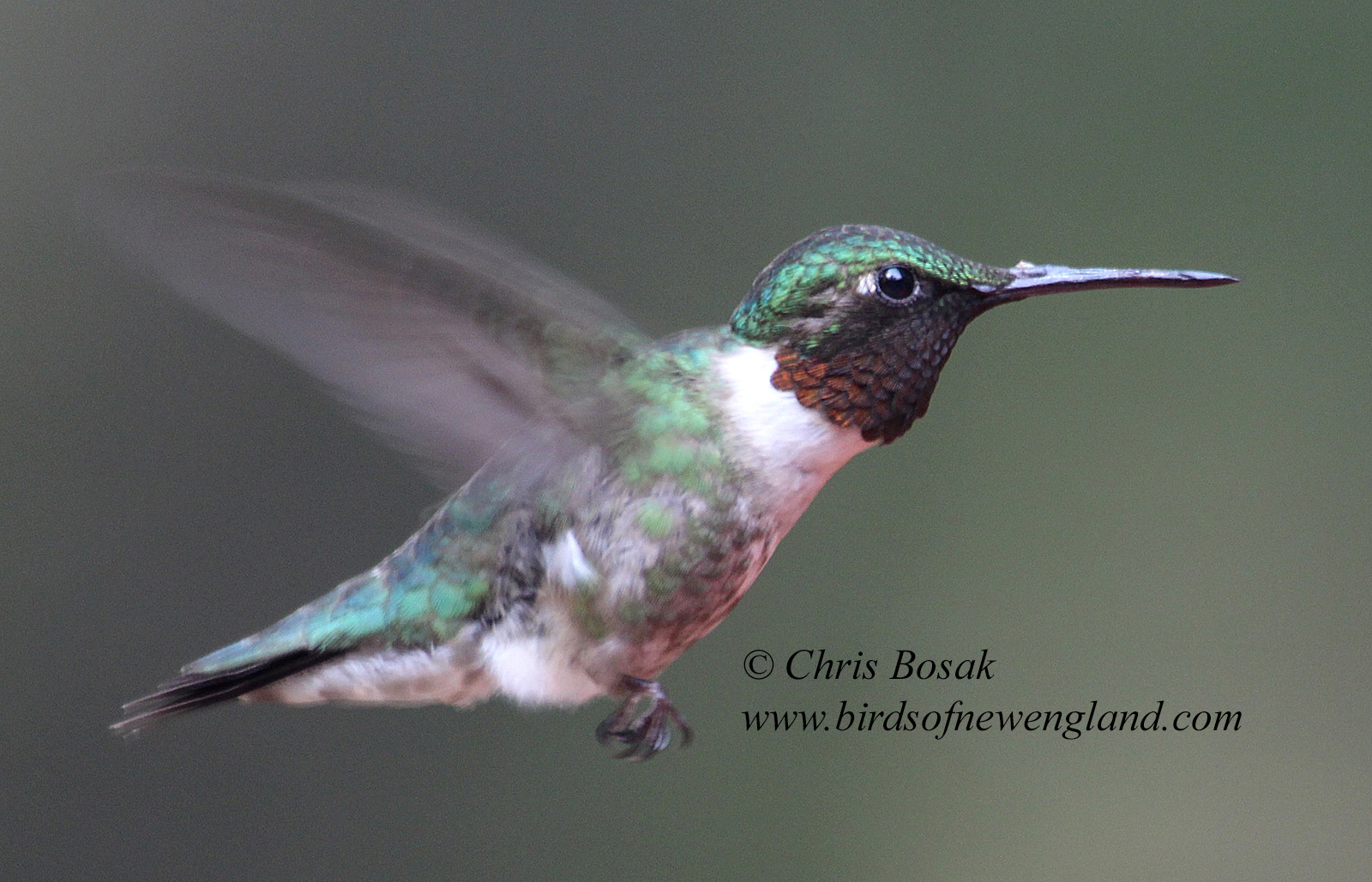
Ruby-throated hummingbirds, the only hummingbird species that regularly occurs in the eastern U.S., start their southward migration out of New England in August (some as early as late July.) Just like adult males were the first to arrive in the spring, they are the first to leave on the southward journey.
Plenty of adult male hummingbirds remain in New England. My most frequent visitor over the last few weeks has been a male. They will mostly be gone by the end of the month. Females and first-year birds will mostly be gone by the middle or end of September. Hummingbird feeders can remain up into October as the stragglers heading out of New England will need to fuel up too.
Hummingbirds need plenty of fuel as these tiny birds make their way to Central America for the winter. The arduous nonstop flight across the Gulf of Mexico takes a lot out of the birds. Whether a bird’s route takes it directly across the gulf or a more coastal route, it’s still a long, perilous journey. Their typical weight is just over three grams. They bulk up to about six grams for the journey and are between two and three grams when they get to the other side of the gulf.
Hummingbirds are always a good conversation starter, especially in that time of year after the bird breeding season, but before fall migration begins. My last few columns on hummingbirds elicited a few responses from readers I’d like to share.
Similar to my “problem,” Mary Ellen from Keene has a territorial female hummingbird that keeps all other would-be visitors away. The feistiness of New England hummingbirds, however, pales in comparison to the rufous hummingbirds she observed at her daughter’s property in Colorado at 9,200 feet of elevation.
“This one bird kept all other hummers from feeding. I put up another feeder thinking that would solve the problem but instead of one territorial rufous, we ended up with two!” she wrote.
Mary Ellen did some research and discovered the migration route of the rufous hummingbird takes them over the Rocky Mountains when alpine flowers are in bloom. Sure enough, she wrote, the aggressive rufous hummingbirds left after two weeks and the other hummingbirds were free to enjoy the feeders again.
Mary Ellen also marveled at how far these tiny birds can fly during migration. Ruby-throated hummingbirds are the only hummingbird species that is regularly found east of the Mississippi River. They get to their territory, including New England, by flying nonstop over the Gulf of Mexico, a 500-mile journey that takes about 20 hours. Some hummingbirds, if they are lucky enough to find one, will stop and rest on a boat or oil rig.
Deb from Royalston, Massachusetts, said her six to 12 hummingbirds visit mostly at dawn and dusk.
Zaden commented on my website that: “In Japanese, they call them hachi-dori, ‘bee birds.” I love that word.”
Eunice wrote on my website: “I have three feeders and 30 healthy hummers here in N.H. but hundreds of flowers for them to enjoy. Yes, my visitors hop from one feeder to another, but they all get to feed. Many are babies. It was a good year for them.”
Don and Heidi Nowers from Westminster, Vermont, thought the rose of Sharon bush and nearby feeder would be enough to keep all of the hummingbirds content. Not so. “It appears that after the dominant hummer chases the little guys off, a couple of bees move onto the feeder. When Ruby comes back, it’s game on.” They wrote that the bees and bird chase each other and play a game of cat and mouse. They did once observe a bee and hummingbird sharing the feeder, proving there is enough to go around.
My house in the woods had a lot of rose of Sharon bushes growing wildly and the hummingbirds loved it. There are lists upon lists of the types of flowers hummingbirds are attracted to. I’ve found that hummingbirds will visit just about any bloom to see if it is a potential food source. Sure, they may prefer red, tubular blooms, but they’ll come to just about any flower, I have found.
Deborah from Fitzwilliam had similar thoughts about sharing the wealth when she purchased a second hummingbird feeder. Alas, instead of the birds sharing, Deborah is “still entertained by hummer wars.” Deborah also noted “that the hummingbirds’ warning of flying in an arch while it chirps is similar to a bumblebee’s warning?” I hadn’t noticed that before but will pay attention next time I see bumblebees acting territorially.
Thank you to all who wrote in and shared your stories. Let’s keep the conversation about nature going.
Photo by Brian Thoele – Brian Thoele of Norwalk, Conn., got this shot of a downy woodpecker on a hummingbird feeder.
Hummingbird feeders, as the name suggests, are meant to attract hummingbirds.
It’s right in the name “hummingbird feeder.”
But, as we all know, it attracts a lot more than hummingbirds. The most common invaders include yellowjackets, hornets, bees, and ants. However, hummingbird feeders also attract larger critters such as bats, squirrels, raccoons, and even bears.
The list doesn’t stop there as a few emails I received this week point out. Other birds enjoy a visit to a hummingbird feeder as well.
Downy woodpeckers are probably the most common other birds that visit hummingbird feeders. Michele from the Monadnock Region wrote in to share that two woodpeckers had dislodged five of the six yellow plastic inserts that go into the feeding ports. The plastic inserts are supposed to keep birds like woodpeckers away, but these woodpeckers found a way around it. Michele did her best to find the inserts and put them back, but the woodpeckers just popped them out again.
Photo by Chris Bosak
A Ruby-throated Hummingbird perches on a feeder in Danbury, CT, summer 2015.
I’ve seen plenty of hummingbird feeders in New England with a dozen or more of the tiny birds zipping around the ports.
I stayed at a small motel in Errol several years ago and was amazed at the hummingbird feeder near the office. The birds were constantly at the feeder, from sunup to sundown, and there were a lot of them. The birds were not necessarily cooperative with each other, but at least they were tolerant.
That has never been the case with hummingbirds that visit my yard. All of my hummingbirds are jerks. I’m joking, of course. They are just territorial. Very territorial.
Such is the case this year again. I saw a female hummingbird off and on throughout this spring and early summer. Over the last two weeks, however, I’ve seen her every day and several times each day.
I’ve also seen a male a few times, but his visits to the feeder are short-lived. As soon as he settles onto the perch and dives his bill into the port, the female appears out of nowhere and buzzes right by his head. The male takes off for cover, followed by the female making sure he knows that the feeder is off limits.
Yesterday, I posted a video of a male ruby-throated hummingbird using a bush by the window as a shelter from the rain. Here are a few shots of the little beauty. Here’s the video in case you missed it.
Well, if he’s going to sit right outside my window on a rainy day then I’m going to make a YouTube video of him. First hummingbird I’ve seen this year (May 4, 2022, in Bethel, Conn.)
Here is the latest For the Birds article. It was published a few weeks ago in newspapers, but is still relevant as September comes to an end.
Photo by Chris Bosak
Hummingbirds are migrating now and will be throughout the rest of the month.
When should I bring in my hummingbird feeders? It’s a common question and may be answered the same way as so many other questions may be answered: It depends.
The answer depends on your tolerance for changing the sugar water in the feeders and your patience for watching a feeder that may not receive any visitors. Hummingbirds started to migrate a few weeks ago and some have gone south already.
With migration under way, now is definitely not the time to bring the feeders in. Hummingbirds need to pretty much double their weight to make their arduous migration, particularly when they reach the Gulf of Mexico and fly the 500 miles without rest.
Sure, there are plenty of natural food sources for hummingbirds this time of year, but an easy meal at a feeder now and then gives the tiny birds a bit of a break. Patches of jewelweed are another favorite of hummingbirds and they are still blooming. Other than feeders, I think I’ve seen more hummingbirds at jewelweed (touch-me-not) patches than any other venue.
Photo by Chris Bosak
A ruby-throated hummingbird hovers around salvia blooms in New England, September 2020.
The hummingbirds that haven’t flown south yet will likely do so soon. Here are a few shots of “my” hummingbirds that are still hanging around.
Photo by Chris Bosak
A ruby-throated hummingbird hovers around salvia blooms in New England, September 2020.Photo by Chris Bosak
A ruby-throated hummingbird hovers around salvia blooms in New England, September 2020.





 Birds of New England.com