
A few weeks ago, I wrote about coming across a sumac patch being invaded by black-capped chickadees. I included only one photo with that post, which is not like me at all. So, here are some more photos from that day.
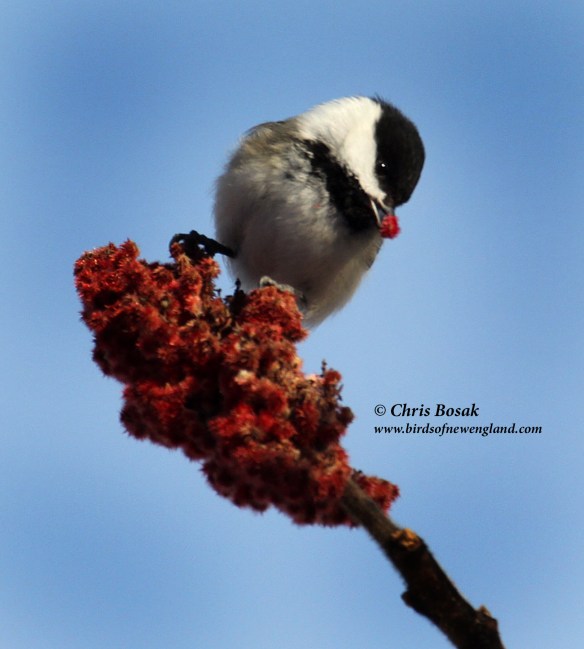


A few weeks ago, I wrote about coming across a sumac patch being invaded by black-capped chickadees. I included only one photo with that post, which is not like me at all. So, here are some more photos from that day.

The temperature when we started our walk was a whole 1 degree Fahrenheit. That number, however, was slowly climbing and there wasn’t a hint of wind to speak of. The sun was shining brightly, and the sky was as blue as you can imagine. In other words, a perfect day to spend several hours outside.
I was visiting my brother in upstate New York near the Vermont border, and two other brothers from out of town were there as well. Paul and I took a relatively short and absolutely birdless walk before returning to Gregg’s house. We both commented on how the single-digit temperatures were having little effect on us because it was a deadly calm day. So why go back inside just because the walk is over?
Gregg lives near an expansive field bordered by woods so Paul opened the hatch to his car and broke out a bag of flying discs. One of his hobbies is disc golf and he’s always Continue reading
Ah, a New England winter. There’s nothing like it.
Zero degrees one day and mid-50s a few days later. Arctic chill to pleasant spring-like weather in the blink of an eye.
Personally, I enjoy both extremes of a New England winter. I’ve said before that one of the great things about being a birdwatcher is that the hobby can be enjoyed regardless of the weather: hot, cold, rainy, snowy. The biggest impact weather — temperatures, anyway — has on birdwatching plans is whether or not the ponds will be frozen.
In the extreme cold, everything is frozen. Small ponds, large lakes and wide rivers are frozen solid. When that happens, I do my birdwatching at home and in the woods. (Lately, it’s been mostly at home, to be honest.) The feeders get particularly active in bitterly cold weather as birds feed with a sense of urgency to fuel up for the cold night ahead. All the birds you’d expect to see over the course of a winter sometimes show up in one day, especially in extreme weather. Cardinals, blue jays, mourning doves, juncos, white-throated sparrows, house finches and, of course, titmice, chickadees, nuthatches and woodpeckers can all show up on those days. Who knows? A pair of Carolina wrens may even show up.
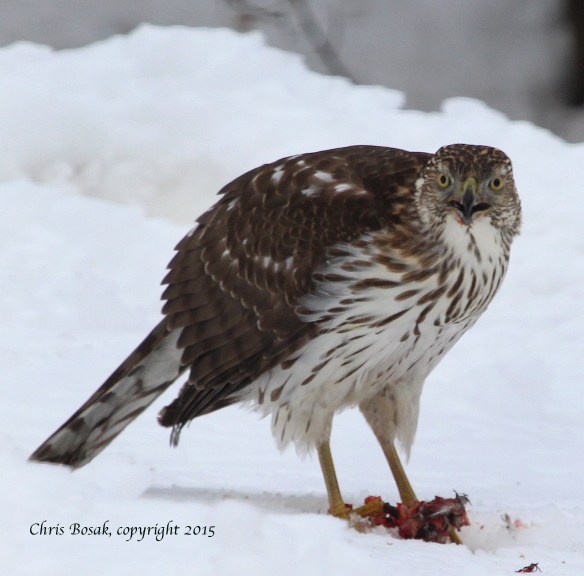
Those types of frenetic feeder days are often accompanied by a visit from an opportunistic sharp-shinned or Cooper’s hawk, but I haven’t seen them around Continue reading
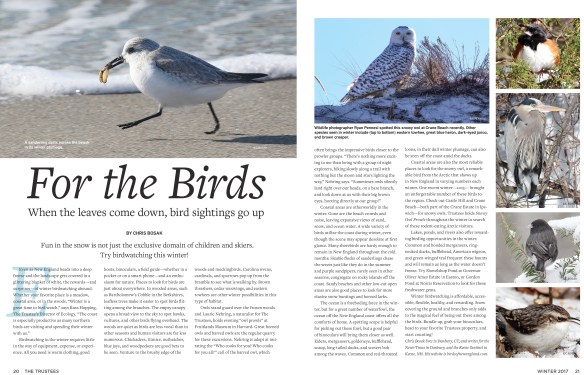
With the year’s first major snowfall to hit New England over the next two days, here’s a look back at an article I did a few years ago for The Trustees, a Massachusetts-based conservation organization. Check out the group here to learn more about the good things it does.
Here’s a link to the story, if you can’t read the attached document.

My attempt to go live from my feeders today was, well, a learning experience. The video quality looked much better on my iPhone screen than how it translated onto the big screen next to me. Also, Facebook live makes you shoot vertically (not how you’re supposed to do it!) so the first several minutes appeared sideways. Who knew?
The birds were fairly cooperative during the 15-minute live shoot. A group of pine siskins covered the tube feeder while mourning doves, titmice, chickadees, goldfinches, juncos, downy woodpeckers, and white-breasted nuthatches visited the various other feeders. A song sparrow, an irregular visitor at my feeders anyway, also showed up and took seeds from the platform feeder.
What was somewhat expected but didn’t show up were blue jays, cardinals, and red-bellied woodpeckers.
I guess it’s time to look into a new camera capable of streaming live video. The iPhone just didn’t cut it – at least for this experiment. Thanks to those who did tune in. Next time will be better.
In the meantime, here are some more photos from the action Continue reading
Here is the latest For the Birds column:

Winter poses serious challenges for birds and other wildlife.
The cold is the first thing that comes to mind. How do small birds such as chickadees and goldfinches survive sustained sub-zero temperatures? How do water birds such as gulls, ducks and geese stand on ice all day with bitter winds driving through them?
Birds that remain in New England all year have adapted to the low temperatures. Cold may be a challenge, but it’s one they can handle.
Chickadees and other birds have all sorts of adaptations to survive bitter cold days and nights. They increase their weight and fat percentage, they puff out their feathers to trap warm air close to their bodies, they huddle together for warmth, they drop their body temperature at night, and they eat a lot.
Water birds have an extra layer of down feathers to keep dry and toasty. Also, their legs don’t freeze because of a magical counter-current heat exchange between their veins and arteries. It’s not magic, of course, but it’s a complex system worthy of its own column. Let’s just say their feet don’t have to be as warm as their bodies (otherwise they’d be covered in feathers) and the way their blood flows keeps the legs from freezing.
So the cold, while uncomfortable on the most bitter nights, is usually Continue reading

Came across this guy today while driving past a small river in SW Connecticut.
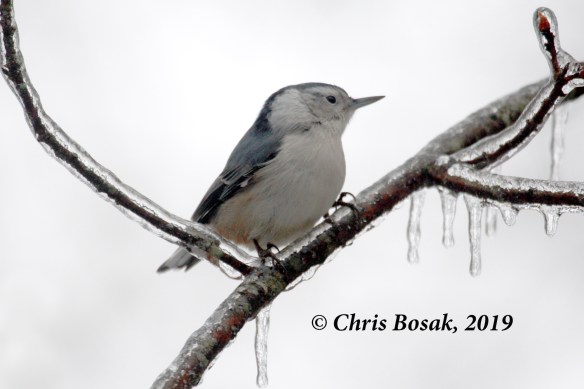
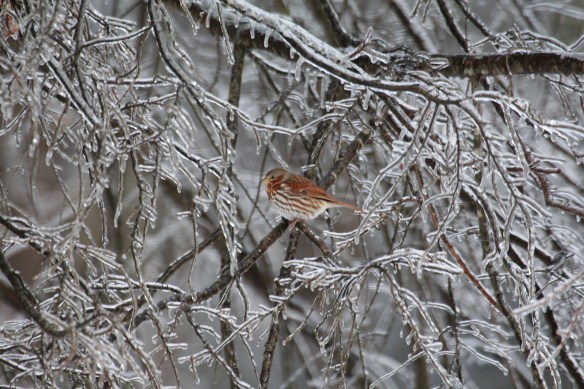
Parts of southern New England remain encrusted in ice. It’s been several days since the snow-then-ice storm hit, but brutally cold weather followed to keep everything frozen. The beautiful ice-covered landscape will change soon, however, as the forecast calls for rain and temperatures in the 40s. In the meantime, I’ll keep taking and sharing bird photos with this icy backdrop.


Here’s a male and female cardinal seen this morning during icy, single-digit temperatures.


In southern Connecticut we woke up to a landscape covered in ice and a grand total of 1 degree Fahrenheit. I’m sure that seems like a heatwave compared to what those in northern New England experienced. But, hey, that’s why we love New England.
Here are a few shots from this morning (Monday, Jan. 21, 2019.)


 Birds of New England.com