Cedar waxwings eating berries

Photo by Chris Bosak A cedar waxwing eats border privet berries in New England, February 2025.

A walk earlier this week yielded these beauties eating border privet berries. Cedar waxwings are one of my favorites.

Continue reading

Never enough cardinal photos

Photo by Chris Bosak Northern cardinal in birdbath, New England, Feb. 2025.

Can there ever be enough northern cardinal photos? Here are a few shots from the other day.

Photo by Chris Bosak Northern cardinal in New England, Feb. 2025.

Red-winged blackbirds return in force

Photo by Chris Bosak A red-winged blackbird rests on a perch near a feeder in New England, February 23, 2025.

This guy showed up at my feeder a few days ago, marking the first time I’ve seen a red-winged blackbird at my feeder in many years. Today, during a walk, I saw dozens and dozens of male red-winged blackbirds, mostly flying overhead. Males show up a few weeks before females to scout out territories. The familiar sounds of red-winged blackbirds are back. The spring migration is under way.

Starlings in birdbath

Photo by Chris Bosak European starlings in birdbath, Feb. 2025, New England.

These starlings look like they are looking for trouble.

For the Birds: Mixing things up

Photo by Chris Bosak Male long-tailed ducks on Long Island Sound, February 2025.

You have to mix it up every once in a while. This goes for most things in life, but certainly for birdwatching.

The other day, I pulled into the parking lot of the state park where I do the majority of my walking and birding. I never got out of the car this time. I had a rare several-hour block to myself, and, as I pondered my options, the siren song of water kept calling me.

While I love walking at my local patch, and I know just where to look and what I might find, I was craving something different on this day. My patch is mostly woods with a few fields, like much of New England. It does have a large pond, but it has been frozen solid since December.

I backed out of the parking lot and headed to a reservoir a relatively short distance away. I knew at least some of the water would be unfrozen and undoubtedly holding some ducks. Open freshwater has been hard to come by this winter.

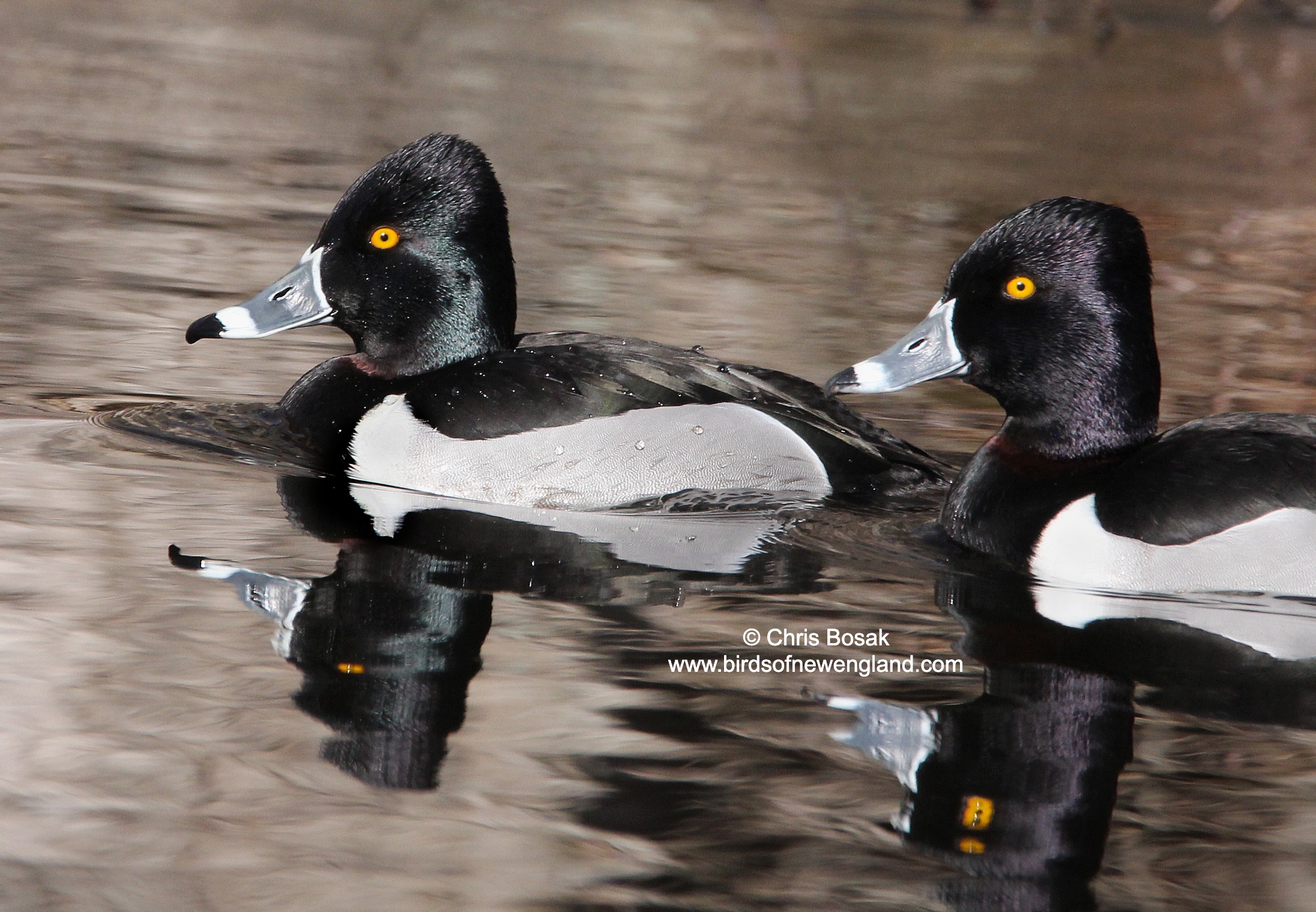
The reservoir, as it turned out, was mostly frozen as well. A small area near the dam was open, and that’s it. This oasis of unfrozen water was, however, a gathering place for a lot of waterfowl. Canada geese were, by far, the dominant species, along with mallards and mute swans. There were also a few buffleheads and ring-necked ducks, along with a lone male wood duck in his splendid breeding plumage. It had been a while since I had seen a wood duck, so that was the highlight of my visit to the reservoir.

Since I had gone that far already and still had time to spare, I figured I’d keep going and pay a visit to Long Island Sound. It wasn’t terribly far and, even though it’s almost always cold and windy in the winter, I knew a lot of ducks and other fowl would be there.

I arrived at the Connecticut state park, and Long Island Sound did not disappoint. I immediately spotted a huge raft of greater scaup and a few small groups of common goldeneye. The odd common loon popped up here and there as well. Common loons are a blend of dull whites and grays in their winter plumage, unlike their iconic black-and-white spotted summer plumage.

Canada geese were there in large numbers, of course, but a massive flock of brant flew past as well. There were also smaller groups of brant hugging the shoreline.

The highlight for me was the long-tailed ducks. Formerly called oldsquaw, long-tailed ducks are another species that look completely different in the winter than in the summer. Not that I’ve ever seen a long-tailed duck in the summer, as they breed well north of New England, but I’ve seen pictures. The male’s winter plumage is a mix of bright white, black and different shades of brown. The bill is dark with a pink patch in the middle. The female’s plumage is more modest with white and brown.

Many of the long-tailed ducks were relatively close to the shore, offering decent photo opportunities. Unfortunately, it wasn’t a great day for photos as it was very gray. Of course, gray can be good for photography as it eliminates harsh shadows, but this was a dull, dark, color-robbing gray. I did my best with the long-tailed ducks nonetheless.

The inland part of the park was good too, with Savannah sparrows, a northern harrier, fox sparrows and a large group of American tree sparrows.

The next day, I was right back at my patch enjoying a walk in the woods. I guess I needed a little change of pace, if only for one day.

The Atlantic coast is not terribly far for a day trip, and Long Island Sound is not that much farther. If the sea is calling your name and you have the time, pack up and go. Let me know what you see.

Cool half moon this morning

Photo by Chris Bosak Half moon in Connecticut, February 20, 2025.

There was a cool half moon out in Connecticut early this morning (Feb. 20, 2025).

A few icy non-bird photos

Photo by Chris Bosak Icy birdbath in New England, February 2025.

I posted the last two days photos of birds following a weekend ice storm. Here are a few shots without birds in them.

Photo by Chris Bosak Ice covers the branches in New England, February 2025.
Photo by Chris Bosak Icy birdbath in New England, February 2025.

More icy photos

Photo by Chris Bosak A white-throated sparrow perches among ice branches in New England, February 2025.

Here are a few more photos from the ice storm in New England, February 2025.

Photo by Chris Bosak
A white-throated sparrow perches on an icy branch in New England, February 2025.

Backyard birds battle the ice

Photo by Chris Bosak Black-capped chickadee perches on an icy branch, February 2025.

A snowy mix covered much of New England this weekend. It started as snow, then changed to freezing rain, and finally just plain, old rain. The freezing rain formed a hard covering over the snow and sheathed every branch in ice. While walking or driving in these conditions is not advised, it’s always fun to look out the window and see how the birds are handling it. As the photos suggest, they are doing just fine. (Sorry for the grainy photos. Not a whole lot of light to work with.)

Photo by Chris Bosak Tufted titmouse takes cover among icy branches, February 2025.
Photo by Chris Bosak A junco perches on icy branches in New England, February 2025.
Photo by Chris Bosak A starling perches on icy wires in New England, February 2025.
Photo by Chris Bosak Black-capped chickadee perches on an icy branch, February 2025.

The other things in the woods

Photo by Chris Bosak White-tailed deer at Sherwood Island State Park, February 2025.

Birds are my primary target on my walks in the woods, but other creatures often make an appearance, and I’m just as happy to photograph them. This young white-tailed deer stood its ground near a trail as I walked past the other day.