
Came across this beauty during a recent walk in southern New England.
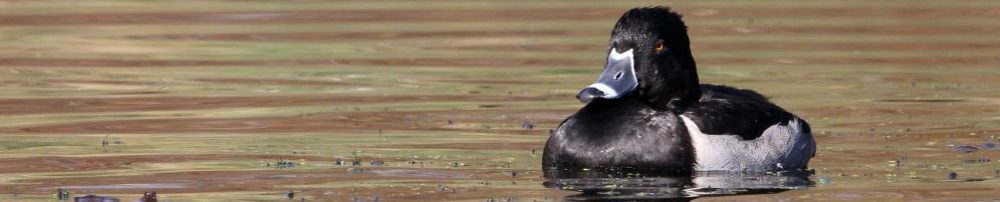
Came across this beauty during a recent walk in southern New England.

I got lucky with this photo. I assumed the birds did not like the dark berries in a small tree in the side yard because winter was moving along and nothing was touching them. As I sat at my desk working the other day, I noticed a flurry of activity out of the corner of my eye. It was a flock of a dozen or more robins descending upon the tree at once. I sneaked onto the covered porch by the tree and hoped the robins wouldn’t take off at the disruption. Most of the photos did not turn out well because of distracting branches in the way, but this one turned out pretty well.
I’ve had pretty good luck with birds-eating-berries photos this past week. I’ll post more photos soon. Thanks for checking out birdsofnewengland.com

My morning stroll at work one day last week was cut short because the field I usually walk through had completely disappeared. Well, it didn’t disappear, of course, but it was under several feet of water. There was no grass to be seen, only a huge pool of water reflecting the gloomy sky above.
The adjacent river, which is really just a trickling creek most of the time, was now a raging, angry force that had spilled over its banks and flooded the land on either side. Heavy rains the previous night, combined with the few inches of snow that had been on the ground, turned a usually serene setting into a foreboding, aquatic landscape.
What struck me most was how different everything looked. Flooding obviously can drastically change a landscape in a matter of moments, but it can be quite jarring when you are used to seeing something every day and suddenly it looks like a different world.
Continue reading
As promised, here are a few photos of the female purple finch, as seen and photographed in Connecticut during Tuesday’s snowfall. She is eating berries from a silky dogwood, I believe. Females lack the bright colors of the male but are spectacularly designed. They are slightly larger and more decorated than female house finches.
If you missed yesterday’s male purple finch, click here.
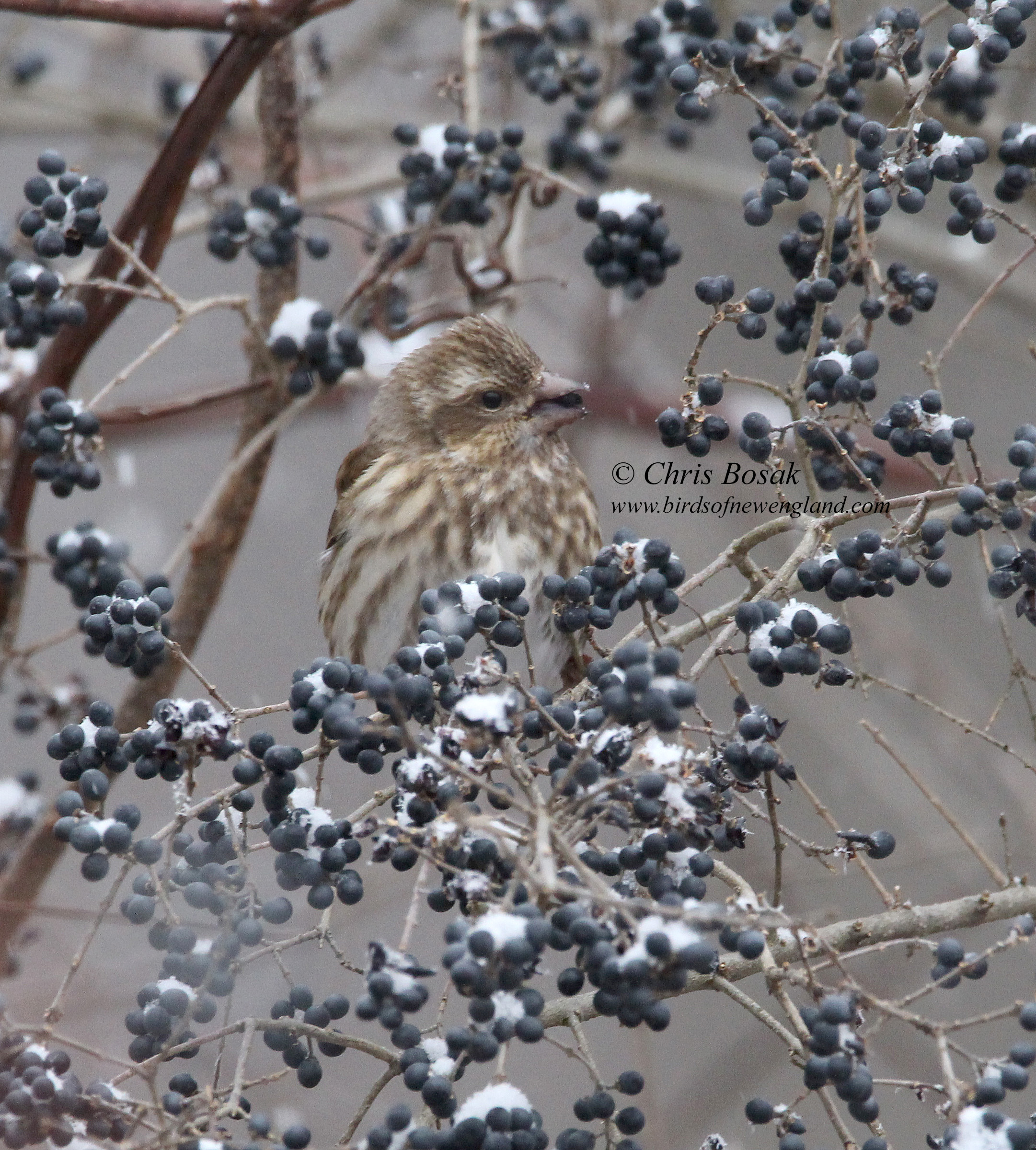
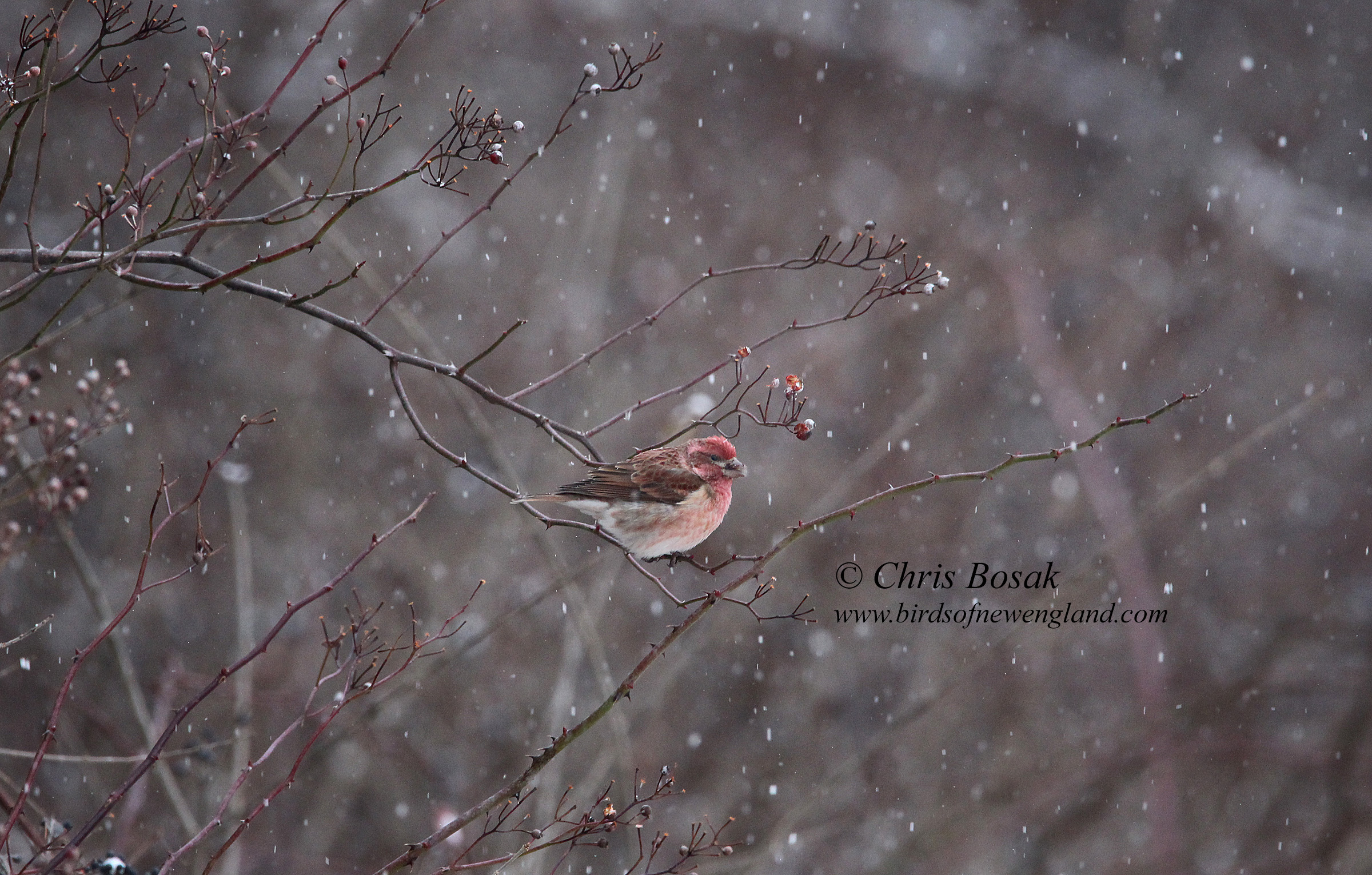
Here are a few shots of a purple finch I found on this morning’s walk through the snow. Male purple finches are more rosy in color and overall more colorful (and slightly larger) than the more common house finch. Plus, purple finches are way cooler.
Tomorrow, the female purple finch.
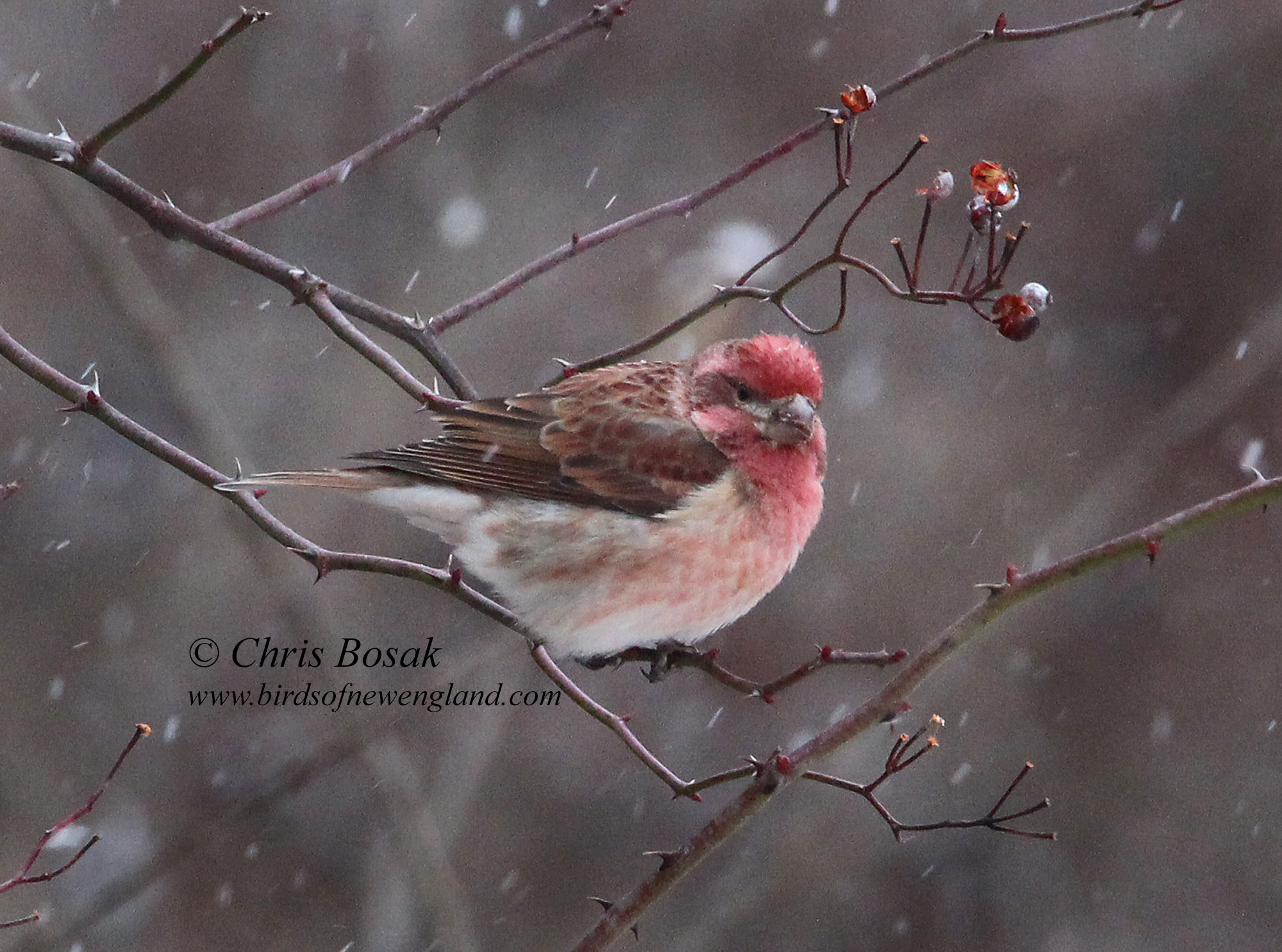
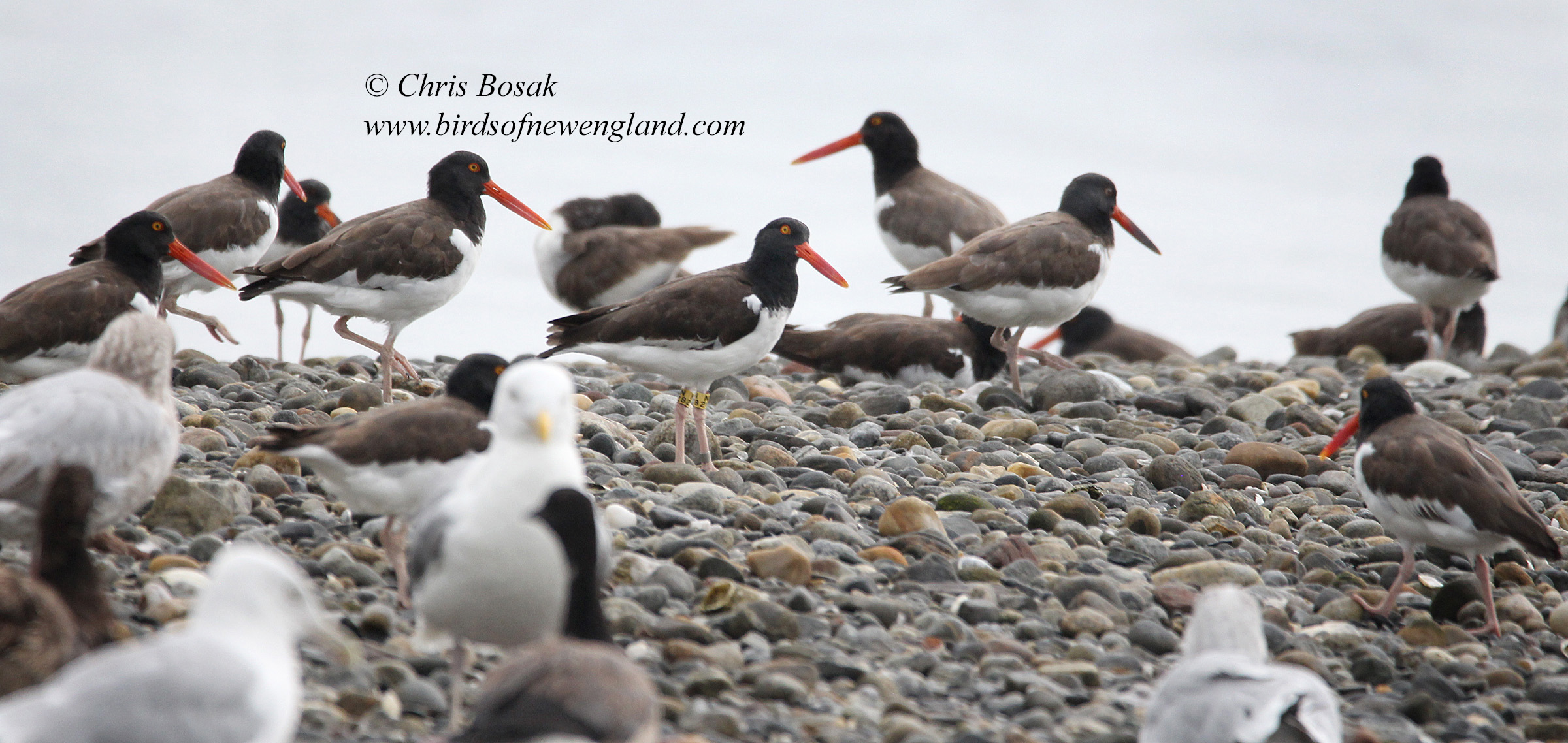
Before it gets too far into the new year, I want to take a look back at my birding highlights from 2023. It was a good year all around with birds small and large. Thanks to you all for being a part of another year of sharing birding adventures.
Here is my annual top 10 list of birding highlights from the past year.
10. The Christmas Bird Count never fails to be a highlight of the year. Whether the birds are plentiful or not, it’s always a good day spent in the field with friends. The weather was cold, gray and damp, and the birds were fairly scarce, but our spirits remained high.
9. Along the same lines, I contributed to eBird more in 2023 than in years past. Checklists from eBird are entered into a massive database that scientists use to track bird populations. Millions of lists are submitted, so my contributions are pretty insignificant, but it all adds up. Anything to help the future of birds. Anyone can participate, regardless of skill level. Sign up through the eBird app or website.
8. I watched a flock of mallards at a park in Baltimore while I was in the city visiting my son at school. It was early in the fall duck migration, but something told me to look carefully at the dozens or hundreds of mallards that dominated the pond. Sure enough, three or four ring-necked ducks swam and rested among the mallards. Not an earth-shattering sighting, but I love my ducks and always love seeing them.
Continue reading
For just a moment, I was in their world.
As I stood there I could see nothing but branches, sticks and stubborn brown leaves that refused to fall off the low trees. Then I crouched like a baseball catcher and there they were: a flock of mallards taking a midday break in the tangled trees growing out of a small pond.
Normally mallards would not make for a memorable birdwatching outing, but this time was different.
A fairly busy road was no more than 50 yards away and my car was about 50 feet away, but I felt as if I were visiting the ducks’ world. The area was thickly wooded and a dark canopy of towering branches hung over the pond’s edge, adding to the feeling of seclusion. It was as if the world was reduced to the woods, the mallards and me.
It was a neat sensation, one that I’ve experience only a handful of times before — usually in extreme northern New Hampshire.
Continue reading
I wanted to do something a little different for my annual Christmas column this year.
I typically do a gift guide column, but I will keep that part of the article brief, only to say that giving someone a membership to a conservation organization, particularly a local one, is always a great gift for your birder. Material gift ideas, such as binoculars or spotting scopes, are readily available online.
For this year, I want to do something that is perhaps a bit corny, but fun anyway. I am going to break down the classic carol The Twelve Days of Christmas and relate each of the days to birdwatching in New England.
Here we go …
12 drummers drumming. My first thought was to use the ruffed grouse as it makes a drumming sound by flapping and rotating its wings in the woods to claim territory. I am, however, going to save the grouse for later. So the 12th day will be the drumming of New England woodpeckers. Hopefully the image you have of drumming is a woodpecker drumming on a tree in the woods rather than drumming on the side of your house.
Continue reading
Birders are trained to find things that look out of place. It is a self-training that happens naturally over the course of many years of looking for birds.
A slight movement in the bushes likely means a bird or small mammal. That bump on a fence railing or post is probably a small perching bird taking a rest. If you are canoeing and the expanse of calm water ahead of you is broken by barely distinguishable ripples, a diving duck may soon reappear on the surface.
This gift that birders have, I think, is most often on display while driving. Most people will drive by a hawk perched on a branch along the road and not even notice it. Birders, on the other hand, see the blob in the tree from a mile away. A positive identification of the blob is made as you zoom past at 65 miles an hour. Just the other day, I noticed a bald eagle perched along a river. From the road, however, it was largely hidden by branches, but something just didn’t look quite right.
This gift is most evident when driving or walking along a familiar route. If you’ve walked a trail through the woods a thousand times, you get to know where every rock, root and upturned tree is. Anything that looks out of the ordinary is immediately noted and inspected to see if it’s a bird or animal.
Continue reading
Every once in a while, birding throws a curveball.
To keep the baseball analogy going, curveballs aren’t necessarily a bad thing. Once some batters learn how to recognize a curveball, they prefer them to fastballs. It’s just a matter of seeing enough curveballs and getting enough experience with them. You could say it’s a learning curve.
In the birding world, curveballs come in all shapes, colors and sizes. That’s why they are called curveballs. I would define a curveball in this regard as any bird that looks different from what a field guide says it looks like.
Leucism is a common curveball the birding world likes to throw. Leucism is similar to albinism in that the bird appears white, mostly white, or patchy white. Robins, juncos and red-tailed hawks are birds often seen with leucism. That is not to say these birds have a high percentage of individuals with leucism, but rather if a bird with leucism is spotted in New England, it’s often one of those birds.
Continue reading Birds of New England.com