Photo by Chris Bosak
A yellow-breasted chat sings from a shrub in New England, June 2025.
I was walking along a productive section of a trail in southern New England when a loud birdsong caught my attention. As is often the case, I didn’t recognize it immediately, but knew it was worth stopping for and investigating.
Sometimes when that happens, it turns out to be a seldom-used song or call from a familiar bird. Tufted titmice have a wide variety of sounds and they often throw me off. The same goes for catbirds, robins and orioles. But this time, it was indeed something uncommon.
I used the Merlin app on my phone and it identified it as a yellow-breasted chat. That would be cool, I thought, but let’s get visual confirmation. The Merlin app is a great new tool for birdwatchers, but it’s not 100 percent accurate, and I always like to get visual confirmation.
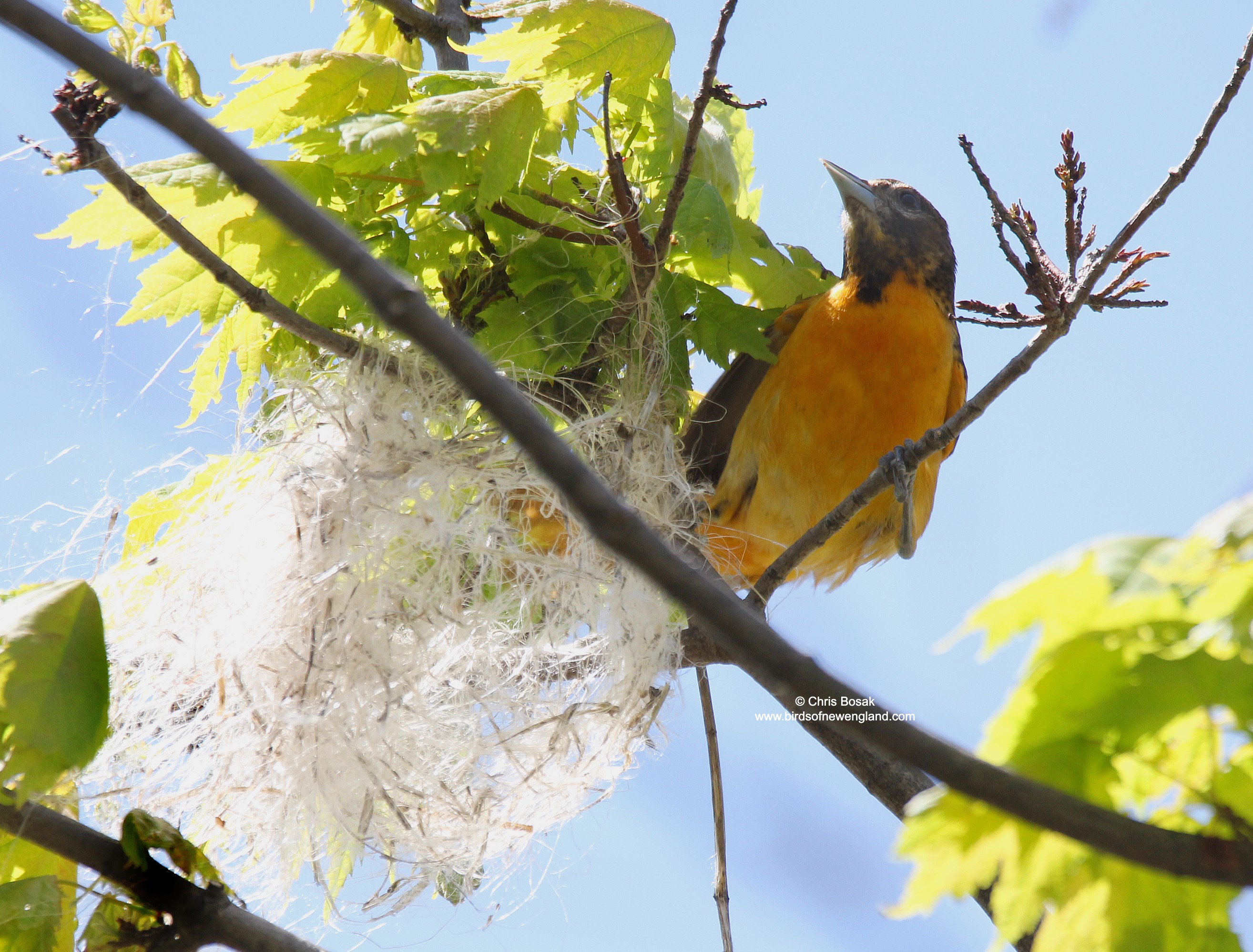
Photo by Chris Bosak
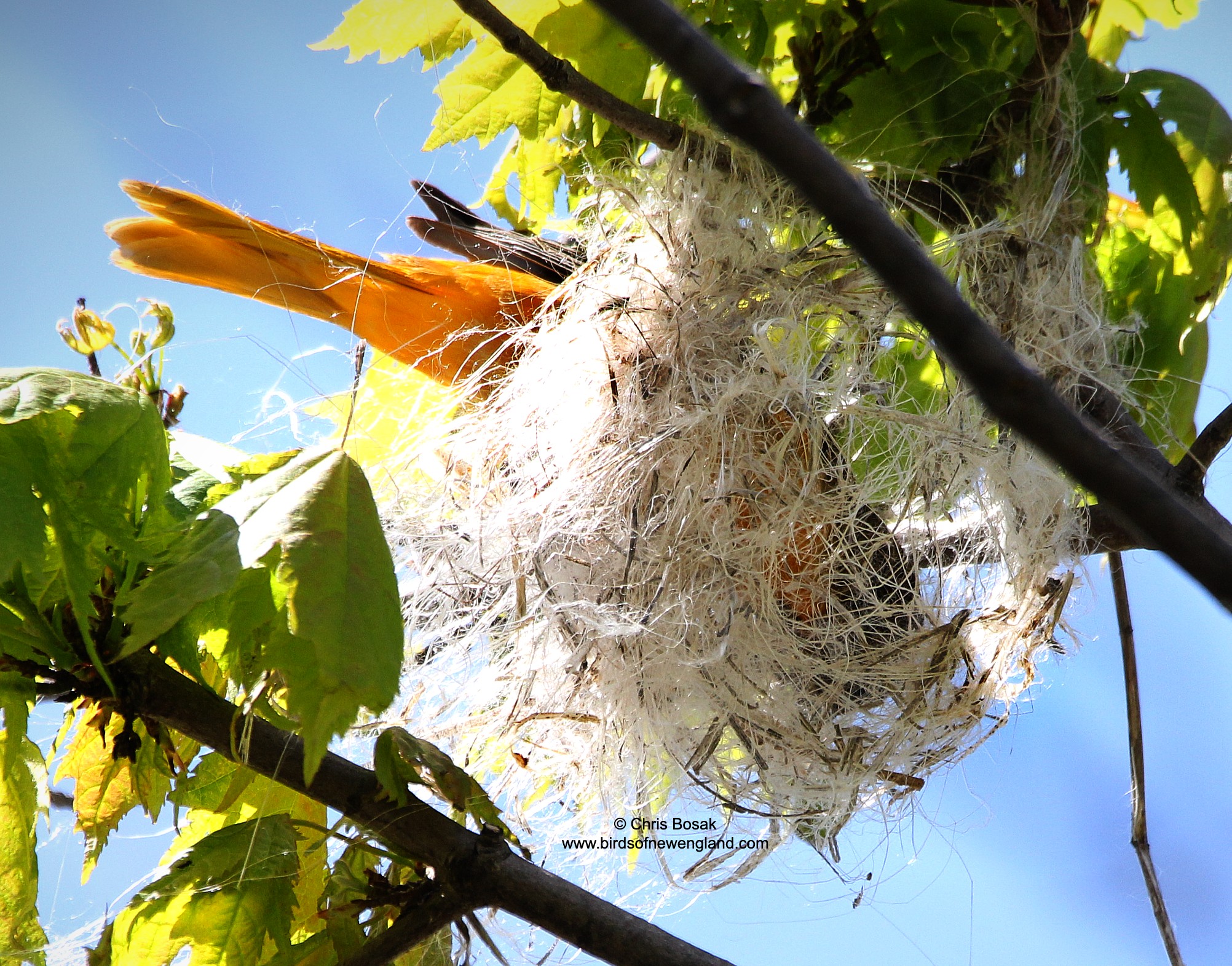
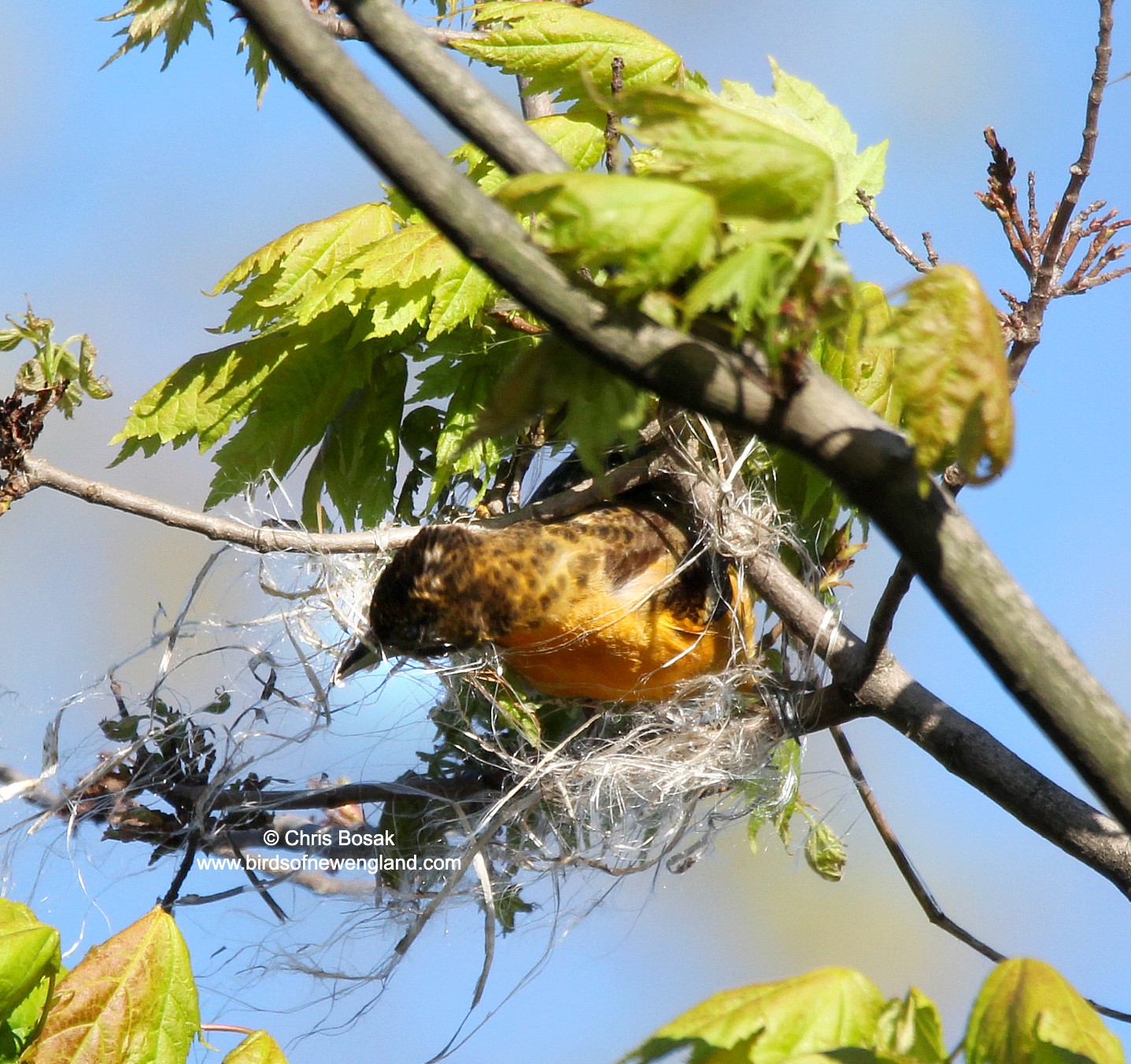
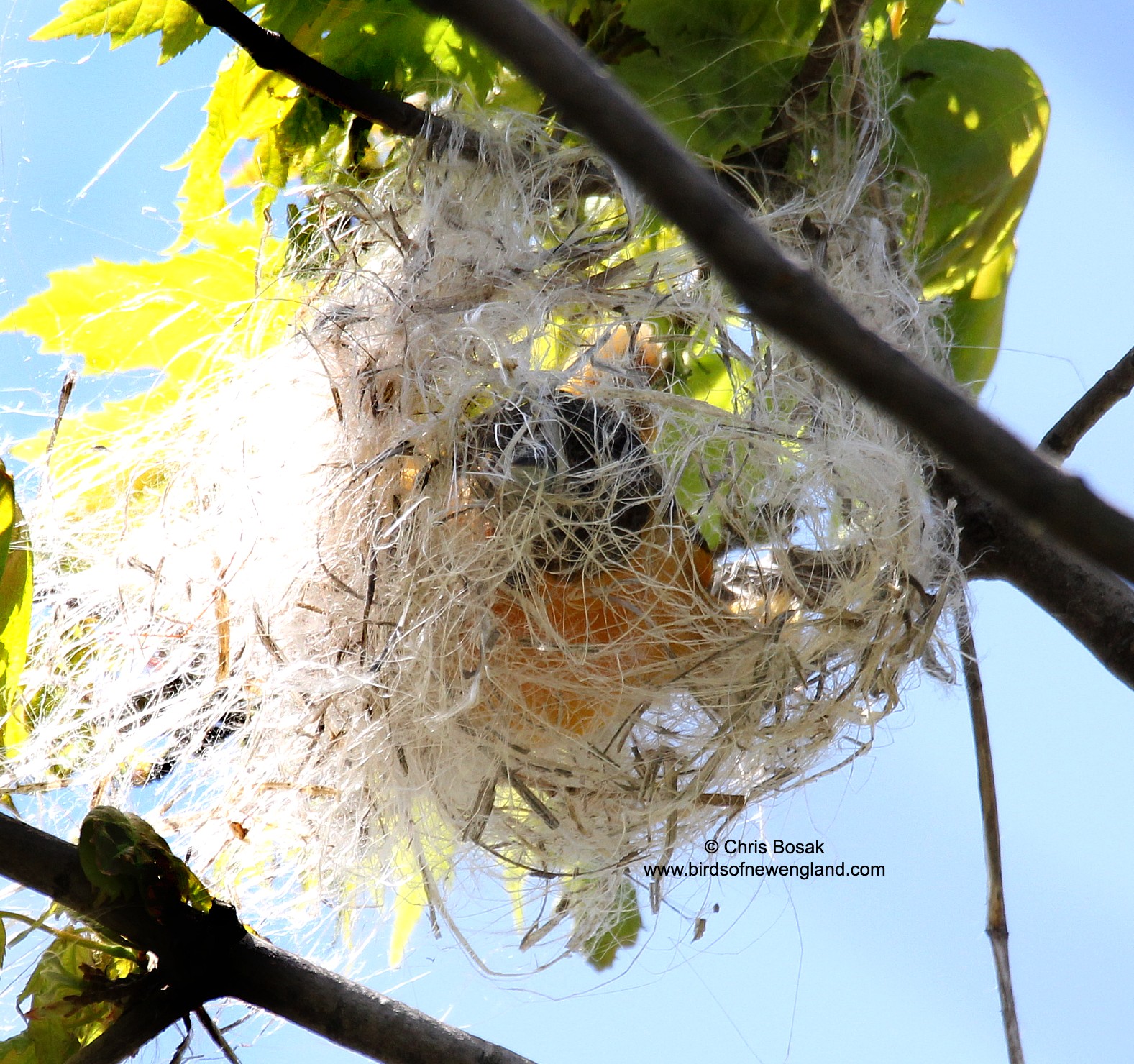
A Baltimore oriole builds a nest at Presque Isle State Park, Erie, Pa., May 2025.
Baltimore orioles have one of the most unique nests of all the songbirds in New England.
According to allaboutbirds.org, “Baltimore Orioles build remarkable, sock-like hanging nests, woven together from slender fibers. The female weaves the nest, usually 3 to 4 inches deep, with a small opening, 2 to 3 inches wide, on top and a bulging bottom chamber, 3 to 4 inches across, where her eggs will rest. She anchors her nest high in a tree, first hanging long fibers over a small branch, then poking and darting her bill in and out to tangle the hank. While no knots are deliberately tied, soon the random poking has made knots and tangles, and the female brings more fibers to extend, close, and finally line the nest. Construction materials can include grass, strips of grapevine bark, wool, and horsehair, as well as artificial fibers such as cellophane, twine, or fishing line. Females often recycle fibers from an old nest to build a new one. Males occasionally bring nesting material, but don’t help with the weaving. Building the nest takes about a week, but windy or rainy weather may push this as long as 15 days. The nest is built in three stages: first, the female weaves an outer bowl of flexible fibers to provide support. Next, springy fibers are woven into an inner bowl, which maintains the bag-like shape of the nest. Finally, she adds a soft lining of downy fibers and feathers to cushion the eggs and young.”
During my recent trip to Presque Isle State Park in Erie, Pa., I came across an oriole pair building a nest. We saw tons of orioles overall, but this was the only nest I found under construction. I was amazed at how much progress the orioles made in just one day. The first photo below was taken on a Sunday and next two photos (and the one above) were taken on a Monday. Nature is amazing.
Photo by Chris Bosak
A Baltimore oriole builds a nest at Presque Isle State Park, Erie, Pa., May 2025.Photo by Chris Bosak
A Baltimore oriole builds a nest at Presque Isle State Park, Erie, Pa., May 2025.Photo by Chris Bosak
A Baltimore oriole builds a nest at Presque Isle State Park, Erie, Pa., May 2025.
Below is the press release (without edits or opinion from me) for the 2025 U.S. State of the Birds report. Commentary will come in a later post. …
The release of the 2025 U.S. State of the Birds report was announced today (Thursday, March 13, 2025) at the 90th annual North American Wildlife and Natural Resources Conference in Louisville, Kentucky. The report, produced by a coalition of leading science and conservation organizations, reveals continued widespread declines in American bird populations across all mainland and marine habitats, with 229 species requiring urgent conservation action. The report comes five years after the landmark 2019 study that documented the loss of 3 billion birds in North America over 50 years.
Key findings from the new report show that more than one-third of U.S. bird species are of high or moderate conservation concern, including 112 Tipping Point species that have lost more than 50% of their populations in the last 50 years. That includes 42 red-alert species facing perilously low populations, such as Allen’s Hummingbird, Tricolored Blackbird, and Saltmarsh Sparrow—birds that are at risk without immediate intervention.
Photo by Chris Bosak
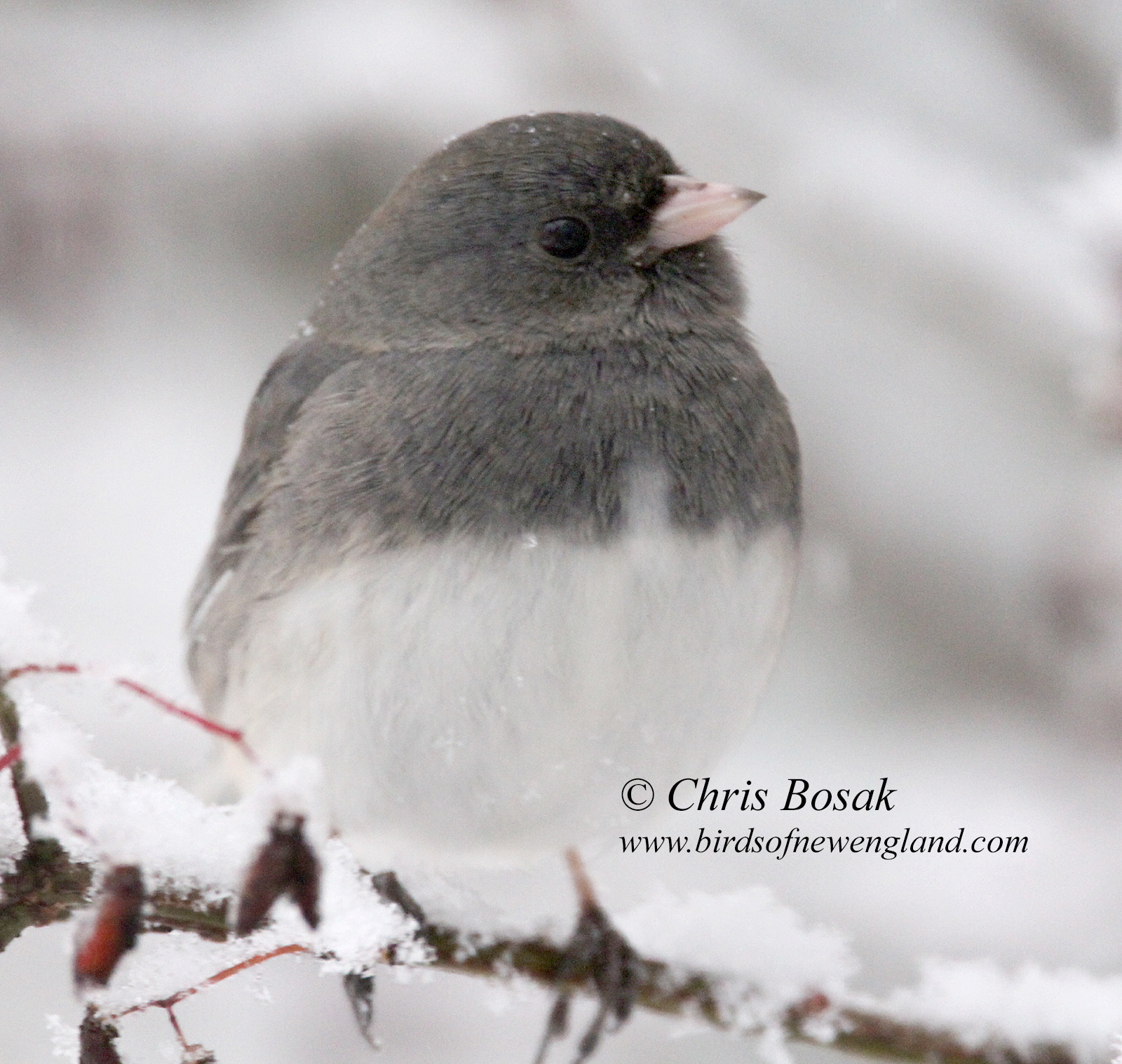
A junco perches on a branch after a snowfall in New England, January 2022.
If it weren’t for the American robin running away with the Bird of Winter title, the dark-eyed junco would be a serious contender.
The Bird of Winter is my very unofficial contest for the bird species seen in unusually high numbers during the winter. As I wrote a few weeks ago, the American robin is far and away the leader this winter, and I continue to see great numbers of robins nearly everywhere I go these days.
The dark-eyed junco, which has won the Bird of Winter title in years past, is making a strong case for honorable mention this year. I see them in my yard, at work, on my walks and all along the roadsides.
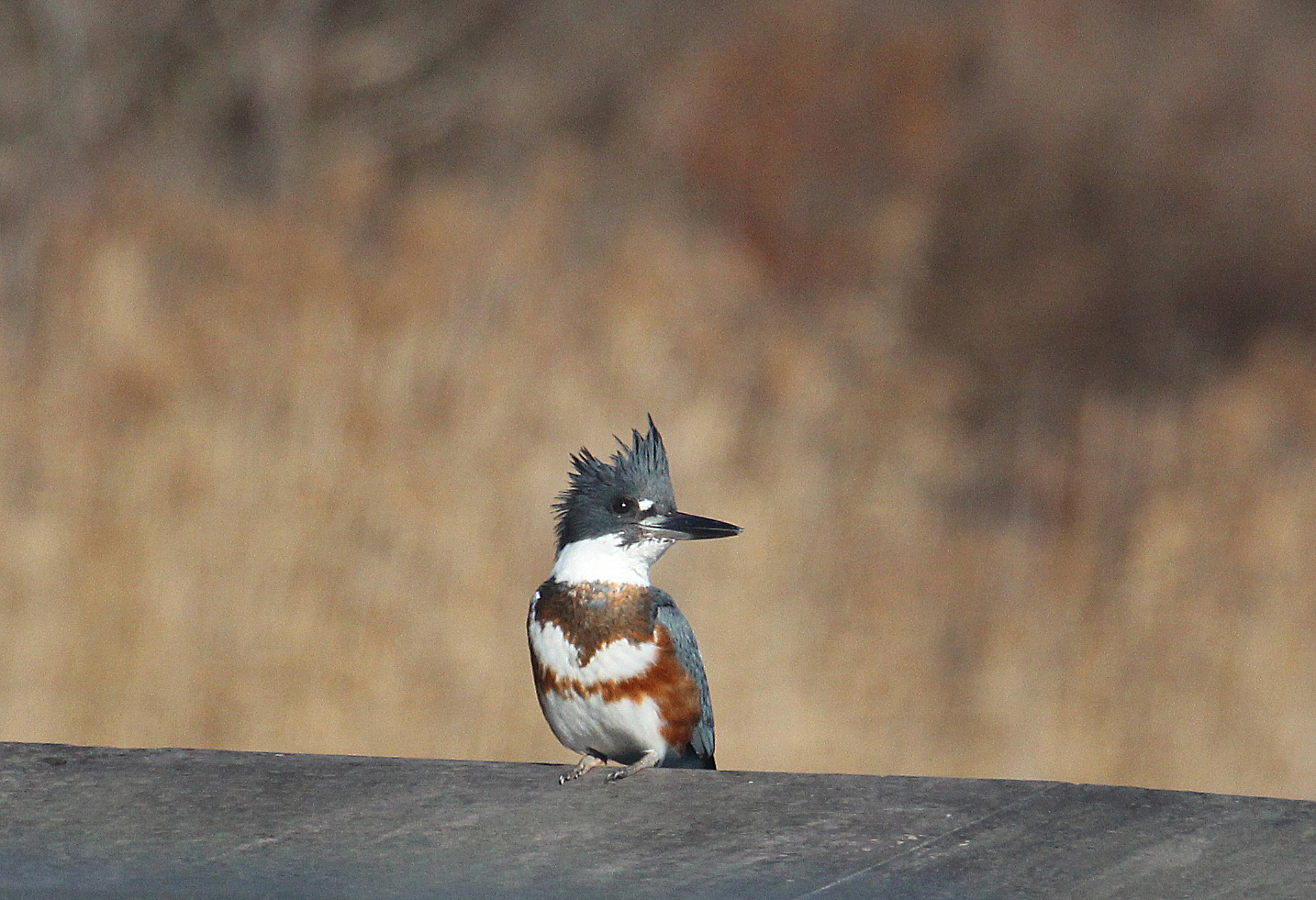
Photo by Chris Bosak – A Belted Kingfisher seen near the Maritime Aquarium at Norwalk on Sunday during the annual Christmas Bird Count.
What comes to mind when thinking of year-round birds in New England?
My guess is the first species that come to mind are songbirds such as black-capped chickadees, tufted titmice, or white-breasted nuthatches. The next birds that come to mind may be slightly larger, like woodpeckers, cardinals, blue jays, or mourning doves. Then it may eventually get to even larger birds such as red-tailed hawks, barred or great horned owls, mallards or turkey vultures.
Some people’s thoughts may veer off to less obvious year-round species such as eastern bluebirds and American robins, which many people may not realize are found in New England during the winter.
My bet would be that belted kingfisher would not immediately come to mind. It certainly would not have for me. I thought about that when I saw one the other day in a rather surprising place, and it reminded me that they are, indeed, year-round birds in New England.
I was walking to the cafeteria at work when I heard a familiar rattling call off to my right. Along the walkway, two consecutive small bridges span streams, one of which is small and often nothing more than a dried-up bed, and the other is a bit larger and flows meekly in dry times and mightily after heavy rains.
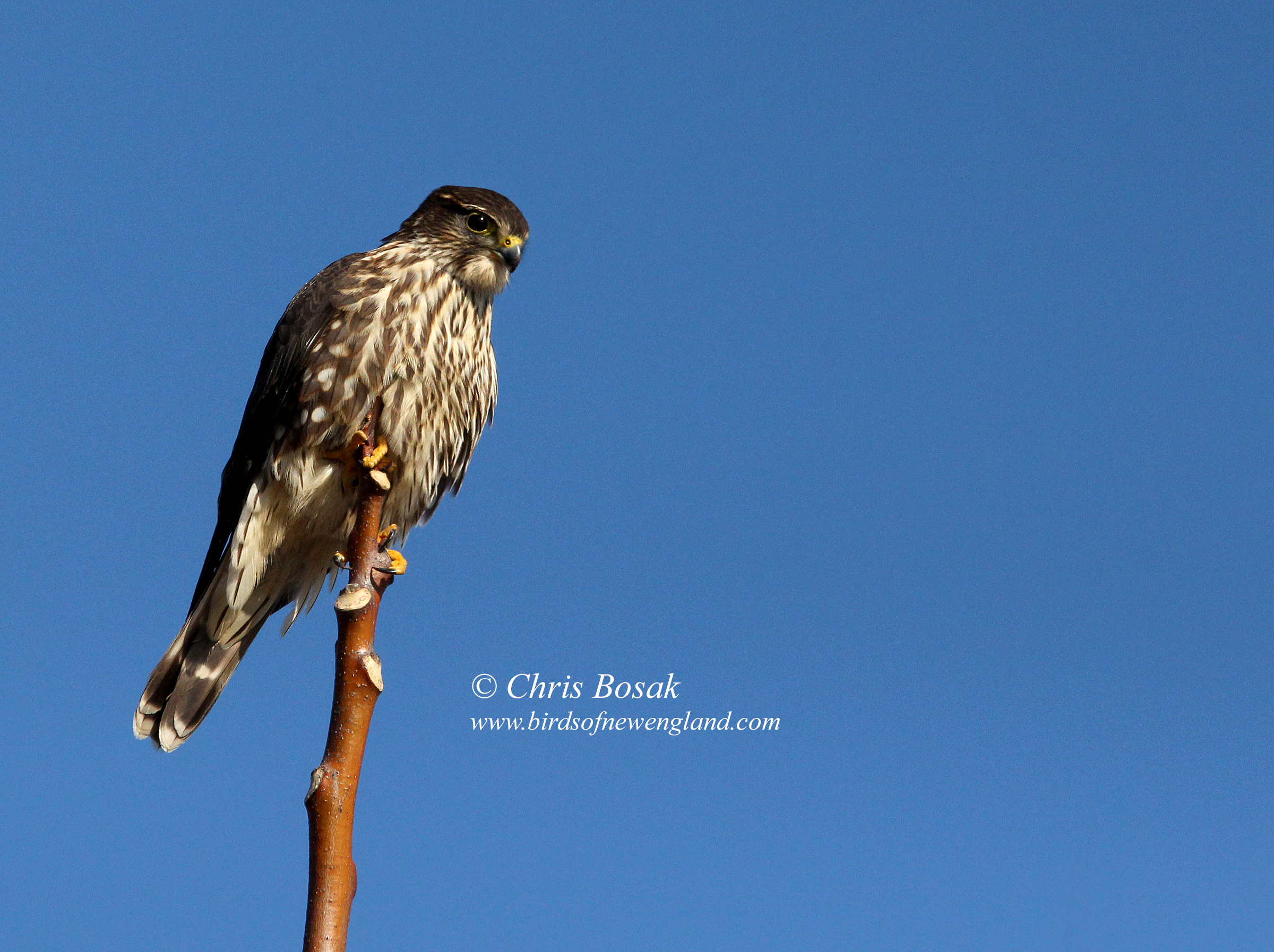
Photo by Chris Bosak – A merlin spotted in southern Connecticut during the Christmas Bird Count, Dec. 2024.
The Christmas Bird Count is typically one of my birding highlights of the year. This year was no exception.
The Christmas Bird Count is a bird census conducted by volunteers each winter to track bird populations and trends. Keene was one of the original 25 locations in 1900. Now there are well more than 2,000 counts held throughout the United States and beyond.
I did my usual area along a coastal region of southwestern Connecticut. It is a good area to cover as there is a nice variety of habitats, including Long Island Sound, marshes, freshwater ponds, wooded areas and even some patches of open field.
We started, as usual, at a park that has a river on one side and a marina on the other. Long Island Sound is a mile or so to the south, so the river and marina often get winter ducks normally associated with larger bodies of water.
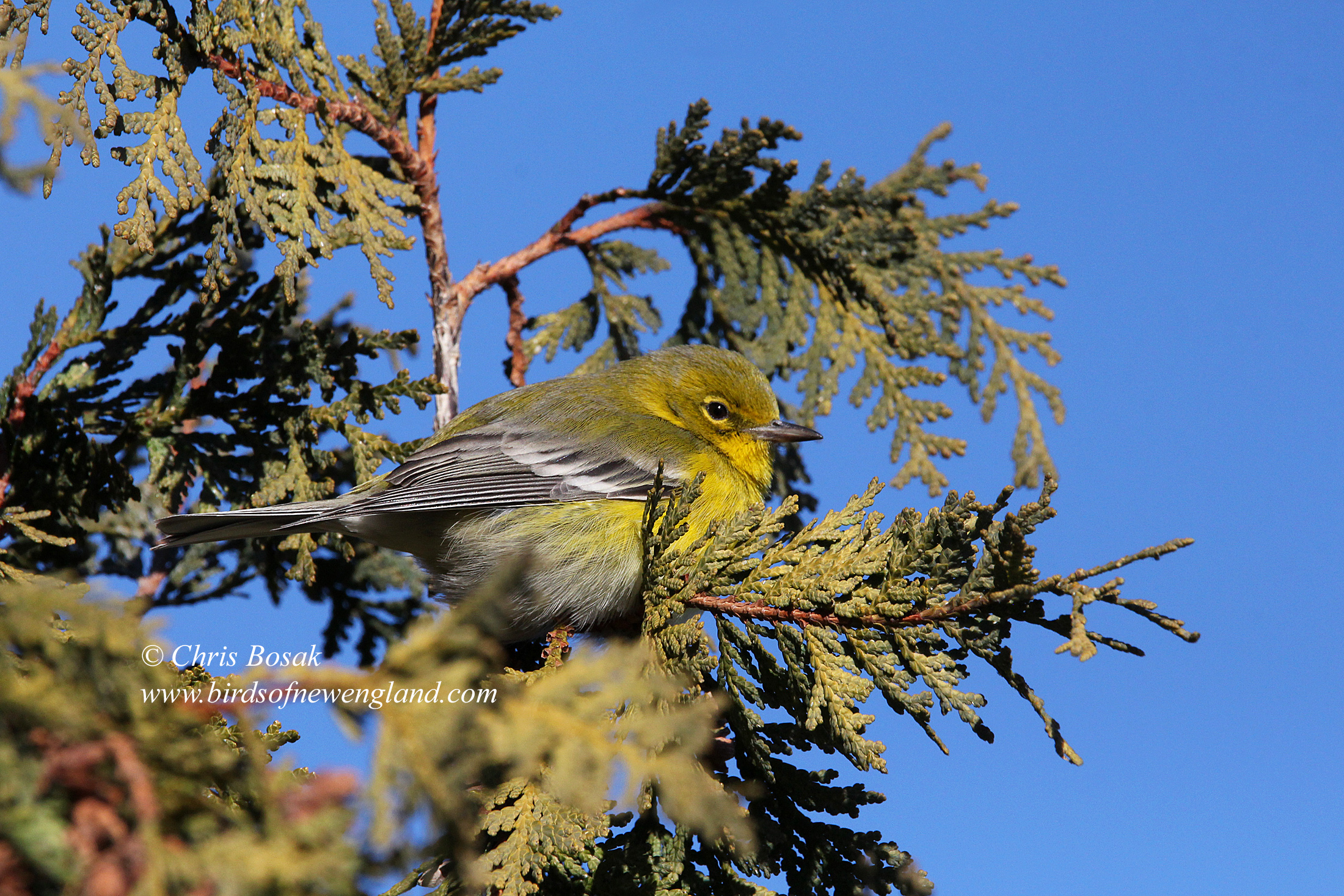
Photo by Chris Bosak – A merlin at Taylor Farm in Norwalk, CT, December 2024.Photo by Chris Bosak – A pine warbler at the esplanade in Norwalk, December 2024.
On Sunday (December 22, 2024), I participated, as usual, in the Christmas Bird Count and covered my usual area of coastal Norwalk (SW Connecticut). Instead of my usual birding partner Frank, I covered the area with Adam and Jo. It was 13 degrees when we started and didn’t seem to get much warmer as the day went on. In fact, the wind picked up and made it seem even colder. The things we do for the birds.
We had a successful day with plenty of highlights, including bald eagle, peregrine falcon, merlin, pipit, pine warbler, yellow-rumped warblerf and both types of kinglet.
Mallards sit on a branch overhanging a pond in New England.
For just a moment, I was in their world.
As I stood there I could see nothing but branches, sticks and stubborn brown leaves that refused to fall off the low trees. Then I crouched like a baseball catcher and there they were: a flock of mallards taking a midday break in the tangled trees growing out of a small pond.
Normally mallards would not make for a memorable birdwatching outing, but this time was different.
A fairly busy road was no more than 50 yards away and my car was about 50 feet away, but I felt as if I were visiting the ducks’ world. The area was thickly wooded and a dark canopy of towering branches hung over the pond’s edge, adding to the feeling of seclusion. It was as if the world was reduced to the woods, the mallards and me.
It was a neat sensation, one that I’ve experience only a handful of times before — usually in extreme northern New Hampshire.




 Birds of New England.com