Photo by Chris Bosak
A ruby-throated hummingbird visits a flower basket in New England, summer 2025.
Other than a few sightings while on walks at local parks, I hadn’t seen a single hummingbird all spring and most of the summer.
It wasn’t for lack of trying. I put out the same feeders and filled them with the same liquid I always do: four parts water, one part sugar. They never came. Not in April or May. Not in June or July.
August was headed toward a shutout as well until one day late in the month, it all changed. And it changed in a big way. Not only did a few hummingbirds show up, but they were around constantly. They visited the feeder one at a time, of course, because god forbid they’d actually share a feeder with four ports.
Photo by Chris Bosak
Hummingbirds are migrating now and will be throughout the rest of the month.
The hummingbird season got off to a slow start for me this year.
I didn’t see a single hummingbird at my feeder in April or May. I saw a few in the backyard in June, but they zipped by my feeding station like it wasn’t even there. That contrasts with last year when a few hummingbirds visited daily from spring through fall.
This year’s fortunes have changed, thankfully, as hummingbirds became a regular occurrence once August hit. I believe the visits are coming from a combination of a hummingbird family that nested nearby and some southward migrants.
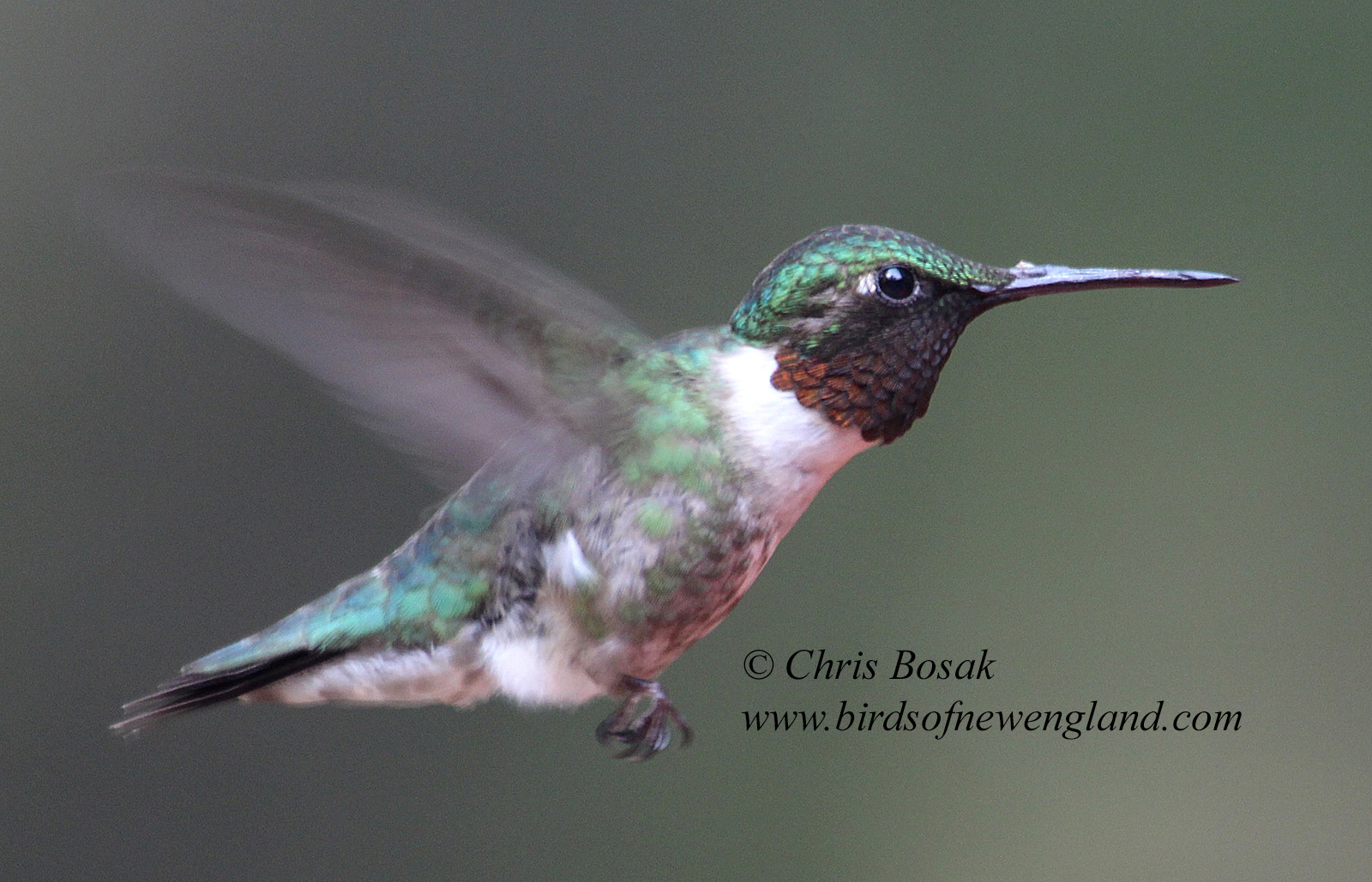
Ruby-throated hummingbirds, the only hummingbird species that regularly occurs in the eastern U.S., start their southward migration out of New England in August (some as early as late July.) Just like adult males were the first to arrive in the spring, they are the first to leave on the southward journey.
Plenty of adult male hummingbirds remain in New England. My most frequent visitor over the last few weeks has been a male. They will mostly be gone by the end of the month. Females and first-year birds will mostly be gone by the middle or end of September. Hummingbird feeders can remain up into October as the stragglers heading out of New England will need to fuel up too.
Hummingbirds need plenty of fuel as these tiny birds make their way to Central America for the winter. The arduous nonstop flight across the Gulf of Mexico takes a lot out of the birds. Whether a bird’s route takes it directly across the gulf or a more coastal route, it’s still a long, perilous journey. Their typical weight is just over three grams. They bulk up to about six grams for the journey and are between two and three grams when they get to the other side of the gulf.
Yesterday, I posted a video of a male ruby-throated hummingbird using a bush by the window as a shelter from the rain. Here are a few shots of the little beauty. Here’s the video in case you missed it.
Well, if he’s going to sit right outside my window on a rainy day then I’m going to make a YouTube video of him. First hummingbird I’ve seen this year (May 4, 2022, in Bethel, Conn.)
Here is the latest For the Birds article. It was published a few weeks ago in newspapers, but is still relevant as September comes to an end.
Photo by Chris Bosak
Hummingbirds are migrating now and will be throughout the rest of the month.
When should I bring in my hummingbird feeders? It’s a common question and may be answered the same way as so many other questions may be answered: It depends.
The answer depends on your tolerance for changing the sugar water in the feeders and your patience for watching a feeder that may not receive any visitors. Hummingbirds started to migrate a few weeks ago and some have gone south already.
With migration under way, now is definitely not the time to bring the feeders in. Hummingbirds need to pretty much double their weight to make their arduous migration, particularly when they reach the Gulf of Mexico and fly the 500 miles without rest.
Sure, there are plenty of natural food sources for hummingbirds this time of year, but an easy meal at a feeder now and then gives the tiny birds a bit of a break. Patches of jewelweed are another favorite of hummingbirds and they are still blooming. Other than feeders, I think I’ve seen more hummingbirds at jewelweed (touch-me-not) patches than any other venue.
Photo by Chris Bosak
A ruby-throated hummingbird hovers around salvia blooms in New England, September 2020.
The hummingbirds that haven’t flown south yet will likely do so soon. Here are a few shots of “my” hummingbirds that are still hanging around.
Photo by Chris Bosak
A ruby-throated hummingbird hovers around salvia blooms in New England, September 2020.Photo by Chris Bosak
A ruby-throated hummingbird hovers around salvia blooms in New England, September 2020.
Photo by Chris Bosak A ruby-throated hummingbird perches on a rope in New England, May 2020. Merganser Lake.
For the past several weeks I’ve posted a Birds to Brighten Your Day photo, featuring my best shot from the day before. Now that it’s Memorial Day Weekend, states are slowly opening and migration is winding down, it’s a good time to move on from Birds to Brighten Your Day. I hope your days are indeed brightening and you keep on checking out BirdsofNewEngland.com. I still hope to post something every day. It could be my best shot from the day before, or even that day, or one of the many shots I didn’t use over the past several weeks. Of course, I’ll continue to post my latest For the Birds nature column too.
I’ll start off with a ruby-throated hummingbird. I’m not sure how they missed being featured on Birds to Brighten Your Day because they are always a fan favorite. “My” hummingbirds arrived on May 1 (or was it May 2?) and have been buzzing around ever since. For years, I never had luck attracting hummingbirds. Now that I’m several years into getting them I consider them an integral part of summer.
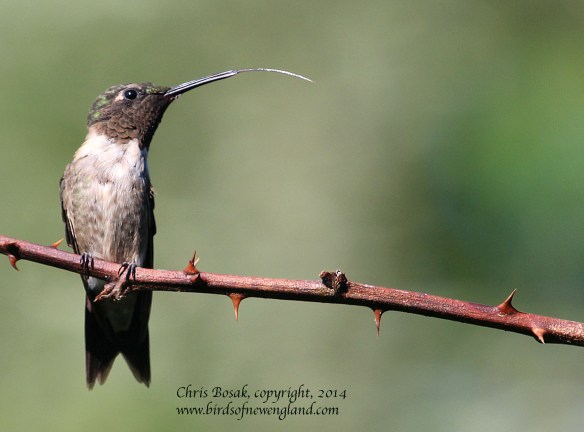
Photo by Chris Bosak A ruby-throated hummingbird perches on a thorny branch.
I’ll be venturing out of New England for a few days and don’t want the birds here to think I forgot about them so I’m instituting my own Hummingbird Week. Each day this week I’ll post a new or old photo of a ruby-throated hummingbird, the only hummer that occurs regularly in New England. There is no such thing as too many hummingbird photos, after all. Each day will also include a joke or fun fact about hummingbirds. This post will wrap up Birds of New England’s Hummingbird Week.
Fun Fact: Ruby-throated hummingbirds spend their winters in Central America or southern Mexico.
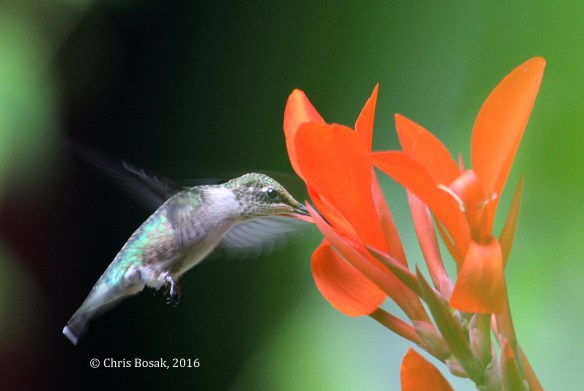
Photo by Chris Bosak
A Ruby-throated Hummingbird sips nectar from Canna flower in Danbury, Conn., summer 2016.
I’ll be venturing out of New England for a few days and don’t want the birds here to think I forgot about them so I’m instituting my own Hummingbird Week. Each day this week I’ll post a new or old photo of a ruby-throated hummingbird, the only hummer that occurs regularly in New England. There is no such thing as too many hummingbird photos, after all. Each day will also include a joke or fun fact about hummingbirds.
Fun Fact: On average, hummingbirds beat their wings about 50 times per second.
Photo by Chris Bosak A Ruby-throated Hummingbird hovers near a feeder at the Errol (N.H.) Motel in the summer of 2015.
I’ll be venturing out of New England for a few days and don’t want the birds here to think I forgot about them so I’m instituting my own Hummingbird Week. Each day this week I’ll post a new or old photo of a ruby-throated hummingbird, the only hummer that occurs regularly in New England. There is no such thing as too many hummingbird photos, after all. Each day will also include a joke or fun fact about hummingbirds. This is one of my favorites because of its patriotic feel.
Fun Fact: There are more than 300 species of hummingbirds, all occurring in the Western Hemisphere. About 12 species may be found in the U.S. with the ruby-throated hummingbird the only one regularly occurring east of the Mississippi River.




 Birds of New England.com