My experience with the coyote the other day got me curious about the species. As I mentioned last week, coyotes are fairly common throughout all of New England these days, but I’ve seen them on only a few occasions.
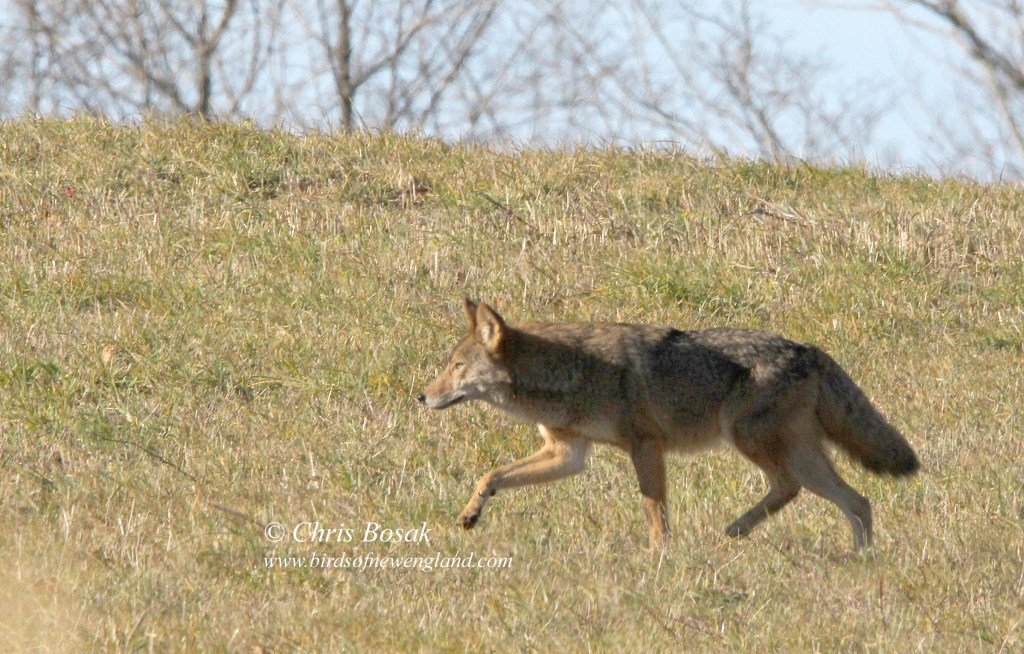
The recent sighting was my closest encounter with a coyote to date and the only one so far that afforded a photo opp. As is often the case, once I get a decent photo of a species, I do a deep dive into its life history.
Here are some interesting facts (at least I found them interesting) about the eastern coyote, gleaned from several sources on the internet.
Eastern coyotes are much larger than western coyotes, up to twice the size, according to the New Hampshire Fish and Game Department, and range in color from “silvery gray to grizzled, brownish red.”
Based on the one I saw the other week, I am not surprised to learn that eastern coyotes are bigger than their western relatives. “My” coyote was big and sturdy looking with a rich, thick coat and bushy tail. It was the opposite of the sickly, scraggly-looking animal that many may imagine when picturing a coyote.
Eastern coyotes have a genetic mix of coyote, domestic dog and wolf, hence their larger size.
“Recent genetic research has attributed the eastern coyote’s larger size and unique behavioral characteristics to interbreeding with Eastern Canadian wolves,” NH Fish and Game writes on its website.
Coyotes are a relatively new species to the region. Although it is unclear whether they are historically native to the region, NH Fish and Game states that there were no coyotes present in New Hampshire in the late 1800s, and the first verified account was in 1944. They gradually spread throughout the state and are now found in every county.
I can recall two incidents, one in Errol near Umbagog Lake and one in Pittsburg near the Canadian border, where I was alone in the woods and heard a pack of coyotes howling and yipping back and forth. Both incidents were in the middle of the day. The frantic and loud nature of the communication was simultaneously unsettling and exhilarating. I never caught a glimpse of the pack in either case.
“Coyotes are capable of many distinct vocalizations − the yipping of youngsters, barks to indicate a threat, long howls used to bring pack members together, and group yip-howls issued when pack members reunite,” NH Fish and Game writes.
Coyotes, contrary to what some believe, do not howl or otherwise vocalize after making a kill, as that could draw the attention of other predators.
“The last thing coyotes would want to do is attract competing coyotes or other predators to their hard-earned kill or to announce their presence to any nearby prey before a hunt. Their howls, yips, and barks likely have more to do with cementing family bonds and defending/establishing territory,” writes the National Park Service on its website.
Coyotes have a varied diet that includes rodents, squirrels, rabbits and hares, insects, fruit, and even carrion and garbage. They have also been known to take house cats and small dogs. In other words, they have adapted well to living among people.
“As for your safety, coyotes pose little risk to people,” NH Fish and Game writes.
Controlling coyotes has proven to be a difficult task, as they are smart, elusive and produce a lot of offspring. Hunting season is open all year for shooting in New Hampshire, and there is also a five-month trapping season. It is illegal to use poison as a means of control.
“Few animal species have been persecuted and hunted down with as much vigor and vitriol as the coyote in the United States,” the National Park Service writes.
I’ve never lost a pet to a coyote, and I don’t have a farm to protect, so I like the idea of coyotes living among us. The resourceful predators add mystery, verve and diversity to New England’s wild landscape.
 Birds of New England.com
Good for you Chris sticking up for these poor animals who are much aligned! In my local area cape cod, I constantly hear on social media ” I saw a coyote at 8 Am! “Saw a Coyote here” or there, so what? They are living among us and consider them relatives of your dog, (which everyone here has), and let them be.
LikeLiked by 1 person