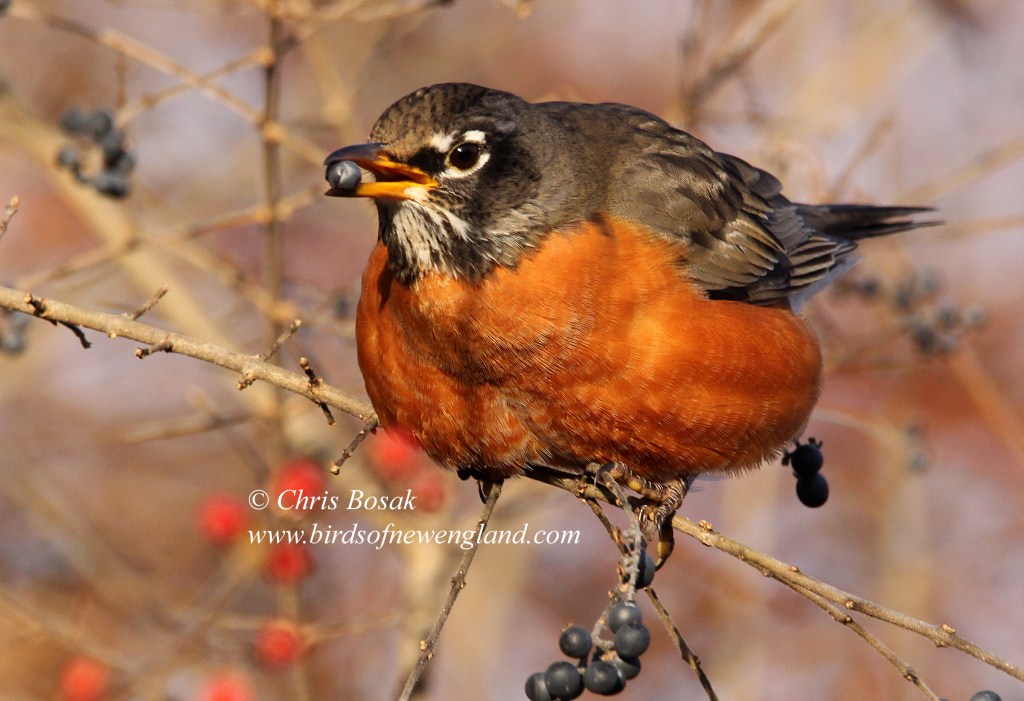
The American robin has secured a spot as the frontrunner for the Bird of the Winter.
I usually announce my Bird of the Winter much later than the second week of January, but I could tell already that the robin is likely to be the winner. The Bird of the Winter recognition, of course, is a very unofficial designation made by yours truly. It goes to the bird, as the name suggests, that is seen in surprisingly high numbers throughout the winter.
Past winters have included snowy owl, barred owl, dark-eyed junco, and eastern bluebird. This year the robin is running away with it.
It started on Christmas Day when I looked out of a window into the side yard and noticed a lot of activity in an eastern cedar tree. The activity, as you probably have guessed, was robins going in and out of the branches, gobbling up the berries in the tree. The robins came and went for hours upon end, and, all told, there had to be over 100 of them.
I took a video with my iPhone and posted the action on my website, birdsofnewengland.com. Because there were so many birds and it was an evergreen tree, it reminded me of a Christmas tree with live ornaments. I know that sounds a little corny, but imagine an evergreen tree covered in robins eating berries.
The next robin experience came a week or so later on my usual morning walk at a nearby park. I had the place to myself as it was about 13 degrees with a moderate wind making it seem even colder. I figured if the birds can handle the New England chill, then so could I.
I reached the same trail where I had previously seen an eastern coyote, and, at first, there was nothing to be seen or heard. A few hundred yards later, the bushes were bustling on both sides of me. There were what seemed like hundreds of birds eating border privet berries, and the bushes were actually shaking from the activity.
The vast majority of the birds were robins with a few cedar waxwings mixed in here and there.
The bushes shook continuously for a stretch of at least 30 yards on either side. Then, suddenly, there was nothing again.
Later in the walk, I did come across a tree with a few robins in it but nothing like the wave of activity I had witnessed previously. Typically, I take a different route back to the car to explore some different habitats, but I returned the same way to see if the robins were still around. They were not, and in fact, there was pretty much nothing to see along the entirety of the trail.
It made me think, just as the coyote sighting did a few weeks ago, that birding is very much about timing and luck. I don’t know how long the robins had been in that spot before I walked by that morning, and I don’t know how long they stayed after I left them, but I was lucky to catch them at that location at the precise moment of their feeding frenzy.
It took at least a little skill as well, I suppose, as an untrained eye (or a disinterested one) may not have noticed the tremendous numbers of robins on either side of the trail. Yes, the bushes were moving with the activity, but it’s not like the robins were sitting in the middle of the trail in plain view.
Not surprisingly, I stopped to take a few photos. Photographing birds eating berries is somewhat of an obsession of mine. For years, I would see photos from other nature photographers of birds eating berries, and it became a goal of mine to capture such a moment. It took seemingly forever, but I did eventually find myself at the right place at the right time to photograph a bird eating berries.
Since that initial time, I have had several opportunities to photograph different species of birds eating many types of berries or other fruit, such as crab apples. The species include robins and cedar waxwings, of course, as well as yellow-rumped warblers, palm warblers, monk parakeets, white-throated and sparrows, scarlet tanagers, and yellow-bellied sapsuckers.
Whether they are common birds like robins or less common birds such as scarlet tanagers, I still get a thrill photographing birds eating berries. I often see trees dripping with ripe berries or crab apples in the fall or winter and wish there were birds eating them. Trails where I discover those trees and bushes often become part of my walking routine. You just never know when luck will strike.
 Birds of New England.com