Photo by Chris Bosak — Eastern bluebird at Huntington State Park, February 2024.
Before this recent string of sunny days, it seemed like it had been weeks since the sun had shown itself. It was gray day after gray day with some of the days made even more gloomy with cold rain. On a walk during one of those gray days, I spotted a flock of bluebirds darting from tree to tree and from tall grass to tall grass in an adjacent field. While most of the flock kept their distance, this drab adult bluebird didin’t mind my presence and let me grab a few portraits.
Photo by Chris Bosak — Eastern bluebird at Huntington State Park, February 2024.Photo by Chris Bosak — Eastern bluebird at Huntington State Park, February 2024.
Photo by Chris Bosak — A yellow-bellied sapsucker taps on a tree in New England, January 2024.
The woods seem to be full of surprises this winter.
Last week I wrote about the gray catbird I have been seeing on my walks this winter. On a walk last week, which was done when it was about 15 degrees outside, I had four species that were marked as “unusual” by eBird, a maassive database of bird sightings. That doesn’t necessarily mean that the birds are rare, but rather they are not commonly seen in New England during the winter. The species were: catbird, hermit thrush, purple finch and yellow-bellied sapsucker.
The catbird, thrush and finch were all species I had seen on previous walks this winter. In fact, it seems as though I typically find a hermit thrush or two each winter in New England. Like the catbird, hermit thrushes typically migrate south of New England before winter, but some remain in our region, opting to tolerate the cold weather rather than take on the risks of migration.
Photo by Chris Bosak – A gray catbird at Huntington State Park in Connecticut during a January 2024 snowfall.
Some things just don’t seem to go together. Peanut butter and tuna fish. Flip-flops on a treadmill. And hearing a catbird when it is 25 degrees and snowing during a New England winter.
I mentioned in last week’s column that I had seen a gray catbird during a recent bird walk. I returned to the same spot several days later. This time, snow was falling all around, painting the beautiful landscape in a covering of pristine white.
I got lucky with this photo. I assumed the birds did not like the dark berries in a small tree in the side yard because winter was moving along and nothing was touching them. As I sat at my desk working the other day, I noticed a flurry of activity out of the corner of my eye. It was a flock of a dozen or more robins descending upon the tree at once. I sneaked onto the covered porch by the tree and hoped the robins wouldn’t take off at the disruption. Most of the photos did not turn out well because of distracting branches in the way, but this one turned out pretty well.
I’ve had pretty good luck with birds-eating-berries photos this past week. I’ll post more photos soon. Thanks for checking out birdsofnewengland.com
My morning stroll at work one day last week was cut short because the field I usually walk through had completely disappeared. Well, it didn’t disappear, of course, but it was under several feet of water. There was no grass to be seen, only a huge pool of water reflecting the gloomy sky above.
The adjacent river, which is really just a trickling creek most of the time, was now a raging, angry force that had spilled over its banks and flooded the land on either side. Heavy rains the previous night, combined with the few inches of snow that had been on the ground, turned a usually serene setting into a foreboding, aquatic landscape.
What struck me most was how different everything looked. Flooding obviously can drastically change a landscape in a matter of moments, but it can be quite jarring when you are used to seeing something every day and suddenly it looks like a different world.
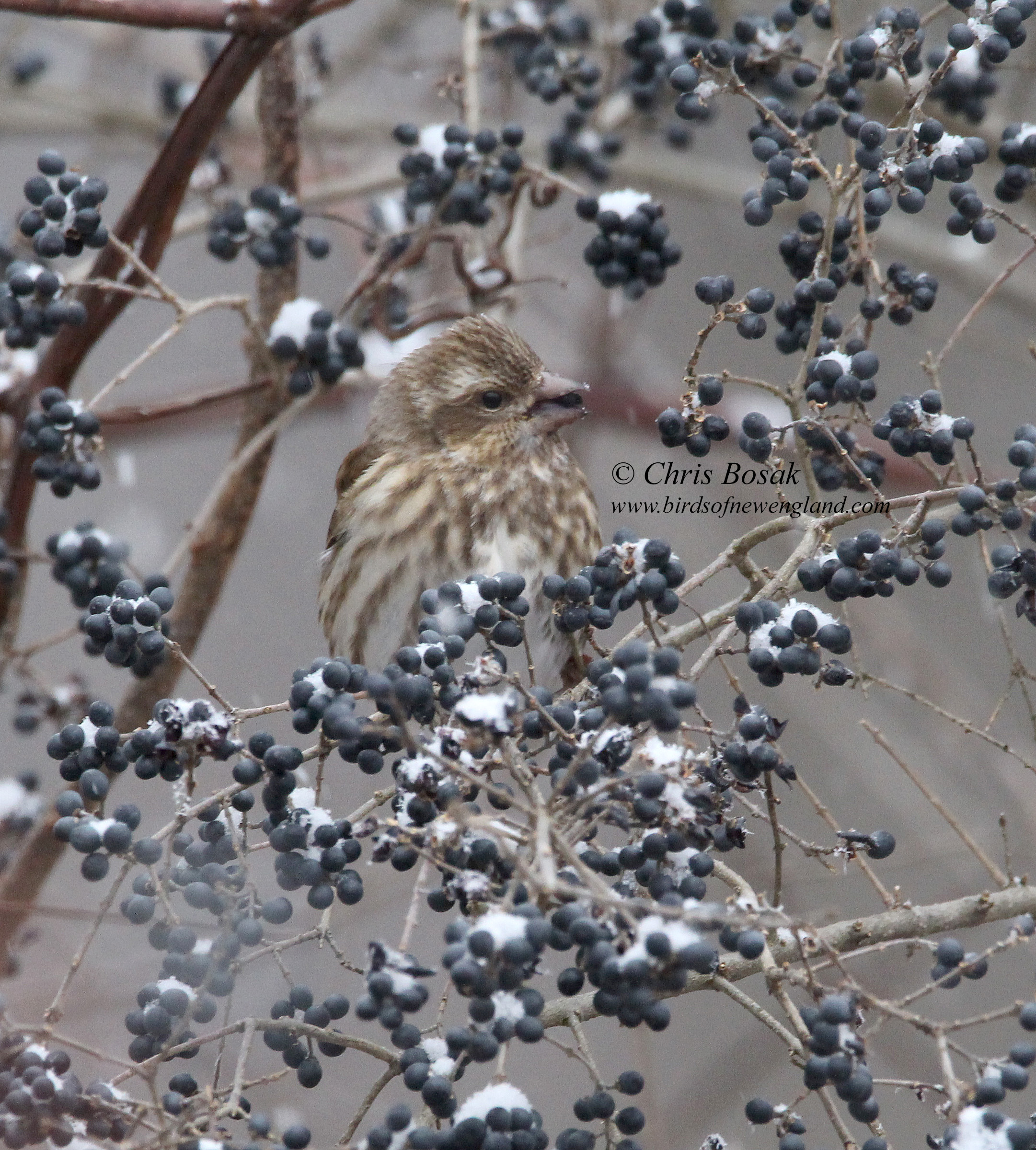
As promised, here are a few photos of the female purple finch, as seen and photographed in Connecticut during Tuesday’s snowfall. She is eating berries from a silky dogwood, I believe. Females lack the bright colors of the male but are spectacularly designed. They are slightly larger and more decorated than female house finches.
If you missed yesterday’s male purple finch, click here.
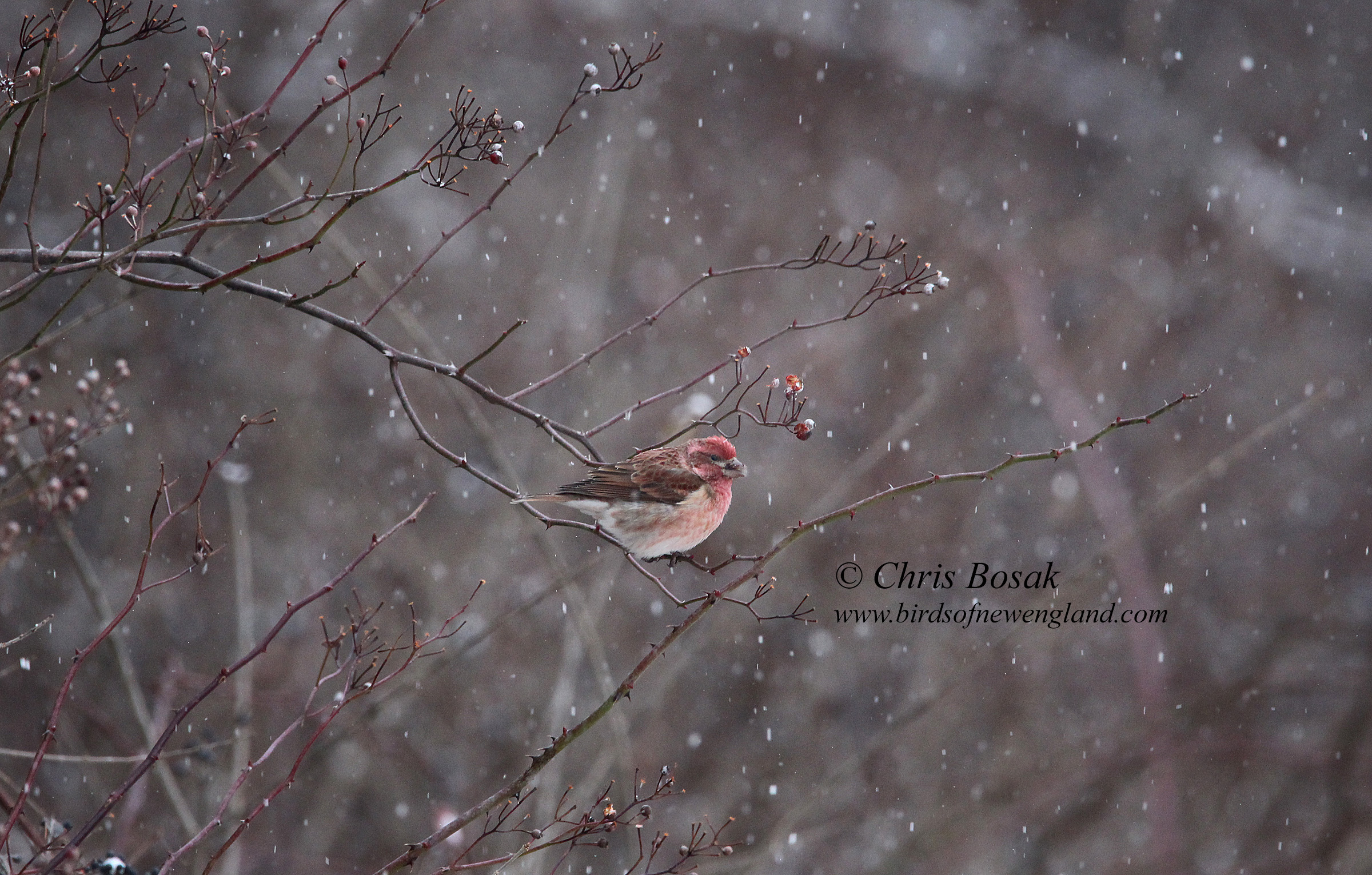
Photo by Chris Bosak – Male purple finch in New England, January 2024.
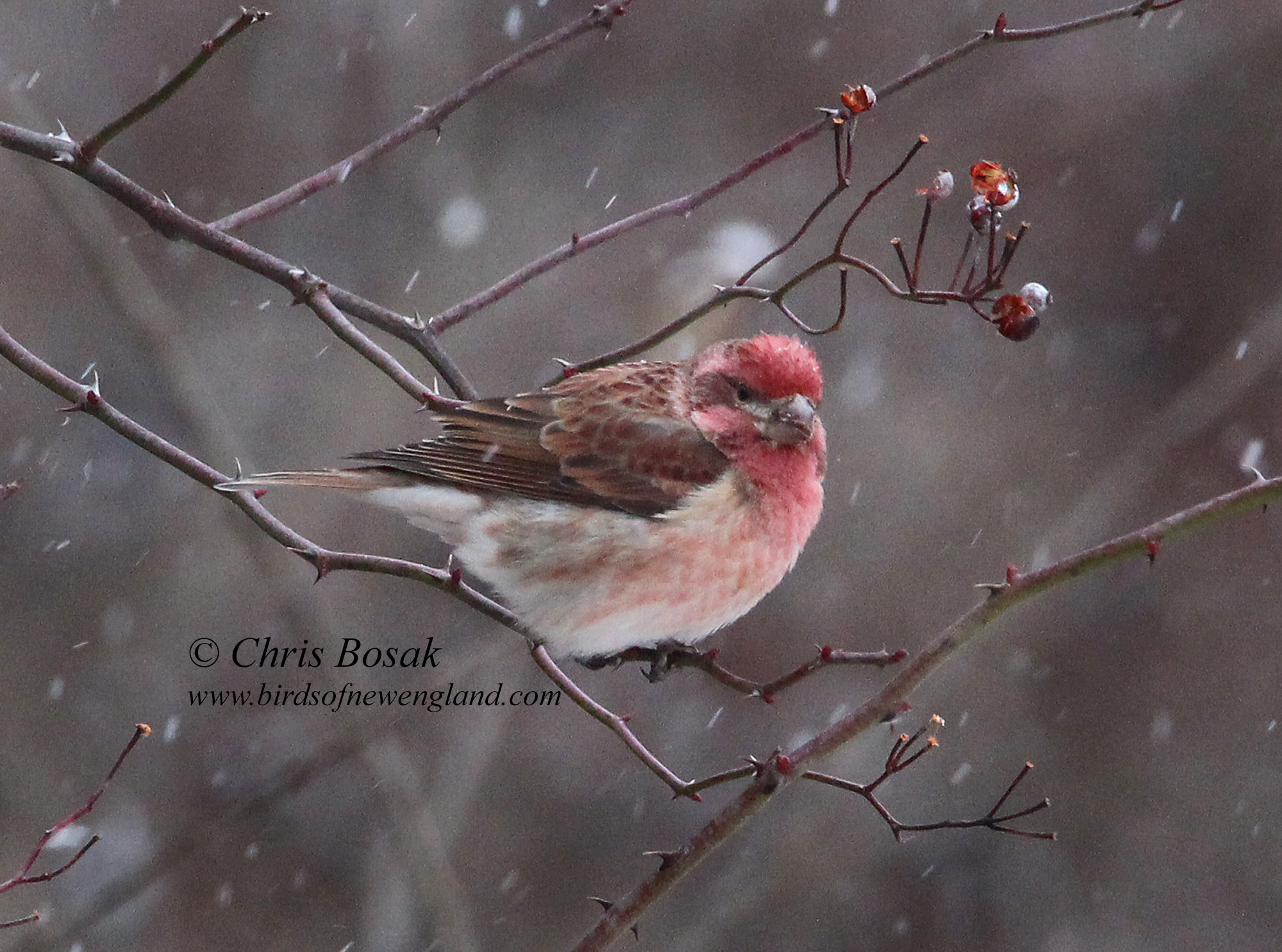
Here are a few shots of a purple finch I found on this morning’s walk through the snow. Male purple finches are more rosy in color and overall more colorful (and slightly larger) than the more common house finch. Plus, purple finches are way cooler.
Tomorrow, the female purple finch.
Photo by Chris Bosak – Male purple finch in New England, January 2024.
Photo by Chris Bosak
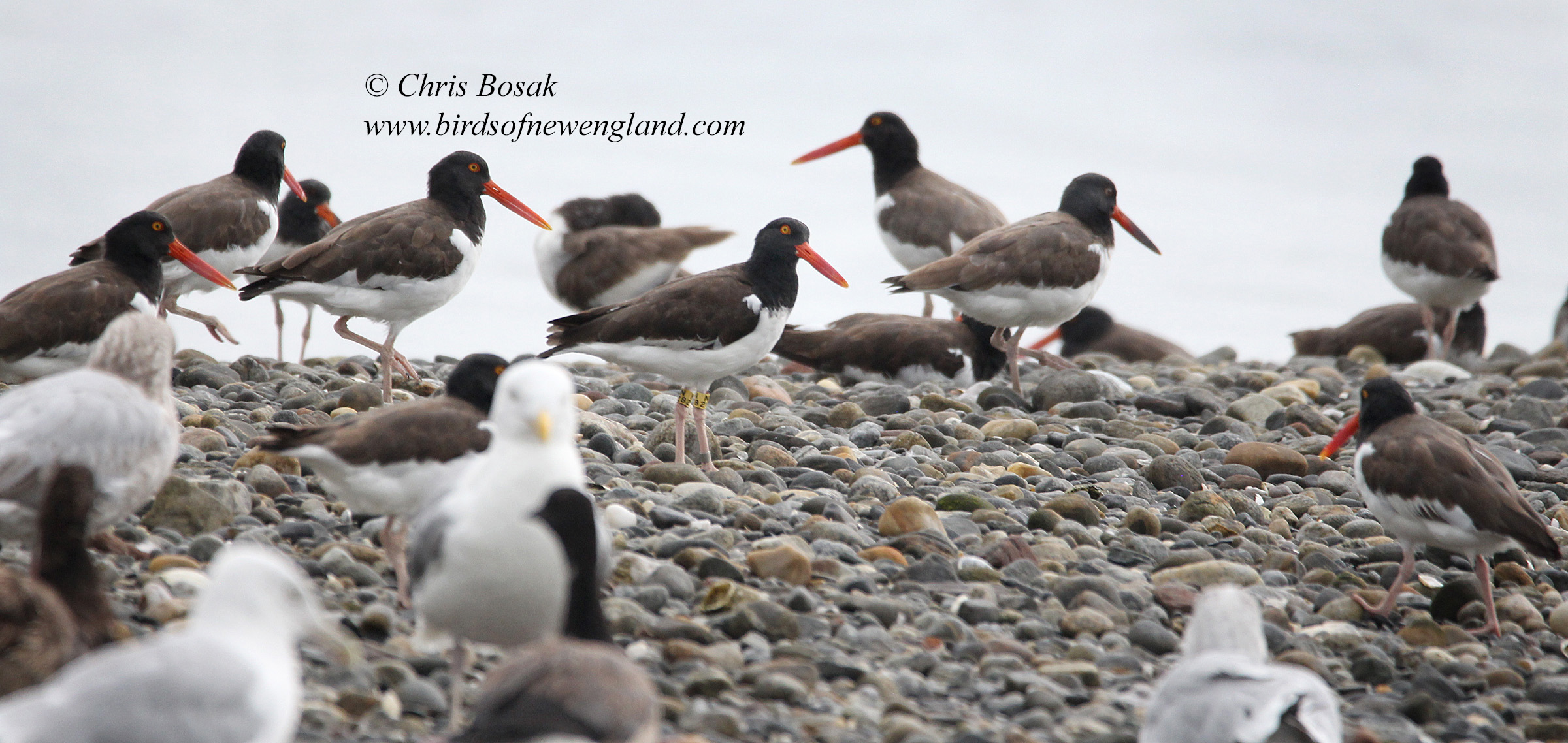
American oystercatchers at Milford Point, fall 2023.
Before it gets too far into the new year, I want to take a look back at my birding highlights from 2023. It was a good year all around with birds small and large. Thanks to you all for being a part of another year of sharing birding adventures.
Here is my annual top 10 list of birding highlights from the past year.
10. The Christmas Bird Count never fails to be a highlight of the year. Whether the birds are plentiful or not, it’s always a good day spent in the field with friends. The weather was cold, gray and damp, and the birds were fairly scarce, but our spirits remained high.
9. Along the same lines, I contributed to eBird more in 2023 than in years past. Checklists from eBird are entered into a massive database that scientists use to track bird populations. Millions of lists are submitted, so my contributions are pretty insignificant, but it all adds up. Anything to help the future of birds. Anyone can participate, regardless of skill level. Sign up through the eBird app or website.
8. I watched a flock of mallards at a park in Baltimore while I was in the city visiting my son at school. It was early in the fall duck migration, but something told me to look carefully at the dozens or hundreds of mallards that dominated the pond. Sure enough, three or four ring-necked ducks swam and rested among the mallards. Not an earth-shattering sighting, but I love my ducks and always love seeing them.
Mallards sit on a branch overhanging a pond in New England.
For just a moment, I was in their world.
As I stood there I could see nothing but branches, sticks and stubborn brown leaves that refused to fall off the low trees. Then I crouched like a baseball catcher and there they were: a flock of mallards taking a midday break in the tangled trees growing out of a small pond.
Normally mallards would not make for a memorable birdwatching outing, but this time was different.
A fairly busy road was no more than 50 yards away and my car was about 50 feet away, but I felt as if I were visiting the ducks’ world. The area was thickly wooded and a dark canopy of towering branches hung over the pond’s edge, adding to the feeling of seclusion. It was as if the world was reduced to the woods, the mallards and me.
It was a neat sensation, one that I’ve experience only a handful of times before — usually in extreme northern New Hampshire.



 Birds of New England.com