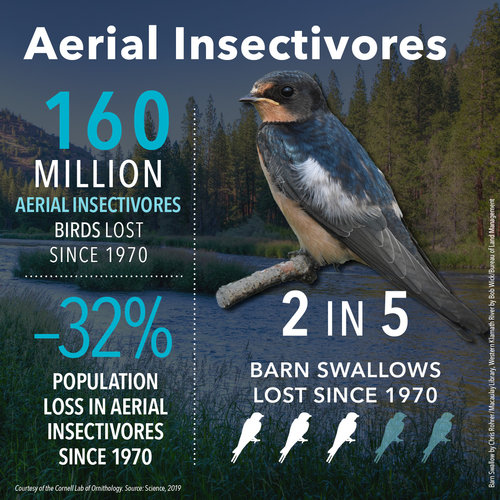
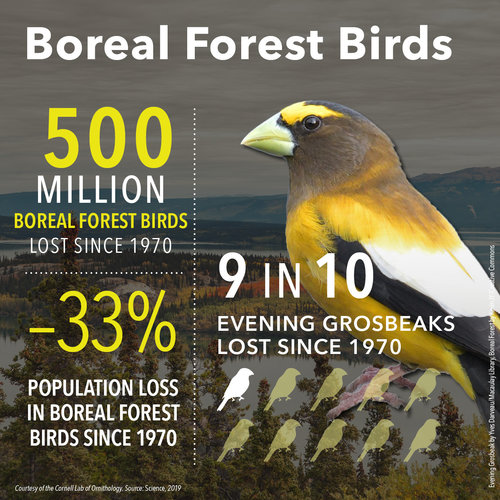
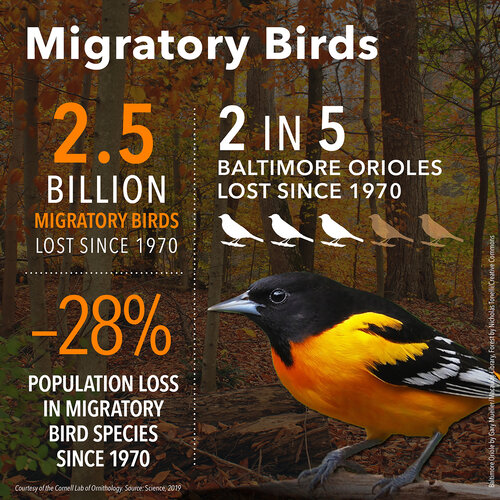
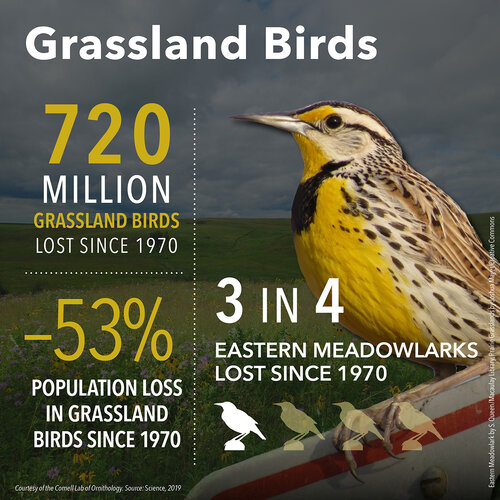
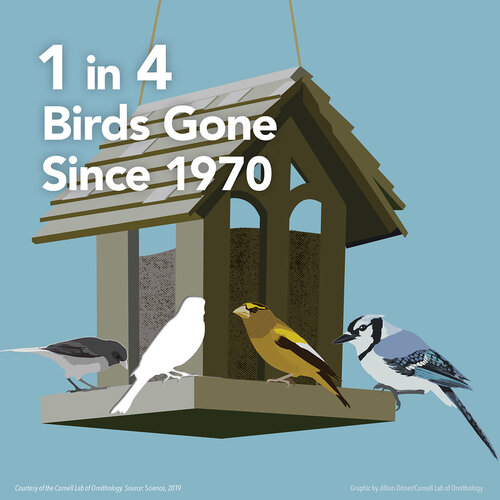
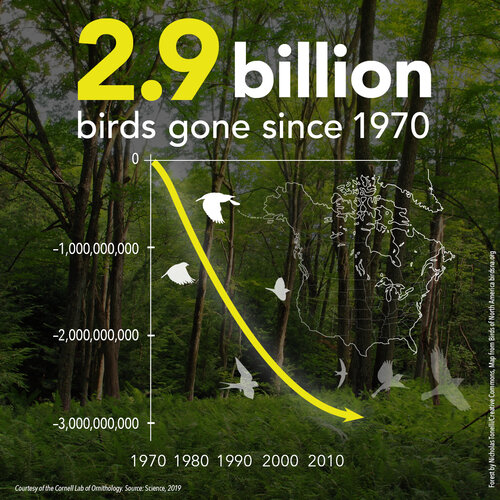
Here are some more graphics from the recently released bird population study that showed a decline of 2.9 billion birds, or 29 percent, in North American over the last 50 years.
Here are some more graphics from the recently released bird population study that showed a decline of 2.9 billion birds, or 29 percent, in North American over the last 50 years.
Here are some more graphics from the recently released bird population study that showed a decline of 2.9 billion birds, or 29 percent, in North American over the last 50 years.
Here are some graphics from the recently released bird population study that showed a decline of 2.9 billion birds, or 29 percent, in North American over the last 50 years.
Here’s another classic For the Birds column, this one originally printed in the fall of 2007. Andrew was five, Will was two, the economy was starting to unravel.
…
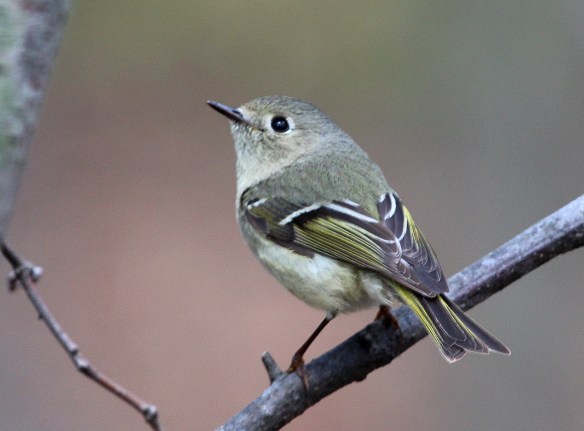
Photo by Chris Bosak A Ruby-crowned Kinglet perches in a tree at Selleck’s/Dunlap Woods on May 5, 2014.
We’re losing birds daily as the days get shorter and nights get cooler. That’s the pessimistic view.
We’re gaining birds daily, too, as the days get shorter and nights get cooler. I like that one better. I try to be a glass-half-full type of guy, even as my 401k plunges into the abyss.
Fall migration is a funny thing for birdwatchers in New England. We say goodbye until next spring to some birds, such as oystercatchers, ospreys, and hummingbirds; and hello to our winter birds such as white-throated sparrows, juncos, and ducks of all shapes and sizes. In the meantime, birds that nest north of here and winter south of here will pass through like a train in no particular hurry to reach its destination.
Now is the time to concentrate on those varieties. The kinglets, warblers and vireos of the bird world. Our summer birds have been with us for months. The winter birds will be here soon and stay with us until spring. The migrants are fleeting. That’s why they’re called migrants.
Kinglets are my favorite fall migrant to watch. A tiny bird that would easily fit in the palm of your hand, kinglets are energetic little bundles of joy. We have two varieties in New England: ruby-crowned and golden-crowned. For the most part they migrate through New England at different times, but I once watched from my kitchen window a ruby-crowned and golden-crowned sharing the same hemlock branch.
Kinglets are not shy and will often hunt for tiny insects within arm’s reach of any human patient enough to stand still long and learn its hunting pattern. They hunt high in trees, along the tops of average-sized bushes and even along the ground. I once watched a ruby-crowned kinglet hunt on a sandy beach a few autumn’s past.
Warblers are the jewels of the bird world in the spring. They are colorful, spritely and somewhat easy to identify if you can get a good look at them. In the fall, they are still sought after, but often painfully confusing for birdwatchers. The males of most species, resplendent in their breeding plumage in the spring, sport feathers that are dulled by age and the toils of summer by fall. First-year birds — mere helpless naked babies a few months ago — are passing through New England in their confusing neither-here-nor-there plumage.
I had an unfortunate warbler sighting last weekend. I was walking along a long road with my five-year-old, Andrew, and two-year-old, Will. First, let me clarify the walking situation. We had just spent a wonderful, but exhausting morning/early afternoon at an Aquarium in southern New England. We had to walk a fair distance back to the car, but the kids were in no mood to walk under their own power anymore — especially if sharks and seals were not involved — so I had Will on my shoulders and Andrew in my arms. I love them to death, but they are getting heavy.
Suddenly Andrew, who was facing backwards, says, “Daddy, you just walked past a bird.” Sure enough, there on the sidewalk was a dead black-throated blue warbler. I put the kids down and examined the bird. It was perfectly intact and likely either collided with a window or simply fell exhausted from the sky. Not that I particularly enjoyed that warbler sighting, but it did serve as an educational lesson for Andrew and Will, and was a mighty handsome subject at that. (It also gave me a little break from carrying two growing boys.)
Double-crested cormorants made for another educational lesson that morning. The cormorants were alive and well, and this lesson was actually fun — at least I thought so, anyway. Cormorants are large diving water birds. When they swim pretty much only their long necks are above the water, making them look like swimming snakes. There were about a dozen of them swimming under a railroad bridge in a river. It was Andrew’s job to first find them and then count them. The game could have gone on for hours as the diving cormorants became “new” birds each time they resurfaced. He got to about 30 before the game got old and we went back into the Aquarium.
Soon, the double-crested cormorants will be gone and great cormorants will take their place along New England’s coast for the winter. Also before long, waterfowl of many varieties will arrive in New England. Some will merely pass through and some will stay all winter.
The days are going to get even shorter and the temperatures are going to get a lot colder. Those ducks, however, will help us get through the winter. They always do.
Photo by Chris Bosak Even common birds such as robins are declining, according to a new study.
Several articles published last week confirmed what we all knew already: Birds are in decline.
What was enlightening, in a bad way, was the degree to which birds are disappearing. Citing a report from the journal Science, the articles reported that there are 2.9 billion fewer birds in the U.S. and Canada now than there were in 1979. That’s a decrease of 29 percent.
The 2.9 billion fewer birds certainly is startling. The 29 percent decline is also eye-opening, but to be honest, that number doesn’t really surprise me given the percentage decline of some species. The wood thrush, for example, has declined 62 percent from 1966 to 2015, according to the North American Breeding Bird Survey. Its beautiful flute-like song still echoes throughout our woods, but not nearly as often as it used to.
Other startling examples include the eastern meadowlark (89 percent decline), cerulean warbler (72 percent decline), salt marsh sparrow (75 percent decline from 1998 to 2012), and American bittern (42 percent decline).
Unfortunately, examples are easy to come by as nearly every species has declined to some degree over the last 50 years. And don’t even get me started with the birds that are on the brink of extinction, such as the Kirtland’s warbler.
According to the latest study published by Science, waterfowl and raptors are faring the best with slight population increases. That is not surprising considering the amazing recovery of species such as the osprey and bald eagle.
It is interesting to note the discrepancies between this latest study and previous studies such as the North American Breeding Bird Survey and the Partners in Flight study. The previous studies showed stable or slightly increasing populations for many of our common birds. The latest study shows decreases even among birds such as robins and the more common sparrows. The study was conducted by a collaboration of government, nonprofit and educational organizations.
Not that it makes the 29 percent decrease in the overall bird population any better, but part of me thought that the number would be even higher.
What is the significance of this report and why should we care if birds are in decline or not? Aside from the fact that they are beautiful and fascinating creatures, and that millions of people enjoy watching them, there are serious consequences to losing birds. Birds eat insects, pollinate flowers, are a vital part of the food chain and contribute greatly to earth’s incredible biodiversity. They help keep nature in balance.
Birds are also an indicator species, those species that give a picture of the overall health of the planet. If something is wrong with the birds, something is wrong with the planet. And something is certainly wrong with the birds.
To lose nearly three billion birds in a relatively short time signals that changes need to be made. Pesticides, despite our earlier close calls with extinction due to their use, continue to plague the environment. Habitat loss continues nearly unabated and the rapidly-growing world population isn’t going to ease those pressures any time soon. The fires in the Amazon rainforest don’t help either.
Unfortunately, the list of factors in the decline of bird populations goes on and on and on. Fortunately, we have taken notice and that’s the first step toward doing something about it.
It looks like an overgrown mosquito and causes fear among many people who find these menacing-looking giants in their homes. But, alas, crane flies are as gentle as they come. They can neither sting nor bite. They can make it difficult to sleep as they flitter around your walls and ceiling at bedtime, but don’t worry, they won’t attack you in your sleep. In fact, they aren’t even capable of attacking as many species do not even have mouth parts. So, no, they don’t eat mosquitoes either as many people believe. And they certainly aren’t mosquitoes, despite their uncanny resemblance.
Photo by Chris Bosak
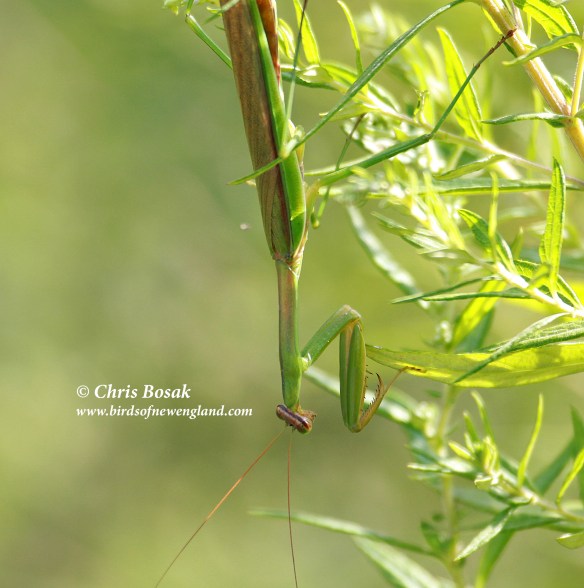
Praying mantis at Highstead in Redding, CT, summer 2019.
The insect world is rife with fodder for Birds of New England’s Stranger Things series. It doesn’t get much stranger than the praying mantis, a beloved insect that is not seen often enough.
It had been a few years since I had seen one, in fact, but a recent walk at Highstead in Redding, Connecticut, yielded three of the beauties. The first one got my attention as it flew across the meadow path and landed on a goldenrod stalk that was bursting with September color. I can’t remember the last time I saw a praying mantis in flight. It’s hard to miss as they are quite substantial insects, regardless of their skinny frame when not flying.
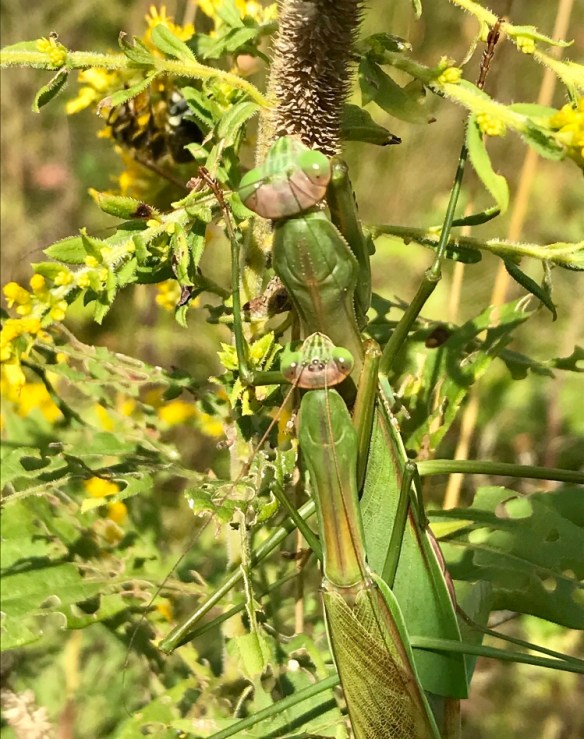
The second and third mantises I saw were on top of each other, literally. These ones were on a goldenrod stalk as well. One of my favorite things about September is the proliferation of goldenrod in New England’s meadows.
The praying mantis is so named because it looks as if it is praying when it’s waiting for food. Check out the bent front legs held together in the photo above.
Praying mantises are excellent hunters with an oversized, triangular head and large compound eyes. They are green, brown or a combination of those colors, making them hard to find for both prey and predators. Another great adaption utilized by mantises are the spikes front legs for capturing and holding prey.
Mantises eat crickets, moths, other insects, and, allegedly, hummingbirds. I’ve never seen this, but I’ve read it enough to include here. They also sometimes eat each other. Yes, sometimes the female eats the male after mating. I don’t know if that was the case with these two. I didn’t stick around to find out.
Photo by Chris Bosak Praying mantises in Redding, CT, summer 2019.
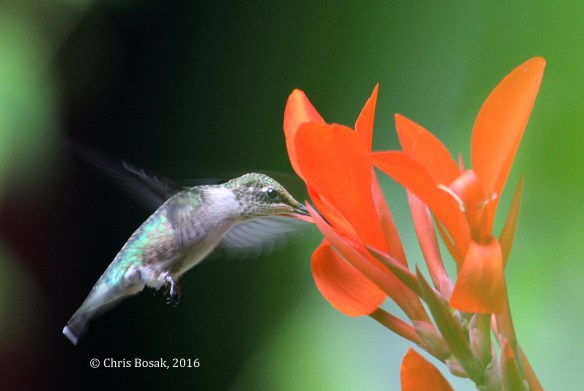
Photo by Chris Bosak A Ruby-throated Hummingbird sips nectar from Canna flower in Danbury, Conn., summer 2016.
I almost hate to say it but summer 2019 is nearly over.
I say “almost” because fall is up next and who doesn’t love a New England fall? In the bird world, it’s pretty much fall already, so really the calendar is the only thing standing in the way of autumn.
With that said, this seems like an appropriate time to reflect on this past summer. I had several birding and other nature highlights, most notably a camping trip to Pillsbury State Park in nearby Washington.
I was lucky enough while canoeing to share the main pond with three loons bright and early one morning. No matter how many times I experience it, I will always be in awe of the scene: sun peaking above the hills in the east, mist rising off the water and loons starting their day with a slow swim around their pond. A yodel or two from the loons completes the scene.
Such was the case at Pillsbury this summer, only instead of the usual one or two loons, there were three. It’s easy to see why the common loon is such an iconic bird in New England.
The bald eagles at Bashakill National Wildlife Refuge in N.Y. were another highlight.
The backyard highlight of the summer, echoing the highlight of the past few summers, was watching the hummingbird family that split their time between the feeders and flowers. This year, I had salvia, fuschia, sunflowers and rose-of-Sharon to offer. They enjoyed them all.
But mostly they drank from the feeders, as usual. I had to put three feeders out this year to mitigate the bickering among the tiny birds.
Recently, however, the visits by hummingbirds have slowed and it is not because of the wasps and black ants that try to take over the feeders. It’s because hummingbirds migrate in late August and early September. The adult males take off for points south first, followed by the females and first-year birds. I still see hummingbirds at the feeders, but the frequency has fallen and the birds are likely not “my” hummingbirds, but rather other south-bound migrants.
Which brings up the age-old question: Is it OK to feed hummingbirds in the fall or will they stick around and migrate too late if food is available? Studies have shown that hummingbirds are triggered to move south by the shortening of the days, not the weather or availability of food. In fact, an argument may be made that it’s beneficial to continue to feed them as these tiny birds essentially have to double their weight as they make their journey to Mexico and Central America.
The vast majority of the hummingbirds will be gone by the end of the month. By then, even the calendar will have yielded and fall will have its run of New England.






 Birds of New England.com