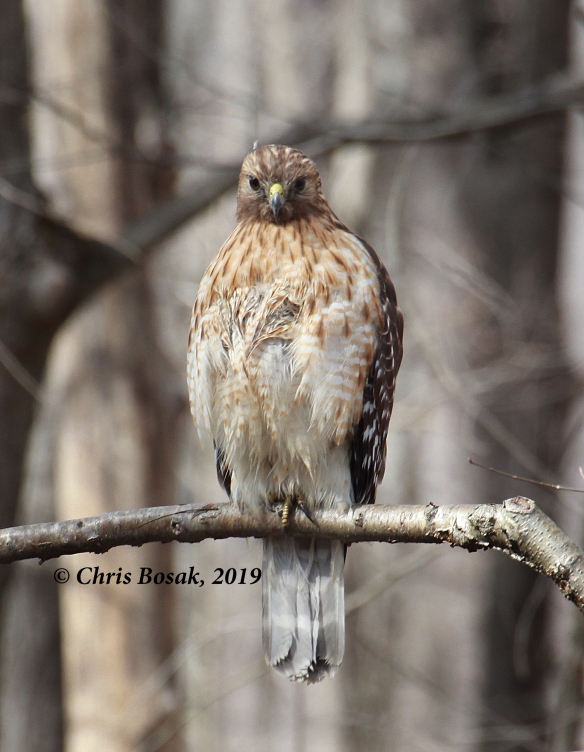
Here’s our old friend, the red-shouldered hawk. This time he’s looking right at us.

Here’s our old friend, the red-shouldered hawk. This time he’s looking right at us.
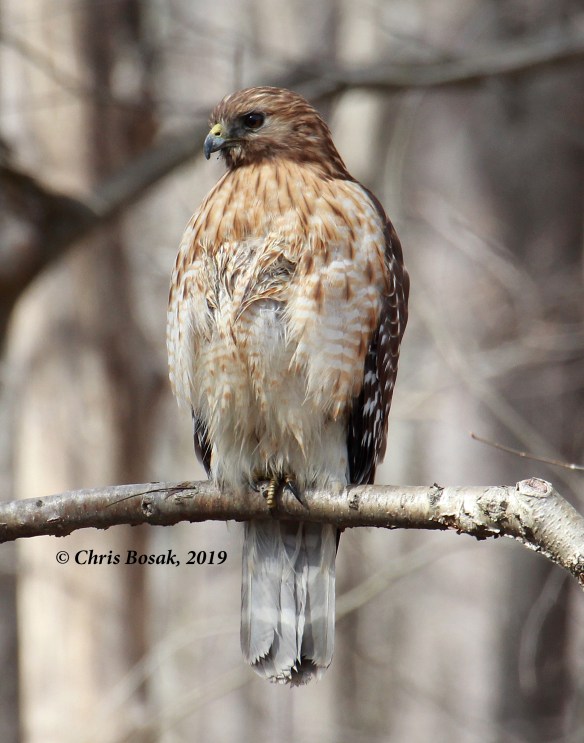
As long as this red-shouldered hawk is going to take obvious perches when I drive by a certain spot, I’m going to take photos of it. Red-shouldered hawk, take 20.
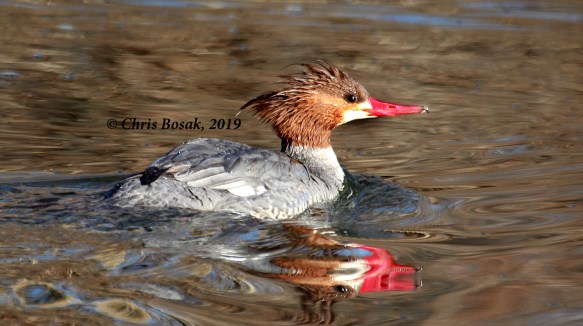
When I posted last week about “Merganser mania,” I had photos of all three mergansers that occur in New England. I had males and females represented, with the lone exception of female common merganser. Well, I happened upon this lady the other day and figured I’d complete the circle. I’ve added her to the original post, which may be found here.

It’s not quite on par with the great osprey rebound, but the recovery of the bald eagle has been fascinating and fun to watch.
Ospreys, once nearly extirpated from New England, have greatly increased their population over the last few decades. They are now common sightings along New England coastlines. Inland bodies of water are also seeing more ospreys but the increase is not as dramatic as along the coast.
Bald eagles are also becoming a more common sighting. I took a canoe ride on an inland lake in Connecticut yesterday and saw two bald eagles — one immature and one adult. (It takes four or five years for an eagle to get its trademark white head and tail.) Later in the day I drove past Danbury Fair, the state’s second-largest shopping mall, and saw an immature bald eagle perched in a snag in a nearby marsh.
I can’t remember the last time I saw three bald eagles in one day. Now that the weather is getting warmer (kind of) and days longer, eagles will be heading north soon. Many eagles, however, will remain in New England to return to nest sites or start new ones. In recent memory, there were no bald eagle nests where I am in southern Connecticut. Now there are several.
Here’s what All About Birds, a website of the Cornell Lab of Ornithology, says about the bald eagle population: “The Bald Eagle’s recovery is a spectacular conservation success story, and numbers have increased between 1966 and 2015, according to the North American Breeding Bird Survey. Partners in Flight estimates the global breeding population at 250,000, with 88 percent spending some part of the year in the U.S., 31 percent in Canada, and 8 percent in Mexico. The species rates a 9 out of 20 on the Continental Concern Score and are not on the 2016 State of North America’s Birds’ Watch List, but are a U.S.-Canada Stewardship Species. Once abundant in North America, the species became rare in the mid-to-late 1900s—the victim of trapping, shooting, and poisoning as well as pesticide-caused reproductive failures. In 1978 the bird was listed for protection under the Endangered Species Act. Since 1980, gentler treatment by humans along with the banning of DDT (the bird’s main pesticide threat) have led to a dramatic resurgence. By the late 1990s, breeding populations of Bald Eagles could be found throughout most of North America. In June 2007, the bird’s recovery prompted its removal from the Endangered Species list.”
It’s always good to hear those types of stories.


Last week, I wrote about seeing three common mergansers on a small pond by a busy shopping mall. Mergansers are typically wary and I was surprised to see the fowl there.
The next day, I drove past Candlewood Lake — a large man-made body of water in southwestern Connecticut — and saw literally thousands upon thousands of common mergansers. The lake was still about half frozen and many of the unfrozen portions were covered with mergansers. Some of the mergansers used the icy edges as a resting spot; others swam in the rippling water.
That setting seemed to me to be a more appropriate spot for common mergansers than the mall-area one. It got me to thinking about the merganser family and their water preferences.
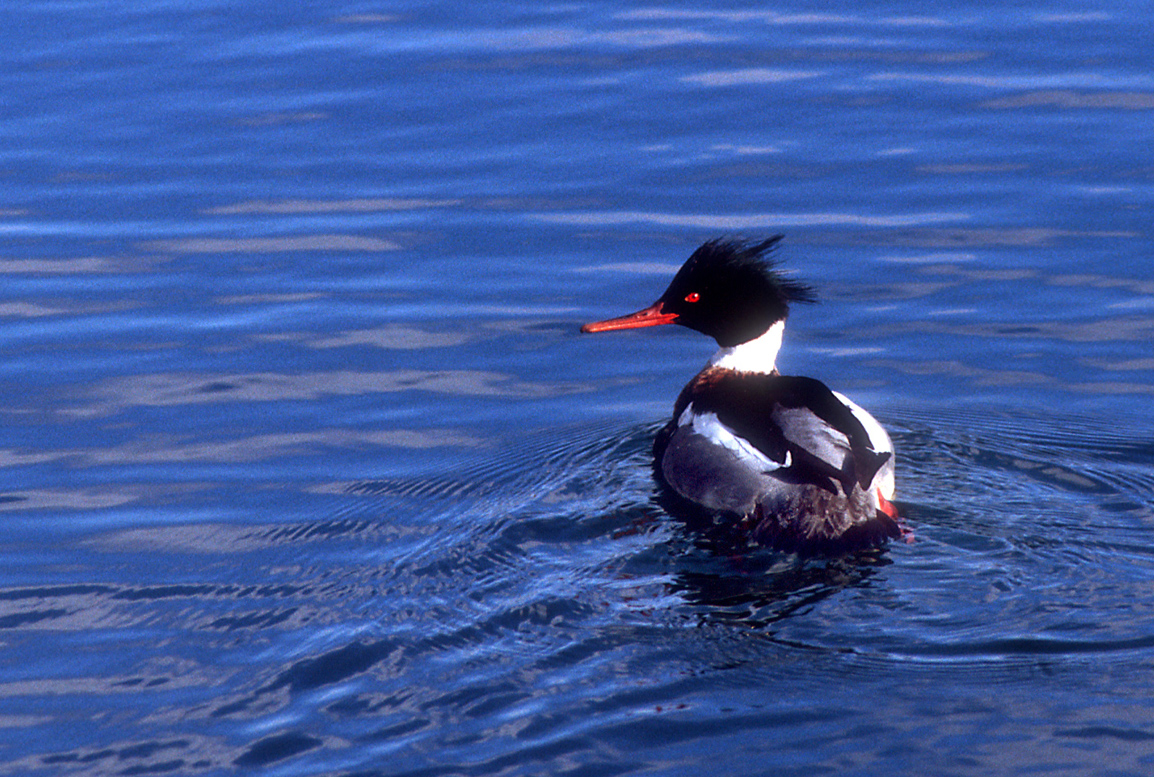
We have three types of mergansers in New England: common, hooded and red-breasted. Generally speaking, they all have different water preferences.
Common mergansers are usually spotted on large, freshwater lakes and rivers. Hooded mergansers favor smaller bodies of water and may be found on fresh or brackish water. Red-breasted mergansers may be found on large bodies of fresh, brackish or salt water.
I have yet to see all three mergansers sharing a common body of water, but I have seen hooded and commons together, and hooded and red-breasted mergansers together. All three are generally wary in nature. From my own observations, I find the common to be the most wary and hooded the most brave.
The hooded merganser is the oddball among them in terms of appearance. They are small ducks and the males are handsomely adorned with pewter sides, black backs and black-and-white heads and chests. Their heads are usually fanned to display a large white patch, but can also be flatted to show just a sliver of white. Female hoodeds are similar in size to the male but are duller in color and design.
Male common and red-breasted mergansers are similar in general appearance with dark green heads, red bills, large white bodies and black backs. There are obvious differences between them, too. The common is much larger and smoother looking. Red-breasted merganser males have spiky “haircuts,” light red breasts and slightly darker sides.
The females are slightly more difficult to differentiate. Female commons are larger, brighter and have a dark rusty head with a funky haircut. Female red-breasted mergansers have a funky haircut, too, but are smaller, darker and have duller, brownish heads.
All three merganser varieties have serrated bills for holding onto fish and other wiggly prey. Those bills have earned the family the nickname sawbill.
Ducks are one of my favorite types of birds to watch and mergansers are my favorite family of fowl. So far the spring migration has been a merganser bonanza. I hope it continues.


The spring migration is under way and many birds have made appearances in New England already. Birds such as red-winged blackbirds started showing up in February but the spring migration here is still in the beginning stages. By the end of April and into May, we’ll be hitting full stride.
Today I heard my first eastern phoebe. That, to me, is a true sign of spring. I’ve also seen a few American woodcock, thousands of mergansers, a handful of hawks, and several great blue herons flying with large sticks in their bills.
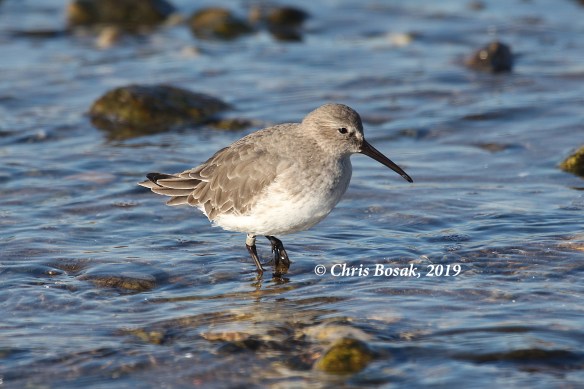
Eventually, all the talk will be about warblers and other songbirds. But we have a few weeks before that happens. To me, the large flocks of shorebirds that move through New England is an underrated aspect of spring migration. Shorebird migration is underrated in general, probably because it is so spread out. The northward movements start in late March and April and continue all the way into June. The southward movements start in July and continue into November. Of course, many shorebirds remain in New England throughout the winter.
So while we are excited to see the ducks, songbirds, hawks and other birds return to New England, don’t forget about the shorebirds dotting our saltwater and freshwater shorelines.

I haven’t written about ducks in a long time. I used to write about them often because waterfowl are arguably my favorite type of bird to watch.
My budding interest in birdwatching became an obsession when I discovered a huge flock of common mergansers on Powder Mill Pond. The number of birds in the flock and the birds’ size and beauty fascinated me. I can’t believe that happened back in the 1990s. Time sure flies.
I’ve been a huge fan of ducks, especially mergansers, ever since. I have canoed hundreds of miles, spent hours behind blinds in swampy areas, and stood on many shorelines with my eye pressed against a spotting scope in search of ducks.
But for whatever reason, I just haven’t written about ducks lately. I guess none of my recent waterfowl experiences have captivated me enough to do so.
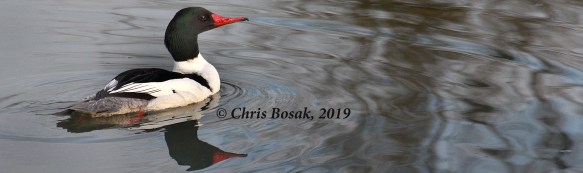
That is until the other day, when I saw a few common mergansers in a very unlikely place. Common mergansers typically favor large freshwater bodies, such as lakes, large ponds or wide rivers. Every so often, however, they may be spotted on much smaller bodies of water.
Not only was my recent sighting on a very small body of water, not even big enough to be considered a pond, but it was also in the shadow of a bustling shopping mall.
Danbury Fair is a mall in western Connecticut. It has a large, inaccessible marshy area behind it and a few very small ponds, if you can call them that, on the sides and in the front. It is a highly developed area, so a variety of wildlife does not thrive there.
It is, however, a fairly reliable place to spot birds such as great blue herons, belted kingfishers, mute swans, Canada geese, American and fish crows, and, of course, mallards. During spring and fall migration times some surprises can show up, which is what keeps me coming back to the spot, even for just a quick loop.
In the few years I have been drive-by birding at the mall, I have seen the aforementioned common species, as well as northern pintail, pied-billed grebes and hooded mergansers.
I associate common mergansers with more wild areas, so I was surprised to see two males and one female swimming in one of these tiny ponds with a steady stream of cars driving by on both sides. Two male hooded mergansers and a few mallards shared the pond.
I found a safe place to pull over in my car and checked out the scene through an open passenger’s side window. I grabbed a few quick photos but the ducks slowly swam away in the opposite direction and did not seem comfortable with the stopped car by the pond.
Common mergansers, I’ve discovered over the years, are quite wary and not at all tolerant of any perceived threat. I didn’t want to further stress them during migration so I quickly pulled out and joined the flow of moving cars.
It had been several years since I had seen common mergansers so close. I find them to be the most wary of New England’s three merganser varieties.
Breaking down the merganser varieties requires its own column because they are so different in many ways, but they also share some similarities. I guess you know what next week’s column will be about.
It sure is nice to be writing about ducks again.

Today is World Sparrow Day. I had never heard of this day before, but it has been around since 2010, according to websites I’ve seen. The day is set aside to celebrate and raise awareness of the decline of the house sparrow. I’m sure many of you (I know I did) immediately questioned that house sparrows are in decline. They are ubiquitous in many areas and so numerous to be considered a pest in others. But, according to many sites posting about World Sparrow Day, the familiar bird is indeed in decline throughout much of its global range.
I’ve been critical of house sparrows in the past and have complained of them “hogging” the birdfeeder perches, but I certainly do not wish a precipitous global decline of the species. I’ve read enough about the passenger pigeon to know that no species is safe regardless of their current population. So I read further on the matter of the house sparrow.
According to WorldSparrowDay.org: “The house sparrow was once the most common bird in the world, but in the past few years, this bird has been on the decline over much of its natural range, both in the urban and rural habitats. The decline of the house sparrow is an indicator of the continuous degradation the environment around us is facing. It is also a warning bell that alerts us about the possible detrimental effects on our health and wellbeing.”
It’s always good to get ahead of a problem before it’s too late, which is what the National Forever Society is doing with World Sparrow Day. Much more information is available at www.worldsparrowday.org. Take a look and make your own decisions about the state of the house sparrow.
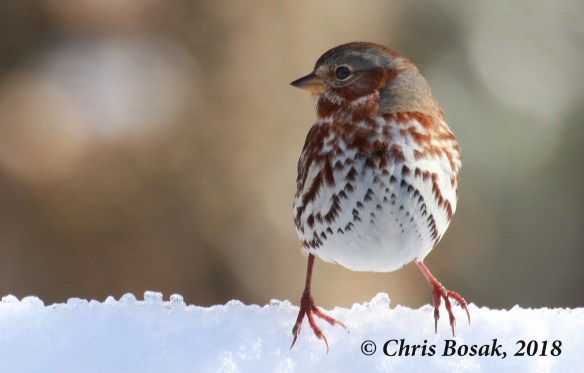
The term “sparrow” is very broad and includes many bird species. In the U.S., we have “Old World Sparrows” and “New World Sparrows.” House sparrows, which are not native to North America, are Old World Sparrows and pretty much every other sparrow we see in New England is a New World Sparrow.
Here are some photos of New World Sparrows we see in New England.


Blue jays didn’t like the homemade peanut birdfeeder when it was hung from a chain, but they came quickly after I set the feeder on its side. It’s so interesting to watch each species’ preferences.

One last shot of that homemade peanut feeder I wrote about last week. Here are the other two links, in case you missed it. White-breasted nuthatch. Downy woodpecker.
 Birds of New England.com