Unknown's avatar

About Chris Bosak

Bird columnist and nature photographer based in New England.

Northern bobwhite highlights walk

Photo by Chris Bosak
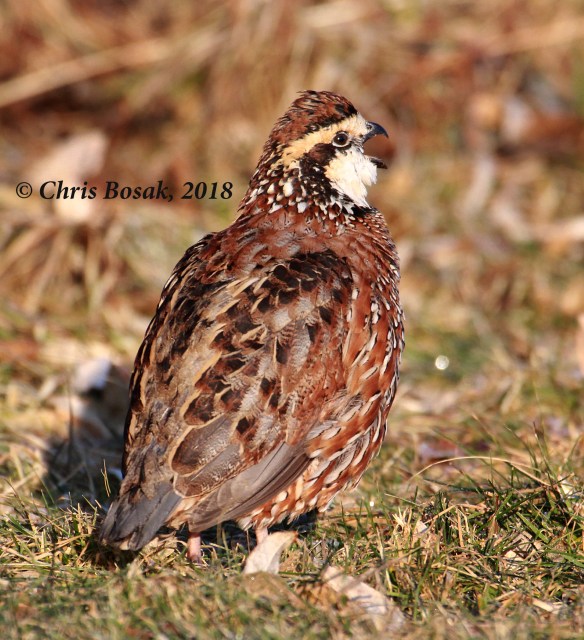
A northern bobwhite calls at Happy Landing in Brookfield, Connecticut, fall 2018.

I can count on one hand the number of times I’ve seen a northern bobwhite in the wild. There are several reasons for that; the biggest being that the bird’s population has declined sharply over the years. Another reason is that 99 percent of my birdwatching is done in New England and the bobwhite is more of a southern bird. 

Despite all that I did come across a male northern bobwhite during a walk at Happy Landings in Brookfield, Connecticut, this morning (Dec. 12, 2018). It was walking along the path near a shrubby area and sauntered off into the brush as I continued along the trail. I walked several yards past the point where the bird had ducked into cover and I took a seat on the trail to see if the bird would come back out. Patience is a birdwatcher’s best tool, I reminded myself as I sat there motionless on this cold and sunny morning. 

My patience was never tested as the bird did come back through the brush and onto the trail in a matter of minutes. It stopped and called a few notes (not its trademark “Bob-white” song, but its less distinctive call) as I watched from a short distance away. It sat there still and called a few more times. I didn’t hear any response calls, but there could have been another bobwhite around. 

It’s hard to tell if this was truly a wild bird or a captive-bred bird that escaped or was released. Bobwhite is a popular game and farm bird. I didn’t notice any leg bands, so I’m hoping it was a bona fide wild bird. Either way, it was a treat to see it in New England. 

The sighting became that much more meaningful after reading this northern bobwhite conservation update from The Audubon Society (audubon.org): “Has disappeared from much of the northern part of its range, and has declined seriously even in more southern areas. The causes for these declines are not well understood. At northern edge of range, many may be killed by unusually harsh winters, but this does not explain its widespread vanishing act.”
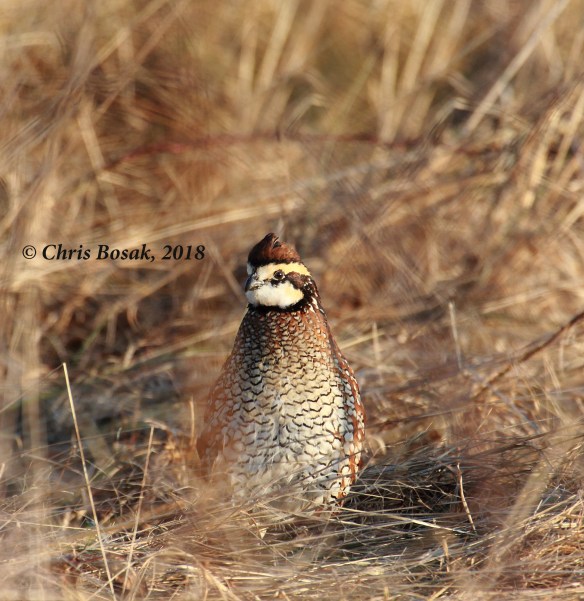
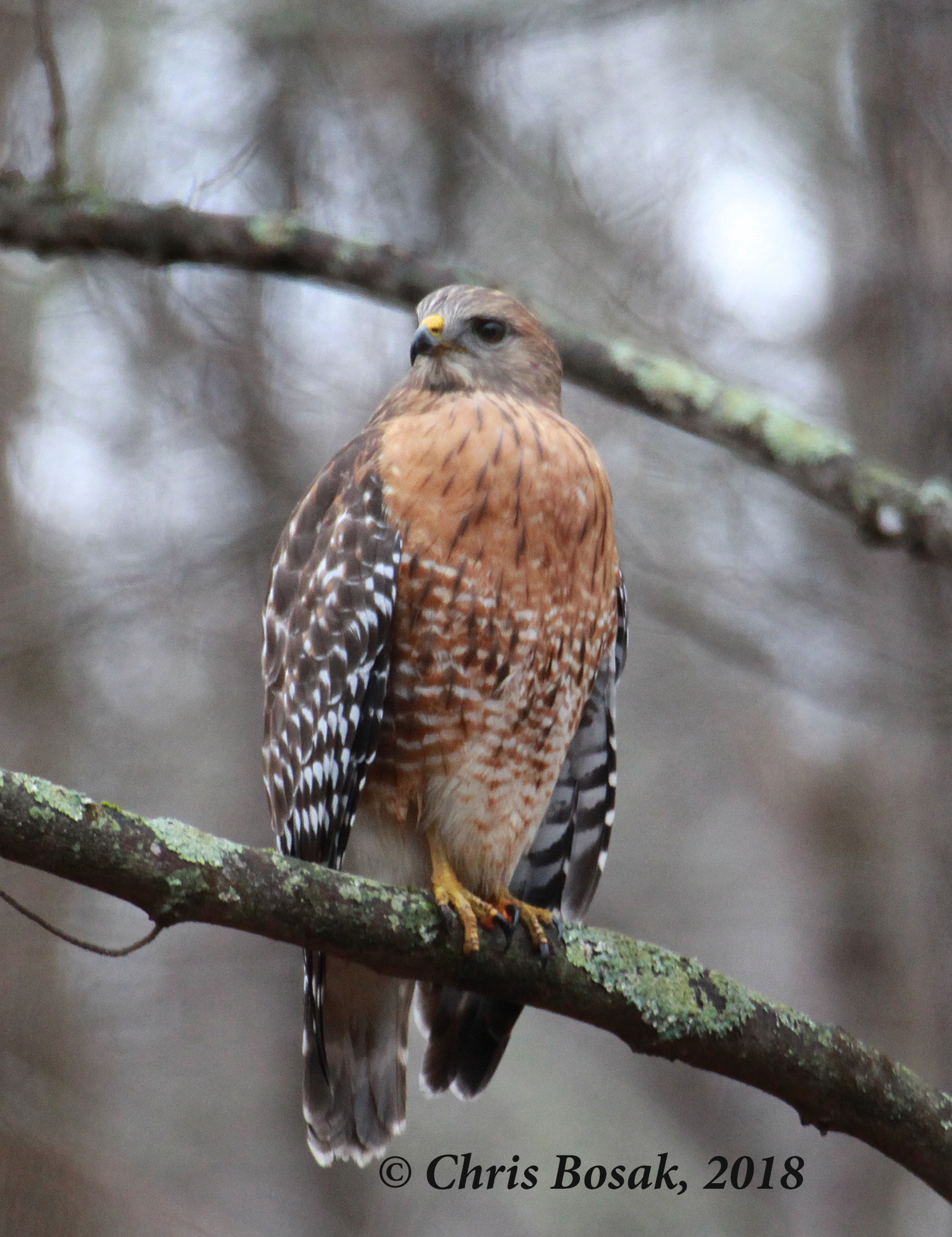
Photo by Chris Bosak A nothern bobwhite calls at Happy Landing in Brookfield, Connecticut, fall 2018.

Red-shouldered hawk in tree

Photo by Chris Bosak
A red-shouldered hawk sits in a tree in Brookfield, Connecticut, fall 2018.

My son Will and I came across this red-shouldered hawk while we were driving through a neighborhood in Brookfield, Connecticut, the other day. It’s times like this that I usually don’t have my camera with me, but this time I happened to be prepared.

The red-shouldered hawk is one of New England’s most common hawks, along with red-tailed hawk, broad-winged hawk, Cooper’s hawk, and sharp-shinned hawk. There are other hawks in the region, of course, but these are the ones seen most often. I typically see red-tailed hawks most often, but I’ve been seeing more and more red-shouldered hawks of late.

Photo by Chris Bosak
A red-shouldered hawk sits in a tree in Brookfield, Connecticut, fall 2018.

Pine siskin vs. American goldfinch video

Here is a video I put together on the current pine siskin (fall 2018) irruption. Also a description on how to tell siskins and goldfinches apart. Subscribe to my YouTube channel by clicking here.

For the Birds: Northern shoveler highlights trip

Photo by Chris Bosak A northern shoveler seen at 14-Acre Pond in Norwalk, Conn., fall 2018.

Here is the latest For the Birds column, which runs in several New England newspapers …

Each month brings its own gifts for birdwatchers.

November brings ducks in large numbers to our ponds, lakes and rivers. If December is kind, weather-wise, that continues. If December is cold and frosty, which it often is, those bodies of freshwater freeze and the ducks head farther south.

This year, November has been colder than usual; many of these waters are frozen already, threatening to spoil the “winter duck” fun early. A quick thaw can bring the ducks back, but an extended freeze will push the ducks away until early next spring.

When the inland waters freeze, New England birdwatchers still have the Atlantic Ocean and Long Island Sound to get their duck fix. But even that falls short in some regards. While there are some duck species that may be found in fresh or saltwater, most are an either-or proposition.

When the freeze takes over, New England can pretty much say goodbye to species such as wood duck, common merganser, ring-necked duck, green-winged teal and gadwall. Other freshwater specialty species — such as pintail and shoveler — are also south-bounfd following a deep freeze.

I was lucky to spot one of these specialty species the other day while checking out an old haunt of mine in southwestern Connecticut. I scanned 14-Acre Pond in Norwalk and noticed a good number of gadwall, a few ring-necked ducks, a pair of mute swans, and many mallards, domesticated ducks and Canada geese. The domesticated ducks were a surprise. I had never noticed them before when I used to frequent the pond.

One duck stood out among the rest, however. The large white patches that sandwich its otherwise rusty side stood out like a beacon. Even though Continue reading

Northern shoveler video

Here’s a quick video I put together on the northern shoveler drake that I featured in a few posts last week. Feel free to subscribe to my YouTube channel, which I hope to populate with more videos in the coming months. It already has several older videos I posted over the years.

To subscribe to my YouTube channel, click on the link below:

https://www.youtube.com/channel/UCTcik_d7xcke8x6_sjusirw?sub_confirmation=1

Oh, here’s that shoveler video …

More and more siskins

Photo by Chris Bosak Pine siskins visit a feeder in Danbury, Connecticut, fall 2018.

It started out as two yesterday morning. Now there are more than 20 pine siskins at my backyard feeding station in Danbury, Conn. That’s often the way it goes with these winter finches: The visits start with a few birds and they multiply and eat the host out of house and home. Not that I’m complaining …

Every perch on the hopper is filled and the rest are on a nearby hopper feeder or on the ground. They are eating Nyjer and sunflower seeds. 

Siskin irruption hits home — finally

Photo by Chris Bosak A pine siskin eats Nyjer seeds at a feeder in Danbury, Conn., fall 2018.

After reading about pine siskins being seen throughout New England for several weeks, I woke up this morning to three of them at my feeding station. Pine siskins are one of the winter finches that irrupt from the north into New England and points south in sporadic winters. (Related post may be found here.)

Pine Siskins are often confused with goldfinches because they look fairly similar and prefer Nyjer (or thistle) seeds. Siskins are a bit larger, more sleek, more streaked and have a longer, pointed bill. The heavy streaking, especially on the sides, and yellow wing and tail markings are the best clues to differentiate the species. The male siskins have more prominent yellow markings. 

So today I celebrate that the siskins have arrived. The birds, however, have a very healthy appetite and Nyjer seed is not cheap, so we’ll see how I feel if their numbers multiply. I’m sure I’ll continue to be inspired by their presence. After all, it’s been about 10 years since I was a part of one of their irruptions. I think I can splurge once a decade on them. 

Here is a photo of them with goldfinches. Note the differences in plumage. The goldfinch is on the lower right. 

Photo by Chris Bosak Pine siskins visit a feeder in Danbury, Connecticut, fall 2018.

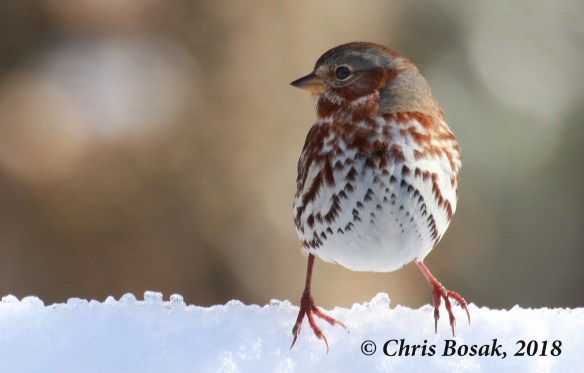
For the Birds: Fox sparrows back in force

Photo by Chris Bosak
A fox sparrow perches on the snow in Danbury, Conn., Nov. 16, 2018.

Here is the latest For the Birds column: 

Last week I wrote about winter finches and how birds that aren’t even finches can easily be lumped into that broad category.

I mentioned a few examples and, of course, as soon as I hit the “send” button, an example that I failed to mention showed up in my backyard. It was a fox sparrow. Well, more specifically, two fox sparrows.

Fox sparrows aren’t finches, naturally, they are sparrows, just as their name suggests. But because they are small (relative to all birds) and show up at feeders throughout New England sporadically during certain winters, I think they can be mentioned under the very broad and nonspecific category of winter finches.

Winter finches, just to review quickly, are the northern birds that show up at New England feeders some winters, only to not be seen again for several years. Pine siskin is the prime example and this year seems to be another good year for siskins. Continue reading

Connecticut’s State of the Birds 2018

Photo by Chris Bosak A Snowy Owl sits on an old telephone pole at The Coastal Center at Milford Point in early March 2014. Smoke stacks in Bridgeport loom in the background.

Here’s the 2018 State of the Birds report from the Connecticut Audubon Society. (Press release shamelessly copy/pasted here.)

November 29, 2018 — For the scores of migratory and nesting bird species in Connecticut to survive and thrive, the state’s cities and suburbs must create, maintain, and improve their local habitats in everything from small neighborhood parks to larger nature preserves.

That’s the key finding of the Connecticut Audubon Society’s 2018 State of the Birds report, released today at a news conference at the Connecticut Agricultural Experiment Station in New Haven.

Titled “In Cities and Suburbs: A Fresh Look at How Birds Are Surviving in Connecticut,” the report shows how the state’s most heavily-developed areas are crucial to the survival of the state’s and the region’s birds. Some of the most vulnerable species nest in Continue reading

Deer jumps over guard rail

Photo by Chris Bosak A white-tailed deer seen at Sherwood Island State Park in Westport, Conn., fall 2018.

I was hoping to come up with a more exciting headline for this post, but alas, I gave up before inspiration hit me. Besides, the headline kind of says it all.

Here’s a series of photos showing a white-tailed deer buck leaping over a guard rail dividing the access road to Sherwood Island State Park in Westport. I saw the deer walking across the road and figured, why not, let’s document him jumping over the barrier. The obvious unanswered question is: Why did it cross the road? (Sorry, bad joke.)

Here’s the entire series:

Photo by Chris Bosak A white-tailed deer seen at Sherwood Island State Park in Westport, Conn., fall 2018.

Continue reading