For the Birds: The Winter of the Barred Owl

Photo by Bob Sullivan
This barred owl perched on a bird feeding pole and took several dives at a vole under the snow in Westmoreland, N.H.

In recent memory we’ve had the winter of the junco, the winter of the snowy owl, and the winter of the robin.

This seems to be the winter of the barred owl. Throughout New England, barred owls are being seen in greater-than-usual numbers.

I received an email and terrific photos from Bob of Westmoreland. On Super Bowl Sunday, he noticed a barred owl perched on the bird feeder pole in his yard. But the thrills didn’t stop there. Bob watched as the owl took a few attempts at snagging a vole in the snow beneath the feeder. Alas, the owl never got its prey.

“I kept pausing the Super Bowl every so often to check,” he wrote. “I have plenty of barred owls in the neighborhood, but this was the first time I ever saw one hunting at the feeder.”

Bob noted that smaller birds such as chickadees kept right on using the feeders and the owl paid them no mind.

People think of owls as nocturnal, but they can be active during the day. This is especially true of barred owls, which often call their eerie “Who cooks for you? Who cooks for you all?” hoots during the day.

The spike in sightings has been so pronounced that The Connecticut Audubon Society called on several bird experts to try to explain the phenomenon. Continue reading

Great Backyard Bird Count personal results

Photo by Chris Bosak A white-breasted nuthatch sits on a bird-shaped birdfeeder during the winter of 2016-17 in Danbury, Conn.

As promised, here are the results of my Great Backyard Bird Count experience this morning. It wasn’t overly successful in terms of finding birds, but it wasn’t too bad either. At any rate, all checklists are valuable, so my 2019 GBBC list is in. Not that participants are limited to one checklist, and I may just do another one tomorrow as the Count runs through Monday.

My species list included: black-capped chickadee, tufted titmouse, white-breasted nuthatch, downy woodpecker, red-bellied woodpecker, dark-eyed junco, pine siskin, American goldfinch, hooded merganser, and ring-necked duck. The waterfowl, of course, I spotted at the pond at the end of the trail behind my house. The pond is 85 percent frozen, but open just enough to hold a small flock of ring-necks.

Feel free to share your highlights by commenting on this site or BirdsofNewEngland.com Facebook.

Since my species list wasn’t so great, here are photos of each bird I saw today. (Note: The photos were not taken today, but these are “file photos.”) Continue reading

Still time to participate in Great Backyard Bird Count

A Red-breasted Nuthatch perches near a birdfeeding station in Danbury, Conn., Oct. 2016.
A Red-breasted Nuthatch perches near a bird feeding station in Danbury, Conn., Oct. 2016.

There is still time to participate in the Great Backyard Bird Count. In fact, in recent years the Count has been extended through Monday — so no excuses. It’s a beautiful day in New England (at least where I am) and I’m eager to head out right after making this post. I’ll let you know what I find later today or tomorrow. As always, feel free to send me your highlights.

Remember, if you see a ton of birds or only a few (or none), it’s all good data. Don’t fail to submit results just because you think it was an “unsuccessful” bird walk. Click here for my recent column on that matter.

Many people are concerned that they are not seeing chickadees at their feeder this winter. This is your chance to contribute to data that may help scientists determine if, indeed, there is a problem.

All the information about the GBBC and how to submit your results may be found by clicking here.

For the Birds: Birds do just fine without feeders, too

Photo by Chris Bosak
A Blue Jay eats an acorn at Selleck’s Woods in Darien, Conn., April 2016.

After a three-hour drive to visit my brother Gregg in upstate New York, it was nice to relax and watch the black-capped chickadees forage in theblue spruce trees outside his kitchen window.

A flock of dark-eyed juncos darted past the window and settled at the base of his house where a bare patch of ground offered the only hope for these ground-feeding birds. The rest of the yard was buried under snow and ice.

A glance back at the spruce trees proved what I had thought all along: The chickadees were not alone. It was a mixed flock of chickadees and tufted titmice poking at the Continue reading

Titmouse and the peanut

Photo by Chris Bosak
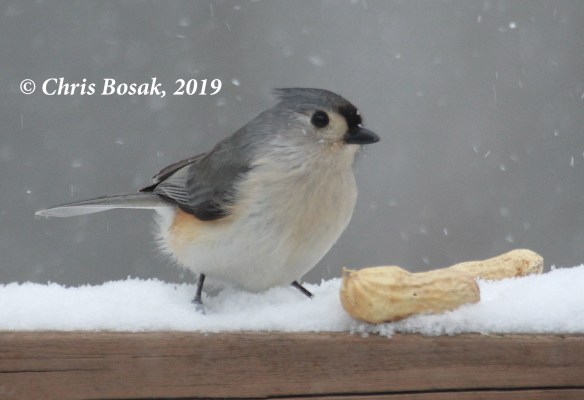
A tufted titmouse take a peanut from a railing in Danbury, Connecticut, February 2019.

Here is a short series of photos showing a tufted titmouse contemplating and ultimately deciding to make off with a peanut, which looks comically large in the bird’s tiny bill. Good thing titmice don’t swallow their food whole.

I got this.

Continue reading

Hardy cardinals on ice

Photo by Chris Bosak Male northern cardinal at feeder, New England, Jan. 2019.

Here’s a male and female cardinal seen this morning during icy, single-digit temperatures.

Photo by Chris Bosak Female northern cardinal on icy branches, New England, Jan. 2019.

For the Birds: DIY birding projects

Photo by Chris Bosak
A downy woodpecker eats a homemade Christmas-themed suet cake, December 2018.

Most birdwatchers I know have a self-reliant, practical side. They don’t necessarily long to live off the grid in a small cabin in the wilderness, hunting for their food and cutting down trees to stay warm, but there is a hint of that spirit in a lot of us.

Luckily, there are many do-it-yourself projects for birdwatchers that may be done in the comfort of our heated, electrified, and well-stocked homes. The projects will save a few bucks (no pun intended) and result in that satisfaction only a good DIY activity can deliver.

The easiest project is making your own hummingbird food. It is inexpensive and requires almost no skill. In other words, perfect for someone like me.

Simply mix four parts water with one part sugar and you’ve got hummingbird food. I usually double the recipe to eight cups of water and two cups of sugar so it lasts longer. I like to bring the water to the point at which it is about to boil then turn off the heat and add the sugar. Most of the sugar will dissolve itself in the hot water, but a minute or two Continue reading

House finch with no tail visits feeder

Photo by Chris Bosak A house finch without tail feathers visits a feeder in Danbury, Conn., January 2019.

I noticed right away that this bird looked different. How can you not notice a bird without a tail?

This house finch has been visiting my feeders (Nyjer and sunflower seeds) for a few days now. Any variety of things could account for his missing tail, but the most likely reason is a close encounter with a predator (cat, hawk, fox, etc.)

I’ve seen house finches with avian conjunctivitis and I even had one get its head stuck in a tube feeder, but I’ve never seen a tail-less house finch before this. Not to worry, though, the feathers will grow back soon.

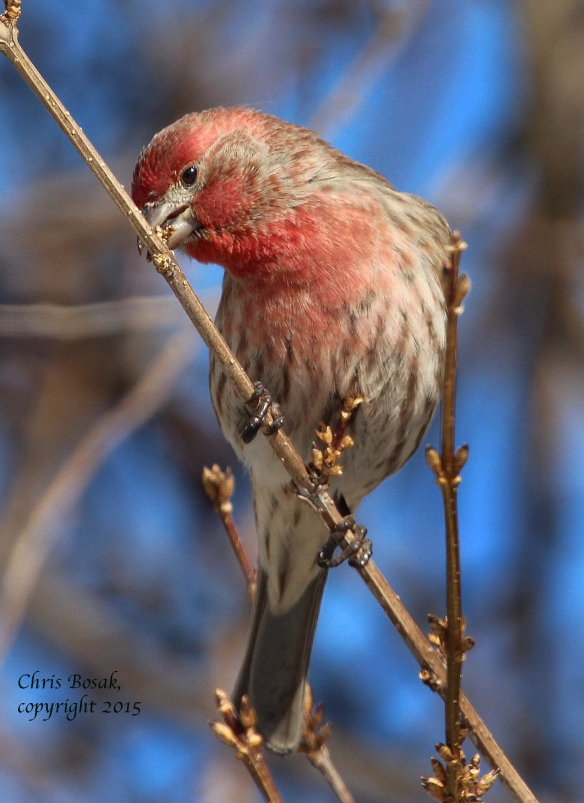
For the sake of comparison, here’s a “normal” house finch.

Photo by Chris Bosak A House Finch eats buds from a bush in Norwalk, Conn., Feb. 2015.

For the Birds: The siskins come at last

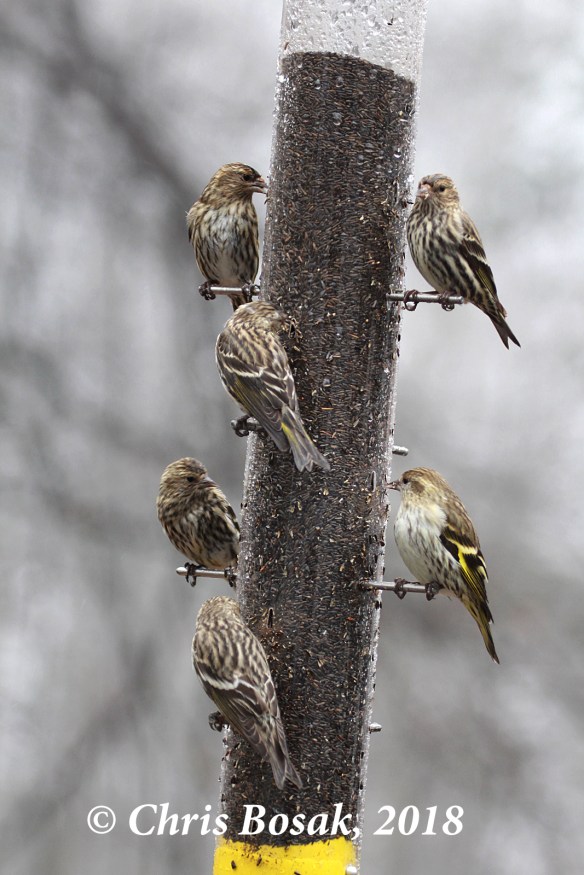
Photo by Chris Bosak Pine siskins visit a feeder in Danbury, Connecticut, fall 2018.

A wise man once said: “The nature of a winter finch irruption, however, could mean a sizable flock of pine siskins can show up and empty out my Nyjer seed feeder at any moment.”

Just kidding. That was me writing two weeks ago about the hot start to the winter finch season. The wise man part is up for debate.

At the time of that writing, a female purple finch had been my only out-of-the-ordinary sighting at my feeding station. A week later a few fox sparrows showed up. I know fox sparrows are not finches, but they can fit loosely into the category of winter finches because of their sporadic visits to New England backyards.

Then last week, true to the sentence at the top of this column, the pine siskins showed up. It started out with two siskins sharing the tube feeder with a group of goldfinches. The next day, I counted three siskins. The third day, about 20 siskins showed up and occupied every perch on the tube feeder and a nearby hopper feeder. The spillover Continue reading

Pine siskin vs. American goldfinch video

Here is a video I put together on the current pine siskin (fall 2018) irruption. Also a description on how to tell siskins and goldfinches apart. Subscribe to my YouTube channel by clicking here.