For the Birds: Christmas Bird Count is always a highlight

Photo by Chris Bosak
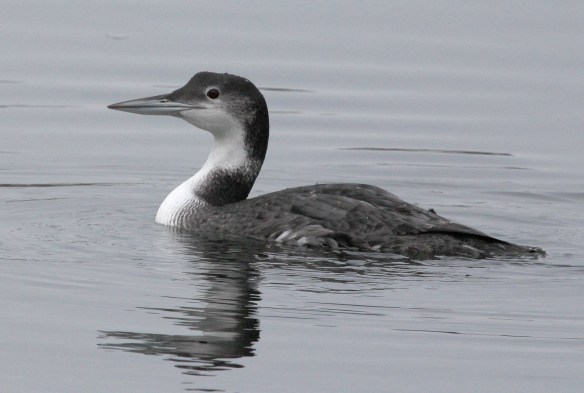
Common loon in winter plumage on Long Island Sound.

The birding had been slow — not dreadfully slow, but slower than usual, for sure — when we rolled up beside some evergreens in a front yard. We noted a flurry of activity (finally) and stopped for a closer inspection.

A half-dozen juncos flitted close to the ground, flashing their white-edged tails. Suddenly, a yellow bird flew from one tree to another. Any yellow bird that is not a goldfinch is cause for “ID at all costs” during a Christmas Bird Count. Not that goldfinches aren’t welcomed species, but they are rather expected to be seen in New England in December. Other yellow birds, not so much.

It landed just long enough for us to get a decent look and for Frank to get a few good-enough photographs. It was a warbler, for sure. We immediately thought orange-crowned warbler as they are the warblers most often seen during a New England Christmas Bird Count. Frank inspected the photos on his camera — something that wouldn’t have been possible 20 or 25 years ago — and determined it was a Nashville warbler instead. In the flurry, we also noted a ruby-crowned kinglet scurry from one bush to another. All the while, a Carolina wren belted out a song from a telephone wire across the street. As a birdwatcher, you love those flurries. You really love them during a Christmas Bird Count.

Frank and I cover a coastal area of Connecticut and have done so for going on 20 years. For that area, we finished the Count with 52 species and close to 2,000 birds. Not bad, not great. We’ve had better years, to be honest.

The Christmas Bird Count is an annual citizen science project that has grown from 27 participants in the inaugural Count in 1900 to now more than 75,000 participants each year. Keene was one of the original 25 Count areas. The data is used by ornithologists and other scientists to track long-term trends of bird populations.

Yes, it’s scientific and for a great cause. But, really, most people do it because it’s great fun. It’s an excuse to take a December day and watch birds from sunrise to sunset (even longer for the owlers.) It does, however, become a responsibility for participants. You don’t want to miss a day and let down the birds or your fellow birders.

Weather plays a big role in the amount of fun you have. Here in New England, a mid-December day can be 50 degrees or zero degrees. It can be sunny, cloudy, rainy, snowy, or any combination thereof. I’ve done Counts in blizzards and I’ve done Counts when it feels like early September.

This year’s Count was cloudy, cold and breezy. I’ll take it. It could have been a lot worse. The breeziness may have kept some birds hunkered down, but I don’t think the lack of birds we saw was due to the weather, except for the freshwater ponds. We visited a few ponds that had been frozen a few days prior to the Count so most ducks flew off for open water. We did see a lot of gadwall, a few ring-necked ducks and hooded mergansers, and, of course, tons of mallards.

We had other successes, too, such as the Nashville warbler and kinglet. Other highlights included several hundred brant, a gray catbird, a peregrine falcon and seven common loons on Long Island Sound.

Frank and I discussed the demise of the monk parakeet. We used to count dozens of the bright green birds along the coast and this year we had only one fly over our heads. Its squawking alerted us to it. Monk parakeets, of course, are not native to New England, but an escaped shipment from JFK Airport decades ago led to an established colony along the Connecticut coastline. They used to thrive here; now, they are all but gone. They build huge, heavy nests made of sticks on utility poles, so we concluded that the utility companies must have had something to do with their disappearance. That’s just a guess, however.

Want to get involved with a Count in your area? Most local Counts have been done already this year, but start planning now for next year. Do an Internet search for “How do I join the Christmas Bird Count” and the first result will be a link to the National Audubon Society’s CBC page. You can also check out historic local results from your area.

If you do sign up, be prepared to have fun. Just be ready to bundle up.

For the Birds: Welcome mat for the typical birds

Here is the latest For the Birds column, which runs in several New England newspapers. Thanks for checking it out …

Photo by Chris Bosak A blue jay grabs a peanut from a deck railing in New England, fall 2019.

The word typical often has a negative connotation.

It is usually used to describe something boring or mundane. “Just a typical day at the office.” Or worse, as a word of exasperation to draw attention to a recurring negative behavior: “He said what? Oh, that’s so typical of him.”

But I’m going to use typical in a positive way here. After all, Thanksgiving is a fresh memory, the holiday season is upon us, and 311 is my favorite band. The band encourages “positivity” and closes its concerts with “Stay positive. Love your life.” So I will do that here with the word typical.

The other day, all the “typical” birds showed up at my feeder. And that’s a good thing.

My typicals include black-capped chickadees, tufted titmice, white-breasted nuthatches, downy woodpeckers, red-bellied woodpeckers and blue jays. You can throw juncos in there, too, during the winter — and late fall as they have already arrived.

Other birds visit from time to time, but those are the birds that are always here. Many people have written to me lately about a lack of chickadees at their feeders. It’s definitely a trend to keep an eye on, but thankfully, I still have plenty of chickadees visiting my feeders. I still haven’t solved the mystery as to why so many people are experiencing a scarcity of chickadees, but I can tell you that I see them often.

I’m not trying to be boastful about my feeders or the fact that I see a lot of chickadees. There are some obvious bird species that I hardly ever see in my backyard.

Cardinals, for whatever reason, are rare sightings at my feeders. I see them all the time in the bushes along the sides of the road when I am driving through the neighborhood, but they avoid my yard like the plague.

Although I get more than my share of juncos in the winter, I rarely see white-throated sparrows — a usual accompaniment of juncos. At my previous houses, white-throated sparrows were a common winter occurrence and easily outnumbered all other winter birds. Here, I barely see them. I’ve seen more fox sparrows here than white-throated sparrows and that’s just plain odd.

I do see a ton of chipping sparrows in the spring and summer, but not enough to add them to my typical list. I am lucky enough to get good numbers of rose-breasted grosbeaks each spring, but their length of stay is too short to make the list. I do enjoy that short window each year, though.

Ruby-throated hummingbirds miss the cut by the barb of a feather. I see them daily from late April until the end of September, but I couldn’t bring myself to include a bird that is not a year-round New Englander. The hummingbirds are off sunning themselves and gorging on insects in Costa Rica or thereabouts, not like the chickadees, titmice and nuthatches that visit me daily regardless of the temperature.

I don’t just give out the title of “typical” to anything, you know.

For the Birds: Cold is no problem for birds

Here’s the latest For the Birds column, written just before the cold snap last week. Now it’s back up in the 50s, go figure.

Photo by Chris Bosak
A mourning dove and chickadee share a platform feeder during a snowfall in Danbury, Connecticut, February 2019.

Birds would fare just fine without human interventions such as bird feeders, birdhouses and birdbaths. They were, after all, here long before we were.

Even in the most extreme cold conditions, such as those we experienced last week and will certainly feel again soon, birds would do just fine without us. Without a doubt, the aforementioned human interventions make birds’ lives easier in the winter. Feeders are an easy source of energy, birdhouses offer refuge from the wind and heated birdbaths are a water source when everything else is frozen.

But, still, the majority of birds would survive even without those things. But how? They are small, delicately built (seemingly) and exposed to the elements. They are not, however, defenseless. They have plenty of strategies to survive the extremes. Let’s take a look at a few of them.

They know to seek shelter. When a driving wind accompanies cold temperatures, you won’t find birds out in the open. A hungry bird or two may brave the wind to visit a feeder briefly, but for the most part, birds hunker down.

That’s when birdhouses come in handy. Birdhouses should be cleaned after the nesting season for sanitary reasons and to make room for birds in the winter. Old woodpecker holes are utilized as well. I once saw a chickadee huddled in the corner of an eave during a snow storm. It was so small and still I almost missed it.

I have a sizable brush pile in my backyard and junco and white-throated sparrows love it. They use it to hide from predators under normal conditions and hunker deep in the crevices during cold, windy weather.

Birds will often huddle together in these shelters, too, for extra warmth.

Many birds will also puff up their feathers to trap warm air near their bodies and keep cold air away. Some tiny birds such as chickadees and white-throated sparrows look almost comical with their feathers puffed up as if they are trying to look big and tough. Not that the birds really care what I think about them, especially when it’s 10 degrees out.

Birds do not hibernate, at least not really. They do sometimes enter a state of torpor, a temporary hibernation-like state in which their body temperature lowers and their metabolism slows. Shivering is another strategy employed by birds to retain heat.

Surviving extreme temperatures and blustery snowstorms is all part of the risk our year-round birds take by forgoing migration.

Migration is fraught with danger. There are buildings to crash into, exhaustion to fight, predators to avoid, and hundreds of miles to navigate without getting lost.

Staying in New England has its challenges, too, as I mentioned above.

For me, I appreciate our year-round birds immensely. Winter is long and dark in New England and I can’t image how dreary it would be without our chickadees, blue jays and other year-round birds.

For the Birds: Keep an eye out for kinglets

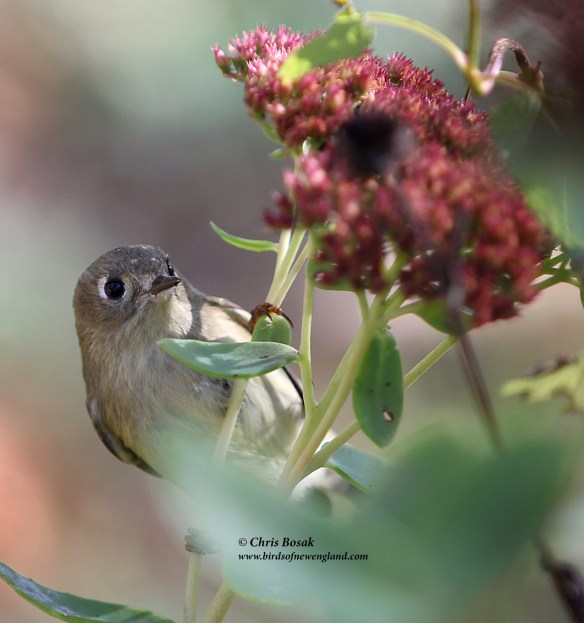
Photo by Chris Bosak A ruby-crowned kinglet inspects sedum for food in New England, fall 2019.

I’ve seen them in the deep woods, in my flower garden, in suburban parks and even at a sandy beach.

There are no excuses for missing out on kinglets during the fall migration. That is, unless you aren’t outside enough looking for them, which is unacceptable.

Last week, I wrote about the tiny kinglets being tough creatures able to withstand extremely low temperatures. This week, I’ll take a closer look at kinglets, a good reliable sighting throughout New England during migration periods.

We have two types of kinglets in New England: the ruby-crowned kinglet and the golden-crowned kinglet. Don’t let the names fool you, the color of the crown is not a good way to distinguish the two species in the field. First of all, you hardly ever see the crowns in the first place — especially that of the ruby-crowned kinglet — and secondly, the colors don’t Continue reading

For the Birds: Many sturdy birds from which to choose

Here is the latest For the Birds column, which runs in several New England newspapers …

Photo by Chris Bosak
A ruby-crowned kinglet inspects sedum for food in New England, fall 2019.

I was recently interviewed about birds and bird population trends by radio show host John McGauley of WKBK.

John had a lot of interesting questions and, following the interview, one in particular stood out in my mind. He asked: “What are the more sturdy birds? Are there any that are especially hardy and durable?”

My on-the-spot answer was hawks and other large raptors. While hawks are indeed large and strong and fierce, I wish I had would have responded differently. All birds, large and small, are hardy and durable. It would have sounded like a wishy-washy answer, but I could have explained it.

Ruby-throated hummingbirds, weighing in at about three Continue reading

For the Birds: Ducks faring well in midst of bad news

Photo by Chris Bosak
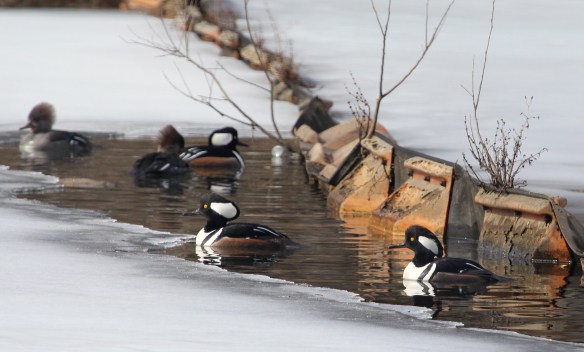
Hooded mergansers in New England.

I have written extensively about the recent study that shows bird populations in North America have dropped by 29 percent over the last 50 years. While the news overall is concerning, the study did reveal some bright spots.

One piece of good news is that ducks appear to be increasing. Waterfowl are a favorite bird type of mine so this news was heartening. Give me a cool late autumn day, a large pond, a spotting scope and ducks swimming all around, and I’m as happy as a lark.

The duck population increase, in large part, is credited to wetland conservation efforts, much of which was and continues to be paid for by hunters. While this has worked exceptionally well for ducks, it hasn’t worked out quite as well for rails and other marsh birds. There is still work to be done in that area.

But let’s stay positive for this column. Preserving wetlands has led to increased duck numbers. No one can say more ducks is a bad thing.

It also stresses the importance of land conservation as a powerful tool in preserving our birds and other animals. While hunters, through the purchase of stamps and other fees, have contributed mightily to this effort, conserving land is something easily done by anyone. Support your local land trust or other conservation organization Continue reading

For the Birds: Vultures add to spooky scene

Photo by Chris Bosak
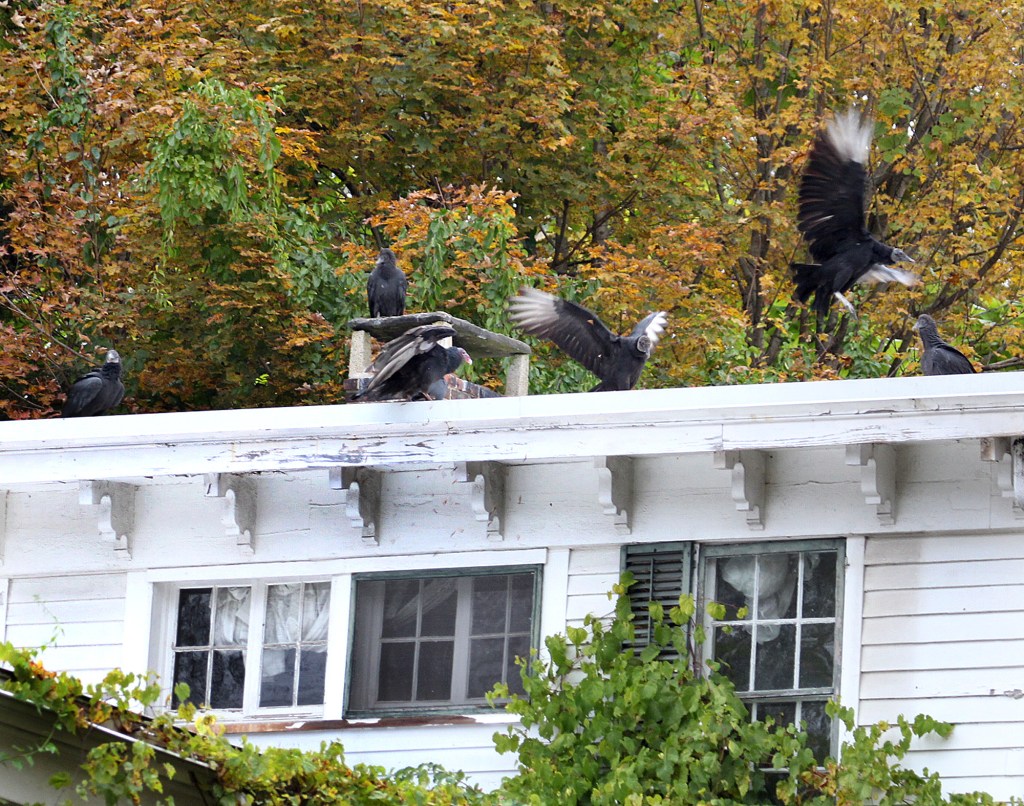
Turkey and black vultures perch on the roof of a house in New England, fall 2019.

Savanna and I reached the overlook and watched a bald eagle soaring above a sizable flock of Canada geese. The geese knew they were too big to be a target for the huge bird of prey so they went about their day as usual on the river.

After a few minutes, the bald eagle landed on a half-dead tree along the shoreline and settled in on its perch overlooking the slightly rippling water. Before we left the spot, a gang of blue jays flushed a sharp-shinned hawk out of an evergreen. We tried to follow the small hawk’s path but quickly lost sight of it among the trees growing up from the side of the cliff.

We returned to the car and pulled out of the parking lot, listening as a Carolina wren and late-staying gray catbird sang from the nearby brush.

Then the outing took a creepy turn.

We soon passed a sign for a haunted village in another park nearby. It was midday and the haunted village wasn’t going to open for another week, but we decided Continue reading

For the Birds: Summer’s last grasps

Here is the latest For the Birds column, which runs in several New England publications.

Photo by Chris Bosak An osprey eats a catfish at Cayuga Lake State Park, October 2019.

Summer is hanging on, if only by a thread.

It’s always fun to see the nutty people who refuse to dig into their long-dormant jeans pile and insist on wearing shorts even when the temperature dips into the 40s. I see one of those yokels every time I walk past a mirror.

In the natural world, some flowers are still putting on a show, but it’s mostly the late bloomers such as goldenrod and asters. Some, but not many, traditional summer bloomers are toughing it out, but store-bought mums are the most commonly seen flowers these days.

The other day I walked past a pollinator garden and a monarch caterpillar stuck out like a sore thumb on the top of a milkweed plant. I hope the caterpillar does what it has to do quickly before the prolonged deep freezes come. It also made me think of all the fields that have been cut down already and I wonder how many monarch caterpillars lost their homes because of it.

Eastern phoebes, which are one of our first migrants to appear in spring with their late March arrivals, are still seen from time to time. I saw a few perched over a pond and bobbing their tails last week. The tangle of brush a few yards away from the pond was teeming with white-throated sparrows, however; a sure sign of fall and pending winter.

I had another exciting reminder of summer during a recent camping trip I took with some long-time friends. We were having breakfast at the picnic table when Wayne pointed to a distant snag and asked: “Is that a hawk or what?”

We grabbed the binoculars and trained them on an osprey eating a fish. We closed in on the dead tree for a closer look and noticed the bird was eating a fair-sized catfish. No blackened seasoning was necessary as the “fish hawk” tore through the skin and into the meat of the fish. Anyone who has ever caught a catfish knows how tough that skin is. The osprey didn’t struggle in the least.

I attended a presentation last week by Alan Poole, the author of two books on osprey. His latest book is “Ospreys: The Revival of a Global Raptor.”

Poole noted interestingly that an osprey has self-sharpening talons. The hard upper part of the talon, or claw, grows at a faster rate than the softer under part of the talon, leaving the large bird of prey with sharp claws at all times.

The osprey we watched did not push the timetable too far, but most ospreys in New England and nearby states have started their journey south by the end of September. Ospreys are not like most hawks and eagles whereby some individuals remain north throughout winter. All ospreys go south so to see one in October is a nice treat for a birdwatcher.

Poole noted that, while ospreys do mate for life, they go on separate migratory journeys.

Much of Poole’s presentation focused on the amazing comeback of the osprey population. After being nearly wiped out in the 1950s due to heavy pesticide use, the osprey has made a remarkable comeback and is now flourishing in North America and northern Europe, as well as on their winter grounds in South America and Africa.

The population turnaround is welcomed news considering the study released a few weeks ago that shows that North America has lost 29 percent of its birds in the last 50 years.

Poole concluded his presentation with this: “Ospreys are a good example that we can get things right if we pay attention and get organized.

For the Birds: DIY steps to help save birds

Here’s the latest For the Birds column.

Photo by Chris Bosak
Tufted titmice gather near a container with coneflower during November 2018. Coneflower is a native plant that attracts birds.

The study released a few weeks ago that reported a 29 percent decline in the number of birds in North America since 1970 did not merely throw out some discouraging facts and leave it at that.

It also included many reasons why bird populations are decreasing, most notably habitat loss. There is not a whole lot the average person can do about habitat loss — other than plead with local officials to stop the development of critical habitat. But the authors of the study did include seven actions that we can all do to help improve birds’ chances of survival.

The actions are as follows: use native plants, avoid pesticides, keep cats indoors, make windows safer, do citizen science, reduce the use of plastic and drink shade-grown coffee. Now, let’s take a closer look at each of these actions.

Planting native flowers, bushes and trees gives birds and insects a source of food they have evolved with. It restores the natural balance of an area and limits the spread of invasive plant species. A simple internet search will yield dozens upon dozens of bird-friendly native choices for your garden and yard.

Pesticides should be avoided for much the same reason. Killing off insects, especially native insects, limits the food available for birds. Many birds rely on insects as the main part of their diet. This is particularly important during the nesting season as birds feed their youngsters and teach their fledglings how to hunt. If an area is void of insects, it is likely void of birds.

I know how difficult it can be to keep cats indoors. Most cats want to be outdoors and it’s hard to deny them that desire. My cat sneaks out on occasion when I have my hands full of groceries and the screen door closes too slowly, so I have work to do in this area as well. But it really is in the birds’ best interest to keep kitty inside. Feral cats? That’s another bigger problem.

If you have some particularly problematic windows that bird keep crashing into, consider buying decals to put on the outside of those windows. The decals are relatively unobtrusive and may be found at bird stores or online. The decals break up the scene that may otherwise be confused as an extension of the outdoors. Building windows? That’s a way bigger problem that many developers are starting to address with bird-friendly design.

Participating in citizen science projects such as the Great Backyard Bird Count, Christmas Bird Count and Project Feeder Watch gives important data to ornithologists that they use to track bird population trends. In fact, this data was a key source of information for the latest study.

There are several easy steps to take to reduce the amount of plastic used. Reusable water bottles, although many are made of plastic, greatly reduce waste. Filling a water bottle each morning instead of drinking two or three store-bought waters has a great impact over the course of time. 

Similarly, reusable shopping bags reduce the need for the one-time use plastic bags. That also keeps those annoying bags out of trees, which I often mistake for birds from a distance.

Industrial-scale coffee plantations are an environmental nightmare as large swaths of land are clear cut on many birds’ winter grounds. Thankfully there are many bird-friendly, shade-grown options. Birds and Beans brand is based in New England.

Employing some of these strategies will help the birds that live in and around your property. It may seem like a drop in the bucket compared to the 2.9 billion birds that have disappeared in the last 50 years, but enough drops will eventually overfill a bucket.

For the Birds: Decline is worrisome, no matter what

Photo by Chris Bosak A European Starling in winter plumage perches on an old sunflower stalk, Dec. 2014.
Photo by Chris Bosak
A European Starling in winter plumage perches on an old sunflower stalk, Dec. 2014.

The study released two weeks ago by the journal Science is worth another look.

As you recall from last week’s column, a collaboration of top bird and conservation organizations performed perhaps the most exhaustive study of the North American bird population and released the results two weeks ago.

The study, which reported a decline in the bird population of 29 percent or nearly three billion birds over the last 50 years, garnered significant attention in the media and science arena. The attention is well deserved as the results are quite shocking and put a number on the decline of birds, which we all knew was happening to some degree.

Most of the immediate media attention focused on the precipitous drop in bird populations and echoed the report’s call for significant action to be taken before it’s too late. That call to action is certainly appropriate and the report most definitely is a wake-up call to everybody on the planet. Some analysts, however, upon taking a deeper dive into the report’s number, see it as not the doomsday scenario that many are painting it to be. They acknowledge, for sure, that it is a big problem and steps should be taken to reverse the trend, but they say mass extinction is not imminent.

According to an article published by undark.org, a nonprofit organization that explores the “intersection of science and society,” the numbers inside the numbers show where much of the decline comes from. Citing a blog post by University of Maine macro-ecologist Brian McGill, the article states that a significant portion of the decline comes from invasive species. House sparrows and European starlings account for 15 percent of the net loss of birds.

On the other hand, if highly adaptable birds such as house sparrows and starlings are declining so much, then something is wrong.

Other sources in the undark.org story point out that most of the top 40 declining species are very abundant and an extinction is not around the corner. Taking the top 40 declining species out of the picture, more bird species are increasing rather than decreasing.

To me, the loss of three billion birds is significant regardless of the particulars. Look at it this way, if we’ve lost 29 percent of our birds, then instead of seeing 100 birds a day, we’d see 71 birds. That’s an oversimplification, of course, but paints a picture of how dramatic the decline is.

The research team, including the American Bird Conservancy, Audubon Society, Cornell Lab of Ornithology, Smithsonian Institute, U.S. Geological Survey and Canadian Wildlife Service, launched the website 3billionbirds.org after releasing the study. The site includes text, graphics and videos to augment the media coverage the report has already received. It also includes steps you can take at home to help save birds.

I’ll take a look at those steps in next week’s column. In the meantime (warning: spoiler alert), keep kitty inside and don’t spray your plants.