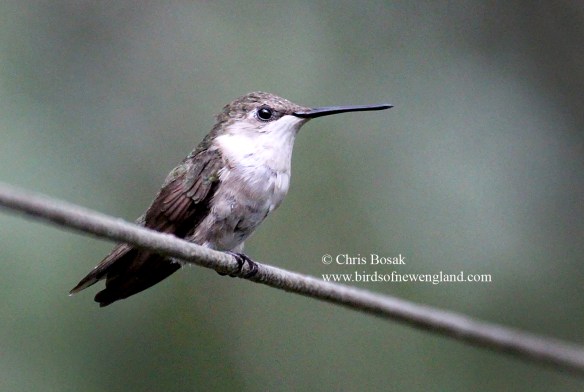
Photo by Chris Bosak A female ruby-throated hummingbird sits on a rope in a backyard in New England, August 2020.
I wasn’t the only one who enjoyed watching the hummingbirds ignore the stormy weather of Aug. 4 and visit the feeders. As you’ll recall, last week I wrote about the tiny birds going about their day as usual as rain fell and wind whipped all around.
I heard from Deb from Royalston, Mass., who said her hummingbirds “had no problem with the fierce winds and rain. All this year’s babies are there now, so we had more than a dozen.” She said it was hard to count them there were so many. I, of course, had only one visit my feeder that day as it was a dominant female who “owns” the feeder.
Jill from Keene wrote: “I too was amazed during the storm the hummingbirds seemed unfazed.” Jill also had a peaceful gathering of hummingbirds and sent me a few photos showing six of them on the feeder at once.
“They did not fight much at all and it was eerily quiet as I usually have several swooping and ‘chirping’ noisily,” Jill added.
A few days later, Jill wrote to say: “The peaceful dinner party was really an anomaly, as they are back to fighting and chasing each other!”
Photo by Chris Bosak A female ruby-throated hummingbird hovers in a backyard in New England, August 2020.
Tropical Storm Isaias really put on a show as it blasted its way through New England. Wind, rain and tornado warnings ruled the day last Tuesday as the storm packed a bigger punch than expected.
My sons and I stood on the screened-in porch and watched as 50 mph winds roared through the woods in the backyard. We ignored the occasional rain that wind gusts blew through the screen. Small maples bent like those inflatable tubes you see outside some businesses. Dead or dying ash trees threatened to topple and, indeed, many did throughout the neighborhood. We were lucky. At one point we heard the alarming sound of a huge tree or branch cracking. I was ready to scramble into the house for protection, but Andrew pointed out that the fracture was occurring in the woods safely away from the house. He pointed out a massive branch high around the top of a gigantic oak tree that had peeled away from the trunk. It never did fall as it got stuck among the canopy branches of nearby trees.
We lost power before 2 p.m. Tuesday and, as I write three days later, it hasn’t been restored. It may take a few more days as trees and power lines are down all throughout the neighborhood. We are hardly alone. More than a million households lost power throughout New England, including more than 700,000 in Connecticut alone.
It’s safe to say Isaias was a major event. I won’t soon forget the sights and sounds of the beast roaring through the woods and leaving a wake of destruction as it headed north. Through it all, believe it or not, my hummingbirds visited the feeder as if nothing was happening. I have three hummingbirds that visit daily: two females and one male. One of the females rules the roost and is constantly chasing the others away. She sat contentedly on the feeder as those 50 mph winds violently swayed the clothesline on which it hangs. The boys Continue reading →
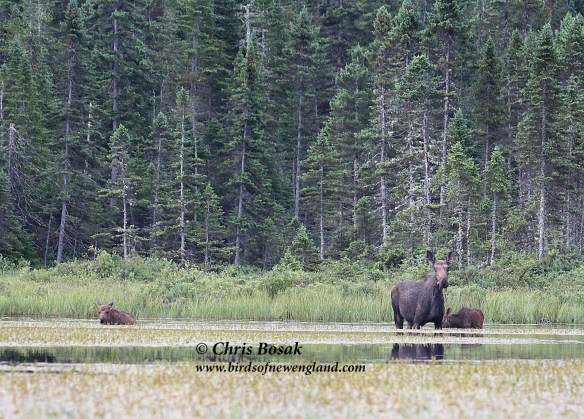
Photo by Chris Bosak A cow moose and two calves eat aquatic vegetation from a pond in northern New Hampshire, July 2020.
I never met Bill Silliker Jr., but I am a fan of his work. He was a nature photographer who passed away in 2003. He was based in Maine, and his specialty was moose. His work graced calendars, magazines, books, you name it. The other day I pulled his book “Moose — Giant of the Northern Forest” off the shelf. He wrote it in 1998 and it is, of course, richly illustrated with his fantastic moose photos.
Again, I never met Mr. Silliker, but his writing comes across as down-to-earth, compassionate and deeply caring about the animals he photographed. The book’s chapters discuss various aspects of moose: history, behavior, rut, etc. At the end of the book, he discusses the many threats to moose. Among them are car and train accidents, predation by bear and wolves (Alaska and western U.S.), and humans by way of pollution and habitat destruction.
He also notes that brainworm “may be the most serious health hazard moose face in regions where their range overlaps with that of the parasite’s carrier, the white-tailed deer.” That concern is indeed playing out, particularly in southern New England, where brainworm is thought to be the chief enemy of the moose population, according to biologists in the region.
Mr. Siliker also writes that tick infestations “sometimes play a role in depleting the health and resistance of moose.” Fast forward 20 years from the book’s publishing and ticks have Continue reading →
Photo by Chris Bosak A cow moose and a calf eat aquatic vegetation from a pond in northern New Hampshire, July 2020.
It’s going on 30 years that I have been making frequent trips to the northern tip of New Hampshire to look for moose and other wildlife. Thirty years? Hard to believe.
I’ve seen a lot of changes in the Great North Woods over the decades, some positive and some negative. Granted, the trips have become less frequent lately, but I still try to make it up at least once a year.
A positive I have noticed is an increase in loon and bald eagle sightings. Both those species have bounced back from low population numbers and now seem to be doing much better. That is thanks in large part to groups like the Loon Preservation Committee, which Continue reading →
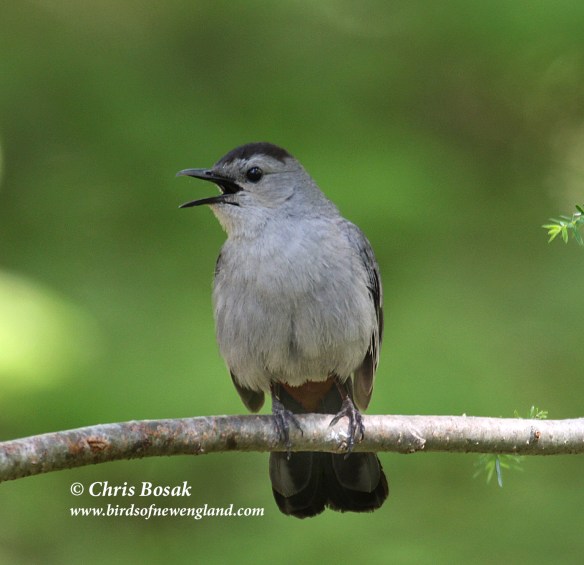
Photo by Chris Bosak A gray catbird perches on a branch in New England, July 2020. Merganser Lake.
Look up “wood duck” in a cheap field guide and you’ll likely see a beautiful duck with green, pewter, tan, white and even some blue plumage. That is, indeed, a wood duck — a male wood duck in its breeding plumage.
If you saw a female wood duck, immature wood duck or male wood duck in its non-breeding plumage, you’d never find it in that field guide and you’d have a hard time believing someone who told you it was a wood duck because it looks nothing like the beautiful bird in the field guide.
Sometimes field guides lie. Well, they leave out a lot of the truth at least. There are top-quality field guides out there and even they can’t portray every bird in every possible plumage. Between the breeding, non-breeding and transitional plumages, it’s impossible to fit every variation of every bird into a book. That’s not even to mention all the other plumage oddities, such as leucism, albinoism and other conditions.
The same can be said for bird sounds as well. There are dozens of apps and websites out there now that feature bird sounds, but as terrific and helpful as they are, they can’t Continue reading →
Photo by Chris Bosak
A female ruby-throated hummingbird visits a flower in New England, July 2020.
Here’s the latest For the Birds column, which runs weekly in several New England newspapers …
Apparently, all I had to do to get my hummingbirds back this summer was complain to my neighbor.
I had had frequent visits from both male and female hummingbirds early in the spring. The daily visits continued for a few weeks and then stopped abruptly. Last year, and the year before that, the visits never stopped and I saw them daily until the fall.
This year, June was largely a hummingbird-free month in my backyard.
During a walk around the neighborhood last week, I noticed a neighbor had bird feeders on her deck so I stopped to chat about what birds she had been seeing. She had a few of the usual suspects but didn’t mention hummingbirds.
I inquired about the tiny birds and she said: “Yes. I see them every day.”
“That’s great,” I replied. “I haven’t seen mine in a while.”
I went on to bore her with the details of my previous years’ good fortune. She feigned interest, we chatted a little more and then said goodbye.
The birding gods must have heard me griping and took pity on me because, the very next day, a female hummingbird showed up at my feeder. She has been back every day since, too. It is very territorial as I have seen her chase away other hummingbirds. Another female and a male have started showing up now and then, too, when the queen is away.
In previous years, a female has dominated my feeders throughout the summer so I wonder if she is the same bird I have been seeing for years. At any rate, it is nice to see the hummingbirds back in the yard. It is also nice to know there are several of them, even if I get only brief glimpses of the other ones before they are chased away.
I have a few feeders and several flowers to lure the hummingbirds. She prefers the feeders, but on occasion will sip from the flowers. This year, most of my flowers are red salvia, an annual with tubular shaped blooms. In the past, I’ve seen hummingbirds visit my coneflower and even sunflowers.
Complaining usually doesn’t solve problems and often makes them worse, but in this case, things worked out pretty well. I plan to take a trip to northern New England in a few weeks in the hopes of finding some of New England’s disappearing moose. Maybe I should proactively start complaining now in the hopes of getting the same results for that trip?
Photo by Chris Bosak
A rose-breasted grosbeak perches on a branch in New England, June 2020. Merganser Lake.
So much for taking a break from feeding the birds.
I mentioned in last week’s column that I had taken down my feeders for the summer as my visits had dwindled to a few species. I also mentioned that I continued to maintain a large platform feeder on my deck to keep those few birds happy. Well, that platform feeder is busier than ever.
One day last week, while working from home and using the outdoor table on my deck as my office for the day, I watched as chickadees, nuthatches, titmice, catbirds, cardinals, blue jays, house finches, downy woodpeckers and red-bellied woodpeckers helped themselves to the offerings.
The feeder, which is nothing more than a large, flat board I found in the basement, is big enough to hold a variety of foods: sunflower seeds, mealworms, suet nuggets and thistle seeds. I nailed a few small branches around the edge of the board to keep the seeds in place during windy days.
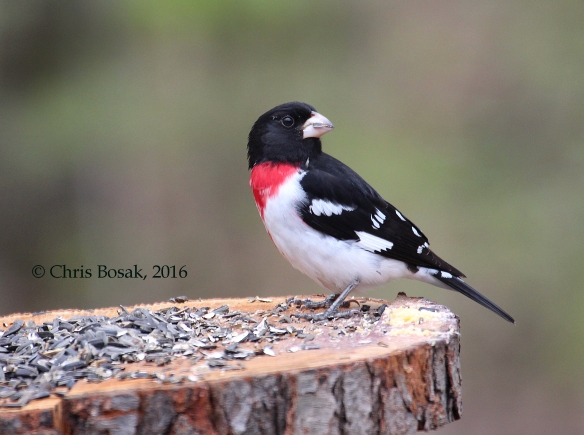
I was already pleasantly surprised by the variety of birds that were coming when a male rose-breasted grosbeak landed on the board. Thankfully, I had the foresight to bring the camera out to the table with me. I was quite sure the strikingly beautiful bird would take off as soon as I lifted my arms to grab the camera off the table as I was sitting only 9 or 10 feet away from the feeder.
Slowly I moved my arms and watched as the black-and-white bird with a bright red triangular bib looked back at me. I was relieved when the bird looked away and started grabbing sunflower seeds. Still, I couldn’t risk double-checking my camera settings or autofocus point and I started photographing away. The settings were fine, luckily, and I got some nice, full-frame shots of the handsome songbird.
What also made the day special was that many of the birds that visited, especially the chickadees, titmice and downy woodpeckers, were first-year birds still gaining their adult plumage. The young woodpeckers usually arrived with a parent and watched and learned. It was amazing to think that some of these birds were born only a few weeks prior. I hope they visit for years to come and can avoid the many dangers birds face as they grow.
So I guess my summer feeding break isn’t going to pan out, which is fine with me. I’ll continue to enjoy the show as long as it lasts.
Photo by Chris Bosak A Rose-breasted Grosbeak visits a homemade platform feeder in Danbury, Conn., on May 6, 2016.
Photo by Chris Bosak
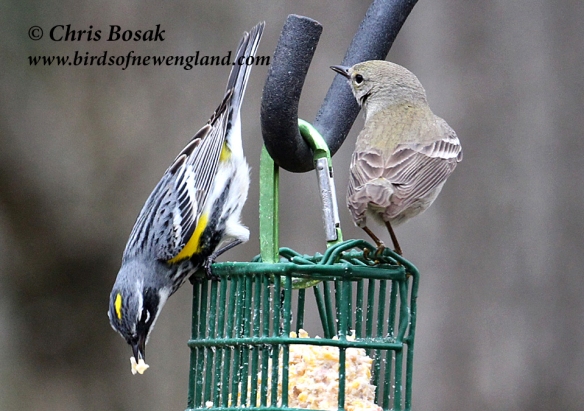
A yellow-rumped warbler and pine warbler share a suet feeder in New England, April 2020. Merganser Lake.
I cut back on my bird feeding last week as my visitors have dwindled to a handful of species.
I am still putting out enough to keep those birds coming back and happy, but I retired many of the feeders until the fall. A big, homemade platform feeder is still on the deck keeping the downy woodpeckers (family of four), cardinals, catbirds and house finches around.
At my previous houses, by this time of year only house finches would be coming around so I would stop feeding altogether in the summer. With the nice variety of birds still coming around, I will continue to throw out a little seed and suet.
Taking down some of the feeders made me think about what a strange year it has been for feeding birds, at least in my yard. I have been feeding birds for decades now and this year marked several firsts. It started in February with the eastern bluebirds. I have never had bluebirds at my feeding station before this year, so you can imagine how thrilled I was to see them arrive. They showed up every day from February until the end of May and even brought their youngsters around for most of May. I still don’t know exactly where they nested, but it must have been somewhere fairly close. It was surprising because there isn’t what I would consider typical bluebird nesting habitat anywhere in my neighborhood.
I have seen catbirds at my feeders before, but only on rare occasions and it has been years since the last time. This spring and summer, however, I am getting at least two different catbirds visiting every day eating suet. They are bold and noisy, belting out their cat-like mew from mere feet away from me. Speaking of suet, it was the attraction that lured my first Baltimore orioles. I have tried for years to attract orioles with all of the things that are supposed to attract them, such as grape jelly, orange halves and nectar (similar to hummingbird food but less sugar). No luck. This year, they visited for several days in late April and early May and always went right for the suet. I hear them calling from high in the treetops on occasion still, but I haven’t seen them at the feeders since early May.
I’ve also never had robins at my feeder before. This year, they visit daily to grab a few mealworms. Mealworms were the main food source that kept the bluebirds coming back as well.
Earlier in the spring, I had daily and frequent visits from pine warblers and yellow-rumped warblers. I have had pine warblers in the past, but that was about three years ago. I had never had yellow-rumped warblers before this year and several showed up daily for weeks on end.
After all these years of feeding birds, it seems strange to get so many first-timers and ones I hadn’t seen in so long all in the same year. Could it be that they have been coming all these years and I just never noticed because I’ve been going off to work every day? Has the opportunity to work from home allowed me to see things that I’ve been missing previously? I don’t think that is the case as even in years when I am going to work daily, I still have mornings, evenings and weekends to stare at my feeders.
There must be another explanation. But what is it?
I don’t know the answer, but I will think of some theories as the summer wears on and the birding continues to be relatively slow. At any rate, I am not complaining, of course, it has been great to see all these new birds in the yard.
Photo by Chris Bosak
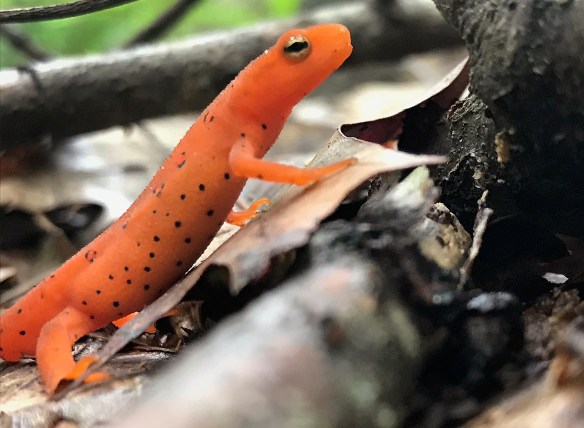
An eft works its way through the woods in Danbury, Conn., during the summer of 2018.
To err is human and I am about as human as they come.
Of course, no one is perfect and trying to solve nature’s mysteries is fraught with pitfalls.
I was walking down a trail one morning not too long ago. It had rained heavily the night before and the trail was damp. I had to watch my step because there were so many efts on the trail. I remembered a time when I mistakenly referred to the bright orange amphibians as newts.
I wasn’t completely off base, of course, as efts are the terrestrial stage of the newt. After being born in the water and then crawling around the ground as an eft for a while (sometimes a few years), they return to the water to live out their time as a newt.
That is just one example of many mistakes and misidentifications I used to make. I’m sure there are some things I currently mistakenly identify and there will certainly be things in the future that I errantly call the wrong name.
Here are some examples I often hear from others that are not correct. There is no judgment, of course, as we have already determined that no one is perfect.
I think I hear the “fisher” called a “fisher cat” more often than its proper name. The fierce, large member of the weasel family is simply called a fisher, no “cat” necessary. Indeed, it is not a cat at all. It is a weasel. Now that the red-bellied woodpecker is expanding its range north throughout New England, it is a good time to remind everyone that it is not actually a red-headed woodpecker. The red-bellied woodpecker does indeed have a mostly red head, but the name red-headed woodpecker is already taken by a bird that does indeed have a fully red head. Adding to the confusion is that the reddish-pink belly of the red-bellied woodpecker is not often seen and not an obvious field mark.
Here’s a tough one that took me years and years to get: the difference between a house finch and purple finch. They look very similar and many people automatically default to the purple finch, which is understandable as it is the state bird of New Hampshire and native to New England. House finch, however, is far more common these days even though they are transplants from western U.S. Purple finches are more colorful (at least the males), slightly larger and have more substantial bills. No, not the type of bills that are due every month.
I often hear people think an owl is singing during the day when they hear a mourning cooing. The mourning dove’s song does have an owl-like quality to it, but it is softer and unique to the dove. The owl that typically sings during the day is the barred owl and its song is much more gruff sounding than the cooing of a dove.
Finally, the osprey is sometimes confused with the bald eagle. Both are large, majestic birds of prey with white heads found near water so the confusion is understandable. The best way to tell them apart is by size. As impressive as the osprey is, the eagle is substantially larger. The typical wingspan of an osprey is about five feet, while an eagle’s is six-and-a-half feet. Also, the underside of an osprey is white and that of an eagle is brown. Either way, it’s great to see the population of both species rebounding so significantly.
In the end, whether people get the name or identification correct pales in comparison to the species being noticed and appreciated.
Photo by Chris Bosak
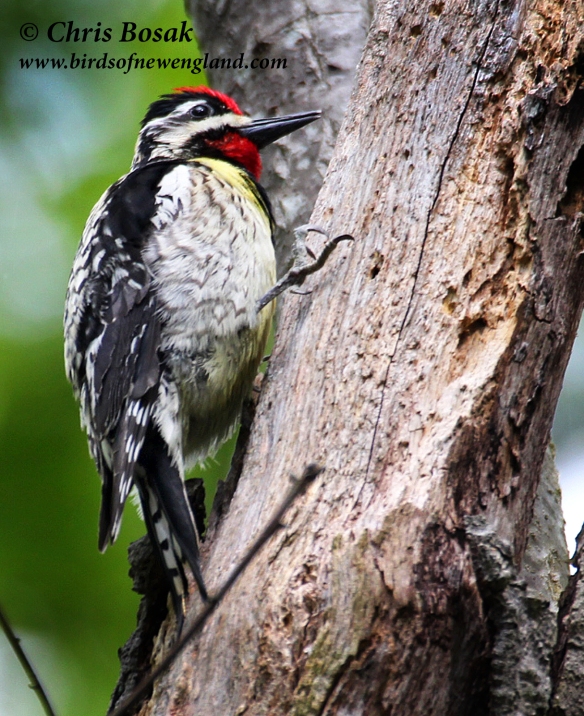
A male yellow-bellied sapsucker perches on a dead tree branch in New England, June 2020. Merganser Lake.
I am quite sure I am not his intended target, but when the yellow-bellied sapsucker drums on the hollow branch in my side yard, I come running. I mentioned in last week’s column that I have a yellow-bellied sapsucker that drums on a branch in my side yard and a pileated woodpecker that drums on a branch in the backyard. Woodpeckers often drum on objects such as hollow branches, the sides of houses, gutters, and chimney flashings. They pick objects such as these because the noise resonates far and wide. This drumming is done to attract mates or announce territory. Obviously, they do not tap on gutters or chimney flashings to find food or make homes.
They may pick hollow branches to make homes, naturally, but the territorial and mate-attracting drumming is more rhythmic and the cadence is specific to individual woodpecker species.
I also mentioned in last week’s column that I was impressed the first time I saw a birdwatcher identify the type of woodpecker from its drumming in the distance. I still do not have that skill down very well, but I am getting a lot of practice distinguishing the yellow-bellied sapsucker and the pileated woodpecker. Just as it is exciting when a bird chooses your property to eat, drink, or make a home, it is also exciting when a woodpecker chooses a branch on your property for its drumming.
It may not be so exciting when they return to your siding, gutter or chimney flashing for this purpose, however. If this is happening, there are measures you can take to try to stop it. Of course, nothing is a guarantee when we are talking about wildlife.
There are literally dozens of products on the market to deter woodpeckers from tapping on your house. Do a simple Internet search for “stop woodpecker damage” and they will all pop up.
New England has several woodpecker types. Most of New England has the aforementioned yellow-bellied sapsucker and pileated woodpecker, as well as downy and hairy woodpecker, and northern flicker. Southern New England and increasingly the middle part of the region also has red-bellied woodpecker. The northern part of New England features the black-backed woodpecker and, to a lesser degree, the American three-toed woodpecker.
The red-headed woodpecker is also an occasional sighting in New England. Many people mistakenly call the red-bellied woodpecker the red-headed woodpecker because it does indeed have a red head, or at least mostly red. The red-bellied woodpecker has a faint pinkish wash on the belly, which gives it its name. The red-headed woodpecker, indeed, has a fully red head. They are more common south and west of New England but, as I mentioned, are occasionally seen in our region.
This is just my own theory, and it hasn’t been scientifically proven to my knowledge, but the dreaded diseases that have ravaged so many of our tree species have greatly benefited woodpeckers. They build their nests in dead trees and branches, and sadly, between hemlock woolly adelgid, chestnut blight, Dutch elm disease and locust borers, they have plenty of dead trees to choose from. And, of course, lots of drumming branches.