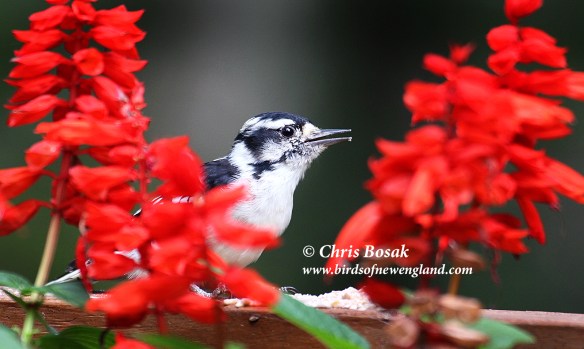
Here’s a random happy bird photo to kick off your Labor Day Weekend. It’s a female downy woodpecker between salvia stalks. Salvia is an annual that is good for attracting hummingbirds with their red, tubular flowers. Have a great long weekend!

Here’s a random happy bird photo to kick off your Labor Day Weekend. It’s a female downy woodpecker between salvia stalks. Salvia is an annual that is good for attracting hummingbirds with their red, tubular flowers. Have a great long weekend!

Happy Friday everyone. Here’s a random photo just because.
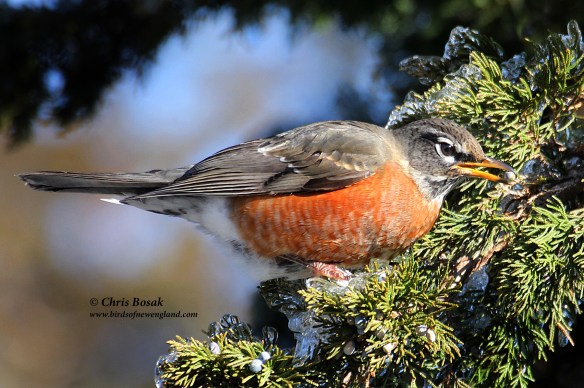
Any photographer, regardless of subject interest or specialty, will tell you about the importance of always having your camera handy because you never know when those special moments will happen. I rarely follow that advice, truth be told, even though I’ve preached that advice many times. I did, however, happen to have my camera handy at work the other day when a flock of robins gathered in a cedar tree to pick at the small, blue berries. Maybe this will be the impetus for me to have my camera at the ready more often. Time will tell.


I’m sure there’s a funny caption to be had for this photo, but I can’t think of it right now. I caught this guy red-handed and looking guilty as anything as he ate the remnants of a pumpkin left over from Halloween. Feel free to send me your caption …

You didn’t think I’d stop at just a couple kinglet photos, did you? Continue reading

Here are two more shots of the nuthatch taken with the borrowed Continue reading

My friend Ellen was excited to show me her new Canan f2.8 lens with a range of 70 to 200mm. She asked if I wanted to borrow it for a week and I said yes (of course). With 200mm as the maximum zoom, its capability as a wildlife photography lens is limited, but still very useful for some circumstances. Many of the days were overcast and that made the 2.8 aperture very handy. It is also a high-quality lens so even subjects that are a bit distant will still be sharp.
I experimented with the lens mostly in the backyard where I know I have a steady supply of subjects near the birdfeeders. White-breasted nuthatches turned out to be the best subjects as they perched in a tree close to the feeders before coming to get a seed. Here are some of the results. Continue reading

This blue jay apparently does, especially since they are really peanuts.

Here’s an interesting scene I came across the other day during a walk at Deer Pond Farm, a property of Connecticut Audubon in Sherman, CT. Phoebes are one of the first migrants to arrive in New England in the spring and one of the last to leave in the fall.

Yesterday, I featured the American redstart in this series. Today, it’s another warbler without the word “warbler” in its name. The common yellowthroat is one of the more commonly seen warblers in New England. They breed throughout the region and are therefore seen from late April into the fall. Pictured is a male with its bandit-like eye mask. Females are a duller yellow and lack the distinctive markings of the male.
 Birds of New England.com