For the Birds: Helping birds this summer

Photo by Chris Bosak A young pileated woodpecker knocks on a fallen tree trunk as it looks for insects, Danbury, Conn., summer 2019. Dead trees are valuable to birds as homes and food sources.

It may be early in the summer season, but it seems like a good time to prepare for the hot days ahead.


Here are some things you can do to protect and help birds this summer:


Feeding hummingbirds is one of the great joys of summer in New England. No matter how many times they have visited already, it is always a thrill to see one land on your feeder, or better yet, feed from flowers planted in your yard. It is important, however, to keep the sugar water fresh and the feeder clean.


Sugar water should be changed every couple of days during hot weather. It can be a bit cumbersome, I know, but it is worth the effort as it keeps the birds happy and safe. Also, sugar water should be made with four parts water and one part sugar, and that’s it. No red dye. It’s unnecessary and potentially harmful to the tiny birds.

Continue reading

Sandhill Cranes in New England

Kevin Peters sent in these terrific photos of a sandhill crane family he saw last week (mid-June 2022) east of Plainfield, Massachusetts. I’ll add these to the Reader Submitted Photos page on this site, but I thought sandhill cranes in New England warranted a post of its own. According to eBird reports, other people have reported sandhill crane sightings in the Berkshire region this year. Numerous sources say sandhill crane sightings are increasing in New England. Definitely something to keep an eye on. Thanks for the photos Kevin!

From reader Jim Smart of New Hampshire: Baby Robin Eric and I

Baby Robin Eric and I
by James G. Smart

On the morning of July 1, this year (2021), I walked out between our screened-in porch and a row of arbor vitae trees. I saw a cute little toad. Ah, how nice I thought. Not far from the toad was a bigger surprise—a baby robin, looking cold and afraid. We had had a strong wind storm the night before and I saw where the robin’s nest was overturned. I ran to my wife, Eleanore, and asked “Should we let nature take its course”? Or should we rescue the baby robin, knowing full well, we would rescue the baby robin.


Thus began the story of Eric. I decided to name him after Leif Erickson, the ancient traveler and wanderer. Eleanore thought I should be sole parent realizing his diet had to be consistent and that live worms would soon be his main diet.


Eleanore fixed up a nice cardboard box for him padded with paper towels. I returned outside and picked him up. He had no feathers on his rump. It was just red skin with hair on it. His little feet felt uncomfortable on my hand, a sensation I had never had before. Of course he has scratchy feet I said to myself—he’s a bird! I placed him in the box, went to the kitchen in search of food, found some blue berries and some leftover cooked farina. That was his first diet in his new home. He was so anxious to eat, it was hard to feed him. He yakked so much his bill often knocked the food out of my fingers. But he got enough.

Continue reading

For the Birds: Love those cooperative birds

It is hit or miss when it comes to photographing birds. It is mostly miss, but that just makes the hits even more rewarding.

Once in a great while, I have come across very cooperative birds. One of the more memorable times took place on a small lake in New Hampshire where a great blue heron stalked its prey on the shoreline as I silently approached in my canoe. The bird never broke its glance on its prey as my canoe drifted into range.

There have been a few times when a loon, or a loon family, has approached me in my canoe. Talk about a wonderful experience, especially when they sing or call from close range. There is no better wilderness experience than that.

Feeder birds can often make for a similar experience, but there is nothing like finding a cooperative bird in the wild. This particularly goes for birds that you otherwise wouldn’t see in your backyard. These moments come along often when I visit family in Florida, but New England birds are much more challenging.

Continue reading

Common yellowthroat, just because

Photo by Chris Bosak — Common yellowthroat in New England, spring 2022.

Here’s a shot of a male common yellowthroat. They are a common warbler that nests throughout most of the U.S. and into Canada. They migrate south in the fall, but in my observations, stick with us a little longer than many of the warblers.

For the Birds: The colors you’ll see

Photo by Chris Bosak An indigo bunting perches in a tree in New England, July 2021.

I’m not going to try to emulate Dr. Seuss, but I think he would have drawn plenty of inspiration from a walk in the woods in New England in May.

His classic “Oh, the Thinks You Can Think!” comes to mind, but only altered to “Oh, the Colors You Can See.”

A recent walk made me think of this. The majority of the walk was along a wide dirt path with shrubby habitat on both sides. Beyond the thickets on one side was a large field and beyond the thickets on the other side were deep woods. It is perfect habitat for a bird walk.

The first bird I saw was a male eastern towhee. It was once called rufous-sided towhee because of the unique dark orange color of its sides that complement the otherwise white and black plumage of the bird. The bird’s red eyes are visible when it approaches among the shrubs closely enough. I did not see a female towhee on this particular day, but they are lighter brownish-orange where the male is black.

Continue reading

One more bobolink photo

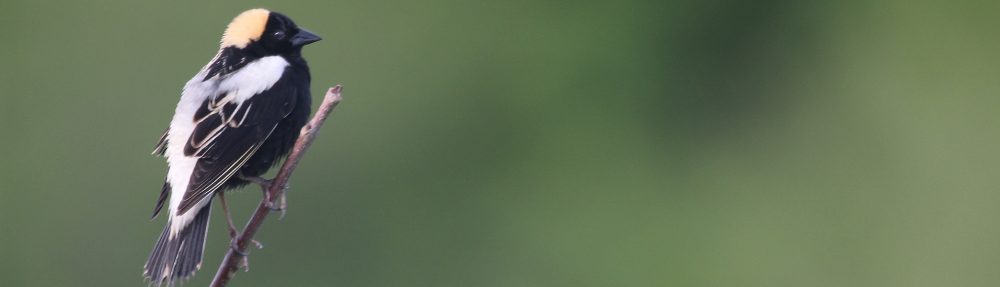
Here’s one more bobolink photo as a follow-up to my last post.

A walk among bobolinks

Photo by Chris Bosak — Bobolink in New England, May 2022.

One of the highlights of the post-spring migration rush in New England is to visit a field in New England where bobolinks nest. Luckily, I have one fairly close to where I live — Happy Landings in Brookfield, Connecticut. The bobolinks’ bubbly song (which reminds me of R2-D2) fills the air as red-winged blackbirds and yellow warblers provide an apt auditory background. Here are a few shots of a recent walk in the field.

Photo by Chris Bosak — Bobolink in New England, May 2022.

Photo by Chris Bosak — Bobolink in New England, May 2022.

Photo by Chris Bosak — Bobolink in New England, May 2022.

Memorial Day: Remember and honor

Photo by Chris Bosak — Wild turkey in New England, April 2022.

“Our flag does not fly because the wind moves it. It flies with the last breath of each soldier who died protecting it.”

– Unknown

For the Birds: That warbler looks like a thrush

Photo by Chris Bosak — Louisana waterthrush in New England, May 2022.

If it looks like a duck, swims like a duck and quacks like a duck, then it probably is a duck.

That great old expression doesn’t work for thrushes because a lot of birds look like thrushes but aren’t thrushes at all. So you can’t say: If it looks like a thrush, then it probably is a thrush.

Members of the thrush family in New England include wood thrush, hermit thrush, veery, Swainson’s thrush and Bicknell’s thrush. They are medium-sized birds, brown overall and their buff-colored bellies and chests are decorated with brown spots. American robins and Eastern bluebirds are thrushes as well but have their own distinctive appearances.

Thrushes are perhaps best known for their songs. Wood and hermit thrushes have amazing flute-like songs that sound otherworldly and have inspired many a line in poetry and literature.

Continue reading