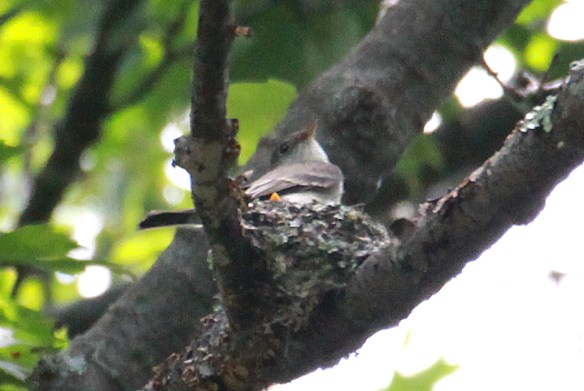
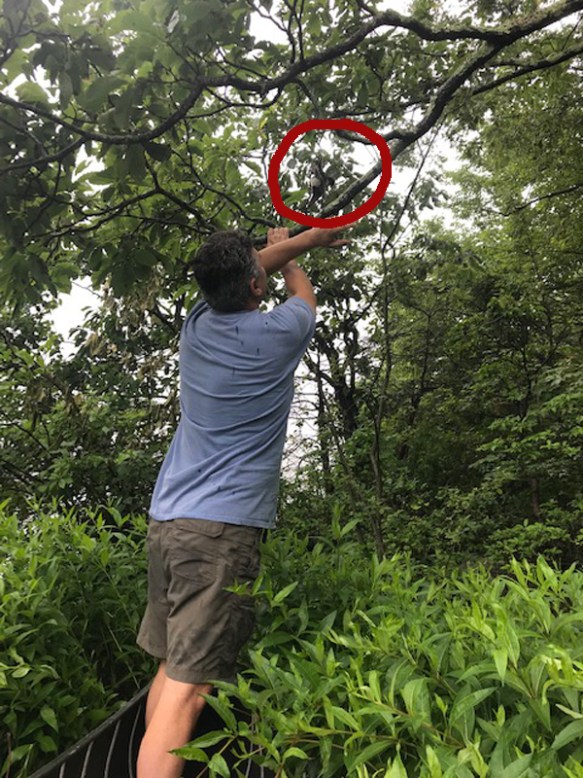
Photo by Chris Bosak An eastern wood-pewee sits on a nest in New England, summer 2019. The small orange thing at the edge of the nest is a newborn pewee.
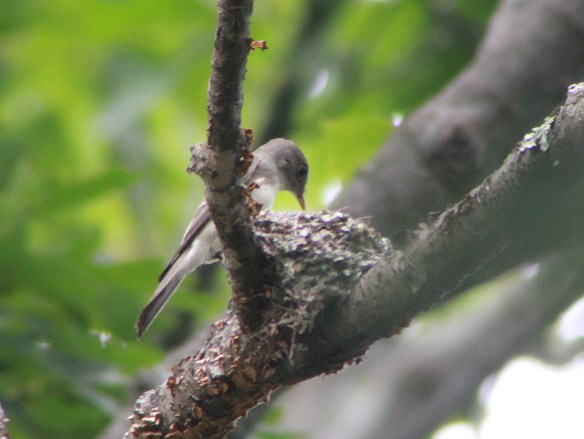
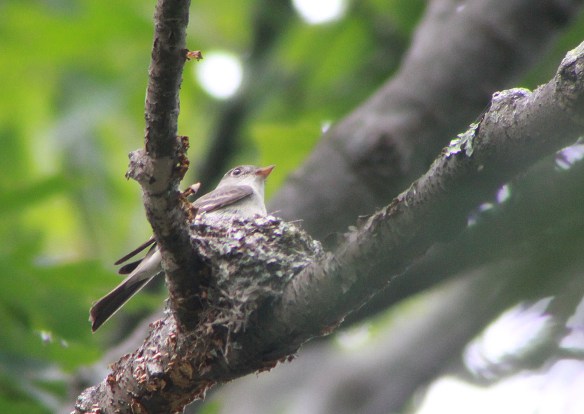
I was happy to find an eastern wood-pewee nest the other day. I found it quite by accident (full story coming next week in For the Birds column.) It’s about 40 feet high and in the Y of a dead branch in an oak tree. Finding a nest is always a thrill and this is the first eastern wood-pewee nest I’ve ever found, making it even more special.
Again, the nest is high up in a shaded area, hence the poor quality of the photos.
What nests do you have in your yard? Drop me a line and let me know.
Photo by Chris Bosak
An eastern wood-pewee tends to a nest in New England, summer 2019.Photo by Chris Bosak
An eastern wood-pewee sits on a nest in New England, summer 2019.
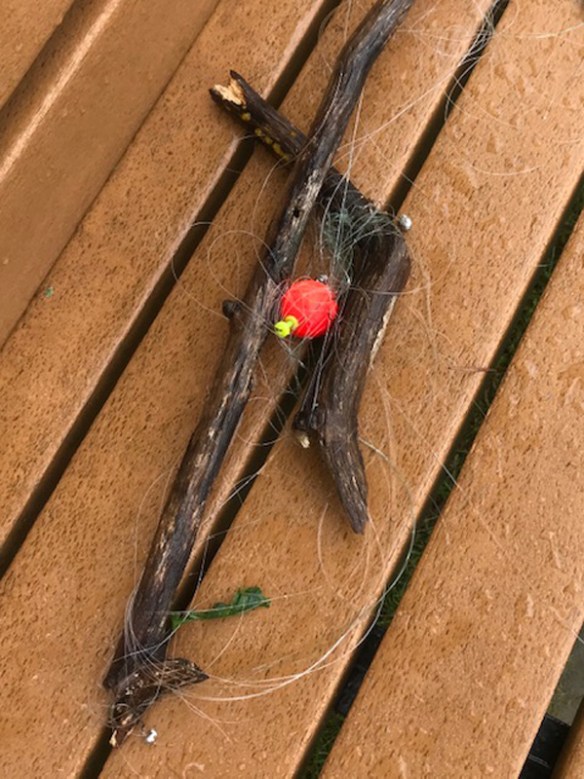
Last week I wrote about an adventure my son Will and I had freeing an eastern kingbird from fishing line. Will was fishing with some friends when he noticed a bird struggling frantically and dangling underneath a branch.
He ran to get me and we worked together to free the bird. There was still a lot of energy in the bird’s struggle, so I am guessing it wasn’t tangled for too terribly long. Otherwise, its struggling would have been less frequent and less energetic. Or even worse, it could easily have died if it had been there long enough without being noticed.
Unfortunately, death is an all-too-frequent result for birds that either become tangled, hooked or snagged by discarded fishing line. I recall years ago coming across the pathetic scene of a belted kingfisher dangling lifelessly above a small stream. Abandoned fishing line had snared the bird and no one found it until it was too late.
I also recall a few years ago seeing a red-throated loon with fishing line around its bill and head in Long Island Sound. This bird, however, was still alive and I even saw it catch a fish, so perhaps this bird’s situation had a better outcome. I had no way of catching the loon; I could only watch — hopelessly — from the shore.
Birds have a tough row to hoe to begin with in nature without having to deal with so many man-made obstacles. Windows, wind turbines, cell towers, cats, cars, and pesticides pose significant obstacles to birds worldwide. Loss of habitat, of course, is perhaps the most serious challenge we throw at birds. Add discarded fishing line to the mix and it’s yet another hindrance we add to decrease a bird’s odds of survival.
There are measures we can take to lessen this bird mortality. Decals on windows, keeping cats indoors, using only natural pesticides, and picking up discarded fishing line can all go a long way toward helping birds survive longer and increase their populations.
So, the next time you are out walking along a lake, river, or pond, and you see fishing line dangling from a nearby branch, grab it if it is in reach and discard of it properly. Whether it is your fishing line or not, go ahead and remove it and potentially save a bird from a horrible, slow death.
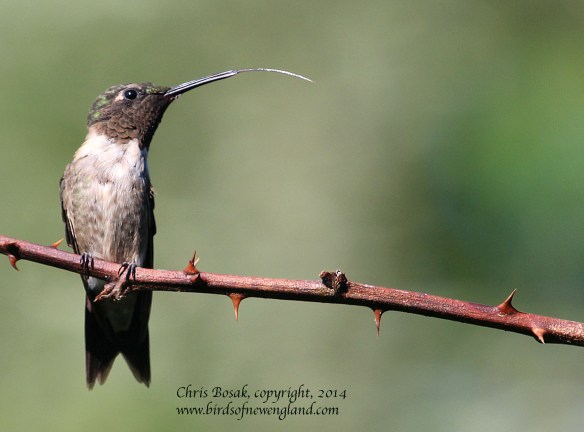
Photo by Chris Bosak A ruby-throated hummingbird perches on a thorny branch.
I’ll be venturing out of New England for a few days and don’t want the birds here to think I forgot about them so I’m instituting my own Hummingbird Week. Each day this week I’ll post a new or old photo of a ruby-throated hummingbird, the only hummer that occurs regularly in New England. There is no such thing as too many hummingbird photos, after all. Each day will also include a joke or fun fact about hummingbirds. This post will wrap up Birds of New England’s Hummingbird Week.
Fun Fact: Ruby-throated hummingbirds spend their winters in Central America or southern Mexico.
Photo by Chris Bosak
A Ruby-throated Hummingbird sips nectar from Canna flower in Danbury, Conn., summer 2016.
I’ll be venturing out of New England for a few days and don’t want the birds here to think I forgot about them so I’m instituting my own Hummingbird Week. Each day this week I’ll post a new or old photo of a ruby-throated hummingbird, the only hummer that occurs regularly in New England. There is no such thing as too many hummingbird photos, after all. Each day will also include a joke or fun fact about hummingbirds.
Fun Fact: On average, hummingbirds beat their wings about 50 times per second.
Photo by Chris Bosak A Ruby-throated Hummingbird hovers near a feeder at the Errol (N.H.) Motel in the summer of 2015.
I’ll be venturing out of New England for a few days and don’t want the birds here to think I forgot about them so I’m instituting my own Hummingbird Week. Each day this week I’ll post a new or old photo of a ruby-throated hummingbird, the only hummer that occurs regularly in New England. There is no such thing as too many hummingbird photos, after all. Each day will also include a joke or fun fact about hummingbirds. This is one of my favorites because of its patriotic feel.
Fun Fact: There are more than 300 species of hummingbirds, all occurring in the Western Hemisphere. About 12 species may be found in the U.S. with the ruby-throated hummingbird the only one regularly occurring east of the Mississippi River.
Photo by Chris Bosak A Ruby-throated Hummingbird perches on a branch in Brookfield, Conn., summer 2016.
I’ll be venturing out of New England for a few days and don’t want the birds here to think I forgot about them so I’m instituting my own Hummingbird Week. Each day this week I’ll post a new or old photo of a ruby-throated hummingbird, the only hummer that occurs regularly in New England. There is no such thing as too many hummingbird photos, after all. Each day will also include a joke or fun fact about hummingbirds.
Photo by Chris Bosak
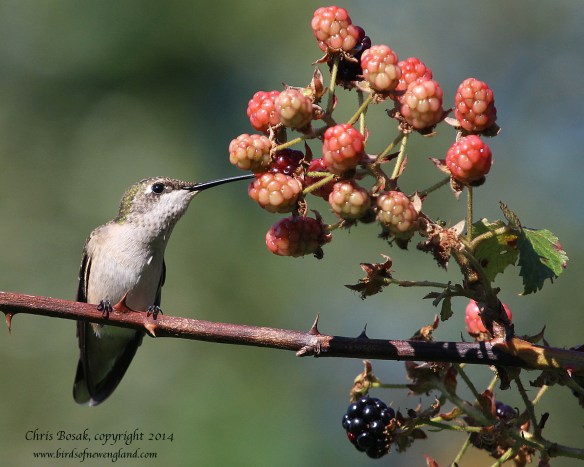
A female Ruby-throated Hummingbird sips juice from a berry in Norwalk, Conn., summer 2014.
I’ll be venturing out of New England for a few days and don’t want the birds here to think I forgot about them so I’m instituting my own Hummingbird Week. Each day this week I’ll post a new or old photo of a ruby-throated hummingbird, the only hummer that occurs regularly in New England. There is no such thing as too many hummingbird photos, after all. Each day will also include a joke or fun fact about hummingbirds.
Fun fact: Their wings aren’t the only things that move fast as a hummingbird’s tongue can sip from a feeder at 13 times per second.
Photo by Chris Bosak A ruby-throated hummingbird visits fuschia blooms in Danbury, Conn., May 2019.
I’ll be venturing out of New England for a few days and don’t want the birds here to think I forgot about them so I’m instituting my own Hummingbird Week. Each day this week I’ll post a new or old photo of a ruby-throated hummingbird, the only hummer that occurs regularly in New England. There is no such thing as too many hummingbird photos, after all. Each day will also include a joke or fun fact about hummingbirds.
Fun fact: Hummingbirds are the only birds that can fly backwards.
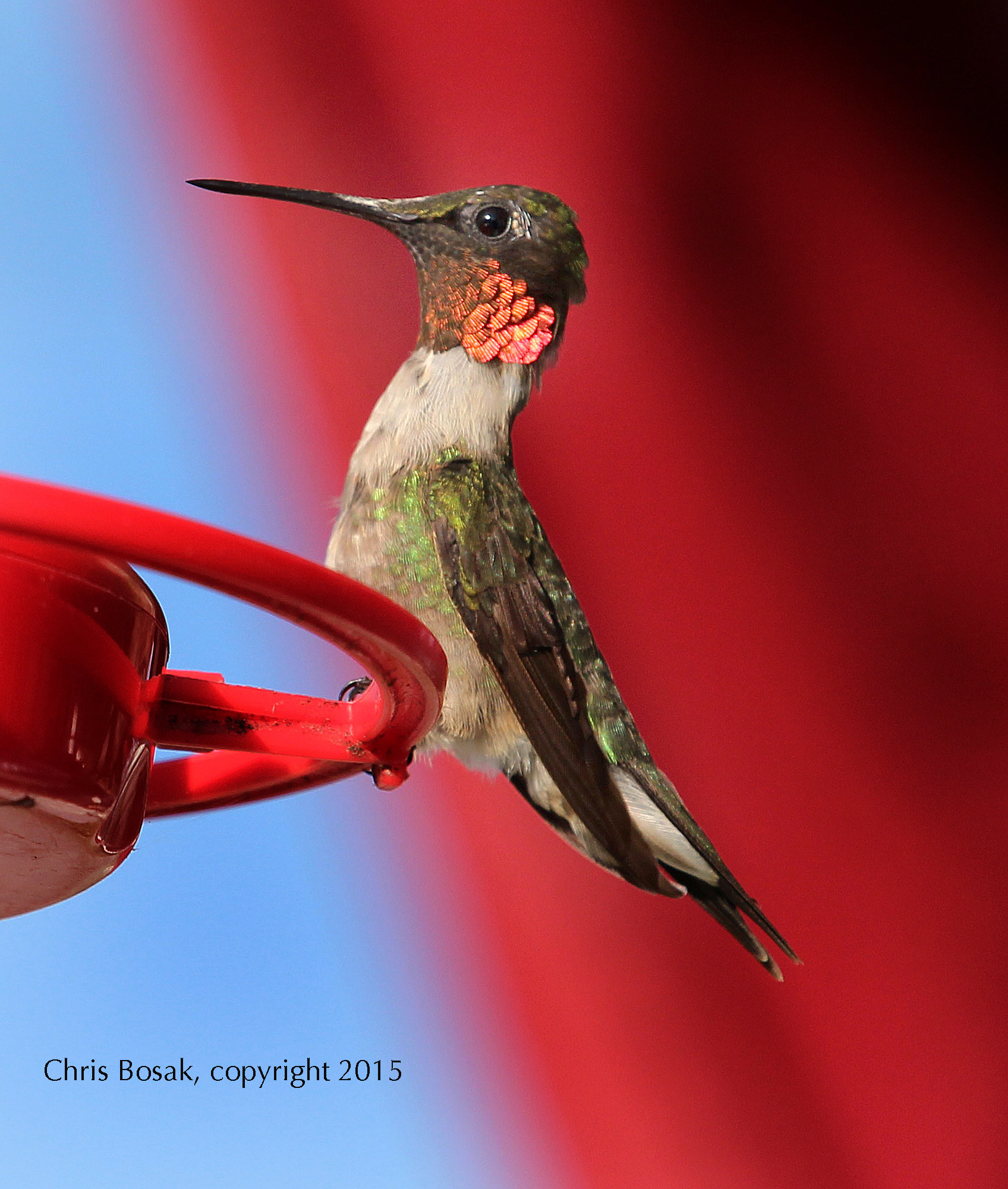
Photo by Chris Bosak A Ruby-throated Hummingbird perches on a feeder at the Errol (N.H.) Motel in the summer of 2015.
I’ll be venturing out of New England for a few days and don’t want the birds here to think I forgot about them so I’m instituting my own Hummingbird Week. Each day this week I’ll post a new or old photo of a ruby-throated hummingbird, the only hummer that occurs regularly in New England. There is no such thing as too many hummingbird photos, after all. Each day will also include a joke or fun fact about hummingbirds. Let’s kick it off with this classic …










 Birds of New England.com