For the Birds: Wrapping up 2024 with the year’s birding highlights

Photo by Chris Bosak – A gray catbird sits among snowy branches during the winter of 2024.

Welcome to 2025, everyone. Without introductory fanfare, here are my top birding highlights from the past year.

10. I see more and more bald eagles every year. I’m not the only one, of course, as bald eagles are doing well as a species, thankfully. I visited family in Erie, Pennsylvania, over the holiday break and saw five bald eagles at Presque Isle during a single visit. I saw a few more on the drive home along I-86 in New York.

9. Hawks, particularly red-tailed hawks and red-shouldered hawks, are even more common than bald eagles, of course. On a few occasions this year, I came across cooperative hawks and got some good close-up photos. In a later column, I’ll show the differences between zoom focal lengths when photographing birds.

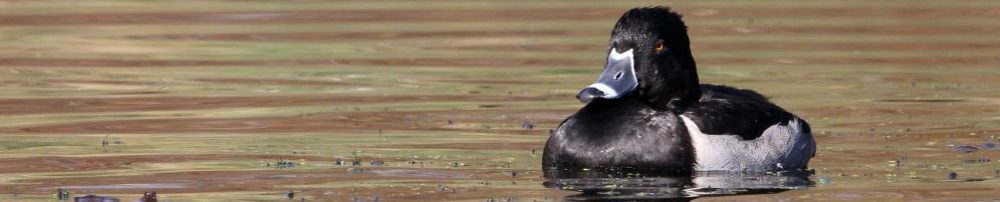
8. Overall, it was a slow year for ducks, which is disappointing considering ducks are my favorite type of bird to watch. My best “duck day” came during the Christmas Bird Count when I got close-up views of long-tailed ducks and American wigeons. I need to do better on my ducks in 2025.

7. A pair of catbirds and four purple finches were regular sightings at my local park throughout January and February. Catbirds do not typically overwinter in New England, but these birds had a reliable food source that kept them here. It was strange to see catbirds with snow covering all the surrounding branches. Purple finches are not uncommon winter sightings, but it was fun to see them daily, nonetheless.

Continue reading

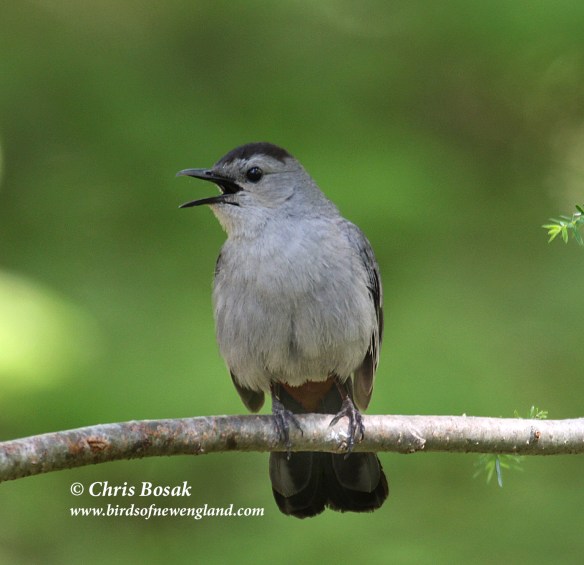
Catbirds delight

Photo by Chris Bosak – Gray catbird, May 2024, New England.

Catbirds always brighten up a spring, summer or fall walk. Here’s a brave one I came across singing his heart out a few weeks ago.


Photo by Chris Bosak – Gray catbird, May 2024, New England.

For the Birds: Rain, rain go away – or not

The weather icons on my iPhone showed rain starting at 8 a.m. I figured that would give me about an hour of dry weather to look for some early spring migrating birds.

No such luck. The rain started even before sunrise so my hour of dry weather wasn’t going to happen. Instead of rolling over and going back to sleep (a very tempting option) or mindlessly scrolling through social media, I decided to head out into the rain anyway. OK, I did take a few minutes to do Wordle quickly before heading out.

The walk started in a light rain, and a lot of birds were out singing. Immediately, I heard robins, cardinals, blue jays, song sparrows and a field sparrow in the distance. Field sparrows have a very distinctive song that sounds like a ping-pong ball bouncing on a table with the time between bounces getting progressively shorter, just like a real ball would do.

As soon as I committed to a trail leading me farther into the woods, the rain picked up. It never turned into a downpour, but it was a good, steady rain. Thankfully, the temperature was a very manageable 55 degrees, so I just got wet instead of wet and cold. I like birdwatching in all types of weather, but a cold rain is probably the worst. Heavy wind is not much fun either, but I would take it over a cold rain.

Continue reading

For the Birds: Whole-bird approach to birdwatching

Photo by Chris Bosak A gray catbird perches on a branch in New England, July 2020. Merganser Lake.

Look up “wood duck” in a cheap field guide and you’ll likely see a beautiful duck with green, pewter, tan, white and even some blue plumage. That is, indeed, a wood duck — a male wood duck in its breeding plumage.

If you saw a female wood duck, immature wood duck or male wood duck in its non-breeding plumage, you’d never find it in that field guide and you’d have a hard time believing someone who told you it was a wood duck because it looks nothing like the beautiful bird in the field guide.

Sometimes field guides lie. Well, they leave out a lot of the truth at least. There are top-quality field guides out there and even they can’t portray every bird in every possible plumage. Between the breeding, non-breeding and transitional plumages, it’s impossible to fit every variation of every bird into a book. That’s not even to mention all the other plumage oddities, such as leucism, albinoism and other conditions.

The same can be said for bird sounds as well. There are dozens of apps and websites out there now that feature bird sounds, but as terrific and helpful as they are, they can’t Continue reading