Photo by Chris Bosak A Scarlet Tanager perches in a tree in Danbury, Conn., July 2016.
The sightings emailed in from readers have been so interesting that they have warranted being the topic of columns for several weeks in a row now. It’s creating a backlog of column ideas for me, but that’s a good problem to have. Besides, spring is the most active time for birdwatchers, so I shouldn’t be surprised.
A quick rundown of my own highlights as spring migration trails off and the birds get down to the important business of nesting:
I haven’t seen my rose-breasted grosbeaks in a few weeks. I’m hoping they are hunkered down on nests. I have, however, seen my ruby-throated hummingbirds Continue reading →
Photo by Chris Bosak A Blue Jay eats an acorn at Selleck’s Woods in Darien, Conn., April 2016.
After a three-hour drive to visit my brother Gregg in upstate New York, it was nice to relax and watch the black-capped chickadees forage in theblue spruce trees outside his kitchen window.
A flock of dark-eyed juncos darted past the window and settled at the base of his house where a bare patch of ground offered the only hope for these ground-feeding birds. The rest of the yard was buried under snow and ice.
A glance back at the spruce trees proved what I had thought all along: The chickadees were not alone. It was a mixed flock of chickadees and tufted titmice poking at the Continue reading →
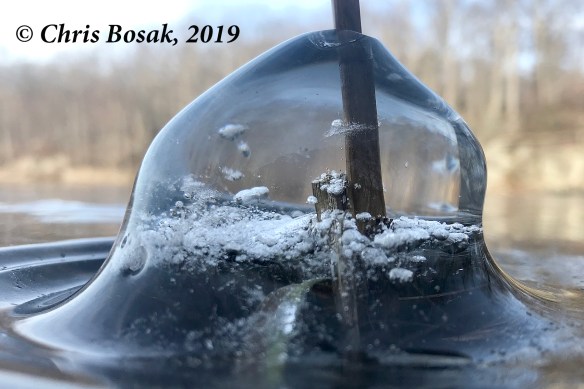
Photo by Chris Bosak Ice on Little Merganser Lake in Danbury, Conn., winter 2019.
Any walk in the woods is a good walk.
I’ve always believed that and am reminded of it every time I step foot in New England woods, a field, a marsh or along a coastline.
For the birdwatcher, not every walk is filled with birds, but there is always something interesting to discover or observe. Even if you’ve walked your patch a thousand times, the next walk almost always holds something special.
A recent walk on the nature trail behind my house drove home that point. I wasn’t expecting much in terms of birds as the temperature was in the low 20s and the pond at the end of the trail was surely frozen.
Turns out I was right. Hardly any birds to speak of on this walk, but it was enlightening nonetheless.
I got to the pond, which is about a 20-minute walk, without seeing a single bird. The frozen pond, obviously, did not offer any hooded mergansers, ring-necked ducks, or even Continue reading →
Photo by Chris Bosak
A nothern bobwhite seen at Happy Landing in Brookfield, Connecticut, fall 2018.
My latest For the Birds column releases my personal top 10 birding moments for 2018. Recapping the previous year is my favorite column to write each late December or early January. This year, instead of blasting out the top 10 all at once I’m going to spread it out and reveal two each day, starting today (Jan. 1, 2019.) This post will include Nos. 8 and 7.
Feel free to comment or send me an email with some of your 2018 birding or nature highlights.
8. First New England northern bobwhite. I saw one of these ground birds in Delaware many many years ago, but I finally got my first New England sighting this fall. It is a species in serious decline and would be nice to see them thriving again.
Photo by Chris Bosak Black-capped chickadee clearing out cavity for nest.
7. Breeding Atlas. Connecticut is undergoing an ambitious three-year survey of its breeding birds. The state is divided into more than 100 blocks that are covered by volunteers. My block features lakes, marshes, mountains, and woods.
Photo by Chris Bosak A purple finch eats seeds at a feeder in New England, Nov. 2018.
There has been a lot of talk lately about winter finches. There usually is this time of year.
I have read accounts of people seeing big flocks of pine siskins. Siskins are probably the most common winter finch that irrupts into the middle and southern parts of New England sporadically in winter.
Winter finch is not an official term with a clear-cut number of species that nicely fits the category. Rather, it is a general term used for members of the finch family that breed up north and typically spend their winters up north, but irregularly move south during the winter as food sources dictate.
The species most commonly associated with a winter finch irruption include pine siskin, common redpoll and purple finch. Larger finches, such as pine grosbeak and evening grosbeak, are also species seen at backyard feeders throughout New England during the winter.
But birds do not even have to be finches to fall into the loose category of “winter finch.” Often, the red-breasted nuthatch is lumped into the category due to its great abundance at feeders some winters and being a no-show during other winters.
So far this winter I have seen a lone female purple finch at my backyard feeding station. That has been the extent of my winter finch season so far. The nature of a winter finch irruption, however, could mean a sizable flock of pine siskins can show up and empty out my Nyjer seed feeder at any moment.
I did see a few red-breasted nuthatches on a recent trip to northern New Hampshire, but that is part of their breeding and winter grounds, and would not fall into the category of a winter-finch sighting.
Admittedly, it took a minute or two to identify the female purple finch that has been visiting my yard. It was clearly something different, so I knew I had to lock down an ID as soon as possible.
Female purple finches are streaky brown in plumage. It didn’t have the look or feel of a sparrow, so I eliminated those possibilities immediately. It looked a lot like a house finch, but was more heavily streaked and slightly larger and plumper overall. The thick bill further eliminated any sparrow possibilities and after very briefly considering the female rose-breasted grosbeak, I was able to nail down the ID as a female purple finch.
In the past when I have seen purple finches, it has usually been a pair so getting an ID was easier because I had the more colorful male to observe.
For whatever reason, regardless of how great a winter finch season it is throughout New England, my yard typically does not drive in a lot of these birds. While I’ve read about several backyards being ambushed by pine siskins already this season, I haven’t seen a pine siskin in about 10 years. That species typically irrupts every three or four years.
If nothing else shows up at my feeders all winter, I still have my regular feeder birds and my female purple finch. And I’m good with that.
A Red-breasted Nuthatch perches near a bird feeding station in Danbury, Conn., Oct. 2016.
Here’s the latest For the Birds column, which runs weekly in The Hour (Norwalk, Conn.), The Keene (NH) Sentinel and several Connecticut weekly newspapers.
…
I wrote three weeks ago about my affinity for the nuthatches we see in New England.
In the middle and southern parts of the region we see white-breasted nuthatches much more frequently than its smaller cousin, the red-breasted nuthatch. The latter variety, however, is seen more often in the northern reaches of New England.
The red-breasted nuthatch does show up at feeders in the middle and southern parts, especially in fall and winter, but not too often and in varying degrees depending on the year. In fact, the little birds will venture all the way to Florida during winter migration.
With that said, I was happy to receive an email from Dean a few days after that column appeared.
“You mentioned red-breasted nuthatches, which reminded me that I have not seen one in years,” Dean wrote from his Marlborough, Conn., home. “They are such cute little birds. Then two days after your article what shows up but an RBN at the feeder.”
A few days after Dean wrote me that email, I was sitting on my deck watching my feeders. It was an unending flurry of black-capped chickadees, tufted titmice, white-breasted nuthatches and downy woodpeckers. I got so tuned into seeing those species that it didn’t immediately register in my brain that a new arrival had appeared.
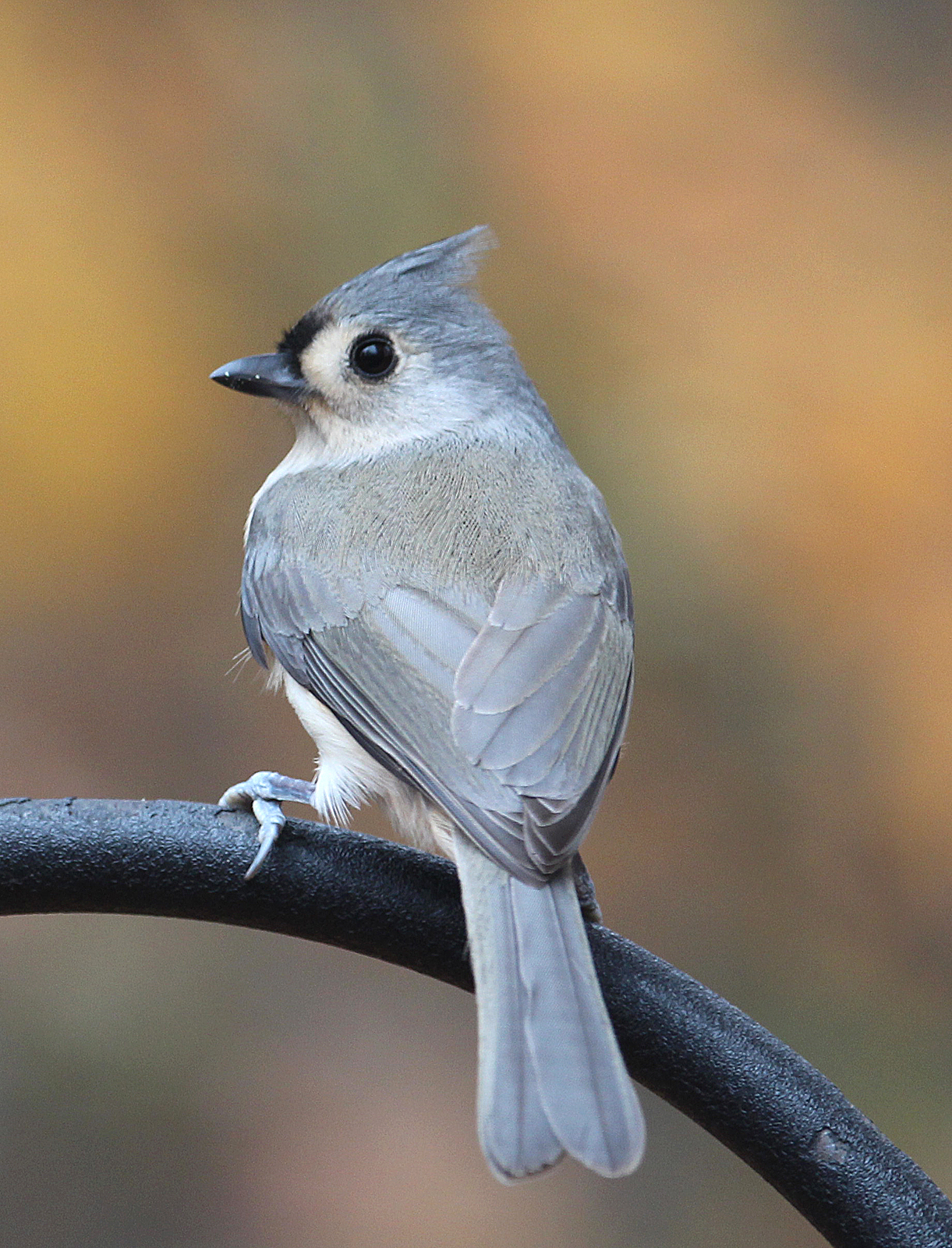
Photo by Chris Bosak A Tufted Timouse perches near a feeding station in New England, fall 2015.
February may be a few weeks away, but there’s no harm in being prepared for what’s in store.
February is a big month in the birdwatching world. It’s a cold month in the middle of winter, but a little birding and bird feeding will help make the cold more tolerable.
First of all, February is National Bird Feeding Month. I don’t normally get too excited about national this month or that, but I’ll celebrate anything that gives me an excuse to do more birdwatching. National Bird Feeding Month was first proclaimed in 1994.
Also, February is always the month of the Great Backyard Bird Count. I’ll write more about this citizen science project in a later column, but just so you can mark your calendars, this year it will be held the weekend of Feb. 12-15.
For now, in honor of National Bird Feeding Month, here are a few tips on how to attract birds to your yard in the typically cold month of February.
Suet is a must. Whether you use pre-packaged suet cakes or make your own out of beef fat (the store-bought cakes are much, much easier), suet should be an offering in the winter. I can count on one hand the number of minutes a bird is not at my suet feeder. Usually it’s a Downy Woodpecker, but also seen are Hairy Woodpeckers, Red-breasted Woodpeckers, White-breasted Nuthatches, and Carolina Wrens. Occasionally, chickadees and titmice visit the suet as well.
Who knows? You may even get lucky and have a Pileated Woodpecker come visit. I had one at my suet feeder about 10 years
Here’s my For the Birds column from last week. Another big Snowy Owl irruption year? We’ll see …
Photo by Chris Bosak A Snowy Owl flies across the beach at The Coastal Center at Milford Point in early March 2014.
The historic Snowy Owl irruption of the 2013-14 winter is still fresh in many people’s minds. I know it’s still on the top of my mind. Could we be in store for another one this winter?
We’ll have to wait and see, of course, but if what is happening in Minnesota, Wisconsin and Michigan already is any indication, the chances are pretty good. We’ve barely turned the calendar over to November and sightings in those states are booming. Typically it is mid to late November when the Snowy Owls start showing up.
The Snowy Owl that delighted hundreds of visitors at Calf Pasture Beach in 2008, however, showed up in early November. This year the sightings in the Midwest came even earlier, starting as early as Oct. 20, according to the folks at eBird. eBird is an online database of bird sightings with much of the data submitted by citizen scientists.
Here’s my latest For the Birds column, which runs weekly in The Hour (Norwalk, CT) and Keene Sentinel (Keene, N.H.)
By CHRIS BOSAK
For the Birds
Last week I addressed a question that was submitted to me by a reader. This week I’ll continue to draw inspiration from my readers and quickly address some more questions and comments that came my way.
One question regarded a one-legged hummingbird. A reader delighted in the antics of a group of hummingbirds at her feeder. As many as four hummingbirds were visiting at one time. The reader noticed that one of the birds had only a stump for a leg. So, can a one-legged hummingbird survive in the wild?
Before I answer that, just a quick note to say that things are not always as they appear. Many birds appear to have only one leg, but often either the leg is tucked away into the bird’s body or the angle from which you see the bird makes it look like it is missing a leg. Waders (herons, egrets), shorebirds and waterfowl often stand on one leg.
But in this case, since the reader saw a stump instead of a leg, it’s likely the bird did indeed have only one leg. Obviously it’s not ideal, but birds that spend most of their time either flying or perched in trees, such as songbirds and hummingbirds, can indeed survive in the wild. Their wings
Photo by Chris Bosak A Snowy Egret looks for food in Norwalk Harbor.
Here’s my latest For the Birds column, which describes the differences between Snowy Egrets and Great Egrets. For the Birds runs each week in the daily newspapers of Norwalk, Conn., and Keene, N.H. If you are out of those areas, tell your local newspaper about For the Birds and perhaps the column can get up and running there, too.
Here’s the column:
There are not many birds out there that have feet a different color than their legs.
From the top of their legs to the bottom of their “toes,” most birds are uniform in color. With many birds, such as songbirds and small shorebirds, the topic is fairly insignificant because their legs and feet are so small and rarely seen Continue reading →







 Birds of New England.com