
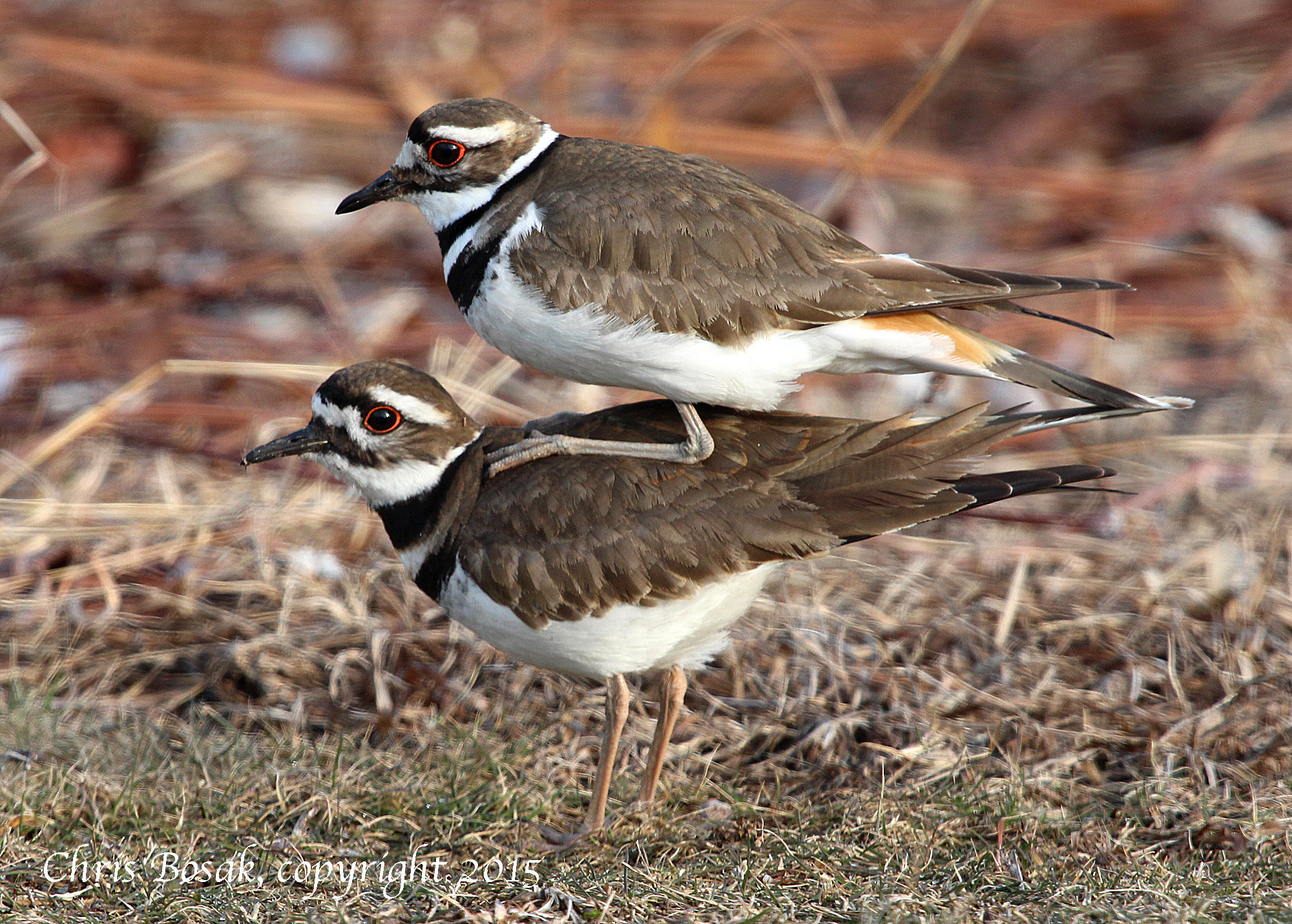
Killdeer doing what Killdeer do to keep the species going

Photo by Chris Bosak A Killdeer pair copulates in Darien in early April 2015.

Photo by Chris Bosak
A Killdeer pair copulates in Darien in early April 2015.

The day after photographing a Killdeer walking along the snow-covered ground of Spring Grove Cemetery in Darien, Conn., I returned to the same spot to see what other birds might be around.

I watched a few Wood Ducks and Ring-necked Ducks in the small pond, but they stayed out of photographic range. It was good to see them anyway, of course.

Then I spotted a Killdeer somewhat near the pond’s edge. What the heck, I thought, may as well take some photographs. I grabbed a few shots and almost started to drive away until I noticed another Killdeer not far away. I almost drove away again as the new Killdeer was not adding any new photographic opportunities. I was happy to see it, don’t get me wrong, but I was ready to move on with me day.

I put the camera back on front seat and reached for the gear shift when I heard a long and consistent “piping.” What are they up to, I thought. Instinctually I got the camera ready again and, sure enough, the male climbed on top of the female and did what comes naturally in the natural world. The continuation of the species … it’s a beautiful thing.

Killdeer handles the cold and snow

Photo by Chris Bosak A Killdeer stands in the snow at a cemetery in southern New England in late March 2015.

Photo by Chris Bosak
A Killdeer stands in the snow at a cemetery in southern New England in late March 2015.

One of the drawbacks to being an early northward migrant is that they are subject to the whims of the early spring New England weather. Will it be hot, cold, just right? Raining, snowing?  The birds that show up in March are subjected to it all. But they’ve been doing it for generations, so for the most part, they can handle whatever is thrown at them.

Killdeer are one of these early migrants. They mate and nest earlier than most birds, too. So a little snow is no big deal for these “shorebirds.” The snow does make for nice photos, though.

Now that’s a lot of robins!

Photo by Chris Bosak A flock of American Robins searches through the light snow near a cemetery in southern Connecticut, March 2015.

Photo by Chris Bosak
A flock of American Robins searches through the light snow near a cemetery in southern Connecticut, March 2015.

Early every spring, the robins return in force. Yes, of course many robins remain in New England all winter, but early spring marks the return of many robins that bolted for warmer temps down south.

Nowhere is that more apparent to me than a cemetery and adjacent field at town hall in Darien, CT. I drive past here nearly every day and suddenly one day in late March the fields are filled with American Robins. That day was a few days ago and the robins remain. Soon they will disperse and get down to the serious business of nesting and raising families.

That first robin of the year may not be an accurate harbinger of spring because many are with us all winter, but when the fields are full of robins … now that’s a sign of spring.

(The above photo is admittedly not the greatest, but it gives an idea of how many there are. About 50 are shown in this photo, but the field extends widely to the left and right. In all, there were about 400.)