The spring migration has certainly begun, but it is still in the building-up phase.
I took a few walks in the woods over the last few days and saw some very welcomed migrants, such as pine warbler, palm warbler, yellow-rumped warbler and Louisiana waterthrush.
When migration is just picking up, however, the action can be hit or miss. In a few weeks, the action will be all hits all the time, and I’m sure we are all looking forward to that.
While those first migrants are great to see after a long winter, they also whet the appetite to see more spring migrants. The woods will be hit or miss for the next several days anyway, so the other day I went to a spot where I knew I would see a few old feathered friends that I hadn’t seen since last summer.
The coast, whether it is the Atlantic Ocean, one of its many bays in New England, or Long Island Sound, is a safe place to find some early shorebird migrants in April. I had a little time, so I headed for one of my favorite spots along the Long Island Sound shoreline in southwestern Connecticut. The spot, the Coastal Center at Milford Point, rarely disappoints, and this time, it was certainly on the mark again.
In terms of sheer numbers and variety, the action was OK, but in terms of quality, it was a well worthwhile trip. One side of the sanctuary is a large tidal bay, and I immediately spotted an osprey pair on its usual nesting platform, as well as dozens of brant and a sizable number of green-winged teal.
The other side of the sanctuary, which features a long sand spit and the whole of Long Island Sound, is where the real action takes place in April, as piping plovers and American oystercatchers return to their breeding grounds.
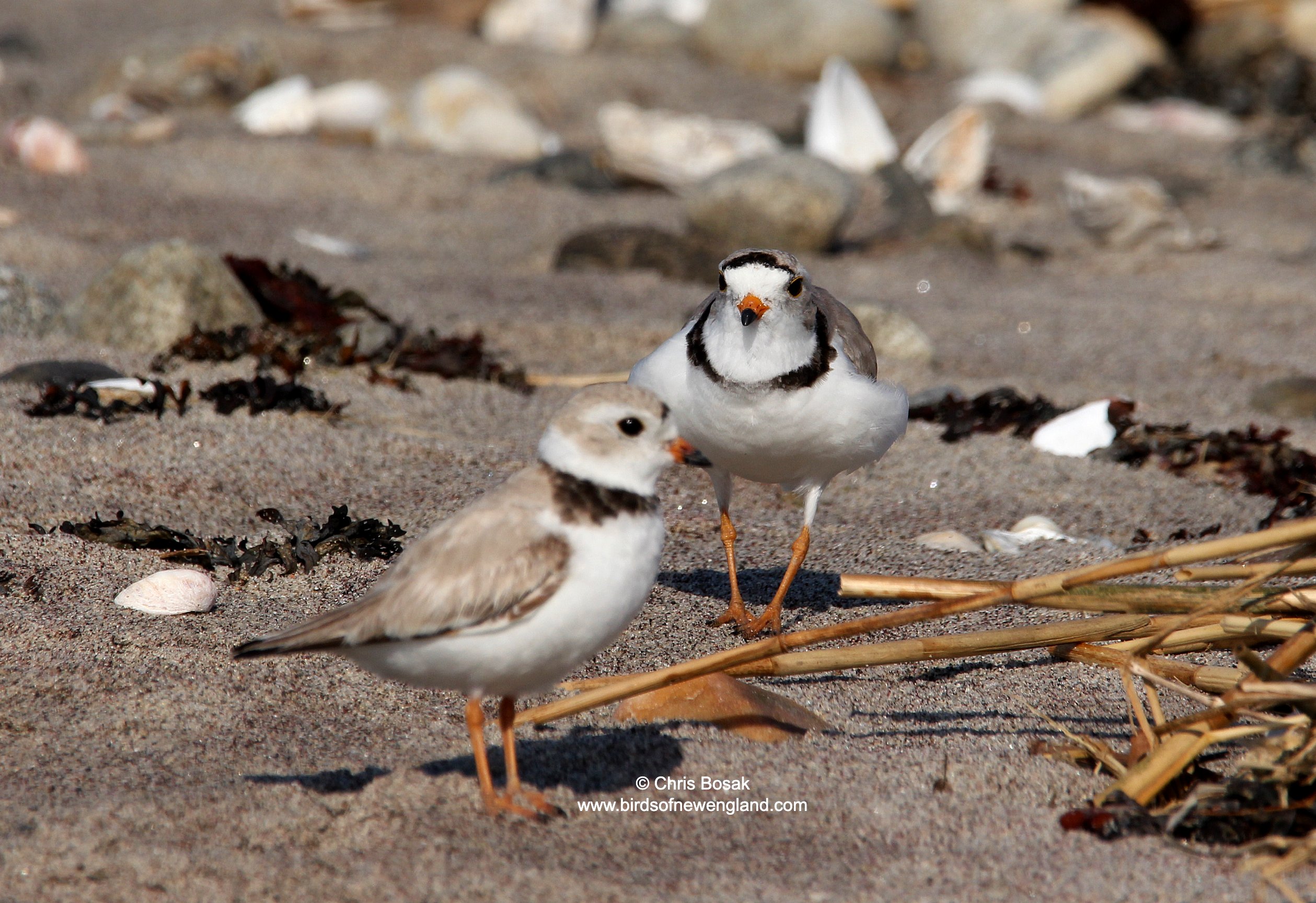
Last year, I made a similar trip a little later in April and was lucky enough to find a piping plover mother with two chicks following closely behind. This year, by chance, I timed it to coincide with the mating season and saw several males displaying and chasing females, and even caught one pair in copulation.
It was good to see the breeding activity, as piping plovers are a species in decline. The Cornell Lab of Ornithology has a paragraph on its website explaining the conservation status as such: “The 2025 State of the Birds report lists Piping Plover as an Orange Alert Tipping Point species, meaning that it has lost more than 50% of its population in the past 50 years and has shown accelerated declines within the past decade. Partners in Flight estimates a global breeding population of 8,400 individuals and rates the species a 16 out of 20 on the Continental Concern Score.”
The sand spit offers a good opportunity to get relatively close to piping plovers. The area where nesting activity occurs is generously roped off to give the birds plenty of space to do their thing.
There were several pairs of oystercatchers as well. Oystercatchers, with their large size, massive orange bills and ubiquitous high-pitched call, are consistently on my ever-changing list of favorite birds.
Given the choice, I would pick the woods over the shore almost every time. The shore, however, does call to me on occasion, and I’m always glad when I hearken to the call.

