It was the early 1990s when I lived in Vermont. I was just starting to get interested in wildlife photography, and my friend Steve said he knew where a large flock of turkeys could reliably be found in the evening.
Steve lived about half an hour north of me, and the turkeys were about 20 minutes north of him. At the time, wild turkeys were still fairly uncommon in New England, so I did not hesitate to make the 50-minute drive. A wild turkey flock would make a great addition to my then extremely modest catalogue of wildlife photos.
I met Steve at the spot, and, sure enough, the turkeys were there ─ at the far end where the field met the woods, maybe 75 yards away. I snapped some photos and couldn’t wait to see the results.
Remember, this was well before digital cameras and film was the only way to go. Buy the film, load the camera, take the set amount of photos on the roll, hurry the film to get developed, wait a week or so to pick up the photos (unless you paid extra for quicker service), and excitedly flip through the prints. Buying the film and having it developed was not cheap.
When I finally got the photos back, the turkeys were not perfectly focused, you could say. As Steve commented, “Well, they’re not tack sharp.” Soft focus may work for some photography, but usually not wildlife. Did I mention the photos were grainy too? The subjects were far away, and it was getting dark.
I was disappointed with the results and wondered when I’d get another chance to photograph turkeys.
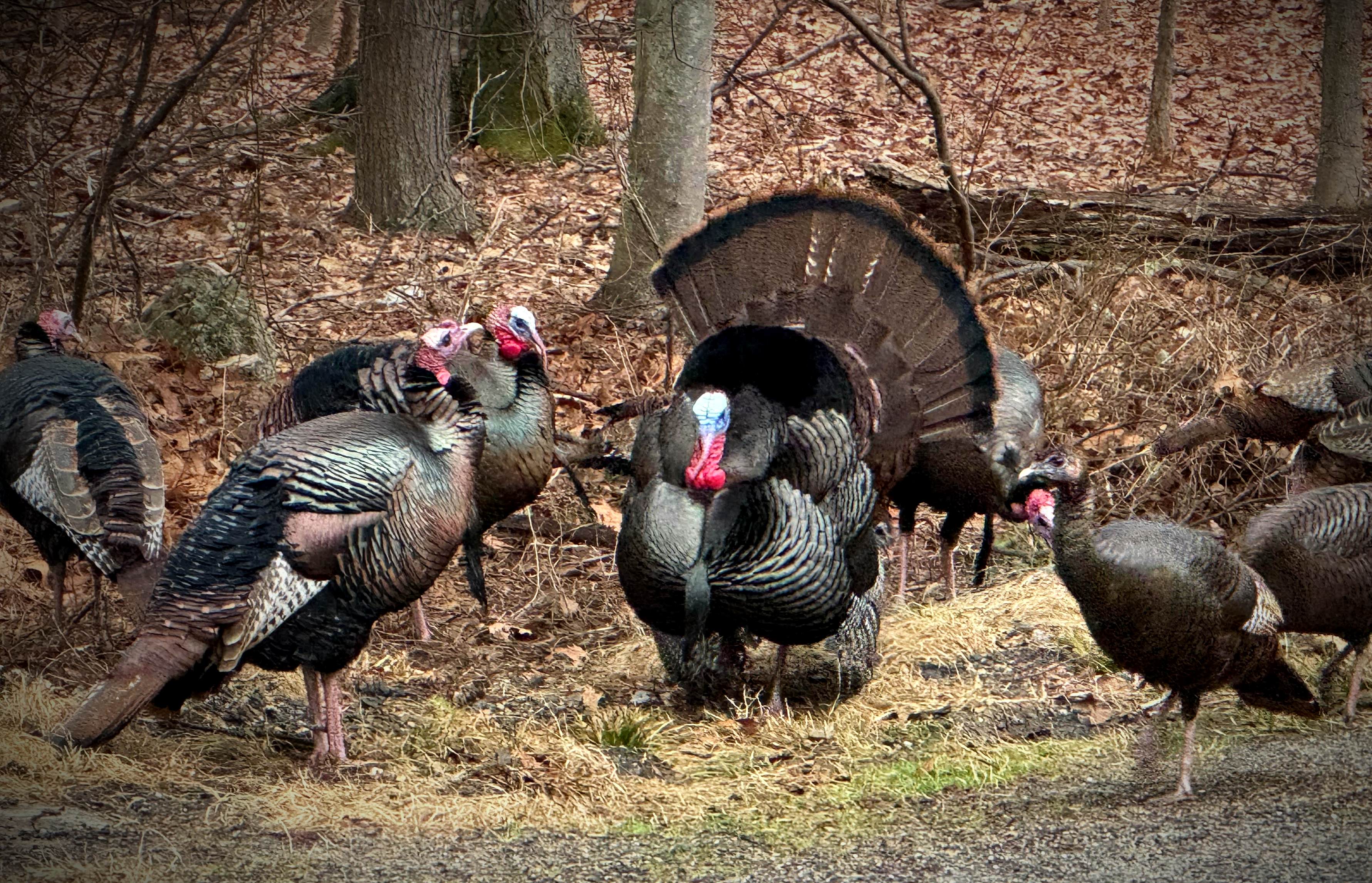
Fast forward to the present day. I pulled into work the other day and off to my left were about a dozen wild turkeys walking along the driveway. As I drove up to them, I stopped the car and looked at a turkey about four feet away from me. It didn’t look at me and was not fazed in the least by the car. It simply kept slowly walking among the flock toward a small stream.
I see these turkeys on a regular basis at work, which is set in a suburban mix of small buildings, patches of grass and woods. There are times when I see them several days in a row, often close to the buildings or even posing in front of a glass door.
They are not shy. Nor are they aggressive. They are simply there. They don’t bother the people, and the people don’t bother them. Most people love to see them (myself included, of course), some people seem to hardly notice them and some people vilify them. I don’t understand the people who don’t like them. The turkeys are not aggressive and they don’t leave their droppings all over the place. As I mentioned, they are simply there.
Seeing this flock the other day made me think back to that time in Vermont. Back then, turkeys were rare, and opportunities to photograph them were uncommon. Turkey hunting was more of a challenge. It may have been half a lifetime ago for me, but in the grand scheme of things, it may as well have been yesterday.
Turkeys have proliferated quickly, not just in New England, but throughout the entire country. They may be found in all of the lower 48 states and parts of southern Canada. Changing habitat (farm to woods) and successful reintroduction programs are largely responsible for their rebirth.
But why are they so common in suburbs? Why not stay in the woods away from people? Wild turkeys, similar to Canada geese, have adapted well to being around people, and suburban and even some urban areas are rich in food sources. These areas are also largely void of large predators, except for the occasional coyote. Domestic dogs can also pose a threat, but turkeys learn quickly to avoid those yards.
Wild turkeys are a successful bird recovery story. Gone, at least for now, are the days of driving 50 minutes to possibly catch a sight of them. Nowadays, all it takes is driving to work.


Great Sent from my iPhoneOn Aug 29, 2026,
LikeLiked by 1 person
I recall seeing them in the wild for the first time in Tyringham, Mass., a small Berkshires town. Now I see them often enough in Cambridge, Mass., probably connected to the flock that resides in Mt. Auburn Cemetery.
LikeLiked by 1 person
I remember in 1990 I was walking my dog in a wooded area that was part of a salt marsh near where I lived at the time. This was in coastal Massachusetts. I saw a turkey in the underbrush off of the trail we were walking, and I thought it was just the coolest thing! Because you never saw them back then, as Chris mentioned. I also remember thinking that the turkey was brave: this was within one or two days of Thanksgiving.
Fast forward to the present, and I see them everywhere. In peoples’ yards on my drive to work. On the side of the street (sometimes IN the street, holding up traffic). I work outdoors where there is lots of open land and woods, and groups of turkeys strut around confidently and casually, and it’s a great sight to see. I especially see them in the upcoming months of October through December. I’m glad they made such a successful comeback in these parts. They’re fun to watch and they don’t bother anybody.
LikeLiked by 1 person
a wonderful achievement here in NH to have these beautiful creatures once again proliferating our state
LikeLiked by 1 person