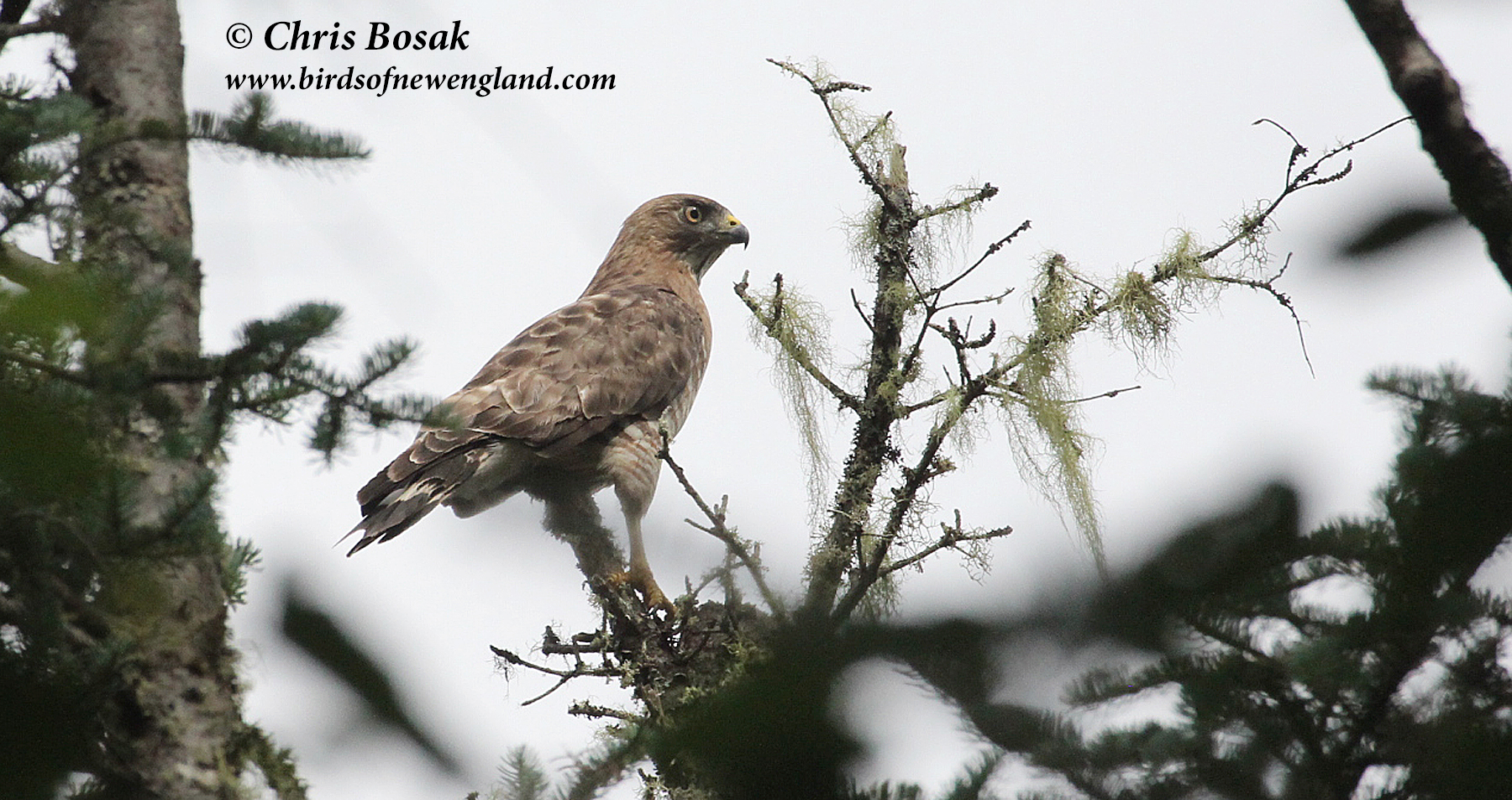
A broad-winged hawk perches in a tree in northern New Hampshire, July 2020.
Last November, I wrote consecutive bird columns based on the results of the Pack Monadnock Hawk Watch. As I wrote the second column, I made a mental note to write another one before the start of the next hawk watching season. Well, here we are.
Instead of reading about what happened already, now you can get out there and see the spectacle for yourself. So here it is, all you need to know about planning a trip to see the thousands of raptors that will pass over southern New Hampshire this fall.
There are other hawk watch sites in New Hampshire, but Pack Monadnock is the most popular, and for good reason. Expert hawk watchers are on site from September 1 through the middle of November to count the hawks, lead talks and answer questions from visitors. Also, it is the place in the state where the most hawks and greatest variety of raptors may be seen heading south. Hawk watches include hawks, eagles, falcons, ospreys and vultures.
The Pack Monadnock Raptor Observatory, as it is officially called, is located near the top of Pack Monadnock Mountain within Miller State Park off Route 101 in Peterborough. Visitors can drive or hike to the site.
A few hawks have already been counted in August, but the numbers have not started to heat up yet. The most thrilling time at Pack Monadnock, and most other hawk watch sites, is when the broad-winged hawks pass through in staggering numbers. When that happens exactly is both predictable and unpredictable. It will happen sometime in mid-September, that much we know, but weather and wind conditions will determine the exact window.
Last year, I spoke with Phil and Julie Brown of Hancock about the timing. If anyone will know, it’s them. Phil is the Bird Conservation Director and Land Specialist at the Harris Center for Conservation Education. His wife, Julie, is the Raptor Migration and Program Director of the Hawk Migration Association.
Here are a few paragraphs from one of those columns from last November:
“While the broad-winged hawk migration is truly a spectacle, with as many as 3,000 or more seen on a single day, it is very time-specific. September 14-20 is the sweet spot when nearly all of the broad-wingeds pass through, the Browns said. Phil said many people take the entire week off from work to not miss the right day.
“Mark your calendars for the middle of next September and keep your eyes out for a forecast that calls for light or variable winds from the north (or northeast or northwest), particularly following a cold front.”
Last year, the best two-day window by far at Pack Monadnock was September 14 and 15, when 3,160 and 562 broad-winged hawks, respectively, passed over the mountain. September 19 and 20 were also solid with 458 and 403 broad-winged hawks soaring past.
Mid-September is also the best time to see sharp-shinned hawks, the second-most-counted raptor at Pack Monadnock. Last year, there were two days (September 14 and 19) when more than 100 sharpies flew overhead.
Last year, September accounted for 7,280 of the 8,581 total raptors counted at Pack Monadnock. While September is obviously the best month to visit, October is still a strong month. The broad-winged hawks, which account for the majority of the birds counted each fall, are mostly gone by the time October rolls around, but there are still good numbers of species such as sharp-shinned hawks, turkey vultures, northern harriers and red-tailed hawks to be seen. American kestrels and merlins, both small falcons, are also passing through in decent numbers in October.
The hawk watch remains open until mid-November, but the action is fairly slow by then. Red-tailed hawks are still moving through at a decent clip, but most of the other species have stopped completely or slowed to a trickle.
This year I’ve given fair warning. Keep an eye on the forecast in mid-September, head to the mountain and see some hawks. Lots of them.

