Photo by Chris Bosak
A pair of Wood Ducks show their displeasure with a nearby Redhead in Darien in March 2014.
Admittedly, it’s not the best photo but how often do you get to see a pair of wood ducks scolding a redhead. Not very often, especially in New England where redheads are not very common. Hang in there everybody!
(Repeat text from yesterday:) With many of us working from home or otherwise “physical distancing” as we combat COVID-19, I figured I’d start a daily series of photos showing different bird species together. Why not? Maybe it will brighten somebody’s day to see commingling bird species each morning as we’re all stuck inside.
Photo by Chris Bosak
Pine siskins visit a feeder in Danbury, Connecticut, fall 2018.
Here’s a species commingling shot I took last year when pine siskins were eating me out of house and home. They hang out with goldfinches a lot so I did a post (and a video) and how to tell the two species apart. Below is the link to the post, which includes the video.
(Repeat text from yesterday:) With many of us working from home or otherwise “physical distancing” as we combat COVID-19, I figured I’d start a daily series of photos showing different bird species together. Why not? Maybe it will brighten somebody’s day to see commingling bird species each morning as we’re all stuck inside.
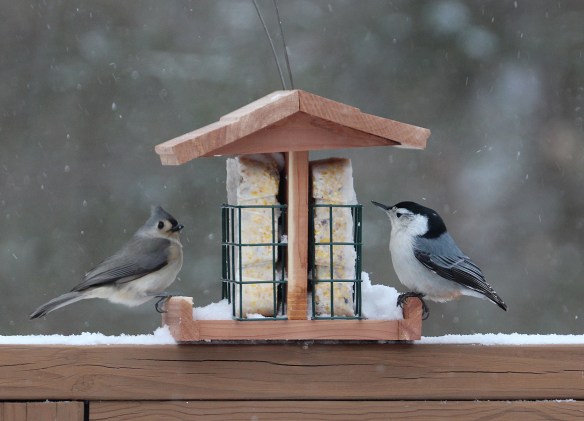
Photo by Chris Bosak A Tufted Titmouse and White-breasted Nuthatch share a feeder during a snowstorm in Danbury, Conn., Jan. 23, 2016.
Bird feeders often bring together birds that would otherwise rarely be seen commingling. In this case, however, nuthatches and tufted titmice, as well as chickadees, are often seen together “in the wild” as they help each other forage for food. This is one of my favorite shots showing two or more bird species together. I guess I like the symmetry.
(Repeat text from yesterday:) With many of us working from home or otherwise “physical distancing” as we combat COVID-19, I figured I’d start a daily series of photos showing different bird species together. Why not? Maybe it will brighten somebody’s day to see commingling bird species each morning as we’re all stuck inside.
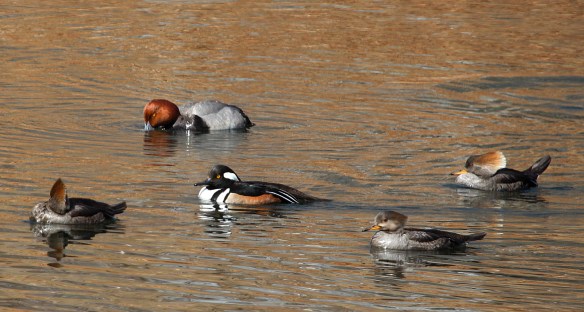
Photo by Chris Bosak American Wigeon and Hooded Merganser in Norwalk, CT, Feb. 2013.
Back-to-back mergansers today with a hooded merganser commingling with American wigeon. Yesterday was a common merganser with mallards. Ducks often form mixed flocks, particularly in smaller bodies of water.
(Repeat text from yesterday:) With many of us working from home or otherwise “physical distancing” as we combat COVID-19, I figured I’d start a daily series of photos showing different bird species together. Why not? Maybe it will brighten somebody’s day to see commingling bird species each morning as we’re all stuck inside.
Here’s a bonus shot of hooded mergansers with a redhead.
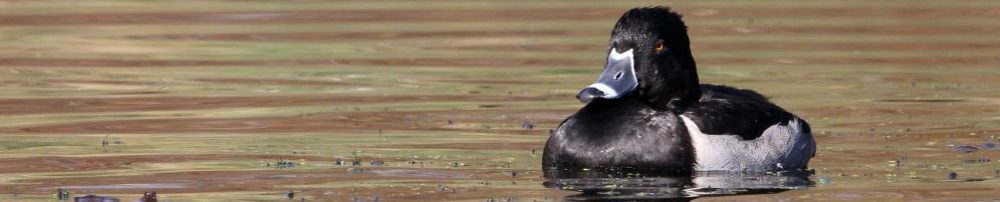
Photo by Chris Bosak A flock of Hooded Mergansers swims past a Redhead at a Darien pond in March 2014.
Photo by Chris Bosak A female Red-breasted Merganser sits along the water with Mallards in New England.
(Repeat text from yesterday:) With many of us working from home or otherwise “physical distancing” as we combat COVID-19, I figured I’d start a daily series of photos showing different bird species together. Why not? Maybe it will brighten somebody’s day to see commingling bird species each morning as we’re all stuck inside.
Photo by Chris Bosak
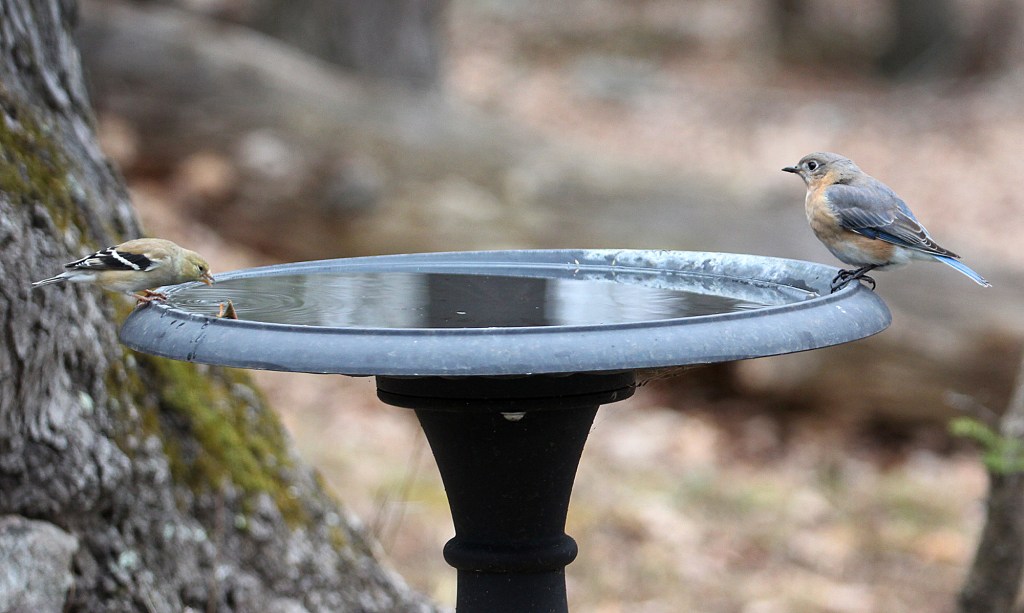
An American goldfinch and female eastern bluebird share a drink at a birdbath in New England, March 2020.
With many of us working from home or otherwise “physical distancing” as we combat COVID-19, I figured I’d start a daily series of photos showing different bird species together. Why not? Maybe it will brighten somebody’s day to see comingling bird species each morning as we’re all stuck inside.
Photo by Chris Bosak
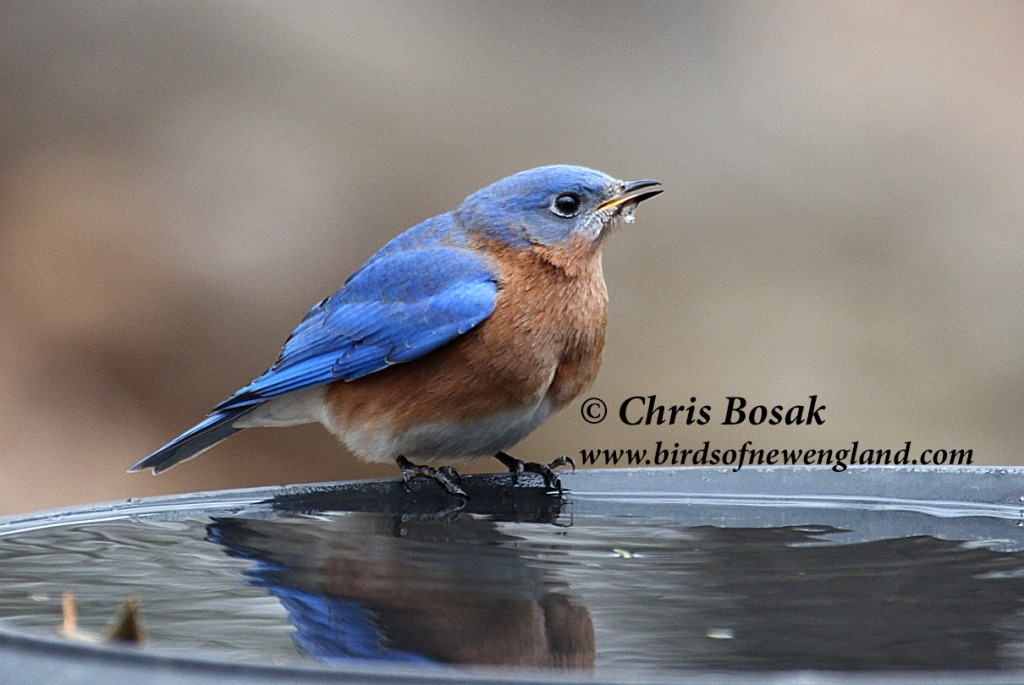
An eastern bluebird gets a drink from a birdbath in New England, February 2020.
There will be more on this coming next week when the next For the Birds column is posted here, but here’s a teaser photo to get you through a weekend of isolation. Moral of the story in short: offer water to the birds too.
Photo by Chris Bosak A red-winged blackbird at Bashakill National Wildlife Refuge.
I heard them, that’s for sure. There was no missing the cacophony made by a large mixed flock of blackbirds.
Then the task became finding them. I figured I wouldn’t struggle too much at this chore as the trees are bare and I could tell from the sound of things there were a lot of them. It wasn’t as easy as I thought, but I did find them in fairly short order.
Yes, the trees were bare, but the sound was coming from a bit of a distance away and I was on terrain with many rolling hills. I crested the second hill and there they were in all their glory. The flock was mostly grackles, but a couple dozen red-winged blackbirds completed the flock.
All told there were about 80 birds. It was a sizable flock, but certainly not the biggest I have seen and most certainly not the biggest working its way into or through New England now.
Red-winged blackbirds are one of the earliest spring migrants to return. My story took place last week, in early March, which is actually a few weeks later than we usually start seeing them. In fact, Elena from Winchester had a few hardy red-winged blackbirds visit her feeders all throughout winter. The flock I saw the other day carried on for a while and then suddenly got quiet. I don’t know if the birds spotted a predator or if they were ready to settle in for the night as it was well into dusk.
I certainly could have missed something, especially considering the fading light, but I noted only grackles and red-winged blackbirds. These mixed flocks of blackbirds often have brown-headed cowbirds and starlings as well. If you’re lucky and take the time to scrutinize over the individual birds in the flock, you may find an unexpected visitor such as yellow-headed blackbird, boat-tailed grackle or rusty blackbird. It is believed that blackbirds winter and migrate in large flocks to offer better protection against predators and, perhaps, more effectively find food sources.
Yes, the spring migration is under way. It won’t be long now before the phoebes start showing up. To me, the return of “my” phoebes to the backyard signifies the real beginning of spring. Then, of course, birds of all shapes, colors and sizes will return to New England to either breed here or pass through on their way to northern breeding grounds.
It hasn’t been much of a winter, at least where I am in New England. That doesn’t mean winter is over, not by any means. I’ve been in New England long enough to know that we aren’t out of the woods until the third or even fourth week of April. Let’s hope it’s not another winter that stretches well into our spring. But that’s out of our control. If it is a long winter, we will deal with it. We always do.
Photo by Chris Bosak
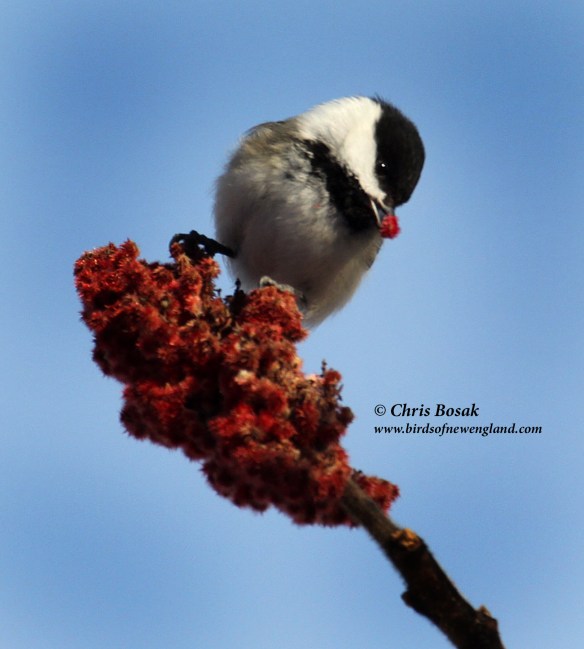
A black-capped chickadee eats staghorn sumac berries in Hoosick Falls, N.Y., February 2020.
A few weeks ago, I wrote about coming across a sumac patch being invaded by black-capped chickadees. I included only one photo with that post, which is not like me at all. So, here are some more photos from that day.
Photo by Chris Bosak
A black-capped chickadee eats staghorn sumac berries in Hoosick Falls, N.Y., February 2020.Photo by Chris Bosak
A black-capped chickadee eats staghorn sumac berries in Hoosick Falls, N.Y., February 2020.
Here is the latest For the Birds column, which runs weekly in several New England newspaper.
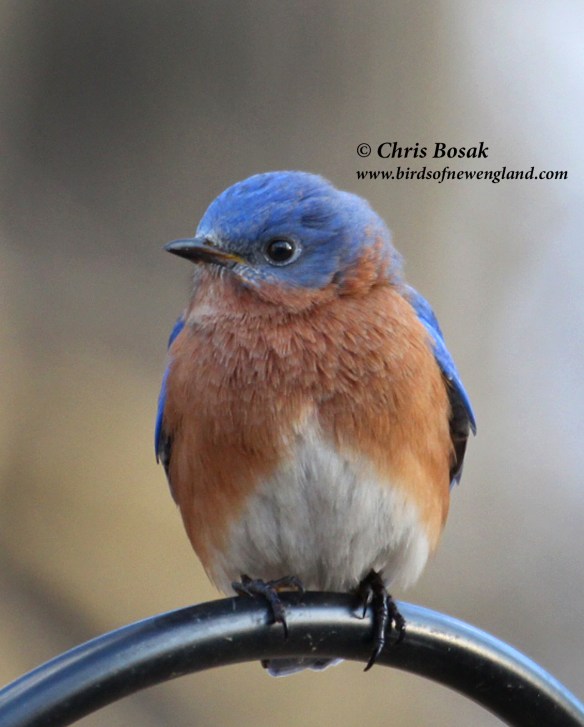
Photo by Chris Bosak An eastern bluebird perches on a pole in New England, February 2020.
Sorry, but I have to go back to writing about bluebirds. After several weeks of writing about bluebirds that other people had in their yards, I finally got some of my own.
I would imagine no apology is necessary, however, as who doesn’t like to hear, read and talk about bluebirds?
I walked into my sunroom and saw through the window just a flash of a bird out of the corner of my eye. The bird had been perched on one of the arms of the feeder pole system and disappeared into woods behind my house.
That was a bluebird, I know it, I told myself, even though I got only the shortest of looks in my peripheral Continue reading →







 Birds of New England.com