Photo by Chris Bosak
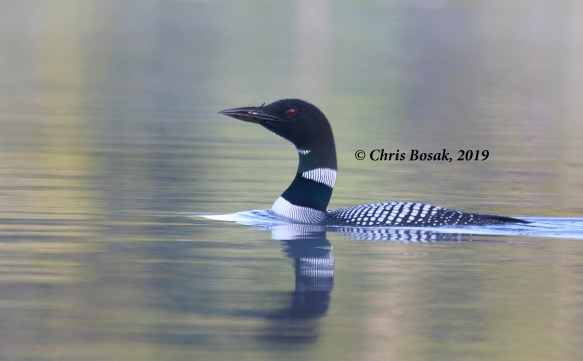
A common loon swims at May Pond in Pillsbury State Park in New Hampshire in June 2019.
Stop posting photos of loons, said no one ever. So, to celebrate Father’s Day, BirdsofNewEngland.com presents a common loon bonanza. Every hour on the hour, a new loon photo will post. All photos were taken earlier this week at Pillsbury State Park in New Hampshire. Happy Father’s Day. Enjoy the loons.
Photo by Chris Bosak
Common loons swim at May Pond in Pillsbury State Park in New Hampshire in June 2019.
Stop posting photos of loons, said no one ever. So, to celebrate Father’s Day, BirdsofNewEngland.com presents a common loon bonanza. Every hour on the hour, a new loon photo will post. All photos were taken earlier this week at Pillsbury State Park in New Hampshire. Happy Father’s Day. Enjoy the loons.
Photo by Chris Bosak
A common loon swims at May Pond in Pillsbury State Park in New Hampshire in June 2019.
Stop posting photos of loons, said no one ever. So, to celebrate Father’s Day, BirdsofNewEngland.com presents a common loon bonanza. Every hour on the hour, a new loon photo will post. All photos were taken earlier this week at Pillsbury State Park in New Hampshire. Happy Father’s Day. Enjoy the loons.
Photo by Chris Bosak
Common loons swim at May Pond in Pillsbury State Park in New Hampshire in June 2019.
Stop posting photos of loons, said no one ever. So, to celebrate Father’s Day, BirdsofNewEngland.com presents a common loon bonanza. Every hour on the hour, a new loon photo will post. All photos were taken earlier this week at Pillsbury State Park in New Hampshire. Happy Father’s Day. Enjoy the loons.
Photo by Chris Bosak
A common loon swims at May Pond in Pillsbury State Park in New Hampshire in June 2019.
Stop posting photos of loons, said no one ever. So, to celebrate Father’s Day, BirdsofNewEngland.com presents a common loon bonanza. Every hour on the hour, a new loon photo will post. All photos were taken earlier this week at Pillsbury State Park in New Hampshire. Happy Father’s Day. Enjoy the loons.
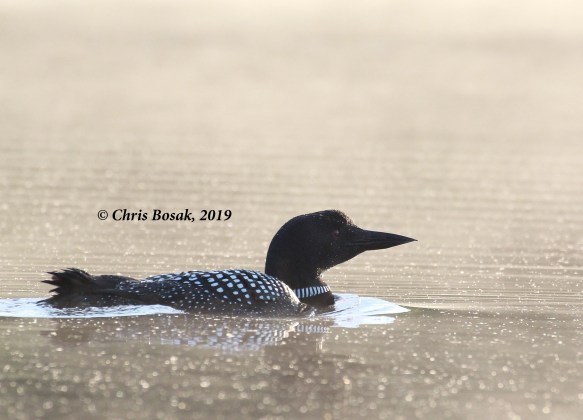
Photo by Chris Bosak A common loon swims at May Pond in Pillsbury State Park in New Hampshire in June 2019.
The recent camping trip to Pillsbury State Park in New Hampshire was a blast, as expected, with good birding every day of the outing. The loons, of course, were the highlight and we heard them from our waterfront campsite day and night.
One morning — the one when it wasn’t raining — I got great views of three loons as I noticed them from far away and just drifted in my canoe and let the loons come to me. It took a bit of time and a lot of patience, but they eventually came toward me and offered close views. At one point, one surfaced very close to me and started preening. They dived and surfaced in the vicinity of my canoe for several minutes before continuing about their day. I didn’t give chase as loons face enough struggles as it is without any added pressures from photographers.
So, here are a few of the loon photos. More to come soon, in addition to some other birds I saw on the trip.
Photo by Chris Bosak Common loons swim at May Pond in Pillsbury State Park in New Hampshire in June 2019.
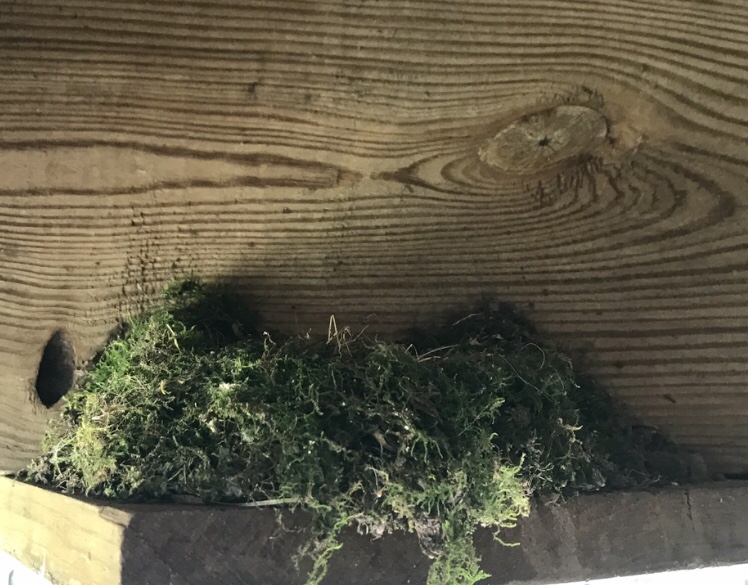
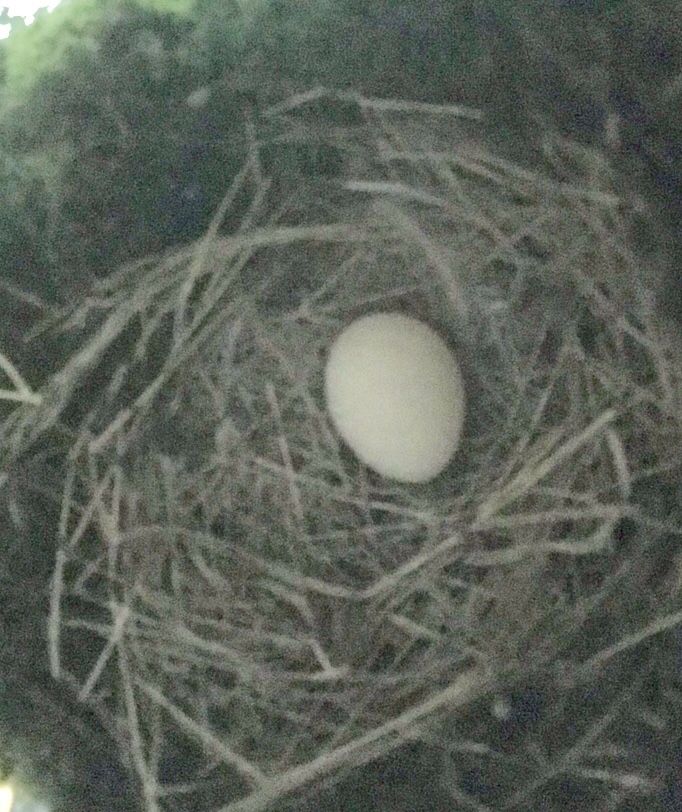
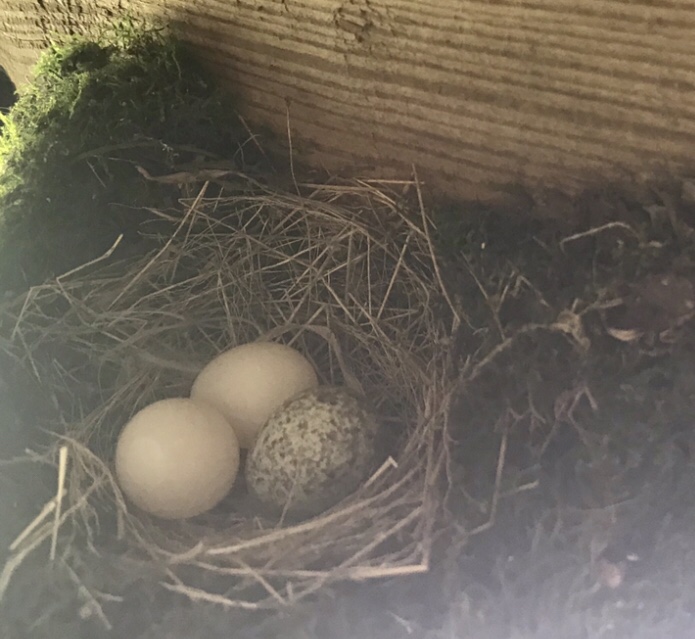
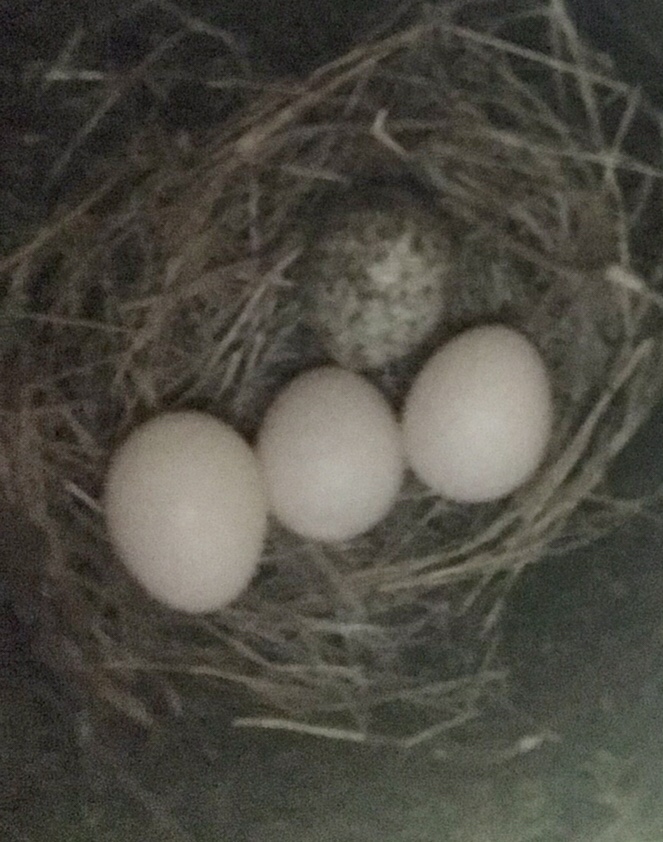
An eastern phoebe finally built a nest on a large piece of wood I had nailed to the underside of my porch three years ago.
Unfortunately, a brown-headed cowbird egg is among the five eggs currently in the nest. Brown-headed cowbirds are brood parasites and lay their eggs in the nests of other birds. Conventional wisdom says to remove the egg, but that would likely result in the vindictive mother cowbird coming back to destroy the other eggs.
Also, a new line of thinking says to let nature take its course and not let human values interfere with nature. It’s difficult, but I’ll leave the nest alone. I’ll check it daily to see how this all shakes out.
The first egg was laid on Tuesday, June 11. On Wednesday, another phoebe egg and the cowbird egg was discovered. Thursday and Friday brought one phoebe egg each for a total of four phoebe eggs and one cowbird egg.
Photo by Chris Bosak A gray jay perches on the roof of a car in Pittsburg, N.H., November 2018.
Well, I did it again. Apparently I’ve been using the wrong name for a bird for the past year or so.
Recall a few weeks ago when I wrote about the common gallinule that had been seen near the Dillant-Hopkins Airport. Many people, myself included, initially referred to the bird as a common moorhen, the name previously used for the bird. In 2011, the American Ornithologists’ Union changed the name to common gallinule after splitting the species from a similar bird in Europe and Asia.
I’m not as far behind on this latest name change. In May 2018, just about a year ago, the union changed the name of the gray jay to the Canada jay. The handsome, bold bird of the north was historically called the Canada jay anyway, so it was really a change back to an old name.
I wrote a column back in November about a trip to Pittsburg, during Continue reading →
I’m heading to New Hampshire for a few days of camping. It’s been a while since I’ve paddled any lake, pond, or river in the Granite State and I’m looking forward to seeing what wildlife will be around. Of course, I’ll let you know when I return. In the meantime, here’s a For the Birds column from 2004 about this very subject …
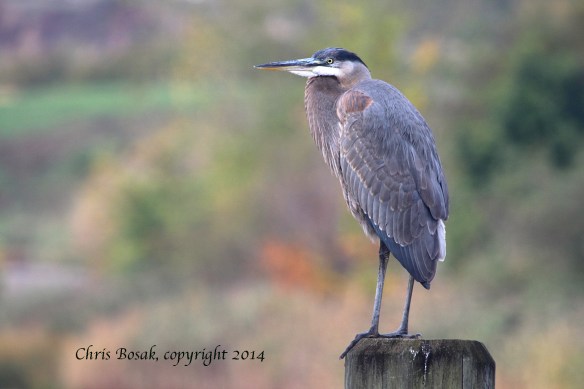
Photo by Chris Bosak A Great Blue Heron stands on a piling along the Norwalk River on Tuesday, Oct. 14, 2014.
A great blue heron lifted its skinny four-foot frame out of the water and used its six-foot wing span to carry it to another spot on the lazy river. It was spotted again around the next corner. A wood duck skulked into the vegetation and disappeared without a trace. Once a wood duck vanishes into the sea of huge green leaves, you can forget about seeing it again.
A muskrat braved a crossing at a swelled portion of the river, using its tail as a rudder. Marsh wrens proudly belted out their peculiar, almost comical, song.
Meanwhile, there were many constant companions. Red-winged blackbirds boisterously claimed various plots of the river’s edge as their own, dragonflies zigged and Continue reading →
Photo by Chris Bosak A Scarlet Tanager perches in a tree in Danbury, Conn., July 2016.
The sightings emailed in from readers have been so interesting that they have warranted being the topic of columns for several weeks in a row now. It’s creating a backlog of column ideas for me, but that’s a good problem to have. Besides, spring is the most active time for birdwatchers, so I shouldn’t be surprised.
A quick rundown of my own highlights as spring migration trails off and the birds get down to the important business of nesting:
I haven’t seen my rose-breasted grosbeaks in a few weeks. I’m hoping they are hunkered down on nests. I have, however, seen my ruby-throated hummingbirds Continue reading →








 Birds of New England.com