Remember a few weeks ago when I urged readers to “check those blotches” carefully. Here’s the column for those who missed it. Basically, the column said that if something looks out of the ordinary in the distance, it should be checked out. It may be a plastic bag or mylar balloon stuck in a tree; or it may be a hawk, owl or something else of note in the tree.
I took my own advice the other day and checked out a small clump on one of the old windmills that grace the property at Happy Landings, an open space in Brookfield, Connecticut. Turns out, it was an American kestrel, a small falcon that is somewhat Continue reading →
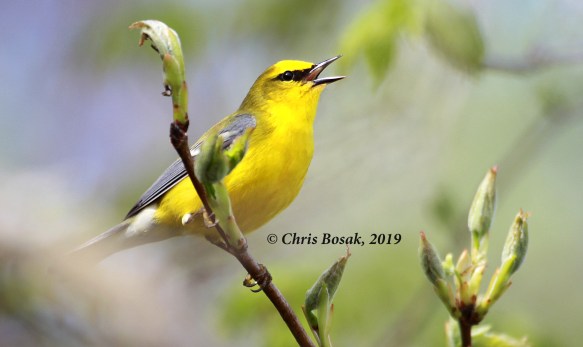
Photo by Chris Bosak A blue-winged warbler sings from a perch in Brookfield, CT, May 2019.
To me anyway, the blue-winged warbler is one of the more strikingly plumaged birds we see in New England. The overall bright yellow plumage is an obvious eye-catcher, but the black eyestripe adds an unmistakable element of coolness to the bird’s appearance. The blue-winged warbler is common in New England and breeds throughout the region. Listen for its insect-like song as you walk along the edge of woods.
Blue-winged warblers have expanded their range northward since the 1800s, which is good and bad news. Why? This is from the Cornell Lab of Ornithology: “In the late 1800s, Blue-winged Warbler populations expanded northward as agricultural fields were abandoned and forest clearcuts started regrowing. This northward expansion increased the frequency of contact with Golden-winged Warblers, a Partners in Flight Red Watch List species, as well as hybridization between the two species. Hybridization and competition between Golden-winged and Blue-winged Warblers is partially responsible for declining populations of Golden-winged Warblers.”
Photo by Chris Bosak A bobolink perches at the end of a branch in Brookfield, CT, May 2019.
I checked out Happy Landings, an open space of fields and shrubby areas in Brookfield, Connecticut, after dropping off my son Will at middle school the other day. With its huge fields, the protected space is a rare haven for bobolinks in New England. There should be more such field habitat. Anyway, I wanted to see if the bobolinks were back and sure enough, they were — along with plenty of other birds. Take a look …
Happy birding and let me know what you see out there this migration period.
Photo by Chris Bosak A yellow warbler sings from a perch in Brookfield Conn., May 2019.Photo by Chris Bosak A yellow warbler perches on a branch in Brookfield Conn., May 2019.
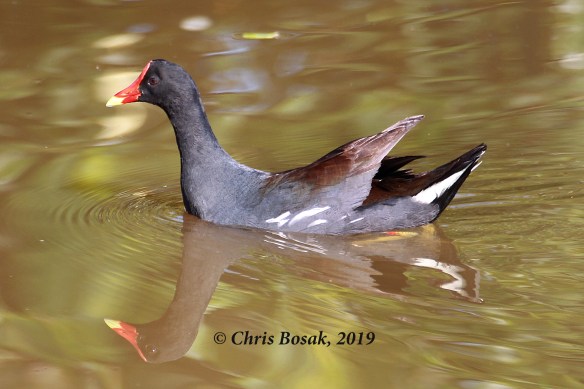
Photo by Chris Bosak A common gallinule in Naples, Florida, April 2019.
Here’s the latest For the Birds column:
…
I brought up the subject of bird name changes last week. The column was about eastern towhees and how the ones we see here in the East were formerly called rufous-sided towhees.
I recently visited family in Florida and came across another interesting bird name change. Coincidently, it relates to a bird that paid a rare visit to Keene last week.
We were walking on a trail south of Naples and seeing many of the birds typically spotted in Florida. One of the more ubiquitous birds was the common moorhen. We kept hearing a rather strange bird, call so I took out my phone, launched my birding app and typed in “common moorhen” so I could find out what the bird sounded like.
Nothing came up. How could that be, I wondered. I know there is a bird called the common moorhen. I saw many of them the last time I was in Florida.
Phone service was spotty on the trail, so I couldn’t do an Internet search for common moorhen at the time. When we got back on the road I discovered why I couldn’t find common moorhen. The bird no longer exists as the common moorhen. The American Ornithologists’ Union split the U.S. bird from the similar marsh bird that is found in Europe and Asia.
The bird found overseas is called the Eurasian moorhen and the U.S. bird is now called the common gallinule. Florida has always had the purple gallinule; now Continue reading →
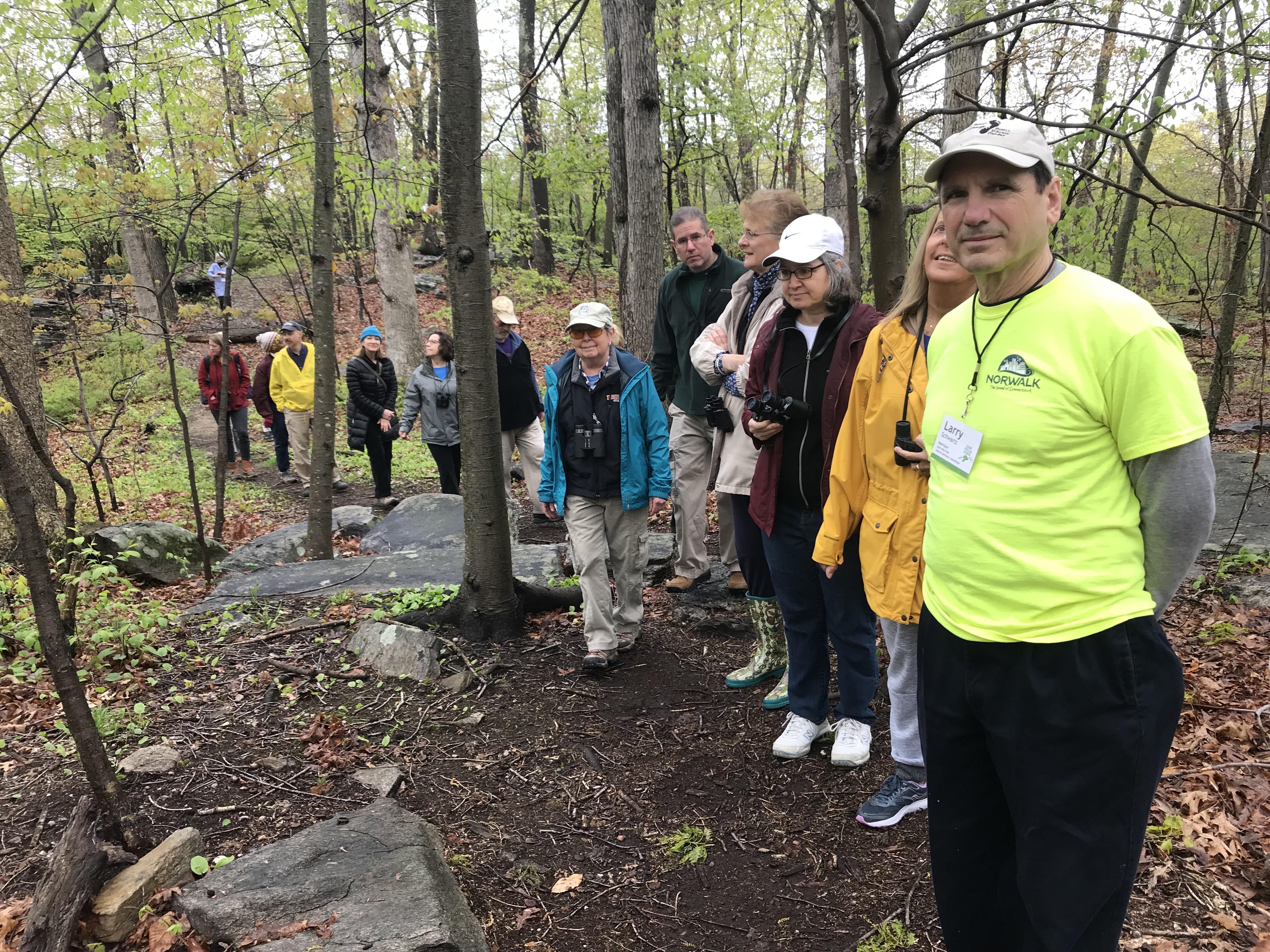
There was a great turnout at yesterday’s bird walk at Oak Hills Park in Norwalk. It is a beautiful park and the folks involved with the nature trail area of it should be proud of their work. It was a decent turnout for the birds as well, highlighted by a very cooperative scarlet tanager. I’ll post more photos and a more complete species list later.
Photo by Chris Bosak A yellow warbler perches on a branch in Ridgefield, Conn., April 2019.
A recent walk in block 91A (my area of the Connecticut Bird Atlas) yielded even more eastern towhees than my walk last week. At one point I saw a female eastern towhee carrying a lump of straw in her bill. Good sign!
Later in my walk, after seeing a beautiful coyote cross the trail and disappear into the woods, I saw my first yellow warbler of the year. Yellow warblers are one of the more ubiquitous warblers in New England as they both migrate through and stay to breed Continue reading →
Photo by Chris Bosak A Scarlet Tanager sings in a tree in Danbury, Conn., July 2016.
Well, it’s cold and rainy in New England … at least it’s not snowing like it is in some parts of the country.
With that said, here are some thoughts of the warm weather ahead and what we can expect to see in our New England yards and woods soon. (Many people are already seeing the rose-breasted grosbeaks and indigo buntings.)
Feel free to drop me a line and let me know what you’re Continue reading →
Photo by Chris Bosak A pileated woodpecker looks for insects at the base of a tree at Merganser Lake in Danbury, Conn., April 2017.
I’ve been lucky enough this week to have seen six of the woodpeckers that live in New England. In fact, early in the week I had for the first time a yellow-bellied sapsucker at my feeder. It made two quick visits to a suet feeder and disappeared for good.
The species I saw were downy woodpecker, hairy woodpecker, northern flicker, red-bellied woodpecker, yellow-bellied sapsucker and pileated woodpecker. Those are the most commonly seen woodpeckers in New England. Red-headed woodpeckers are seen on occasion and a few species (black-backed and three-toed) require a trip to far northern New England to see.
Songbirds, such as warblers and grosbeaks, steal the show during spring, but woodpeckers Continue reading →
Photo by Chris Bosak
An eastern towhee perches on a branch in New England, April 25, 2019.
My foot was feeling up for a short, relatively non-taxing walk yesterday (Thursday) so I grabbed a walking stick and hit a trail. The aching foot enhanced the walk in one fashion as it made me slow down and take in all the sights and sounds of the spring New England woods. Too often when I walk I’m rushing to a destination or point of interest (pond or open field) and don’t take the time to fully absorb all that is around me. Not that I’m hoping the foot keeps hurting, but that was the silver lining in this latest bout of tendonitis.
It was still a bit early for a big warbler count — blue-winged and black-and-white were the only warbler species I found — but eastern towhees were numerous. I’ll expand on the eastern towhee in an upcoming post, but this large sparrow is one of my favorites. The calls and songs of the towhee filled the edge of the woods and I noticed several pairs, which bodes well for a strong breeding season (hopefully.) Above is the male eastern towhee and below is the female. The female is duller in color, but still a striking bird.
Photo by Chris Bosak
A female eastern towhee perches on a branch in New England, April 25, 2019.






 Birds of New England.com