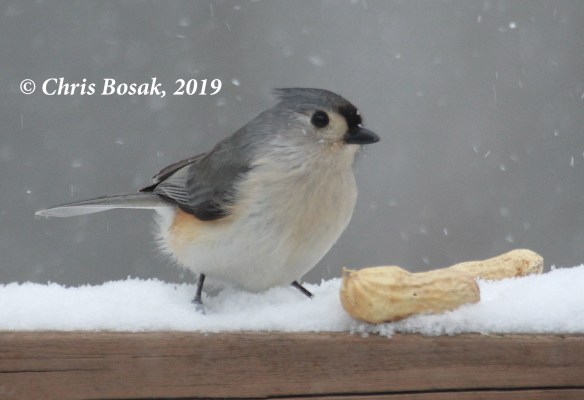
Photo by Chris Bosak A tufted titmouse take a peanut from a railing in Danbury, Connecticut, February 2019.
Here is a short series of photos showing a tufted titmouse contemplating and ultimately deciding to make off with a peanut, which looks comically large in the bird’s tiny bill. Good thing titmice don’t swallow their food whole.
Photo by Chris Bosak A song sparrow takes shelter in an old Christmas tree during a snowfall in Danbury, Connecticut, February 2019.
My attempt to go live from my feeders today was, well, a learning experience. The video quality looked much better on my iPhone screen than how it translated onto the big screen next to me. Also, Facebook live makes you shoot vertically (not how you’re supposed to do it!) so the first several minutes appeared sideways. Who knew?
The birds were fairly cooperative during the 15-minute live shoot. A group of pine siskins covered the tube feeder while mourning doves, titmice, chickadees, goldfinches, juncos, downy woodpeckers, and white-breasted nuthatches visited the various other feeders. A song sparrow, an irregular visitor at my feeders anyway, also showed up and took seeds from the platform feeder.
What was somewhat expected but didn’t show up were blue jays, cardinals, and red-bellied woodpeckers.
I guess it’s time to look into a new camera capable of streaming live video. The iPhone just didn’t cut it – at least for this experiment. Thanks to those who did tune in. Next time will be better.
In the meantime, here are some more photos from the action Continue reading →
It’s a beautiful, snowy day in southern New England. The feeders are active — as they typically are during snowy times — so why not go live?? I’ll go live from noon until about 12:30 p.m. It’s a gamble as all the birds may disappear by then and return at 12:31, but it’ll be fun nonetheless. There will be limited narration, but feel free to send in questions via this site or Facebook and I’ll try to answer as quickly as possible. Tell your bird-loving friends, too.
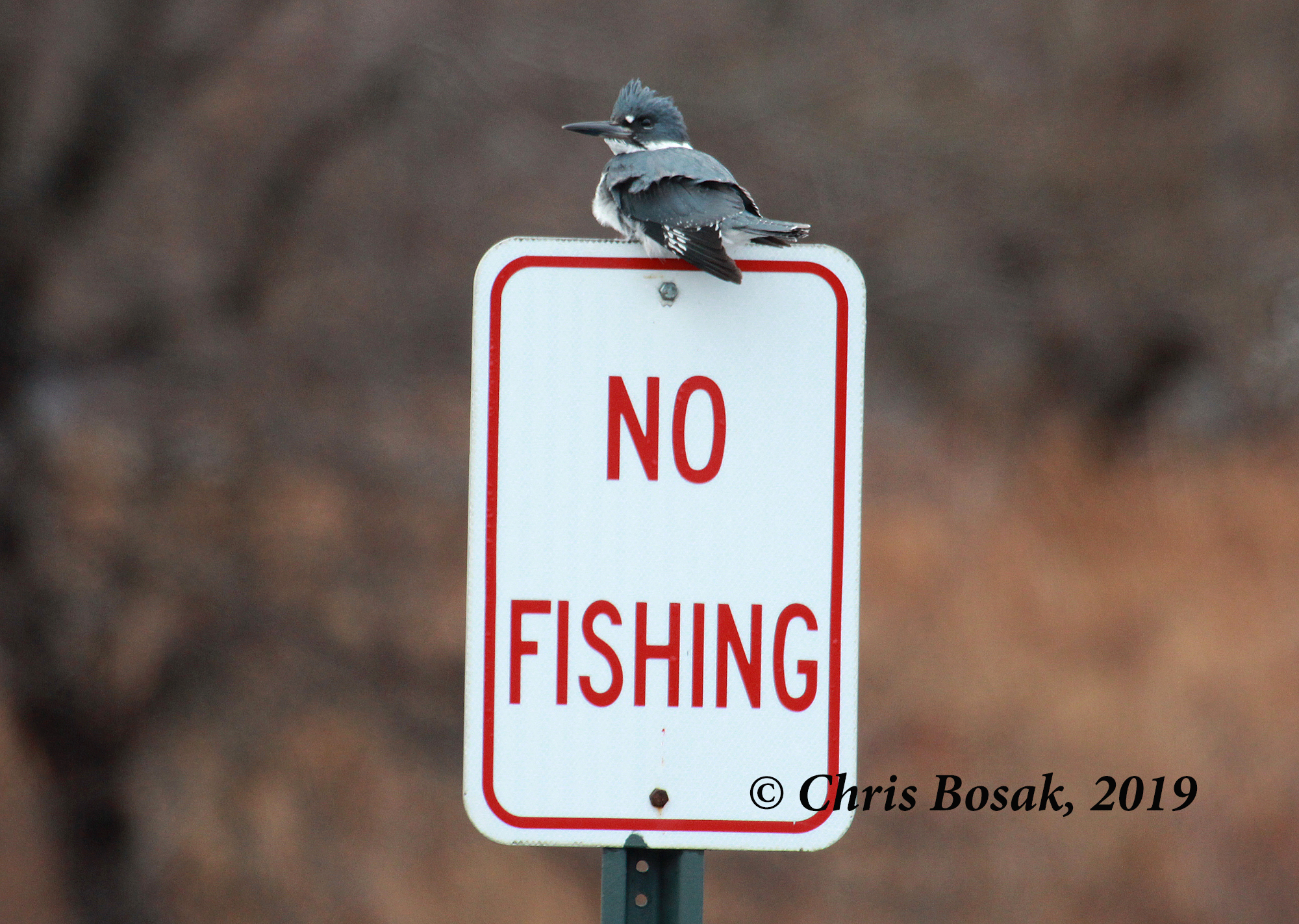
Photo by Chris Bosak A belted kingfisher perches on a “No Fishing” sign in Danbury, Connecticut, February 2019.
Here are a few more photos of the male belted kingfisher on the “No Fishing” sign I spotted the other day. Remember, in a somewhat rare occurrence in the bird world, belted kingfisher females are more colorful with the rusty band on the belly. An old photo of a female is included on the bottom of this post as a reference. Continue reading →
Photo by Chris Bosak
A belted kingfisher perches on a “No Fishing” sign in Danbury, Connecticut, February 2019.
Here’s a funny bird photo for your Friday.
Sometimes you spend hours in the woods looking for birds and find nothing. Sometimes you drive along the access road at the local shopping mall and a belted kingfisher is perched on a “No Fishing” sign. Now, if only the bird had a fish in his mouth … Happy Friday everyone!
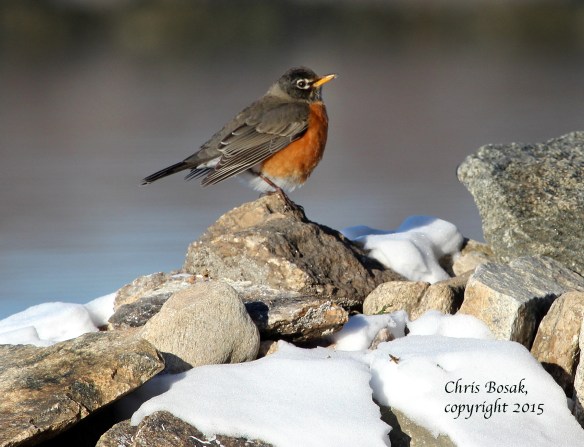
Photo by Chris Bosak An American Robin perches on a rock at Weed Beach in Darien, Conn., in Jan. 2015. Flocks of robins often show up during winter bird counts
I am guilty. I admit it.
Even though I have preached in this column before about the importance of participating in citizen science studies and turning in results, whether those results are good or bad, I often do not submit my “bad walks.”
Take eBird, for example.
Even though it would valuable to report all of my walks to this online bird database, I often submit only results for the walks that yield unique or plentiful species. I saw only two chickadees and a turkey vulture flyover, I say to myself. How is that data going to be valuable?
In reality, that data is just as valuable as the results I turn in when the birding is good. Scientists who track this data need to know what’s going on out there at all times, not just when a lot of birds are around.
Is there a problem brewing with a certain species? Biologists will never know Continue reading →
Photo by Chris Bosak A black-capped chickadee rests on an icy branch during a winter storm in Jan. 2019 in New England.
Winter poses serious challenges for birds and other wildlife.
The cold is the first thing that comes to mind. How do small birds such as chickadees and goldfinches survive sustained sub-zero temperatures? How do water birds such as gulls, ducks and geese stand on ice all day with bitter winds driving through them?
Birds that remain in New England all year have adapted to the low temperatures. Cold may be a challenge, but it’s one they can handle.
Chickadees and other birds have all sorts of adaptations to survive bitter cold days and nights. They increase their weight and fat percentage, they puff out their feathers to trap warm air close to their bodies, they huddle together for warmth, they drop their body temperature at night, and they eat a lot.
Water birds have an extra layer of down feathers to keep dry and toasty. Also, their legs don’t freeze because of a magical counter-current heat exchange between their veins and arteries. It’s not magic, of course, but it’s a complex system worthy of its own column. Let’s just say their feet don’t have to be as warm as their bodies (otherwise they’d be covered in feathers) and the way their blood flows keeps the legs from freezing.
So the cold, while uncomfortable on the most bitter nights, is usually Continue reading →
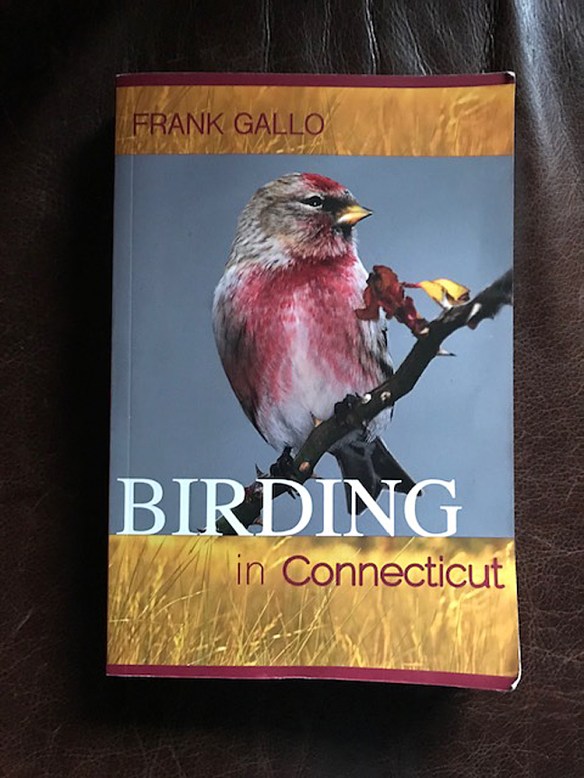
Planning a birding trip to Connecticut and not exactly sure where to go? Now there’s help.
Frank Gallo, a well-known birder in Connecticut, has recently written “Birding in Connecticut,” published by Wesleyan University Press. The book breaks down the state by regions and offers insight, directions, and unusual species that may be seen there.
“Birding in Connecticut” is valuable to those who know Connecticut well and those who don’t know a thing about the Constitution State. I know Connecticut and its birding hot spots Continue reading →
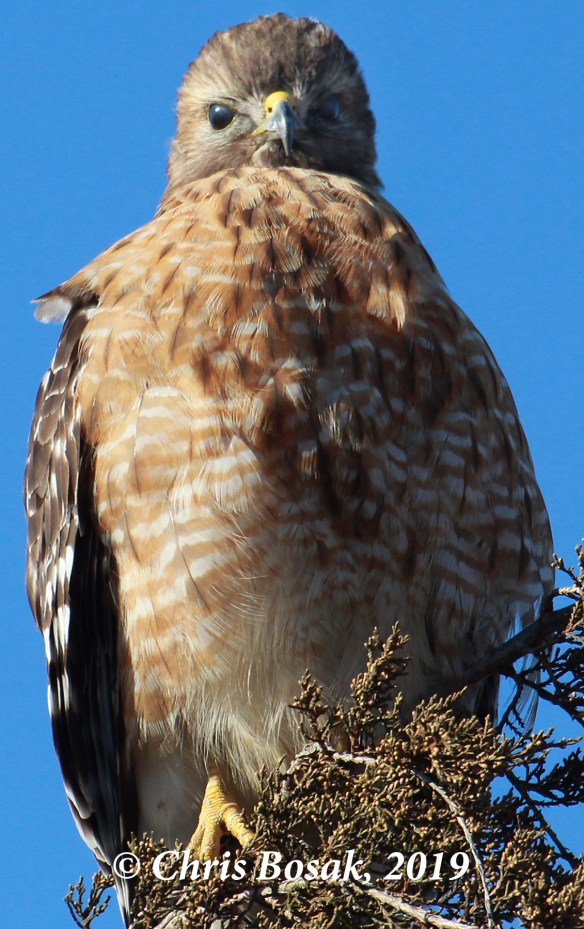
Photo by Chris Bosak A red-shouldered hawk perches on the top of an evergreen, Brookfield, Connecticut, January 2019.Photo by Chris Bosak
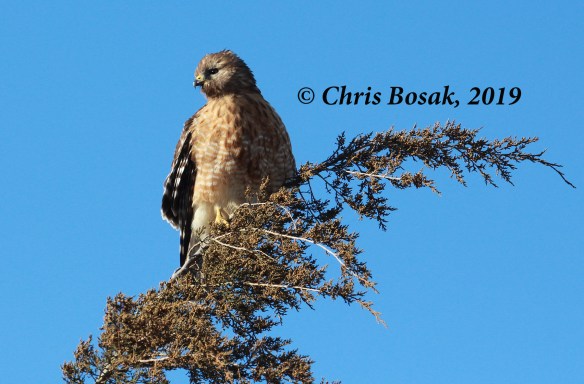
A red-shouldered hawk perches on the top of an evergreen, Brookfield, Connecticut, January 2019.
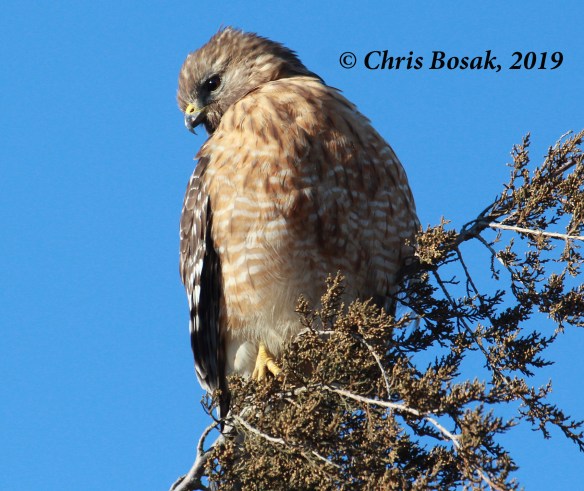
Photo by Chris Bosak A red-shouldered hawk perched on the top of an evergreen, Brookfield, Connecticut, January 2019.
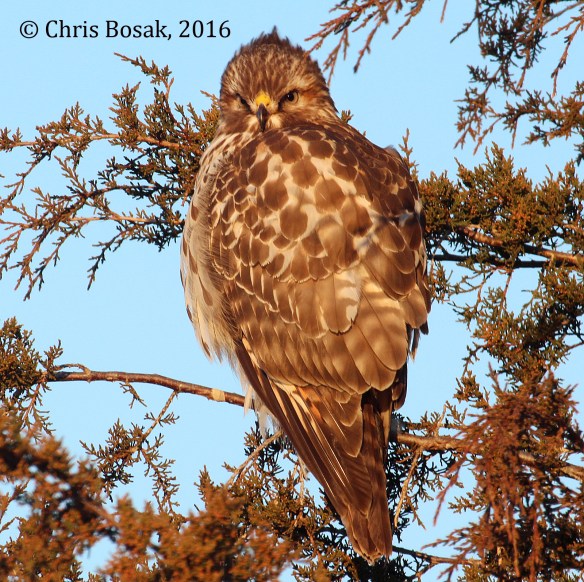
About three years ago I got a photo of a red-tailed hawk in an evergreen tree across the road from Brookfield High School in SW Connecticut. Yesterday, I was able to photograph another hawk in the same tree — this one a red-shouldered hawk.
There is often confusion between the two species as they are both large birds of the genus buteo. Throw in the broad-winged hawk and there’s even more confusion with three common buteos to be found in New England. (There are others, too, but not as commonly seen.)
The red-tailed hawk is the largest and broad-winged the smallest, but size is of little help in the field — unless, of course, individuals of all three species are perched next to each other, which never happens. I find the easiest way to distinguish the red-shouldered hawk is with its reddish or rusty chest and belly. Young birds, however, have tan or brown chests and bellies, similar to the other buteos in question.
For comparison’s sake, here’s a shot of the red-tailed hawk I photographed in the same tree in 2016.
Photo by Chris Bosak
A Red-tailed Hawk perches in an evergreen in Brookfield, Conn., winter 2016.






 Birds of New England.com