Photo by Chris Bosak
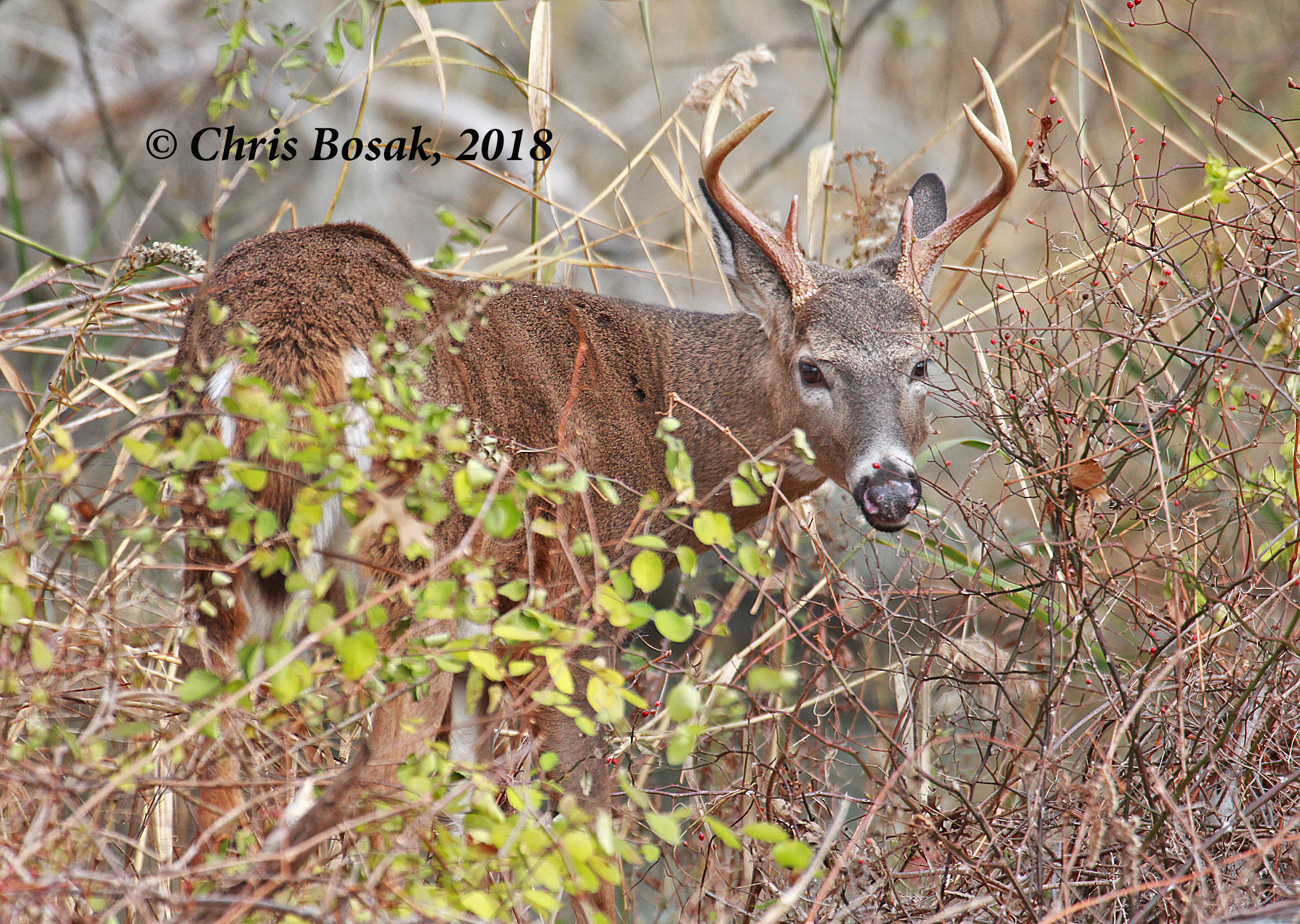
A white-tailed deer seen at Sherwood Island State Park in Westport, Conn., fall 2018.
The name of this site may be birdsofnewengland.com and the hobby may be called birding, but most birdwatchers, myself included, are always on the lookout for any type of wildlife. In fact, my interest in this hobby got its start by my fascination with a non-bird wildlife species: moose.
Some of the interesting non-bird wildlife frequently encountered while roaming New England’s woods, fields and bodies of water include beaver, mink, otter, muskrat, and fisher — just to name a few. Oh, and white-tailed deer, of course. In some areas of New England, such as southwestern Connecticut, deer are so plentiful they are seen as pests by some residents. In most areas of the region, they are revered as the magnificent animals they are.
I came across this handsome fellow the other day while looking for birds at Sherwood Island State Park in Westport, Conn.
Photo by Chris Bosak
A northern shoveler seen at 14-Acre Pond in Norwalk, Conn., fall 2018.
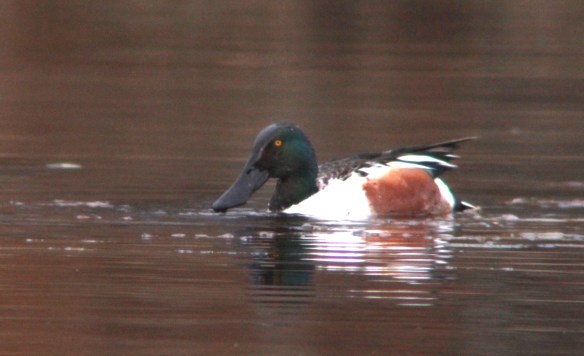
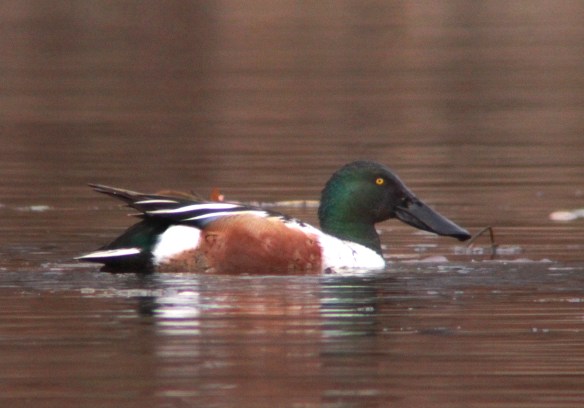
You didn’t think I’d post only one full photo of a northern shoveler, did you? Here are a few more. I tried digiscoping for one of the first times, so the quality of the photos are not great. I’ll keep practicing that skill.
Photo by Chris Bosak
A northern shoveler seen at 14-Acre Pond in Norwalk, Conn., fall 2018.Photo by Chris Bosak
A northern shoveler seen at 14-Acre Pond in Norwalk, Conn., fall 2018.
Photo by Chris Bosak A northern shoveler seen at 14-Acre Pond in Norwalk, Conn., fall 2018.
Its shovel-like bill is its most distinguishing feature. Both males and females have that flattened bill, but only the male (drake) features this bright plumage. Females are mottled tan or brown, like many female ducks.
Photo by Chris Bosak A purple finch eats seeds at a feeder in New England, Nov. 2018.
There has been a lot of talk lately about winter finches. There usually is this time of year.
I have read accounts of people seeing big flocks of pine siskins. Siskins are probably the most common winter finch that irrupts into the middle and southern parts of New England sporadically in winter.
Winter finch is not an official term with a clear-cut number of species that nicely fits the category. Rather, it is a general term used for members of the finch family that breed up north and typically spend their winters up north, but irregularly move south during the winter as food sources dictate.
The species most commonly associated with a winter finch irruption include pine siskin, common redpoll and purple finch. Larger finches, such as pine grosbeak and evening grosbeak, are also species seen at backyard feeders throughout New England during the winter.
But birds do not even have to be finches to fall into the loose category of “winter finch.” Often, the red-breasted nuthatch is lumped into the category due to its great abundance at feeders some winters and being a no-show during other winters.
So far this winter I have seen a lone female purple finch at my backyard feeding station. That has been the extent of my winter finch season so far. The nature of a winter finch irruption, however, could mean a sizable flock of pine siskins can show up and empty out my Nyjer seed feeder at any moment.
I did see a few red-breasted nuthatches on a recent trip to northern New Hampshire, but that is part of their breeding and winter grounds, and would not fall into the category of a winter-finch sighting.
Admittedly, it took a minute or two to identify the female purple finch that has been visiting my yard. It was clearly something different, so I knew I had to lock down an ID as soon as possible.
Female purple finches are streaky brown in plumage. It didn’t have the look or feel of a sparrow, so I eliminated those possibilities immediately. It looked a lot like a house finch, but was more heavily streaked and slightly larger and plumper overall. The thick bill further eliminated any sparrow possibilities and after very briefly considering the female rose-breasted grosbeak, I was able to nail down the ID as a female purple finch.
In the past when I have seen purple finches, it has usually been a pair so getting an ID was easier because I had the more colorful male to observe.
For whatever reason, regardless of how great a winter finch season it is throughout New England, my yard typically does not drive in a lot of these birds. While I’ve read about several backyards being ambushed by pine siskins already this season, I haven’t seen a pine siskin in about 10 years. That species typically irrupts every three or four years.
If nothing else shows up at my feeders all winter, I still have my regular feeder birds and my female purple finch. And I’m good with that.
Here’s a quick birding quiz for your Tuesday. The answer will be revealed later today when I post the most recent For the Birds column. Hint: With winter approaching, people throughout New England are seeing different visitors at their feeders as birds “irrupt” from the north and west.
Photo by Chris Bosak An American goldfinch perches on a chain that holds birdfeeders during a November 2018 snow storm in Danbury, Connecticut.
The snow this week brought not only the unexpected visitors, such as fox sparrows, but also the regular visitors such as chickadees, nuthatches, titmice, doves, juncos, and woodpeckers. It also brought goldfinches, which was to be expected, but what was surprising was the number of goldfinches. Every perch on my thistle tube feeder was filled and other goldfinches either waited patiently nearby or “settled” for sunflower seeds at other feeders. There were even goldfinches on the ground among the many juncos.
I hope to post a video of the goldfinches later today. Let’s see if time and my technical knowledge of video programs permit …
Photo by Chris Bosak American goldfinches eat Nyjer seed from a tube feeder in Danbury, Conn., Nov. 2018.





 Birds of New England.com