Photo by Chris Bosak
Pine siskins visit a feeder in Danbury, Connecticut, fall 2018.
It started out as two yesterday morning. Now there are more than 20 pine siskins at my backyard feeding station in Danbury, Conn. That’s often the way it goes with these winter finches: The visits start with a few birds and they multiply and eat the host out of house and home. Not that I’m complaining …
Every perch on the hopper is filled and the rest are on a nearby hopper feeder or on the ground. They are eating Nyjer and sunflower seeds.
Photo by Chris Bosak
A pine siskin eats Nyjer seeds at a feeder in Danbury, Conn., fall 2018.
After reading about pine siskins being seen throughout New England for several weeks, I woke up this morning to three of them at my feeding station. Pine siskins are one of the winter finches that irrupt from the north into New England and points south in sporadic winters. (Related post may be found here.)
Pine Siskins are often confused with goldfinches because they look fairly similar and prefer Nyjer (or thistle) seeds. Siskins are a bit larger, more sleek, more streaked and have a longer, pointed bill. The heavy streaking, especially on the sides, and yellow wing and tail markings are the best clues to differentiate the species. The male siskins have more prominent yellow markings.
So today I celebrate that the siskins have arrived. The birds, however, have a very healthy appetite and Nyjer seed is not cheap, so we’ll see how I feel if their numbers multiply. I’m sure I’ll continue to be inspired by their presence. After all, it’s been about 10 years since I was a part of one of their irruptions. I think I can splurge once a decade on them.
Here is a photo of them with goldfinches. Note the differences in plumage. The goldfinch is on the lower right.
Photo by Chris Bosak
Pine siskins visit a feeder in Danbury, Connecticut, fall 2018.
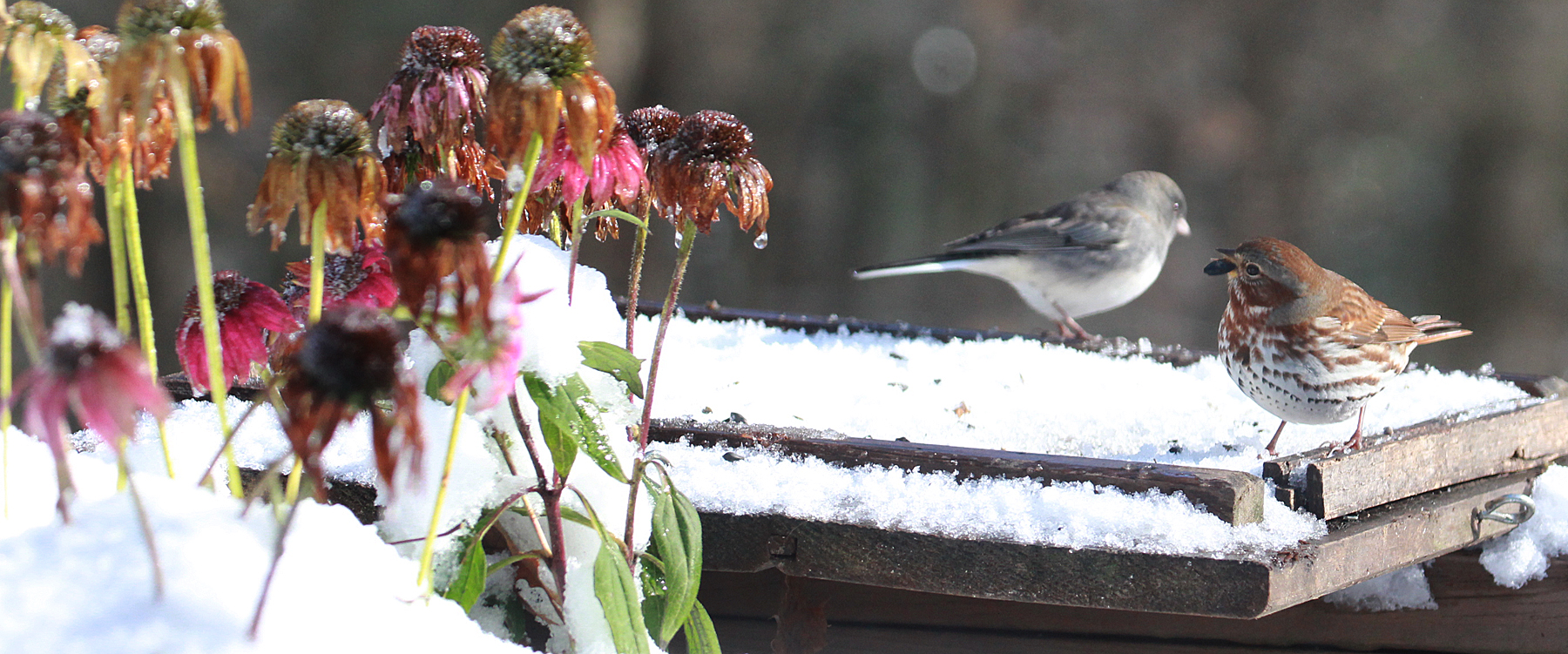
Photo by Chris Bosak A fox sparrow perches on the snow in Danbury, Conn., Nov. 16, 2018.
Here is the latest For the Birds column:
Last week I wrote about winter finches and how birds that aren’t even finches can easily be lumped into that broad category.
I mentioned a few examples and, of course, as soon as I hit the “send” button, an example that I failed to mention showed up in my backyard. It was a fox sparrow. Well, more specifically, two fox sparrows.
Fox sparrows aren’t finches, naturally, they are sparrows, just as their name suggests. But because they are small (relative to all birds) and show up at feeders throughout New England sporadically during certain winters, I think they can be mentioned under the very broad and nonspecific category of winter finches.
Winter finches, just to review quickly, are the northern birds that show up at New England feeders some winters, only to not be seen again for several years. Pine siskin is the prime example and this year seems to be another good year for siskins. Continue reading →
Photo by Chris Bosak A purple finch eats seeds at a feeder in New England, Nov. 2018.
There has been a lot of talk lately about winter finches. There usually is this time of year.
I have read accounts of people seeing big flocks of pine siskins. Siskins are probably the most common winter finch that irrupts into the middle and southern parts of New England sporadically in winter.
Winter finch is not an official term with a clear-cut number of species that nicely fits the category. Rather, it is a general term used for members of the finch family that breed up north and typically spend their winters up north, but irregularly move south during the winter as food sources dictate.
The species most commonly associated with a winter finch irruption include pine siskin, common redpoll and purple finch. Larger finches, such as pine grosbeak and evening grosbeak, are also species seen at backyard feeders throughout New England during the winter.
But birds do not even have to be finches to fall into the loose category of “winter finch.” Often, the red-breasted nuthatch is lumped into the category due to its great abundance at feeders some winters and being a no-show during other winters.
So far this winter I have seen a lone female purple finch at my backyard feeding station. That has been the extent of my winter finch season so far. The nature of a winter finch irruption, however, could mean a sizable flock of pine siskins can show up and empty out my Nyjer seed feeder at any moment.
I did see a few red-breasted nuthatches on a recent trip to northern New Hampshire, but that is part of their breeding and winter grounds, and would not fall into the category of a winter-finch sighting.
Admittedly, it took a minute or two to identify the female purple finch that has been visiting my yard. It was clearly something different, so I knew I had to lock down an ID as soon as possible.
Female purple finches are streaky brown in plumage. It didn’t have the look or feel of a sparrow, so I eliminated those possibilities immediately. It looked a lot like a house finch, but was more heavily streaked and slightly larger and plumper overall. The thick bill further eliminated any sparrow possibilities and after very briefly considering the female rose-breasted grosbeak, I was able to nail down the ID as a female purple finch.
In the past when I have seen purple finches, it has usually been a pair so getting an ID was easier because I had the more colorful male to observe.
For whatever reason, regardless of how great a winter finch season it is throughout New England, my yard typically does not drive in a lot of these birds. While I’ve read about several backyards being ambushed by pine siskins already this season, I haven’t seen a pine siskin in about 10 years. That species typically irrupts every three or four years.
If nothing else shows up at my feeders all winter, I still have my regular feeder birds and my female purple finch. And I’m good with that.
Photo by Chris Bosak An American goldfinch perches on a chain that holds birdfeeders during a November 2018 snow storm in Danbury, Connecticut.
The snow this week brought not only the unexpected visitors, such as fox sparrows, but also the regular visitors such as chickadees, nuthatches, titmice, doves, juncos, and woodpeckers. It also brought goldfinches, which was to be expected, but what was surprising was the number of goldfinches. Every perch on my thistle tube feeder was filled and other goldfinches either waited patiently nearby or “settled” for sunflower seeds at other feeders. There were even goldfinches on the ground among the many juncos.
I hope to post a video of the goldfinches later today. Let’s see if time and my technical knowledge of video programs permit …
Photo by Chris Bosak American goldfinches eat Nyjer seed from a tube feeder in Danbury, Conn., Nov. 2018.
Photo by Chris Bosak
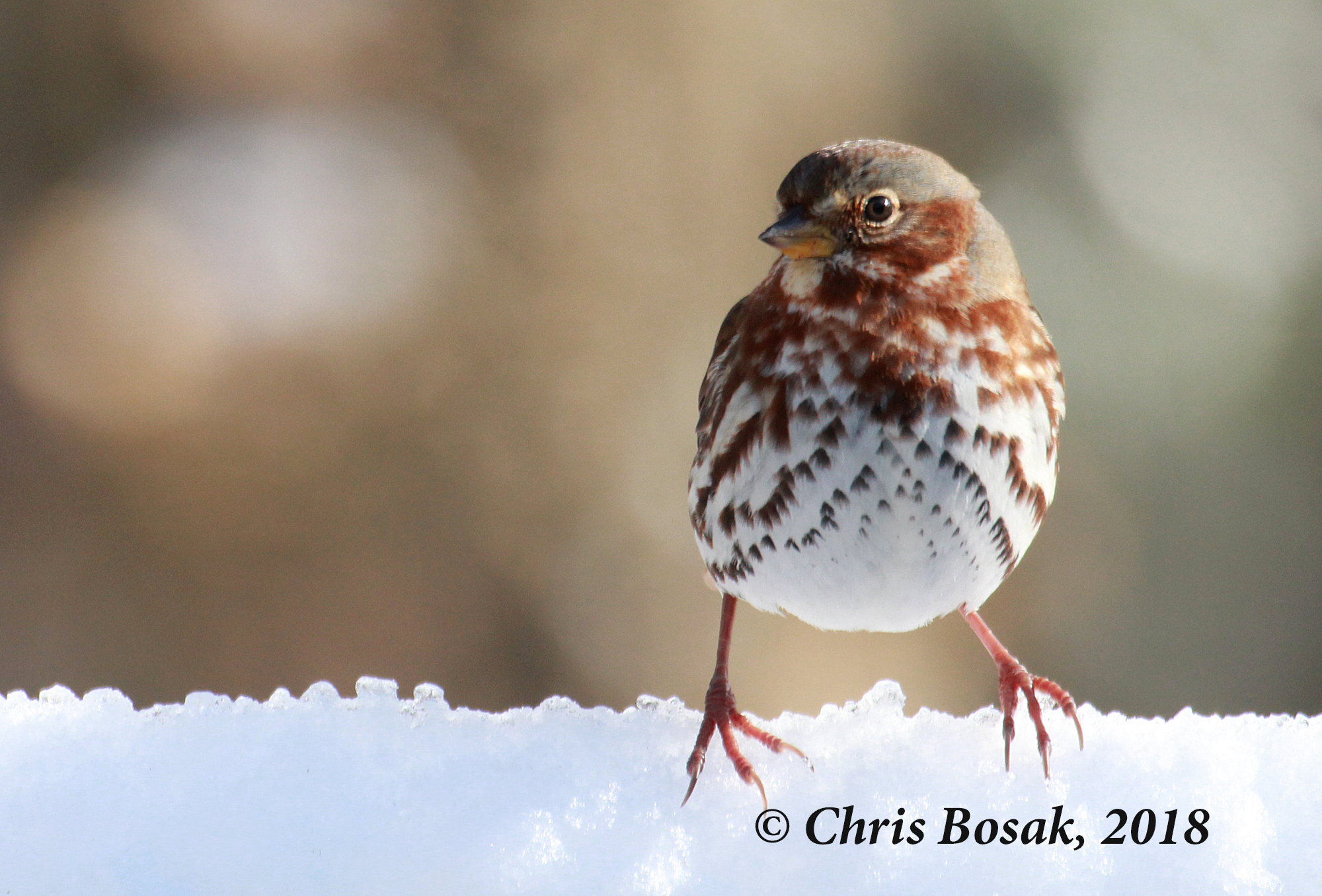
A fox sparrow perches on the snow in Danbury, Conn., Nov. 16, 2018.
As an addendum to my last post, here are some more photos of the fox sparrows that are visiting my yard today following a snow and ice storm.
Later today or tomorrow, I’ll add some photos of the goldfinches that are visiting today. There are lots of them.
Photo by Chris Bosak
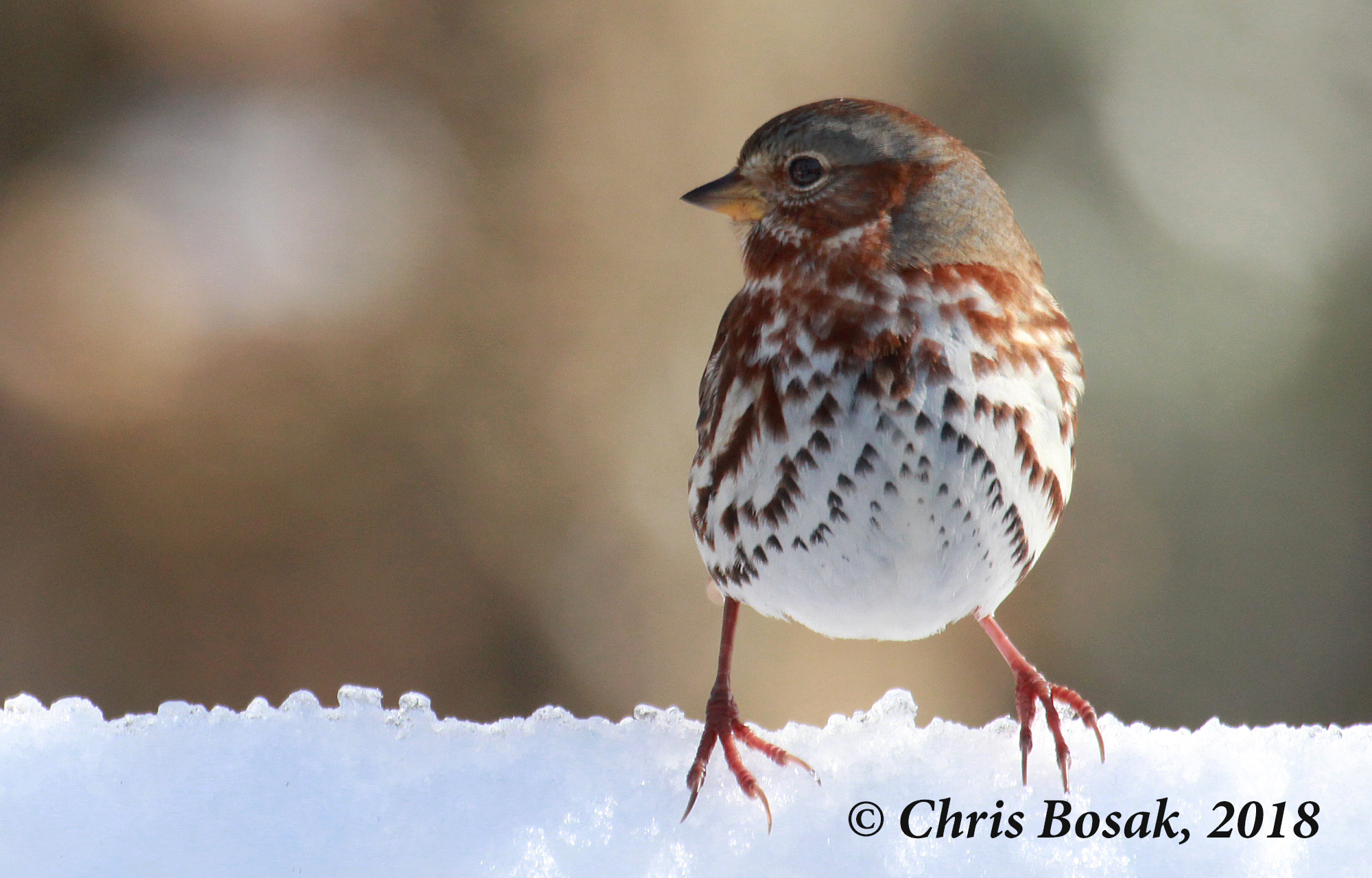
A fox sparrow perches on the snow in Danbury, Conn., Nov. 16, 2018.
Photo by Chris Bosak
A fox sparrow and junco eat sunflower seeds following an ice storm in Danbury, Conn., Nov. 16, 2018.Photo by Chris Bosak
A fox sparrow perches on the snow in Danbury, Conn., Nov. 16, 2018.
Photo by Chris Bosak
A fox sparrow eats sunflower seeds from the ground during an ice storm in Danbury, Conn., Nov. 16, 2018.
Southern New England got its first snow of the season on Thursday evening, a bit earlier than usual on Nov. 15. At some point overnight, the snow gave way to a snow/freezing rain mixture. The four or five inches of snow that fell now has a hard layer of ice on top.
The harsh weather brought in a pair of unexpected, but welcomed, visitors: fox sparrows. The large sparrows, which are also a bit more colorful than the usual sparrows in New England, show up sporadically throughout the region, mostly during the winter. With strange weather gripping the region, keep an eye out for unexpected visitors at your feeder stations. Let me know what you see by commenting on this post.
Photo by Chris Bosak An American goldfinch perches on a coneflower head, Nov. 2018.
Since I have some late-blooming coneflower thanks to a clearance sale at a nearby big-box hardware store, I may as well milk the blooms when it comes to photographing birds. Here’s a shot I took today (Tuesday, Nov. 13, 2018) of an American goldfinch eating seeds from one of the dead heads.
More shots featuring the flowers coming soon, I’m sure. Best $2 flowers I ever bought!
Photo by Chris Bosak
Tufted titmice gather near a container with coneflower during November 2018.
Scenes like this are quickly fading as winter starts to creep into New England. These coneflowers have lingered into late fall because I purchased them at a box hardware store on clearance a few weeks ago. I’m hoping the flowers return next year, but until then I’m enjoying their later-than-usual blooms. The birds are, too, of course.






 Birds of New England.com