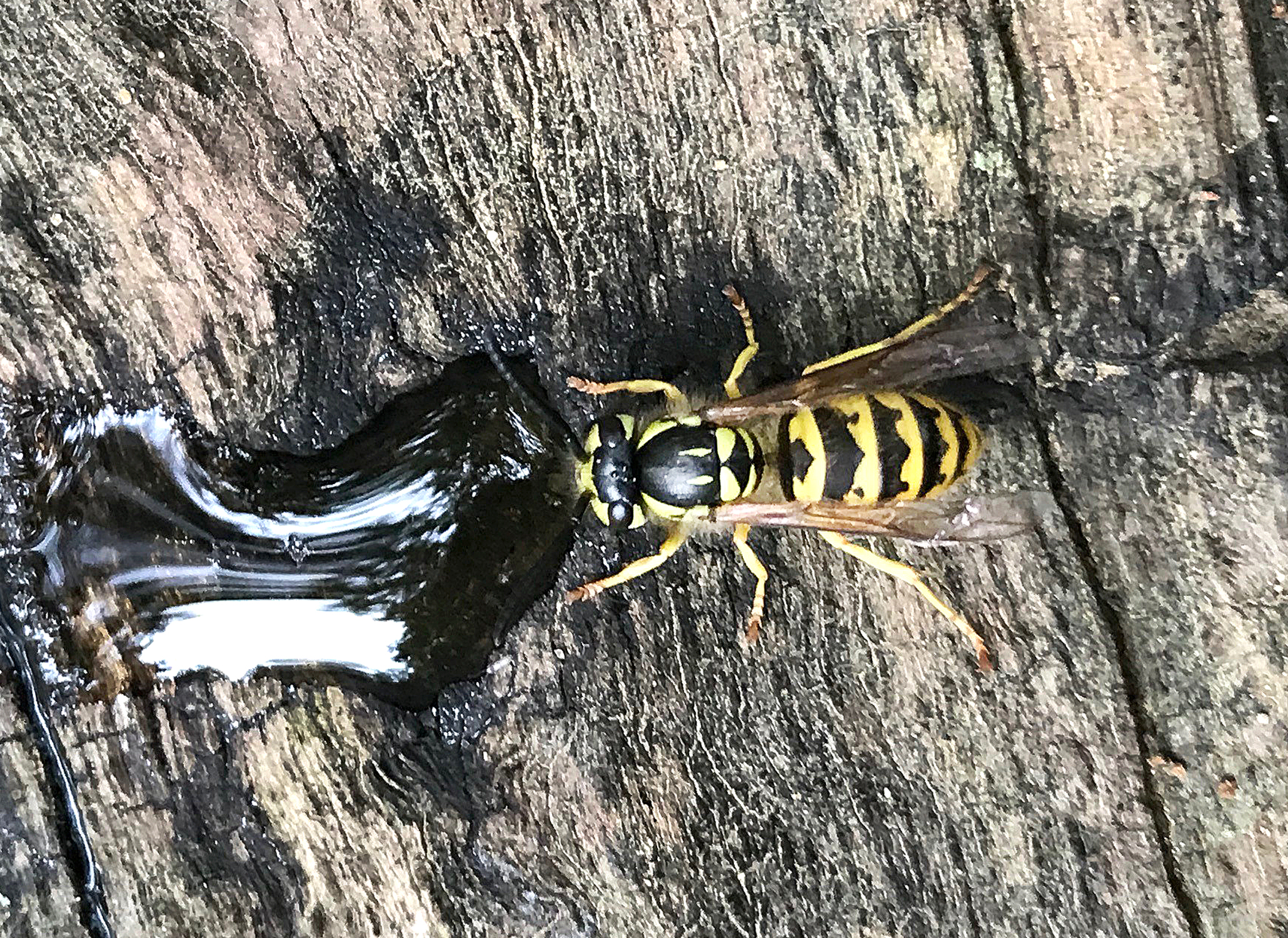
Photo by Chris Bosak Yellow jackets are one of the few threats to New England wildlife watchers.
Here is the latest For the Birds column, which runs in several New England newspapers.
…
Being an avid wildlife watcher in New England is a relatively safe proposition.
Notice I included the word relatively.
We do have two types of poisonous snakes in our region, but they are rarely seen and not widespread. Travel south or west and snakes become a bigger concern.
In all of my hours in the New England woods searching for birds, moose and other wildlife, I can count on one finger the number of times I have seen a bear. So, if just seeing a bear is very uncommon then the likelihood of a New England black bear attacking someone is remote at best.
Without getting too deep into the controversial subject of mountain lions in New England, it is safe to say that the odds of being attacked by a catamount in our region are extremely low.
Don’t let the lack of large dangers lull you into a false sense of security, however. Dangers do lurk, but they are smaller in size and more subtle in their “attacks.”
We may not have scorpions, black widows, or tarantulas in New England, but we do have our share of Continue reading →
One of the nice things about fall — in addition to the foliage, apples, pumpkins and cool weather — is going to the nursery clearance sales. Perennials that were out of my price range in July are suddenly a fraction of the cost.
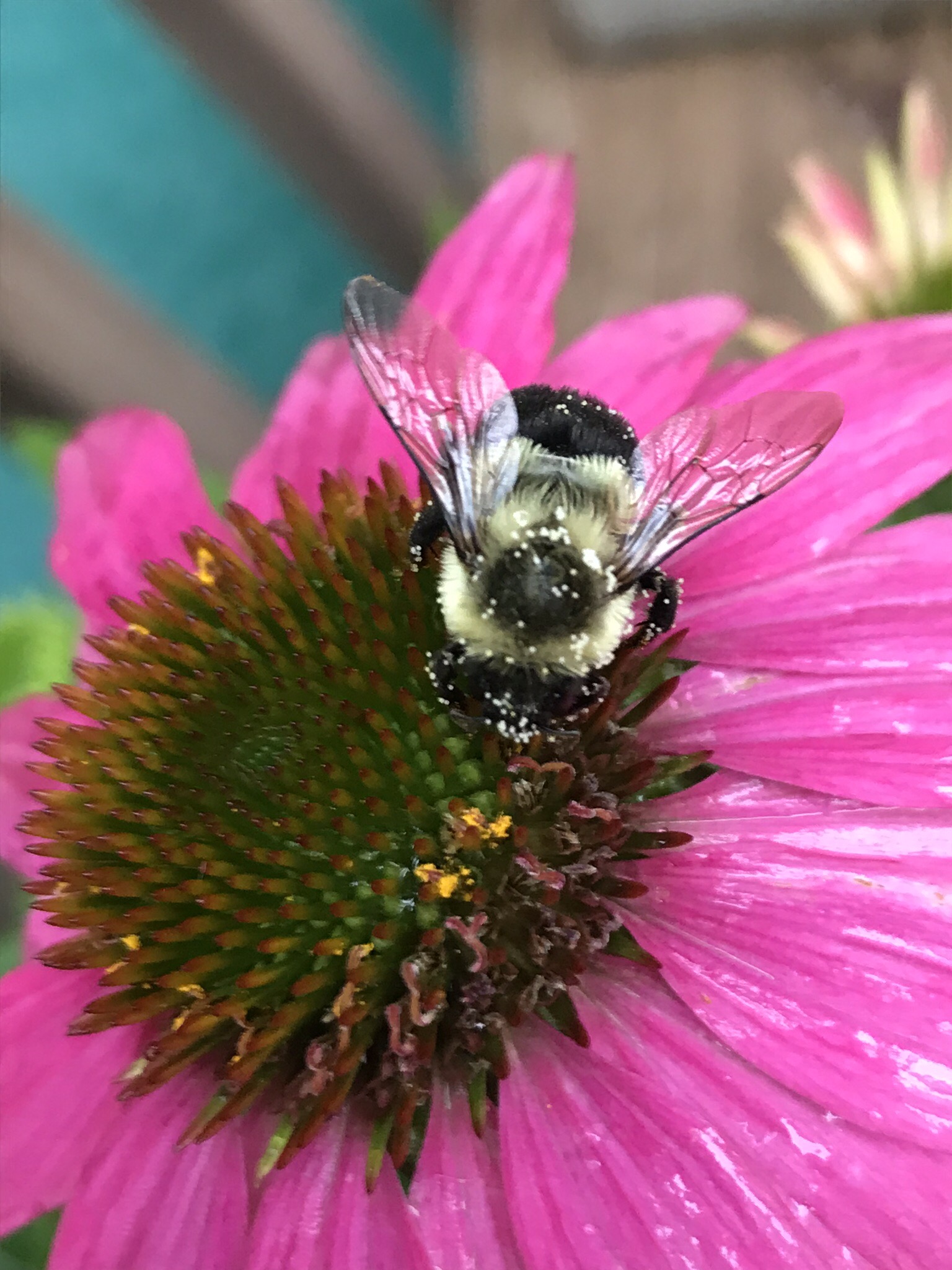
Perennials planted in the fall will pop up again next spring just like all the other perennials in the garden. Another nice thing about buying these plants late in the fall is that they are still blooming. Other than the sedum, my other perennials faded a few weeks ago. Now I have some nice pink and white coneflower blooms that are attracting a lot of bees, especially bumble bees.
The bee in the accompanying photos is obviously finding its fill of pollen.
Here is the latest For the Birds column, which runs in several New England newspapers. Yes, back-to-back hummingbird columns.
Photo by Chris Bosak
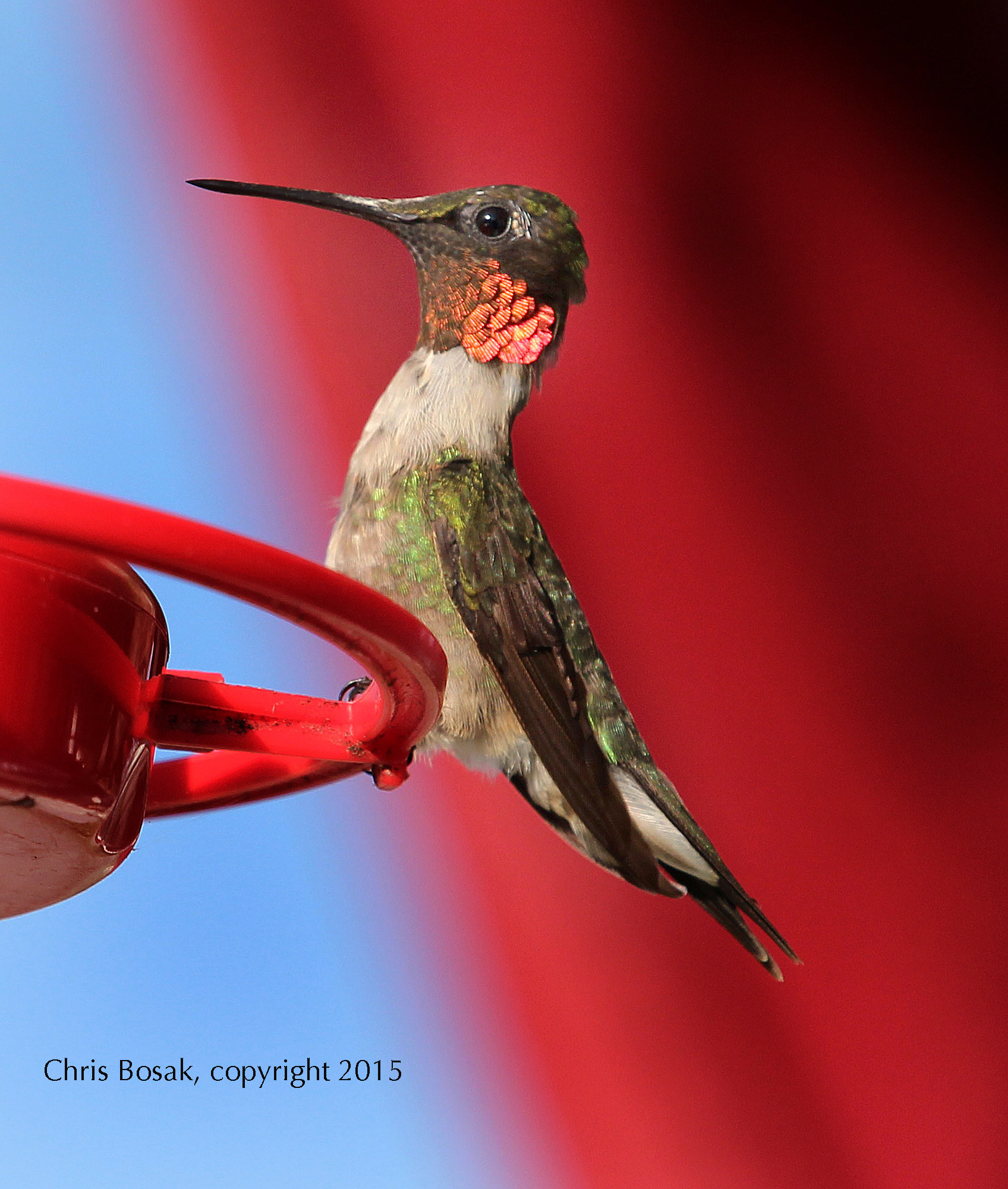
A ruby-throated hummingbirds hovers near a feeder at Merganser Lake in Danbury, Conn., in April 2017.
The hummingbird questions kept coming, so why not devote one more column in 2018 to these little charmers?
This time the question came from Pamela, whose hummingbird feeders in East Alstead are “covered with yellow jackets,” and preventing the intended targets from visiting.
“The poor hummers can’t get near it! The yellow jackets drank the whole thing in one day,” she wrote.
I think we can all relate to this quandary. Whether it’s ants, yellow jackets, or as was my case earlier this summer, raccoons, keeping hummingbird feeders open and available for hummingbirds can be a challenge.
When the raccoons ravaged my hummingbird feeders nightly this summer, I got fed up and simply moved the feeder a few feet way to the clothesline. No more raccoon problem. The hummingbirds found it just fine and actually appreciate the extra-long perch.
So how does that relate to yellow jackets, which certainly aren’t going to be daunted by flying a few feet to the left or right? Well, according to some experts in the field, that just might be enough to discourage yellow jackets.
The educational and fun website Journey North states that insects are “only likely to visit convenient sources and probably won’t search for relocated feeders.”
So, if you’re hummingbird feeder is inundated by yellow jackets, ants or some other insects, try moving it somewhere close so the birds can find it, but still in a place where you can see and enjoy it.
If that doesn’t work and the insects still take over, Journey North offers more tips on discouraging yellow jackets from visiting hummingbird feeders.
First, the site cautions against using cooking oil, petroleum jelly or any other oily substance that can get onto the birds’ feathers.
Clean the feeders regularly. If the sugar water spills or leaks, clean it up and rinse with water. It doesn’t take a genius to know sugar water is going to attract bugs (my words, not Journey North’s).
Use feeders designed to keep insects away.
“Feeders with saucers position the nectar away from the feeding port where long-tongued hummers can reach nectar, but insects cannot,” the site reads. Or, you can try installing insect traps that are sold in bird and hardware stores.
Insect guards placed in the holes of feeders can also be useful, but don’t use yellow ones as bees are attracted to yellow. Yellow guards already attached to the feeder may be painted red with non-toxic paint.
Speaking of red, remember the “nectar” in the feeder does not need to be red, and, in fact, dyes should be avoided. One part sugar to four parts water is all that’s needed.
Because I borrowed so much from Journey North, I’ll add a bit more information about the site and encourage you to check it out. Journey North for more than 25 years has been a citizen science project in North America for children and the public at large. Sightings of creatures, such as hummingbirds and butterflies, are recorded and mapped in real-time to track migration patterns.
One more tip about feeding hummingbirds this time of year. Last week we established that it is OK to keep feeding hummingbirds into the fall and it will not impact their instinct to head south. So, if you are going to keep feeding hummers for as long as possible, make sure the feeder is filled.
At this time of year, with migration on their minds, they are filling up as much as possible. One day, or even a few hours, with an empty feeder could cause the birds to seek food elsewhere and they may not come back until next year.
Good luck and let me know what you’re seeing out there.
Photo by Chris Bosak
A Ruby-throated Hummingbird perches on a feeder at the Errol (N.H.) Motel in the summer of 2015.
A question from Lida in Harrisville came in the other day that I found interesting for two reasons. The question was: “What is the current thinking on when to stop feeding hummingbirds?”
She recalled a time when it was suggested that people stop feeding hummingbirds in August so that the birds would be encouraged to fly south. She added that her feeders remained active with lots of hummingbirds.
The question at face value is interesting because I’m sure it is on a lot of people’s minds now that summer unwinds and fall looms. The question is also interesting because it got me thinking about how opinions change over time depending on knowledge available. This is true for birdwatching and any aspect of life, really.
In the birdwatching world, for instance, the names of bird species change fairly regularly. Long-tailed ducks were oldsquaws not too long ago. Rufous-sided towhees are now eastern towhees. Dark-eyed juncos are either one species with different forms or several individual species, depending on the current thoughts of ornithologists.
It was once taught to never touch a baby bird because the parent will smell human scent and reject the youngster. While it’s true that it is usually best to not touch a baby bird because the parent is likely nearby, a mother bird will not reject a bird because it has human scent on it.
It was once thought that birds are unintelligent, hence the term “bird brain.” Well, we all know that’s not true now.
Now back to the question at hand: When should we stop feeding hummingbirds? Coincidentally, a recent issue of Birds and Blooms magazine addressed this very topic in a myth-buster type of article featuring its bird and garden experts.
The magazine’s bird experts, Kenn and Kimberly Kaufman, wrote that hummingbirds will fly south when they are ready, regardless of whether there are feeders available or not. The Kaufmans wrote that the powerful instinct to migrate is much stronger than a backyard hummingbird feeder. They wrote to “feel free” to keep feeders up as long as there are hummingbirds around.
Given that a hummingbird’s natural instinct is to fly south when the time is right, I would offer a reason to keep filling your hummingbird feeder for as long as possible. Hummingbirds need a lot of energy to make their long journey to Central America. A quick fill-up at New England backyard feeder or garden can give the birds a nice head start on their arduous adventure — just like most people fill up their cars before heading out on a vacation.
Also, let’s say a hummingbird is injured or otherwise unable to fly south when their instincts tell them to do so. A reliable food source while the bird waits out the delay could be important to the bird’s survival.
As of this weekend, I still have my share of ruby-throated hummingbirds that visit the feeder, canna, salvia and fading geraniums. It’s good to hear from the experts that feeding them is not disrupting their natural behaviors.
Photo by Chris Bosak A downy woodpecker eats suet nuggets from a tube feeder in New England, summer 2018.
Sometimes you have to adjust, even in the world of bird-feeding.
Three mornings in a row I went into the backyard to fill the feeders for the day and noticed the hummingbird feeder on the ground. Two of those days the cap to the feeder had been jarred loose.
Clearly, it was time to make an adjustment, so I moved the feeder a few feet away to the clothesline — out of reach of whatever was knocking it down. It was, as I suspected, a raccoon, as revealed by game-camera footage.
The slight change of location has made a tremendous difference. It used to hang from one of the arms of the pole system, sharing space with two other feeders and a potted snap dragon flower. Hummingbirds came to the feeder, but it was dominated by a male and the larger birds that visited the other feeders often scared away the tiny hummingbirds.
The other morning, I headed toward the backyard and noticed three hummingbirds near the feeder. One was on the feeder and two were perched on the c Continue reading →
Here is the latest For the Birds column, which runs in several New England newspapers.
…
Photo by Chris Bosak A ruby-throated hummingbird perches on a stick being used as a garden stake in New England, summer 2018.
One of the nice things about living in the woods is that you are never at a loss for garden stakes.
Does that tomato plant need support? Take a little walk in the backyard, find a thin but sturdy stick on the ground, and you’ve got yourself a garden stake. Sure, it’s not apt to be perfectly straight, and it might not sport a perfectly pointed end for jabbing into the soil, but that’s nothing a whittle or two with a jackknife can’t fix.
A bonus to using these natural garden stakes, I’ve noticed, is that if they are placed near a birdfeeder, they make for good perches, too. This is especially true if the sticks have smaller branches at the top.
My property is predominantly shaded, but there is a sunny enough area on the deck and a small portion of the yard near the deck. I do a lot of container planting on the deck, so these garden stake/bird perches are high off the ground.Continue reading →
Here is the latest For the Birds column, which runs in several New England newspapers.
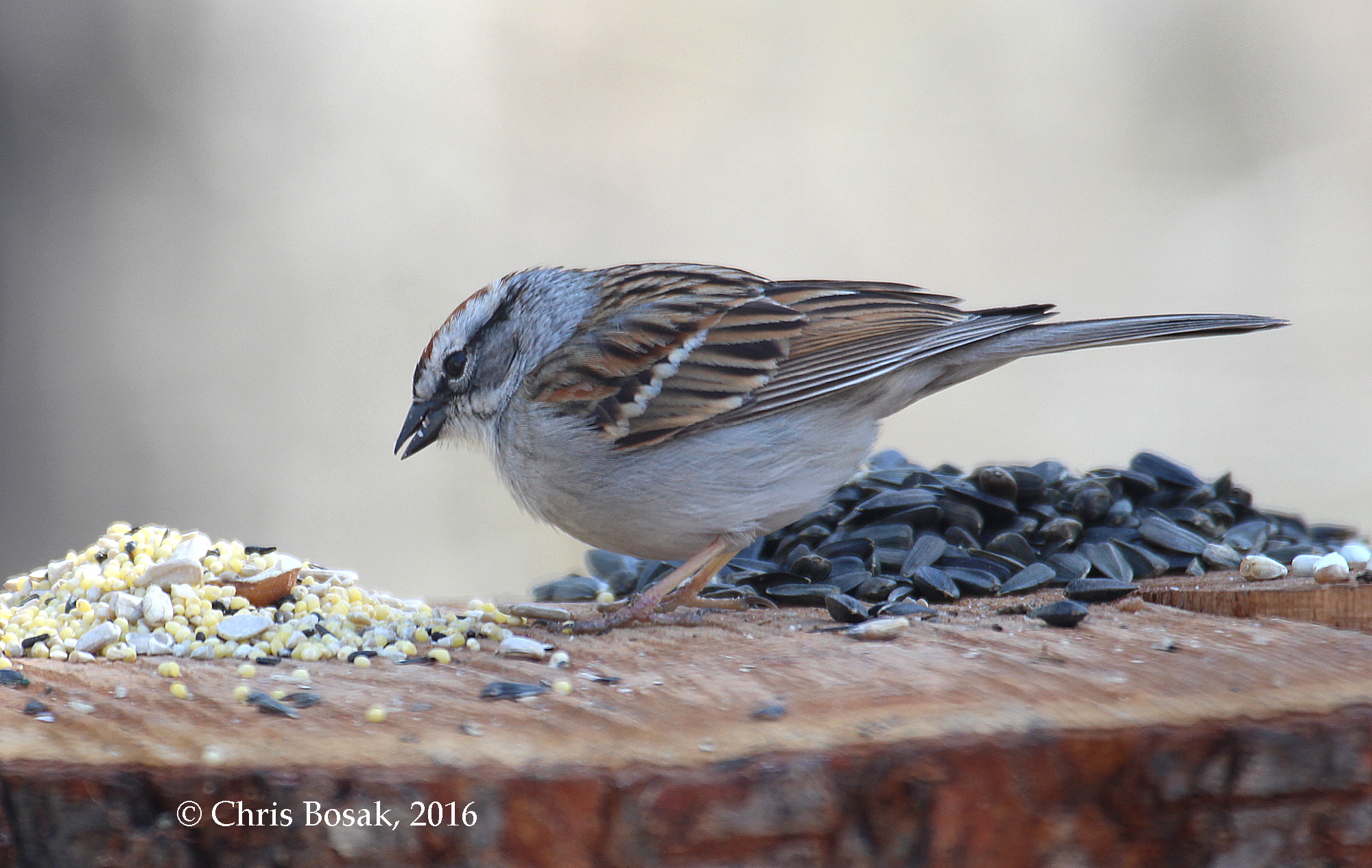
Photo by Chris Bosak A Chipping Sparrow visits a homemade birdfeeder in Danbury, Conn., April 2016.
It’s been the year of the chipping sparrow in my yard. It started in the winter and hasn’t stopped yet.
Like most other birdwatchers, I had more than my fair share of dark-eyed juncos at my feeders this past winter. The other dominant species in winter is usually the white-throated sparrow, but this winter I didn’t see a single white-throat in the yard. I did see plenty of chipping sparrows, though.
When spring arrived, the juncos headed north to their breeding grounds and I haven’t seen one since. Chipping sparrows, on the other hand, have been a daily sighting from those snowy, winter days into spring and even early summer. I don’t think a day has gone by when I haven’t seen a chipping sparrow — and that’s a good thing, of course.
I have seen plenty of these tiny birds in the past, but I don’t remember seeing them in this number or frequency before. It has been a welcome revelation.
Chipping sparrows are small, handsome birds. They rank among the smallest in New England, in fact, outsizing hummingbirds and kinglets, but being comparable to warblers and juncos.
When the leaves start to fall in a few months (not that I’m rushing it), we may discover the nests used in the spring and summer by chipping sparrows. They are tiny structures built in the classic cup shape with material such as hair, mud, and straw. This year for the first time I filled a suet cage with dog hair to see if any birds would come for nesting material. The only taker I saw was a white-breasted nuthatch, but I would bet the chipping sparrows took some hair when I wasn’t looking.
Chipping sparrows are among the more vocal birds in my backyard, too. In the spring, its trilling was a daily auditory treat. Now that the babies have fledged, Continue reading →
Here is the latest For the Birds column, which runs in several New England newspapers.
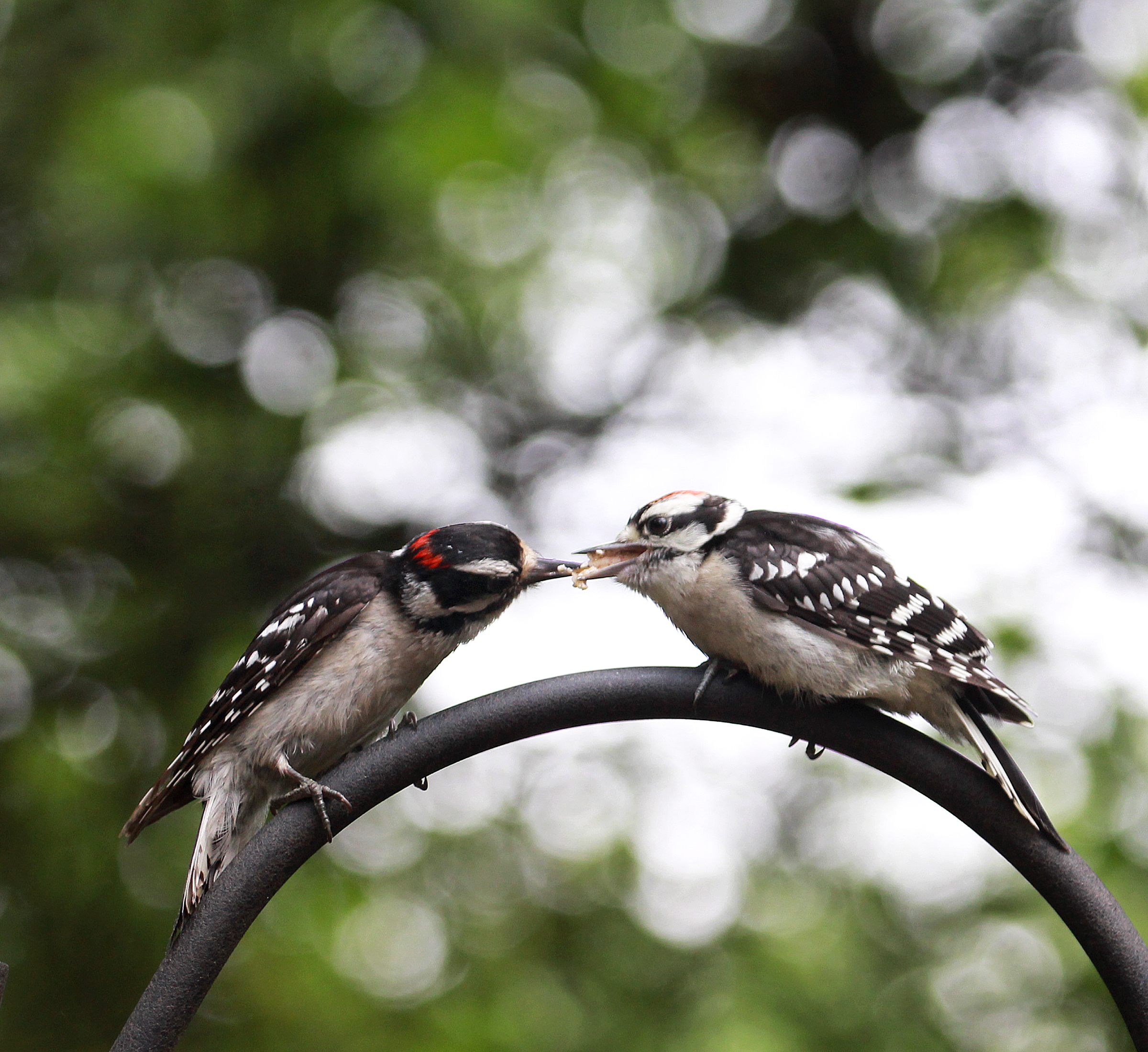
Photo by Chris Bosak An adult male downy woodpecker, left, feeds an immature male downy woodpecker near a birdfeeder in New England, summer 2018.
They grow up so fast.
I was working at my computer at home, tending to the order of the day, when a flash of brown darted across the window and caught my attention. I followed the bird as it made its way through the thick cluster of branches in the front yard. It settled on a branch near the base of one of the many dying hemlocks.
It was a female rose-breasted grosbeak. Good sighting, I thought, especially considering the suddenness of the whole thing. It got better, though.
A few seconds later another flash — this one black, white and red — burst upon the scene. The male rose-breasted grosbeak flew from branch to branch and finally settled a few inches away from the first bird. The original bird tilted back its head, opened its beak and fluttered its wings. The male, who had been collecting worms from the various branches it had previously landed on, fed the youngster and went about looking for more food.
That scene made me question my original thought of it being a female rose-breasted grosbeak. Clearly, it was a youngster and born only a few weeks prior. From the distance and angle, I couldn’t tell if it was a male or female youngster Continue reading →
Here is the latest For the Birds column, which runs in several New England newspapers.
..
Photo by Chris Bosak A female rose-breasted grosbeak visits a feeder in Danbury, Conn., during the spring of 2018.
Photo by Chris Bosak A male rose-breasted grosbeak visits a feeder in Danbury, Conn., during the spring of 2018.
I heard its call and knew the indigo bunting was close.
Suddenly, it burst from the tall grasses and wildflowers and perched at the top of a blade of grass. The blade bent, but held the bird’s weight.
Once the bird settled, my first thought was “Oh, just the female.” The male indigo bunting is on many New England birdwatcher’s “most-wanted” list. Its brilliant blue plumage is one of the most inspiring sights in New England’s natural world. The female? Well, it’s brown and rather sparrow-like.
My attitude toward the female bunting changed quickly as I realized any indigo bunting sighting is worth celebrating, regardless of whether it’s a male or female. I snapped one photo before the female bunting left her perch and disappeared again into the tall grasses.
The indigo bunting is a prime example of sexual dimorphism. I’m usually not the type to throw out terms like that, but this one is worth knowing. Sexual dimorphism is the difference in appearance between males and females of the same species.
New England is filled with great examples, even among our common, year-round species. Cardinals are an obvious example. The males are brilliant red and females are a duller olive green or light brown.
Our most colorful songbirds, such as the scarlet tanager and rose-breasted grosbeak, are other fine examples. The females of both species are dull in color, while the males sport brilliantly colorful plumage.
I thoroughly enjoyed looking at the male and female rose-breasted grosbeaks at the feeder this spring and early summer.
Many female birds are duller, of course, so as to not attract attention, especially during nesting season. Let the males be the targets and keep predators away from the nest.
Other extreme cases may be found by looking at our water birds. The wood duck is about as colorful a bird as you can imagine. The male, that is. The female is muted browns and tans. Even the mallard, our most common and well-known duck, is an example with the shiny green head of the male and overall brown of the female.
Now, let’s look at some examples from the other side — the monomorphic birds. Male and female blue jays, for instance, have a similar appearance. The same goes for chickadees and mourning doves and many other common New England species.
Some species straddle the line and have less obvious differences. The male Baltimore oriole is a brilliant, vibrant orange, while the female is a duller orange. Male eastern towhees are black, white and rufous, while the females are similarly designed with brown instead of black plumage. The difference between sexes is even closer with the American robin, with the males having a slightly more polished coat.
Birds of prey are an interesting study in sexual dimorphism. In their case, the females are usually slightly larger. The bald eagle is an extreme case as the females can be up to 30 percent larger.
Sexual dimorphism is not exclusive to the bird world. Male deer and moose have antlers, females don’t. That’s one obvious example, but in most cases, male and female mammal species look pretty much alike.
Eventually, I found the male indigo bunting, too. He was keeping watch among the top branches of a nearby tree. While it was great to see the electric blue of its plumage, as I look back, I was just as happy to the see the muted brown of the female.
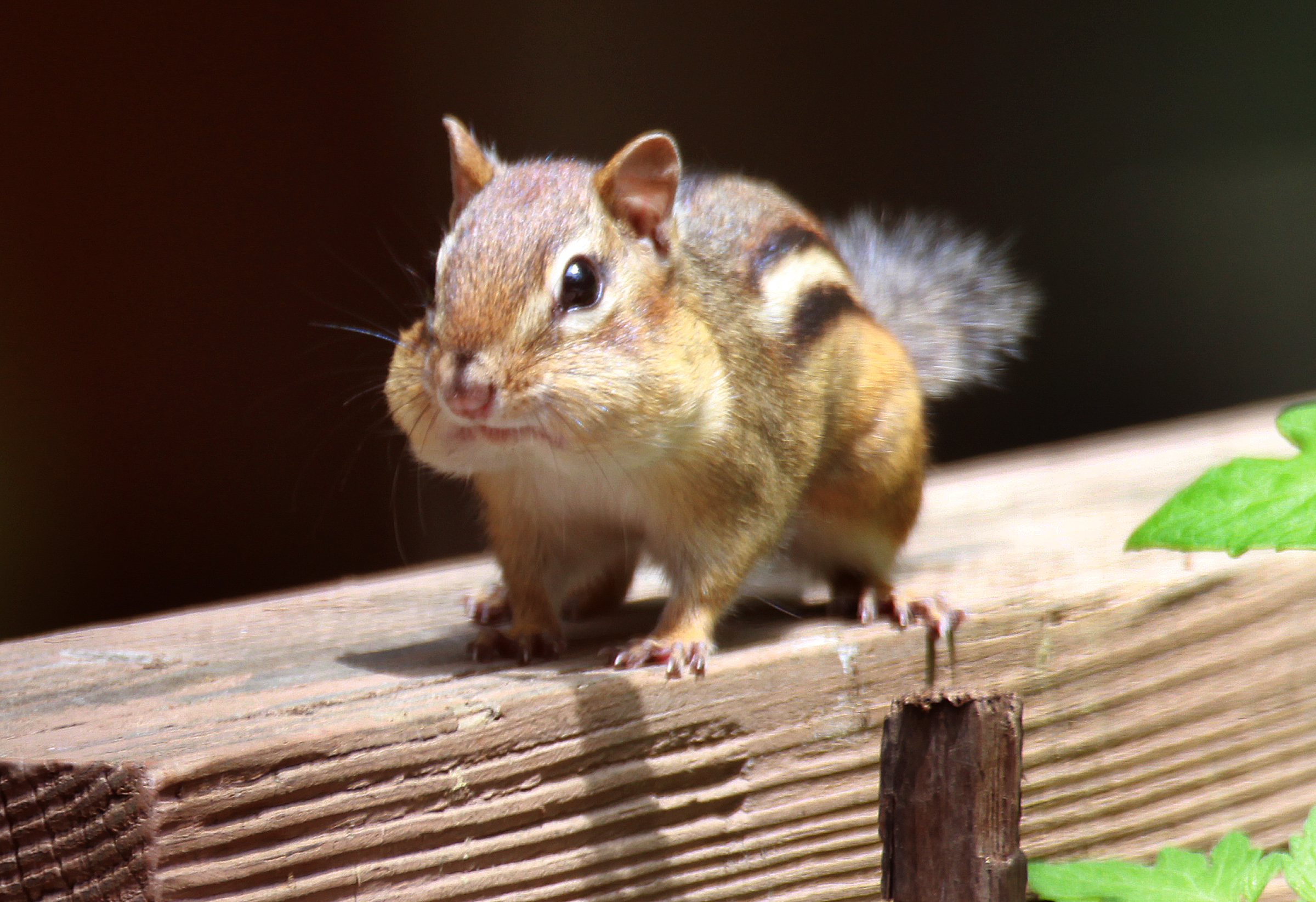
Photo by Chris Bosak A chipmunk looks up after grabbing sunflower seeds from a feeder in Danbury, Conn., during the summer of 2018.
“I could have sworn I just put a handful of seeds down,” I mumbled to myself as I threw yet another handful of seeds on the platform feeder on my deck.
I scratched my head, turned around and walked back inside. I returned to my makeshift office in my son’s room to get back to work. As I wrote one thing or another, I glanced out at the feeder and saw a head pop up from behind the tomato plant that obstructs part of the feeder. Aha, that’s the culprit: a chipmunk. It dropped its head back down and a minute later ran across the railing of the deck with a mouthful of seeds.
I’m sure it’s not the only chipmunk out there. Squirrels like to join in that fun, as well. The birds still keep coming, despite the competition, so I guess I shouldn’t complain. Plus, I’m basically serving it to the rodents on a platter — no wait, that’s exactly what I’m doing — so what should I expect.
Photo by Chris Bosak A chipmunk runs back toward its home after grabbing sunflower seeds from a feeder in Danbury, Conn., during the summer of 2018.







 Birds of New England.com