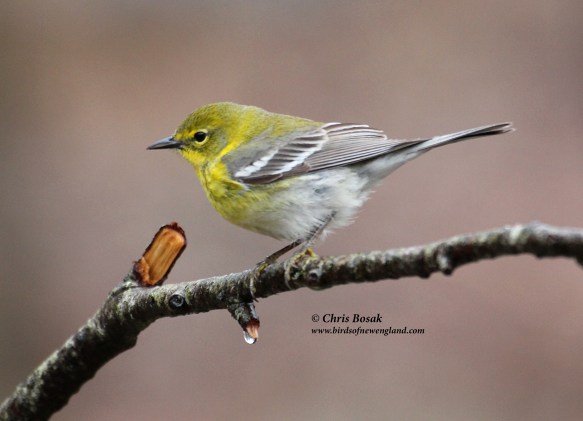
Photo by Chris Bosak A pine warbler visits a backyard in New England, April 2020, Merganser Lake.
Another quick, one-day break from the A Day on Merganser Lake photo series to bring you the latest For the Birds column …
Could it be warbler season already?
It sure is and I’m just as surprised as the next person. Not that the first week of April is unusual for the early warblers to arrive; it’s right on time.
Still, I was surprised when I looked up and saw a pine warbler perched at the top of my bird-feeder pole system the other day. I wasn’t ready for it. In a normal year, I’d be counting down the days until the first warblers arrived. But this is no normal year. I think we can all agree on that.
Like many others, I’m sure, I’ve been consumed with COVID-19, or coronavirus. It’s on the news 24/7. Grocery stores have one-way aisles, most people are wearing masks and the cashiers are wearing face shields. My work (thankfully I am still working) is busier than ever due to the virus and the days start earlier and end later than ever.
No sports. No concerts. No parties. Heck, no talking to your Continue reading →
I’m taking a one-day break from my photo series so I can share my latest bird column, which runs in several New England newspapers. …
Photo by Chris Bosak An American goldfinch perches on a wire in New England, March 2020.
I alluded in last week’s column to a goldfinch being in transitional plumage.
The truth is, in a way, American goldfinches are always in transitional plumage. Unlike most songbirds that look pretty much the same year-round, goldfinches look dramatically different in their breeding and non-breeding plumage. All birds molt (replace) their feathers at least once a year, usually at the end of summer. Most songbirds, whether the molt is done gradually or all at once, look the same at both ends of the molt.
Male American goldfinches are a brilliant yellow in their breeding (summer) plumage. They are a beloved bird and they adorn calendars, magazine covers, bookmarks and conservation promotional materials. It is this brilliant yellow-and-black plumage that makes them desirable fodder as bird models.
However, you rarely see goldfinches in their non-breeding (winter) plumage on magazine covers. The non-breeding plumage is Continue reading →
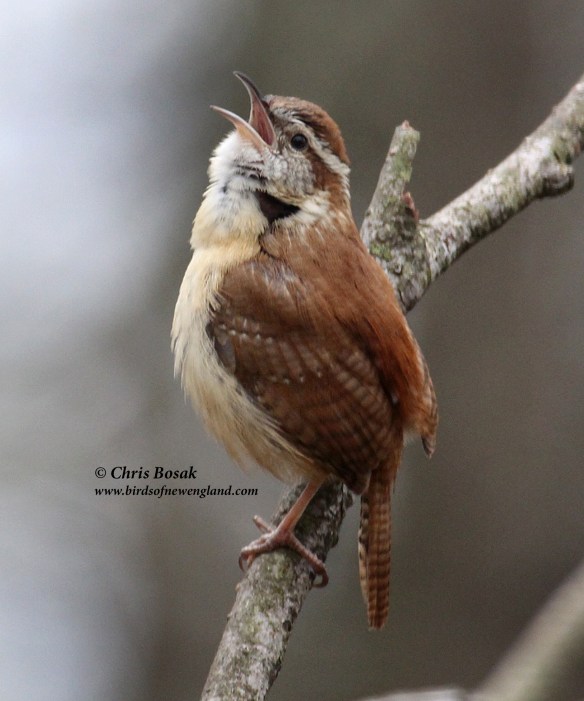
Photo by Chris Bosak A Carolina wren sings on a branch this spring in New England.
I’ll start another series of photos tomorrow, but I figured I’d bridge the gap with the latest For the Birds column. The answer to yesterday’s Birding Quiz is at the bottom of this post.
…
Spring is in the air and it couldn’t have come at a better time with global anxiety sky high and most of us living in relative isolation.
The other day, while on a video conference call while working from home, I had to unplug my laptop and go to a different room because a Carolina wren was making such a racket outside the window. “Tea-kettle, tea-kettle, tea-kettle!” It was a pleasant disruption, for sure.
Later, it was a northern cardinal distracting my work with one of his beautiful, clear spring songs. I’ve been hearing that more and more. Thankfully.
The other day while walking in the woods I heard the much more subtle song of the eastern phoebe, one of the first songbirds to return to New England each spring. Phoebes are named after their song, just like the chickadee, whip-poor-will, bobwhite, pewee and many others. Last year, a phoebe pair built a nest under my raised deck. I hope they come back this spring.
Late March is also a good time to look for American woodcock. This strangely awesome bird does a dazzling aerial dance at dusk, coupled with an odd “peent” call. Woodcock are back in New England already. I received an email from Tricia from Alstead who heard the peent call while taking a walk with a neighbor. The neighbor later found the woodcock, or timberdoodle, in her yard hunting for worms. Woodcock are Continue reading →
Photo by Chris Bosak An eastern phoebe sits on a sign near at the edge of Deer Pond in Sherman, CT, fall 2019.
Coronavirus may have robbed us of our schools, normal work routine, hand sanitizer and toilet paper, but it hasn’t taken away our enjoyment of the outdoors yet. Hopefully it won’t even as scientists and officials put additional regulations on our lives almost daily.
Not that I am questioning or making light of the regulations. I understand the reasoning behind social distancing and sheltering in place. It is important to not let the virus get even more out of hand.
Experts have said that being outdoors is fine and even encouraged during this time. They do suggest avoiding crowds and maintaining a six-foot buffer between you and the next person, even outdoors.
That is fine for birdwatchers. Many of us like to enjoy our hobby either alone or with only a few people anyway, so avoiding crowds and maintaining distance is not a problem. The coronavirus crisis may even lead more people into this great hobby Continue reading →
Photo by Chris Bosak A red-winged blackbird at Bashakill National Wildlife Refuge.
I heard them, that’s for sure. There was no missing the cacophony made by a large mixed flock of blackbirds.
Then the task became finding them. I figured I wouldn’t struggle too much at this chore as the trees are bare and I could tell from the sound of things there were a lot of them. It wasn’t as easy as I thought, but I did find them in fairly short order.
Yes, the trees were bare, but the sound was coming from a bit of a distance away and I was on terrain with many rolling hills. I crested the second hill and there they were in all their glory. The flock was mostly grackles, but a couple dozen red-winged blackbirds completed the flock.
All told there were about 80 birds. It was a sizable flock, but certainly not the biggest I have seen and most certainly not the biggest working its way into or through New England now.
Red-winged blackbirds are one of the earliest spring migrants to return. My story took place last week, in early March, which is actually a few weeks later than we usually start seeing them. In fact, Elena from Winchester had a few hardy red-winged blackbirds visit her feeders all throughout winter. The flock I saw the other day carried on for a while and then suddenly got quiet. I don’t know if the birds spotted a predator or if they were ready to settle in for the night as it was well into dusk.
I certainly could have missed something, especially considering the fading light, but I noted only grackles and red-winged blackbirds. These mixed flocks of blackbirds often have brown-headed cowbirds and starlings as well. If you’re lucky and take the time to scrutinize over the individual birds in the flock, you may find an unexpected visitor such as yellow-headed blackbird, boat-tailed grackle or rusty blackbird. It is believed that blackbirds winter and migrate in large flocks to offer better protection against predators and, perhaps, more effectively find food sources.
Yes, the spring migration is under way. It won’t be long now before the phoebes start showing up. To me, the return of “my” phoebes to the backyard signifies the real beginning of spring. Then, of course, birds of all shapes, colors and sizes will return to New England to either breed here or pass through on their way to northern breeding grounds.
It hasn’t been much of a winter, at least where I am in New England. That doesn’t mean winter is over, not by any means. I’ve been in New England long enough to know that we aren’t out of the woods until the third or even fourth week of April. Let’s hope it’s not another winter that stretches well into our spring. But that’s out of our control. If it is a long winter, we will deal with it. We always do.
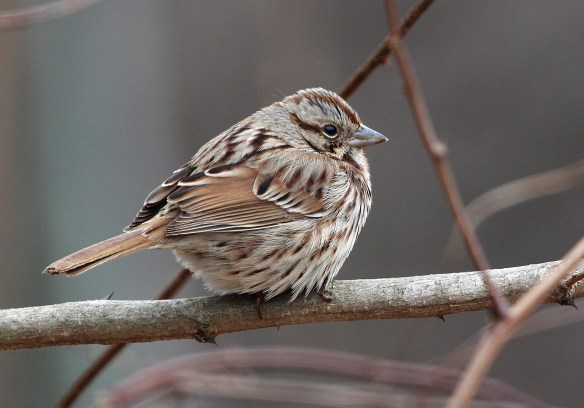
Photo by Chris Bosak A Song Sparrow seen in Selleck’s/Dunlap Woods in Darien, Conn., March 2014.
You always hope for a storm, but sometimes all you get is a flurry or two.
I’m not talking about a high school student who didn’t study for a test and is praying for a snow day. I’m talking about birding, of course.
The other day I visited a preserve in southern New England for the first time. I was struck immediately by the vast fields and several small wooded areas that looked to me like islands among the grassy expanse. My first thought was that this place is probably hopping with bobolinks, bluebirds and all sorts of other birds in the spring and summer.
But this wasn’t spring or summer. It was a dreary, raw winter day and the grass was short and brownish-yellow. Lifeless. The wooded islands were void of leaves and you could see the gray sky through the tangle of trunks and branches.
My plan was to walk along the edge of the wooded areas and see what was lurking in there. The anticipation of the new walk at a new place faded over time as close to an hour had passed and a few crows cawing in the distance was the only sign of birdlife I had noticed. I wanted to zero in on the crows to see if they were mobbing a hawk, owl or some other intruder. I couldn’t even find the crows in the sky, let alone zero in on them.
The anticipation may have faded, but my appreciation of the walk remained high. I spent much of 2019 battling off-again, on-again tendinitis in my right foot and hobbling around by putting pressure on the part of my foot that hurt the least. Walks on uneven terrain were out of the question. To be able to walk pain-free is something I’ll never take for granted again.
So I was enjoying the walk, birds or not. I made plans in my mind where Continue reading →
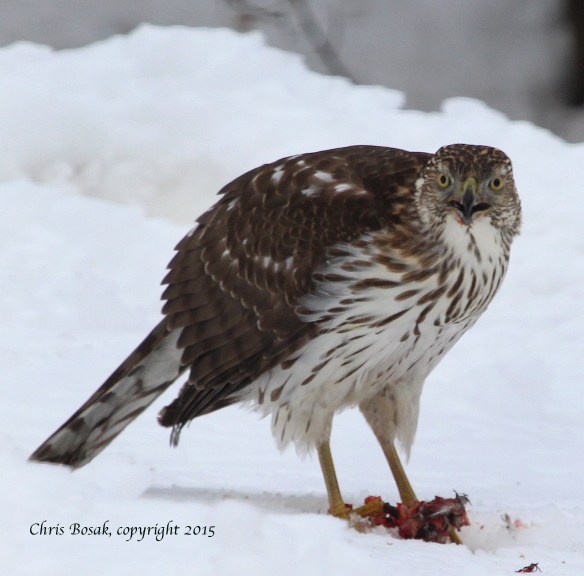
Photo by Chris Bosak A young Cooper’s Hawk eats a squirrel in southern New England in Feb. 2015.
Ah, a New England winter. There’s nothing like it.
Zero degrees one day and mid-50s a few days later. Arctic chill to pleasant spring-like weather in the blink of an eye.
Personally, I enjoy both extremes of a New England winter. I’ve said before that one of the great things about being a birdwatcher is that the hobby can be enjoyed regardless of the weather: hot, cold, rainy, snowy. The biggest impact weather — temperatures, anyway — has on birdwatching plans is whether or not the ponds will be frozen.
In the extreme cold, everything is frozen. Small ponds, large lakes and wide rivers are frozen solid. When that happens, I do my birdwatching at home and in the woods. (Lately, it’s been mostly at home, to be honest.) The feeders get particularly active in bitterly cold weather as birds feed with a sense of urgency to fuel up for the cold night ahead. All the birds you’d expect to see over the course of a winter sometimes show up in one day, especially in extreme weather. Cardinals, blue jays, mourning doves, juncos, white-throated sparrows, house finches and, of course, titmice, chickadees, nuthatches and woodpeckers can all show up on those days. Who knows? A pair of Carolina wrens may even show up.
Those types of frenetic feeder days are often accompanied by a visit from an opportunistic sharp-shinned or Cooper’s hawk, but I haven’t seen them around Continue reading →
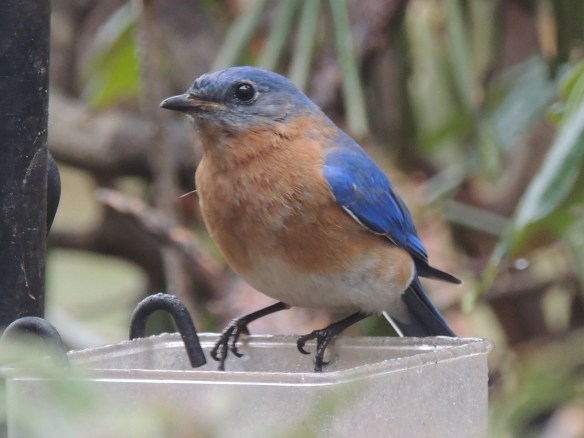
Annette Connor of New Hampshire got this shot of an eastern bluebird this winter.
The reports keep coming in so I’m going to ride the Eastern bluebird train for one more week.
In what is shaping up to be the unofficial Winter of the Bluebird, many sightings continue to come in from throughout New England, and beyond. Bluebirds, as I’ve written before, are not uncommon in New England in the winter, but the sheer number of reports this year is unique.
In case you missed the column from a few weeks ago, each winter seems to have a bird that shows up more frequently and noticeably than in typical winters. In recent years we’ve had the winter of the snowy owl, barred owl, American robin and dark-eyed junco. I’m sure you’ve figured out by now that this is highly unscientific and based on my own observations and the anecdotal observations of others.
I’ll run down the most recent sightings sent in and then close with a few fun facts about bluebirds.
Dick and Pat from Westmoreland wrote to say they had four bluebirds on their roof one recent morning, presumably drinking melted snow as it rolled down the shingles.
What’s better than having three bluebirds show up in your yard on a consistent basis in the winter? Having four show up, of course. That’s what Kathy from Swanzey is experiencing this year. She was pleasantly surprised to host three bluebirds last winter; this winter she added one to the count.
“We see them almost every day. It’s wonderful to hear their chirping Continue reading →
Photo by Chris Bosak An eastern bluebird scans a yard in Danbury, CT, March 2019.
I thought it was going to be the winter of the junco again, but it’s looking more and more like the winter of the bluebird.
Last year was the winter of the barred owl. As you recall, barred owls were being seen in great numbers all throughout New England. Experts had conflicting theories on why so many of these beautiful owls were being seen, but there is no denying that more than usual were found. On one trip to visit my brother in upstate New York, I found two barred owls. The second owl was perched atop a Welcome to New York sign on the Vermont border.
Several years ago, Christmas Bird Count results were teeming with huge dark-eyed junco numbers. Whereas there are usually hundreds of juncos in a particular count area, there were thousands that year. I dubbed it the winter of the junco and have been on the lookout for similar anecdotal phenomena since then.
Who can forget the winter of the snowy owl a few years back? I can recall robins and pine siskins being highlighted in previous winters.
As I drive to work every day, one stretch of a particular road often has a large flock of juncos. They scatter as I drive by; their white-outlined tails giving away their i Continue reading →
Photo by Chris Bosak Blue-headed vireo, Pillsbury State Park, N.H., June 2019.
Last year at this time I wrote about my New Year’s resolutions to help birds. They largely focused on citizen science projects I would either undertake for the first time or continue to be involved in.
Looking back, I could say that I did fairly well with my resolutions. Some of them, however, like most resolutions, just never came to fruition.
I did participate in a number of citizen science projects. I have done the Christmas Bird Count and the Great Backyard Bird Count for many years continuously. This past year was no exception.
Also, last year was the second year of the three-year Connecticut Breeding Bird Atlas, an ambitious project to document what birds are breeding in that state. I have an adopted area and look forward to this spring to add to my breeding bird list. I also beefed up this past year my contributions to eBird, a free app in which all reported sightings are entered into a massive database.
I fell short in a few areas. I never did take the steps to join Project FeederWatch, which I had vowed to do. Maybe this year.
I will take a slightly different approach to my bird New Year’s resolutions this year. I will continue to do the citizen science projects, of course, but will also add some resolutions of a different sort.
I have been thinking about and being encouraged to write a book or two about my birding adventures. I haven’t done so after all these years because I wasn’t Continue reading →






 Birds of New England.com