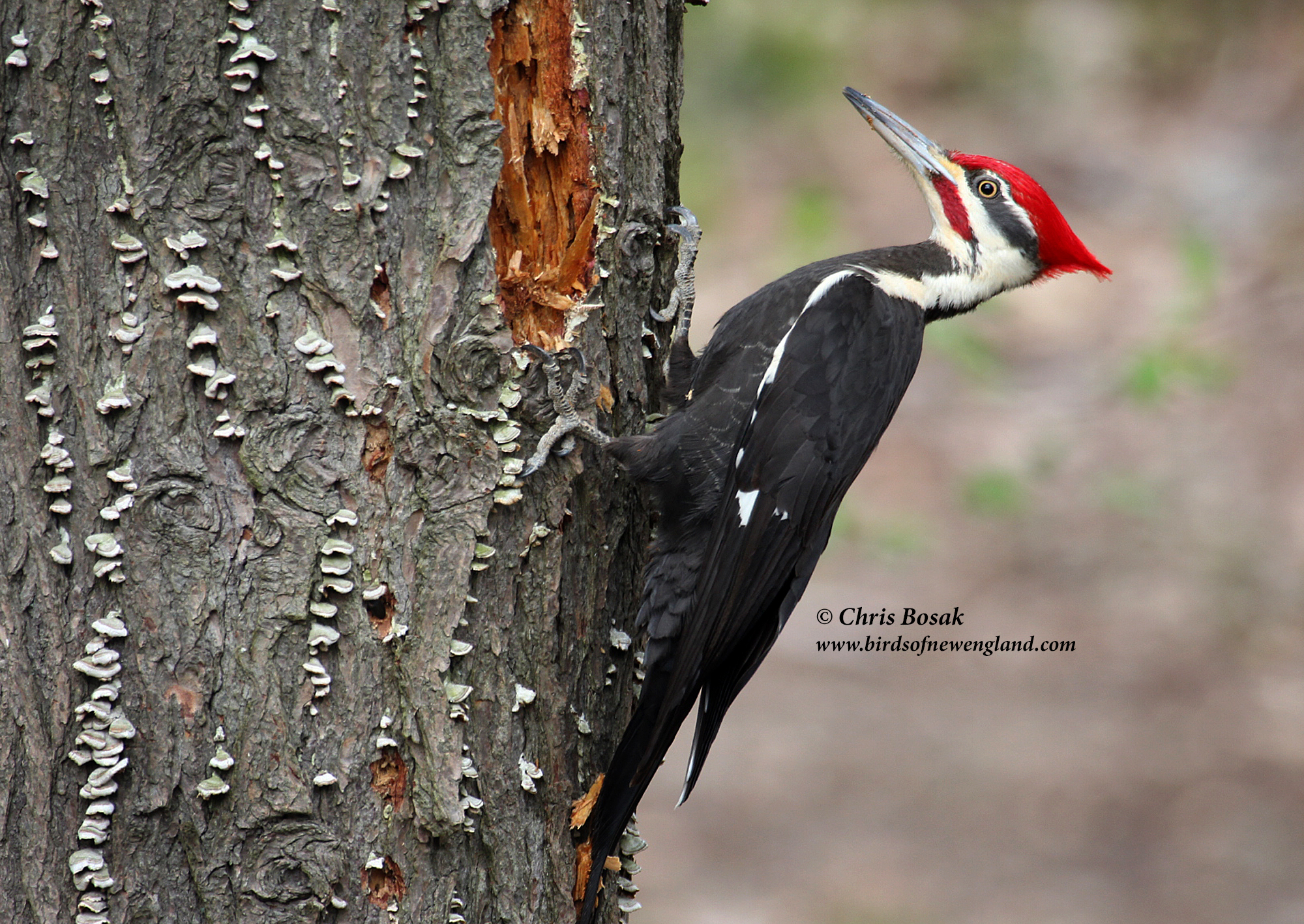
Photo by Chris Bosak A pileated woodpecker works over a tree in New England, May 2020. Merganser Lake.
It may have been a disastrous year in most regards, but one bright spot is the connection with nature many people made while dealing with the pandemic and associated quarantines, isolation and soul-searching.
Bird-feeding stores reported increased sales as people stuck at home turned to the hobby as a much-needed escape. Nature preserves closed their visitor centers, but most of the trails remained open and people flocked to them to ward off cabin fever.
I worked from home for most of the year and, while I missed seeing my co-workers, I did enjoy watching my backyard bird-feeding station daily as the seasons changed. I never realized how much you miss when you go about your regular routine.
With that in mind, here are my top 10 bird/nature watching highlights of 2020. Feel free to send me an email with some of your highlights.
10. Warblers in the snow
A rare overnight snowfall in early May dropped a coating of snow that lasted until about noon. It provided a short window to see warblers and other migratory songbirds in snow. I managed a few photos of an ovenbird and blue-winged warbler.
Photo by Chris Bosak A white-throated sparrow visits to a New England backyard, December 2020.
The first major snowstorm of the year hit New England with a varying degree of impact. Parts of the region were socked with a foot or more, while other parts were hardly touched.
I woke up to about a foot of light snow, and I loved it. As anticipated, the activity at the bird feeder was frenetic. Juncos, dozens of them, along with a few white-throated sparrows and a lone song sparrow grazed nervously on the ground under the feeder. Chickadees, titmice and nuthatches politely took turns at the hopper feeder, and a pair of Carolina wrens occupied the platform feeder.
The wrens were quickly displaced by a boisterous blue jay who made it very clear whose turn it was at the feeder. Not that the blue jay waited patiently in the first place. The big, Continue reading →
With Thanksgiving upon us, I am going to revisit my turkey fun facts column. I used to do this annually, but the content got staler than week-old stuffing. To add a little spice to this year’s column, I will start out by debunking a widely held belief about America’s favorite game bird.
If you do a web search for “turkey fun facts,” invariably the “fact” that Ben Franklin wanted the wild turkey to be our national bird instead of the bald eagle will come up. In full disclosure, an old column of mine may come up in that search as I’ve used it as fact before in my own writing. But is that really a fact? Evidently, no. I’m not a historian and I certainly wasn’t around in the 1700s to verify it myself, but I’ve come across several accounts that challenge the notion that Ben Franklin wanted the turkey to be our national symbol.
According to the articles, he actually wanted a Biblical scene to be our national symbol, not a bird at all. He did reference the bald eagle and wild turkey in some of his correspondences, but the references had nothing to do with our national symbol and some of the references were believed to be Continue reading →
Photo by Chris Bosak
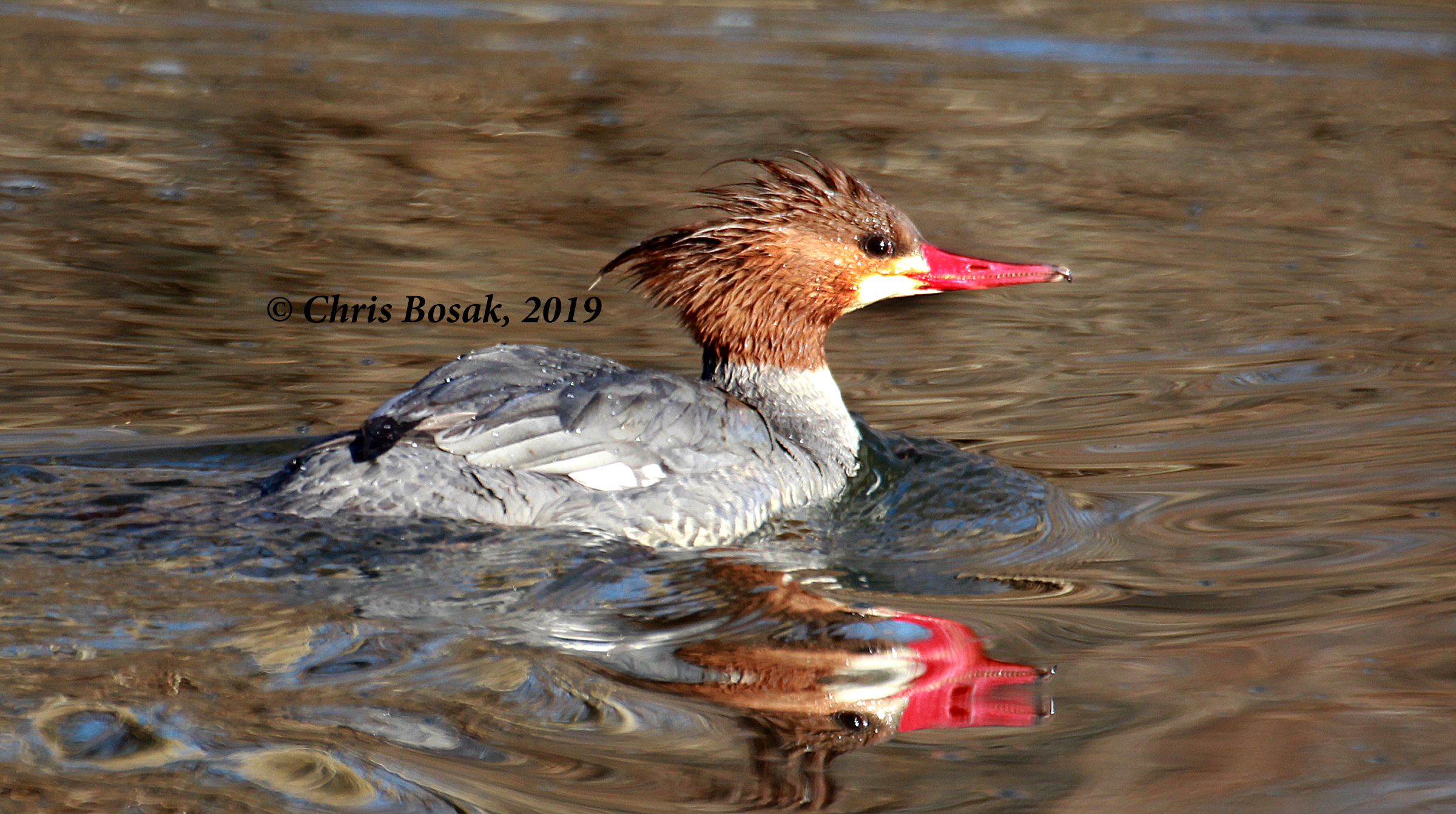
A female common merganser swims in a pond in Danbury, Conn., March 2019.
The recent stretch of beautiful weather aside, November can be a tough month for birdwatchers.
Frigid temperatures, cold rain and even some snow has many of us longing for the more pleasing fall weather of September and October. Most of the migrants, such as hawks and songbirds, are gone by November. The last of the leaves have fallen off the trees, except for a few hangers-on, erasing most of the color from the landscape. With most of the flowers long gone too, brownish-gray tree trunks and dark green foliage of evergreens dominate the landscape.
Birders, however, are eternal optimists and always find bright spots. For me, November means that the waterfowl migration has begun in earnest. It starts slowly in October and hits its stride in November. Ducks, as I have written for years, are my favorite type of bird to watch, so I never dread November.
My first duck migration sighting of the year came a few weeks ago when I spotted four male hooded mergansers swimming away from the shoreline as I approached a neighborhood pond. It was a beautiful thing to see and the first of many similar sightings that will occur for the next several months.
I received an email last week from Amy, who wrote that she had seen a flock of more than 70 common mergansers on Childs Bog in Harrisville.
Common mergansers often form huge flocks and may be seen throughout late fall and winter on our lakes and large ponds. Smaller flocks and individual mergansers are often seen as well, including on smaller ponds and rivers.
The merganser family, which also includes the red-breasted merganser, is an interesting family to study in New England. They are divers, meaning they dive underwater for their food as opposed to dabbling, and they have serrated bills to keep the food from slipping away as they surface.
Mergansers, especially common mergansers, are extremely wary, at least in my experience. Occasionally, I have come across a slightly less timid hooded merganser, but I have yet to find a common merganser that is not ultra-wary.
Of course, the merganser family just scratches the surface of all the ducks we will see passing through New England for the next several months. Bodies of fresh water will attract a different variety than salt water. There are some species that will readily go to fresh, brackish or salt water, but many species have a preference. Loons are interesting in that they breed on large freshwater bodies of water but are mostly found on salt or brackish water in the winter. Long Island Sound off the coast of Rhode Island and Connecticut is an excellent place to find common and red-throated loons in the winter. They are not the flashy birds that they are in the summer but rather a much more dull-colored version of themselves. They are still a thrill to see regardless of what plumage they are sporting.
With the duck season just picking up pace now, there will be plenty to write about in the next several months. I look forward to sharing my experiences. As always, feel free to drop me a line and let me know what you are seeing as well.
Photo by Chris Bosak A purple finch perches on a log in New England, November 2020.
The regular flow of feeder birds continued this past week, but they were joined by a few newcomers.
Two weeks ago, it was a lone red-breasted nuthatch that showed up and stayed for a day. This past week, a lone purple finch and a lone pine siskin joined the usual gang of backyard birds. The purple finch stayed for only one day — a few hours, to be more precise. The pine siskin, however, has visited daily ever since it first arrived on the scene.
Pine siskins are notorious for showing up in large numbers and cleaning out thistle feeders. I am surprised this siskin has not been joined by others of its kind, but so far it has been just the one. It mixes with a large group of American goldfinches and can be quite feisty when another bird tries to steal its perch. Pine siskins often flock with American Continue reading →
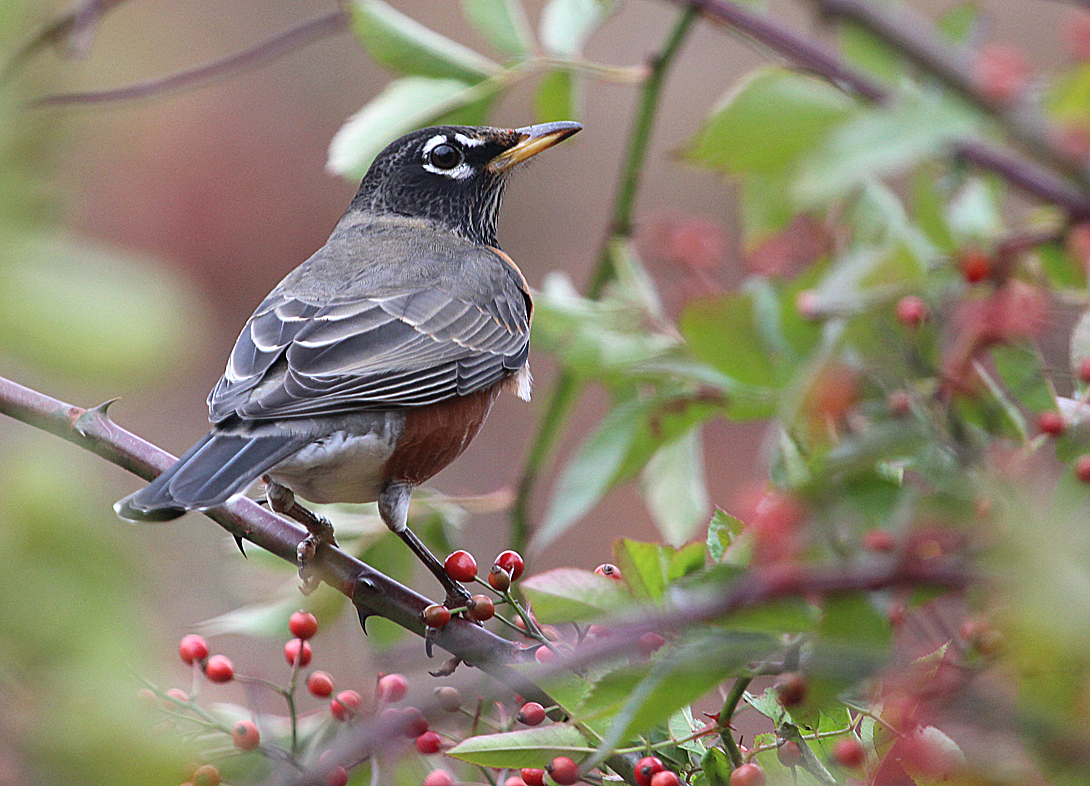
Photo by Chris Bosak American Robin in Selleck’s Woods in fall 2013.
Activity at the birdfeeders has been nonstop. I have not seen any of the winter finches or really anything out of the ordinary, but the regulars are showing up in droves. I did see a palm warbler in the birdbath and a few yellow-rumped warblers in the trees.
I’m not alone in being invaded by feeder birds. Bill from Keene wrote recently and made an interesting analogy regarding the many birds at his feeders when he likened the action to an airport terminal. His visitors have included tons of juncos, jays, robins and many more. “Almost clouds, all flying madly, like insects,” Bill wrote. “Looks like an airline terminal.”
I really do like the airport analogy and thought of it the next time I watched my feeders. My frequent fliers are titmice, chickadees, white-breasted nuthatches and downy Continue reading →
Photo by Chris Bosak
A pine siskin perches on the top of an evergreen in Danbury, CT, March 2019.
The 2020-21 Winter Finch Forecast is out and it looks like it could be an exciting next several months in New England.
This is the first forecast by Tyler Hoar. Ron Pittaway did the forecast for several decades before passing the torch to Hoar this year. The Winter Finch Forecast is a prediction of what finch (and other) species may irrupt into New England and parts south and west. An irruption is when northern birds move to or through an area in abnormally high numbers. For example, many years we get very few or even no pine siskins. Other years we get so many we can’t fill the feeders fast enough. Irruptions occur mainly due to food availability, or lack thereof. If it is a bad crop year up north for a certain type of food, such as pine cone seeds, irruptions may occur as birds move in search of food sources.
According to Hoar, this is shaping up to be a good year for purple finches and evening grosbeaks. It is also a year when red-breasted nuthatches are moving south in high numbers. Perhaps you’ve seen more of these small, charismatic birds than usual in your yard this fall already. I hadn’t seen or heard a red-breasted nuthatch in my yard for about four years. This fall, I’ve had three already. I’ve seen only one, and heard the other two. Red-breasted nuthatches have higher-pitched songs and calls than their cousins, the white-breasted nuthatch. It’s an unmistakable difference once you learn it. Red-breasted nuthatches are the more common nuthatch throughout much of New England, particularly up north. In southern New England, irruption years of red-breasted nuthatches are a special treat as they are not resident birds.
The Winter Finch Forecast covers finches such as redpolls, crossbills and siskins, as well as a few small birds that aren’t finches. Irruptions are not limited to these small birds, of course. Who can forget the winter of 2013-14 when snowy owls were all the rage and showed up in places they’d never been seen before?
To see the full forecast, enter “2020-21 Winter Finch Forecast” into a web search and have at it. Are we likely to see common redpolls this winter? I’ll leave that research up to you. I’m always looking forward with excitement regardless of the season, but the Winter Finch Forecast offers that much more incentive to cheer on winter and the colder months. Winter is not so bad after all.
Photo by Chris Bosak Praying mantis at Highstead in Redding, CT, summer 2019.
In my opinion, September ranks up there as one of the best months for wildlife watching in New England. Top two or three, I’d say. I like each of the months, of course, and you could make an argument for pretty much any of them being in the top five. May is hard to beat as it is the height of the songbird migration in New England and comes on the heels of several months of cold weather. Also, the flowers start blooming and trees fully leaf out, adding color to a landscape that had been mostly gray for far too long.
So May, I think, has to be number one.
April, September and October duke it out for second. To me, September gets the nod. Like May, September is a transition month. The fall migration begins in earnest during September, but summer still hangs on tightly. Not only do we get to see the fall migrants pass through, but all of the things that make summer special remain. Loons and hummingbirds are around for much of September, but they are mostly gone by October.
September is a great time to take a walk in a field. The goldenrod is in bloom and if you look closely, you can often find interesting critters such as a praying mantis or yellow garden spider. It is interesting to note that praying mantises are not native to North America. Also, male yellow garden spiders are small and brownish; only the female has the intimidating size and colorful pattern.
September also marks the beginning of the southward hawk migration, which is a highlight of the year for many birdwatchers. September features the massive broad-winged Continue reading →
Photo by Chris Bosak A hummingbird moth sips nectar from a butterfly bush in New England, summer 2019.
Odds and ends from the natural world:
I led you astray in a recent column and I’m here to own up to it and make it right.
I wrote about and included a photograph of a tomato hornworm caterpillar being covered in the small white cocoons of a wasp parasite. That part was true. It was a tomato hornworm and it was covered in the cocoons of braconid wasps. These wasps start their life cycle as an egg laid inside the giant green caterpillar and eat their way out to build their cocoons.
I was mistaken, however, in saying that the caterpillar would have turned into a hummingbird moth – at least the kind we enjoy watching around our flowers in the summer and early fall. That moth is the hummingbird clearwing moth and is not Continue reading →
Photo by Chris Bosak A tomato hornworm is covered in braconid wasp larvae on a tomato plant in New England, August 2020.
(Note: This post has been updated from its original content to correct information about the hummingbird moth caterpillar.)
I was all set to follow my last column about fall migration with a closer look at some of the songbirds, including warblers, that are heading south now and will be for the next several weeks.
That column has been put on hold as I saw something in the garden last week that just can’t wait. Experienced vegetable gardeners have likely seen this before, but it was a first for me and I was amazed at the gruesome details when I researched it online.
First, a little background. It is a first-year garden plot. I dug it during April at the height of the COVID-19 outbreak in the Northeast. More than anything else, it was a diversion from the nuttiness going on in the world; something to keep my mind and body occupied during quarantine. I’ve never had a green thumb and I had little hope in the garden ever yielding impressive crops.
As it turns out, my pessimism was warranted. Once the leaves popped on the giant oaks that surround my property, the garden didn’t stand a chance. Tomato plants require how much sunlight? Continue reading →