For the Birds: Early-morning wake-up call

Here is the latest For the Birds column, which runs in several New England newspapers.

Photo by Chris Bosak An American Robin perches on a gravestone at at a cemetery in Darien, Conn., April 2014.

Photo by Chris Bosak
An American Robin perches on a gravestone at at a cemetery in Darien, Conn., April 2014.

A raccoon knocked over something in the backyard around three in the morning. The crash woke me from a dead sleep, so I got up to investigate. A quick look in the pitch-dark with a cheap flashlight did not yield the cause of the crash. The potted plants looked to be intact and the birdfeeders seemed to be in their place.

I went back to the screened-in porch to continue my night’s sleep, but sweet dreams eluded me. I used to be the world’s best sleeper; able to sleep anytime, anywhere. As I’ve gotten older, however, it’s gotten less easy.

So, I stared into the dark woods, listened to the night sounds and hoped to doze off again. When the robins started singing I gave up. I checked the time: 4:45. Still dark. I got to thinking as I sat there waiting for the sun to rise about why birds would sing before dawn in the summer. I can understand in the spring, as the male birds want to attract females, so why not get an early jump on the competition.

But in the summer, why sing so early? Why sing at all, really?

The breeding season, for the most part, is over, so impressing females shouldn’t be at the top of their list. That is the beauty of thinking, of course. You come up with theories, right or wrong, about your questions. Robins are the most-hearty singers in the morning in the summer, at least at my place. Robins are early nesters, getting started before a lot of our songbirds. They also have several broods each year — two or three in New England.

So, it made sense to me that a robin would be singing that early because he may still be in the breeding season.

In my weary ruminations, I thought of another reason. Birds sing for two main purposes: to attract females and to protect their territory. The breeding season might be over, but the task of raising young is still at hand. A bird waking up that early to sing is calling out to other birds that they are alive and well to stay the heck away.

Now for the beauty of the Internet: You can discover what others think on the subject. There are other theories on why birds sing so early — atmospheric condition is one theory — but I will leave the scientific research to those more capable.

I did find some interesting tidbits on singing. Bird pairs recognize each other’s “voice.” It is mostly the males that sing, of course, but all birds call to each other. The songs and calls may all sound the same to us, but birds can recognize individuals by the nature of the sounds.

Some females do sing. I’ve heard female cardinals singing on plenty of occasions. I’ve read that female grosbeaks and orioles also sing.

Sleeping outside (the screened-in porch is close enough to outside) opens your eyes and ears to the dark side of nature. I mean dark in a literal sense, of course.

Also, when sleep escapes you, it gives you time to ponder.
Continue reading

For the Birds: A chipping sparrow kind of year

Here is the latest For the Birds column, which runs in several New England newspapers.

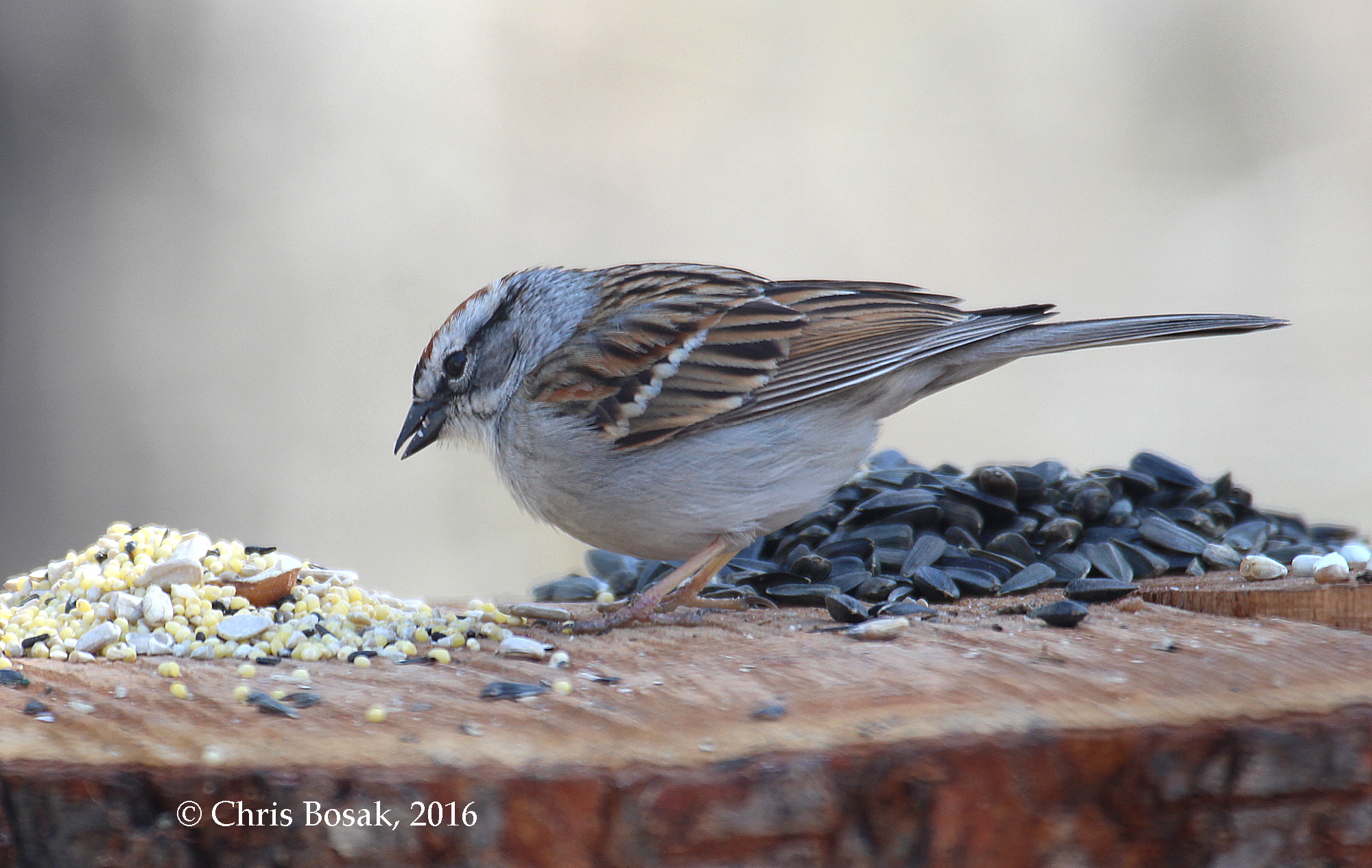
Photo by Chris Bosak A Chipping Sparrow visits a homemade birdfeeder in Danbury, Conn., April 2016.

Photo by Chris Bosak
A Chipping Sparrow visits a homemade birdfeeder in Danbury, Conn., April 2016.

It’s been the year of the chipping sparrow in my yard. It started in the winter and hasn’t stopped yet.

Like most other birdwatchers, I had more than my fair share of dark-eyed juncos at my feeders this past winter. The other dominant species in winter is usually the white-throated sparrow, but this winter I didn’t see a single white-throat in the yard. I did see plenty of chipping sparrows, though.

When spring arrived, the juncos headed north to their breeding grounds and I haven’t seen one since. Chipping sparrows, on the other hand, have been a daily sighting from those snowy, winter days into spring and even early summer. I don’t think a day has gone by when I haven’t seen a chipping sparrow — and that’s a good thing, of course.

I have seen plenty of these tiny birds in the past, but I don’t remember seeing them in this number or frequency before. It has been a welcome revelation.

Chipping sparrows are small, handsome birds. They rank among the smallest in New England, in fact, outsizing hummingbirds and kinglets, but being comparable to warblers and juncos.

When the leaves start to fall in a few months (not that I’m rushing it), we may discover the nests used in the spring and summer by chipping sparrows. They are tiny structures built in the classic cup shape with material such as hair, mud, and straw. This year for the first time I filled a suet cage with dog hair to see if any birds would come for nesting material. The only taker I saw was a white-breasted nuthatch, but I would bet the chipping sparrows took some hair when I wasn’t looking.

Chipping sparrows are among the more vocal birds in my backyard, too. In the spring, its trilling was a daily auditory treat. Now that the babies have fledged, Continue reading

Latest For the Birds column: Persistence pays off in birding

Here is the latest For the Birds column, which runs in several New England newspapers.

Photo by Chris Bosak A Great Egret stands on a deck railing overlooking the Norwalk River in Norwalk, Conn., April 2016.

Photo by Chris Bosak
A Great Egret stands on a deck railing overlooking the Norwalk River in Norwalk, Conn., April 2016.

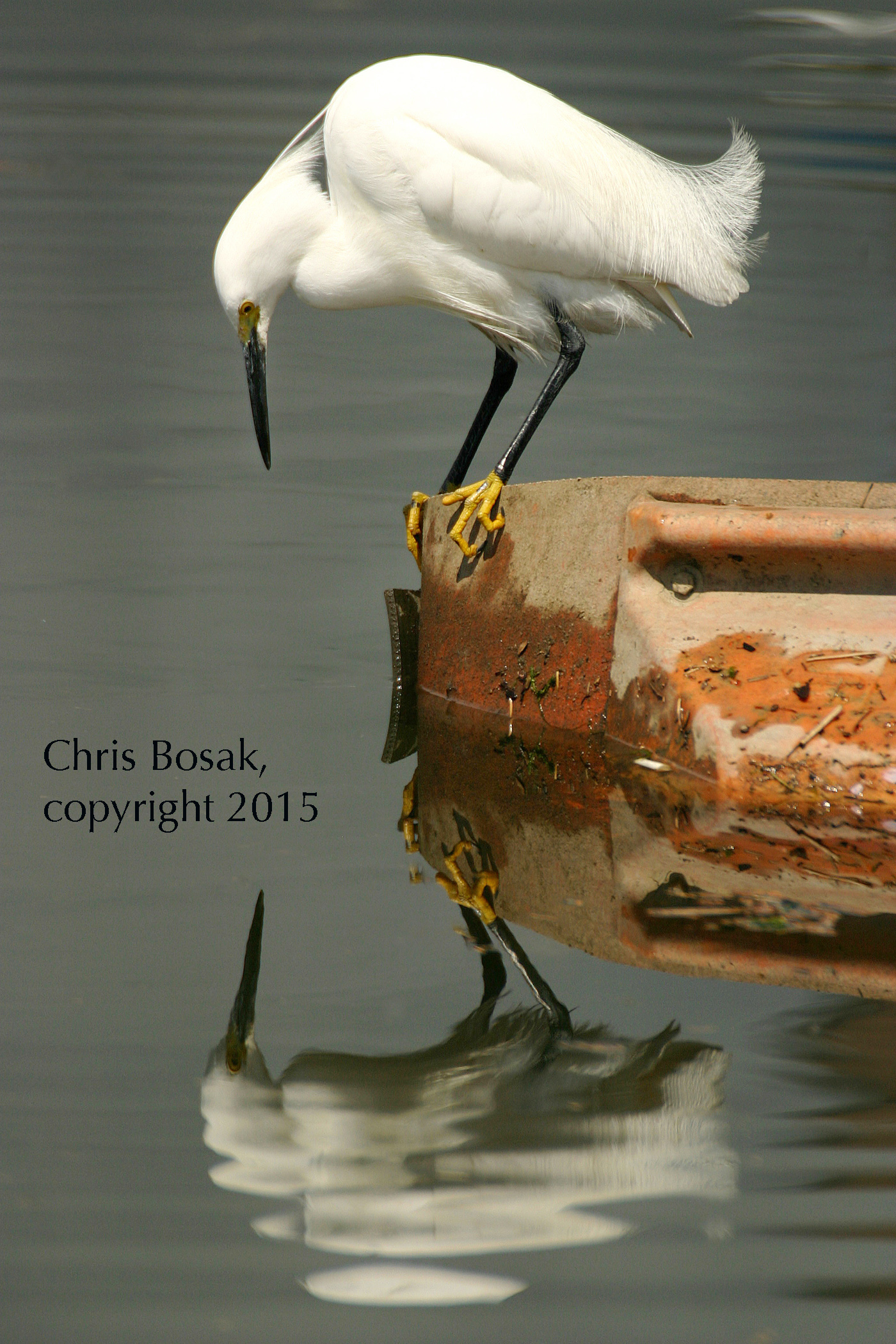
Photo by Chris Bosak A Snowy Egret looks for food in Norwalk Harbor.

Photo by Chris Bosak
A Snowy Egret looks for food in Norwalk Harbor.

Persistence, practice and patience will often make things that seem so difficult at the beginning become relatively easy.

It can be said of just about any hobby, but it certainly applies to birdwatching.

I can remember struggling with differentiating great egrets from snowy egrets. It seems somewhat silly now. Great egrets are markedly larger, have yellow bills and black legs and feet. Snowy egrets, aside from being much smaller, have black bills, black legs and yellow feet.

The differences are clear and obvious. But, as a beginner, I saw only tall white birds, and telling them apart was a challenge.

Trying to decide if I was looking at a downy or hairy woodpecker was another early sticking point. It took me years to come up with an easy way to tell the species apart. Aside from size, downys and hairys are identical — right down to the difference Continue reading

For the Birds: Watching the babies grow

Here is the latest For the Birds column, which runs in several New England newspapers.

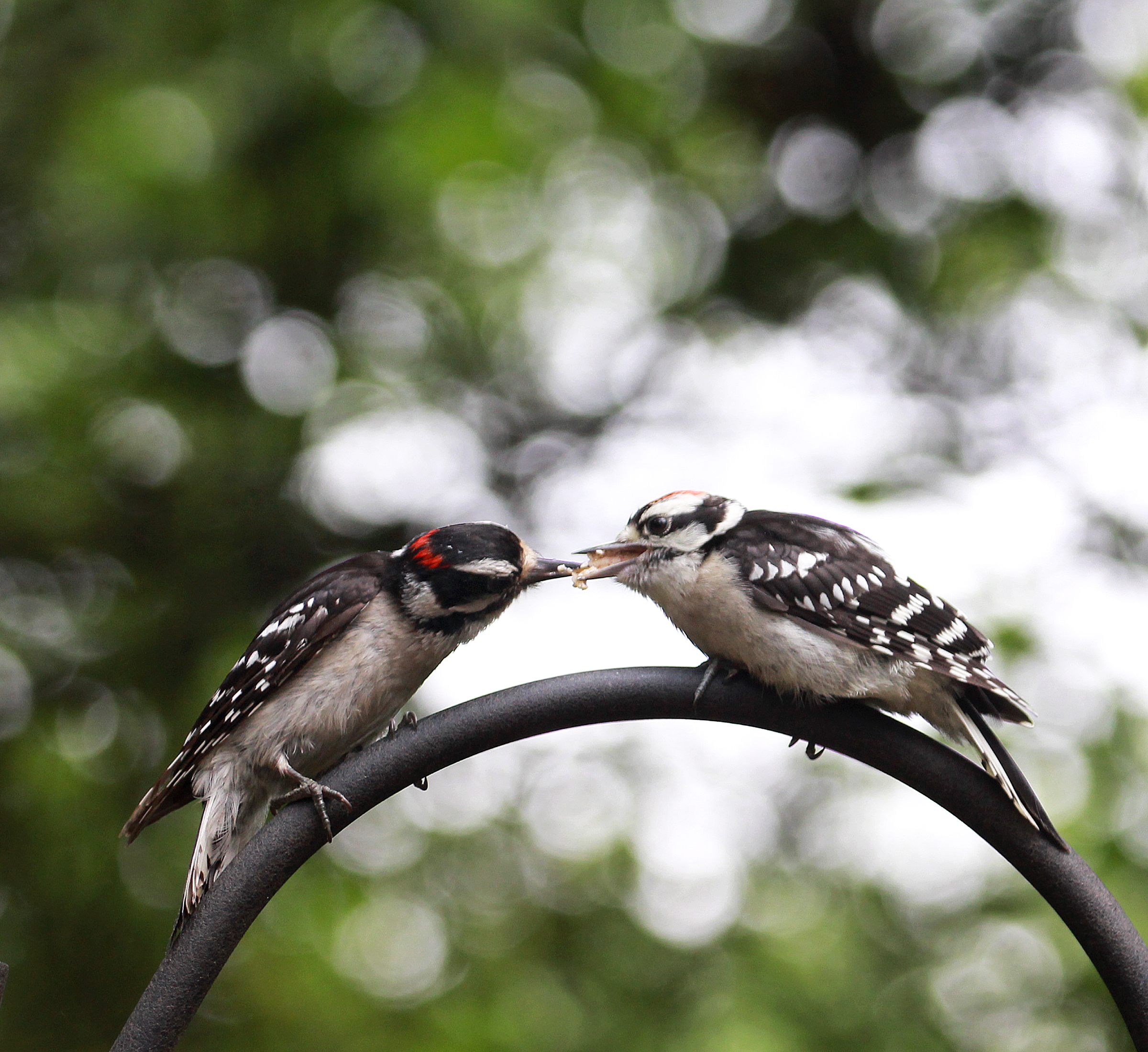
Photo by Chris Bosak An adult male downy woodpecker, left, feeds an immature male downy woodpecker near a birdfeeder in New England, summer 2018.

Photo by Chris Bosak
An adult male downy woodpecker, left, feeds an immature male downy woodpecker near a birdfeeder in New England, summer 2018.

They grow up so fast.

I was working at my computer at home, tending to the order of the day, when a flash of brown darted across the window and caught my attention. I followed the bird as it made its way through the thick cluster of branches in the front yard. It settled on a branch near the base of one of the many dying hemlocks.

It was a female rose-breasted grosbeak. Good sighting, I thought, especially considering the suddenness of the whole thing. It got better, though.

A few seconds later another flash — this one black, white and red — burst upon the scene. The male rose-breasted grosbeak flew from branch to branch and finally settled a few inches away from the first bird. The original bird tilted back its head, opened its beak and fluttered its wings. The male, who had been collecting worms from the various branches it had previously landed on, fed the youngster and went about looking for more food.

That scene made me question my original thought of it being a female rose-breasted grosbeak. Clearly, it was a youngster and born only a few weeks prior. From the distance and angle, I couldn’t tell if it was a male or female youngster Continue reading

For the Birds: The difference, or not, between the sexes

Here is the latest For the Birds column, which runs in several New England newspapers.

..

Photo by Chris Bosak A female rose-breasted grosbeak visits a feeder in Danbury, Conn., during the spring of 2018.

Photo by Chris Bosak
A female rose-breasted grosbeak visits a feeder in Danbury, Conn., during the spring of 2018.

Photo by Chris Bosak A male rose-breasted grosbeak visits a feeder in Danbury, Conn., during the spring of 2018.

Photo by Chris Bosak A male rose-breasted grosbeak visits a feeder in Danbury, Conn., during the spring of 2018.

I heard its call and knew the indigo bunting was close.

Suddenly, it burst from the tall grasses and wildflowers and perched at the top of a blade of grass. The blade bent, but held the bird’s weight.

Once the bird settled, my first thought was “Oh, just the female.” The male indigo bunting is on many New England birdwatcher’s “most-wanted” list. Its brilliant blue plumage is one of the most inspiring sights in New England’s natural world. The female? Well, it’s brown and rather sparrow-like.

My attitude toward the female bunting changed quickly as I realized any indigo bunting sighting is worth celebrating, regardless of whether it’s a male or female. I snapped one photo before the female bunting left her perch and disappeared again into the tall grasses.

The indigo bunting is a prime example of sexual dimorphism. I’m usually not the type to throw out terms like that, but this one is worth knowing. Sexual dimorphism is the difference in appearance between males and females of the same species.

New England is filled with great examples, even among our common, year-round species. Cardinals are an obvious example. The males are brilliant red and females are a duller olive green or light brown.

Our most colorful songbirds, such as the scarlet tanager and rose-breasted grosbeak, are other fine examples. The females of both species are dull in color, while the males sport brilliantly colorful plumage.

I thoroughly enjoyed looking at the male and female rose-breasted grosbeaks at the feeder this spring and early summer.

Many female birds are duller, of course, so as to not attract attention, especially during nesting season. Let the males be the targets and keep predators away from the nest.

Other extreme cases may be found by looking at our water birds. The wood duck is about as colorful a bird as you can imagine. The male, that is. The female is muted browns and tans. Even the mallard, our most common and well-known duck, is an example with the shiny green head of the male and overall brown of the female.

Now, let’s look at some examples from the other side — the monomorphic birds. Male and female blue jays, for instance, have a similar appearance. The same goes for chickadees and mourning doves and many other common New England species.

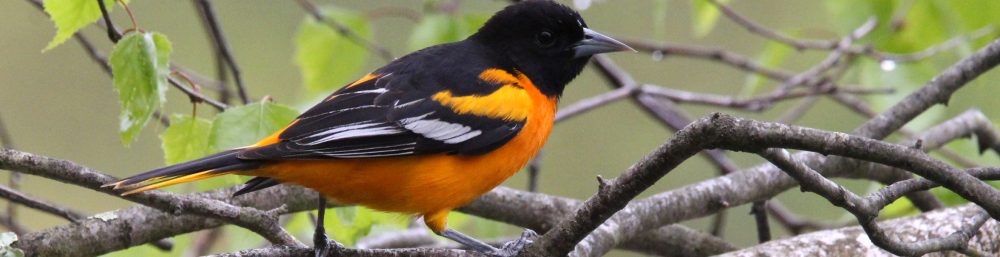
Some species straddle the line and have less obvious differences. The male Baltimore oriole is a brilliant, vibrant orange, while the female is a duller orange. Male eastern towhees are black, white and rufous, while the females are similarly designed with brown instead of black plumage. The difference between sexes is even closer with the American robin, with the males having a slightly more polished coat.

Birds of prey are an interesting study in sexual dimorphism. In their case, the females are usually slightly larger. The bald eagle is an extreme case as the females can be up to 30 percent larger.

Sexual dimorphism is not exclusive to the bird world. Male deer and moose have antlers, females don’t. That’s one obvious example, but in most cases, male and female mammal species look pretty much alike.

Eventually, I found the male indigo bunting, too. He was keeping watch among the top branches of a nearby tree. While it was great to see the electric blue of its plumage, as I look back, I was just as happy to the see the muted brown of the female.

Continue reading

For the Birds: The tricky nesting season

Here is the latest For the Birds column, which runs in several New England newspapers.

Yellow-bellied sapsucker cleans out its nest.

Yellow-bellied sapsucker cleans out its nest.

The nesting season can be tricky for birdwatchers.

Just when you are sure certain birds are nesting on your property, something happens that makes you question whether it’s true.

You would think a bird going in and out of a birdhouse would leave no doubt that the bird is, indeed, nesting there. But that’s not always the case. In fact, it’s often not the case.

I have four birdhouses strategically placed throughout my property and not a single one is occupied. I’ve seen black-capped chickadees go in and out of two of them on different occasions this spring. Yet, as I continue to monitor those houses, I see no activity.

I likely caught the birds checking out the houses and, apparently, they didn’t like something. Whether it was the location in the yard, the dimensions of the house, or they just didn’t like the vibe, they moved on and hopefully found a suitable place elsewhere.

At least the chickadees checked out the houses and moved on. Wrens will continue to tease homeowners into thinking they are nesting in the house. Of course, teasing the homeowner is Continue reading

For the Birds: Persistence pays off in birdwatching

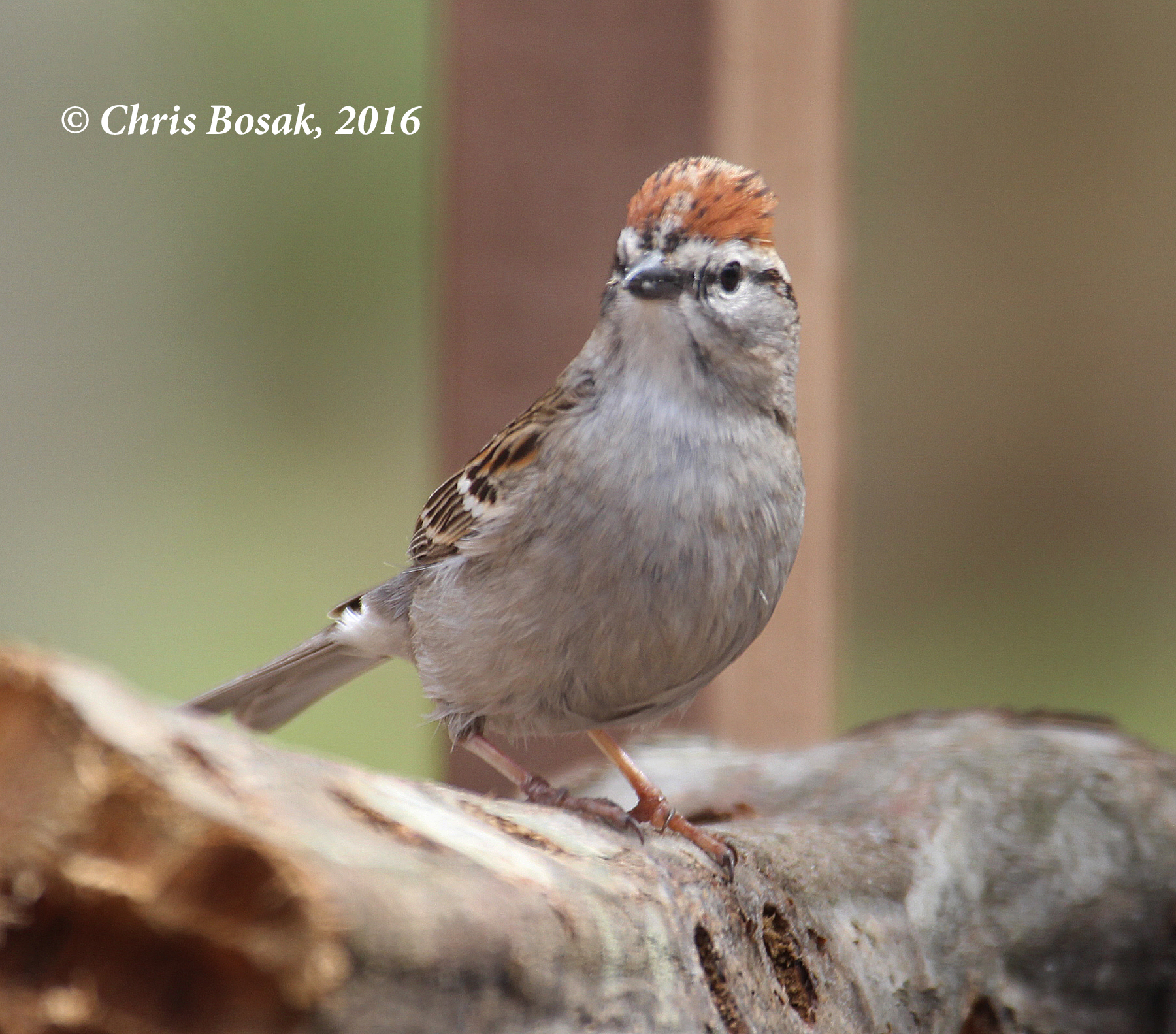
Photo by Chris Bosak A Chipping Sparrow raises its crest while standing on a log in Danbury, Conn., summer2016.

Photo by Chris Bosak
A Chipping Sparrow raises its crest while standing on a log in Danbury, Conn., summer2016.

I wasn’t about to let this one slip away.

I’ve said that to myself plenty of times over the years and most of the time it does, indeed, slip away. But not this time.

Persistence is often necessary when trying to nail down a bird’s identity. The problem is this: The bird doesn’t know this and often (usually?) flies away before you can study it long enough to get that ID.

This latest bird was driving me crazy. It sang loud and clear from the depths of the woods. The song appeared to be an endless series of robin-like phrases sung over and over. Despite the constant notes, I couldn’t find the bird in the treetops.

My first thoughts were that the bird was either a Baltimore oriole, rose-breasted grosbeak or scarlet tanager. I was thinking big in terms of color apparently. I looked in the tree tops, but saw nothing.

Eventually, I eliminated those birds from consideration because the song was too constant. The aforementioned birds take at least a little break between repeating their respective songs.

My next thought was a gray catbird as the song had a bit of a squeakiness to it. It wasn’t the right habitat for catbirds, however, as the scene was heavily wooded.

I recorded the song in case the bird decided to fly away, leaving me frustrated without a positive ID. I’ve tried that before, however, and it rarely seems to work. Just like birds Continue reading

For the Birds: How to find the rarities

Here is the latest For the Birds column, which runs in several New England newspapers.

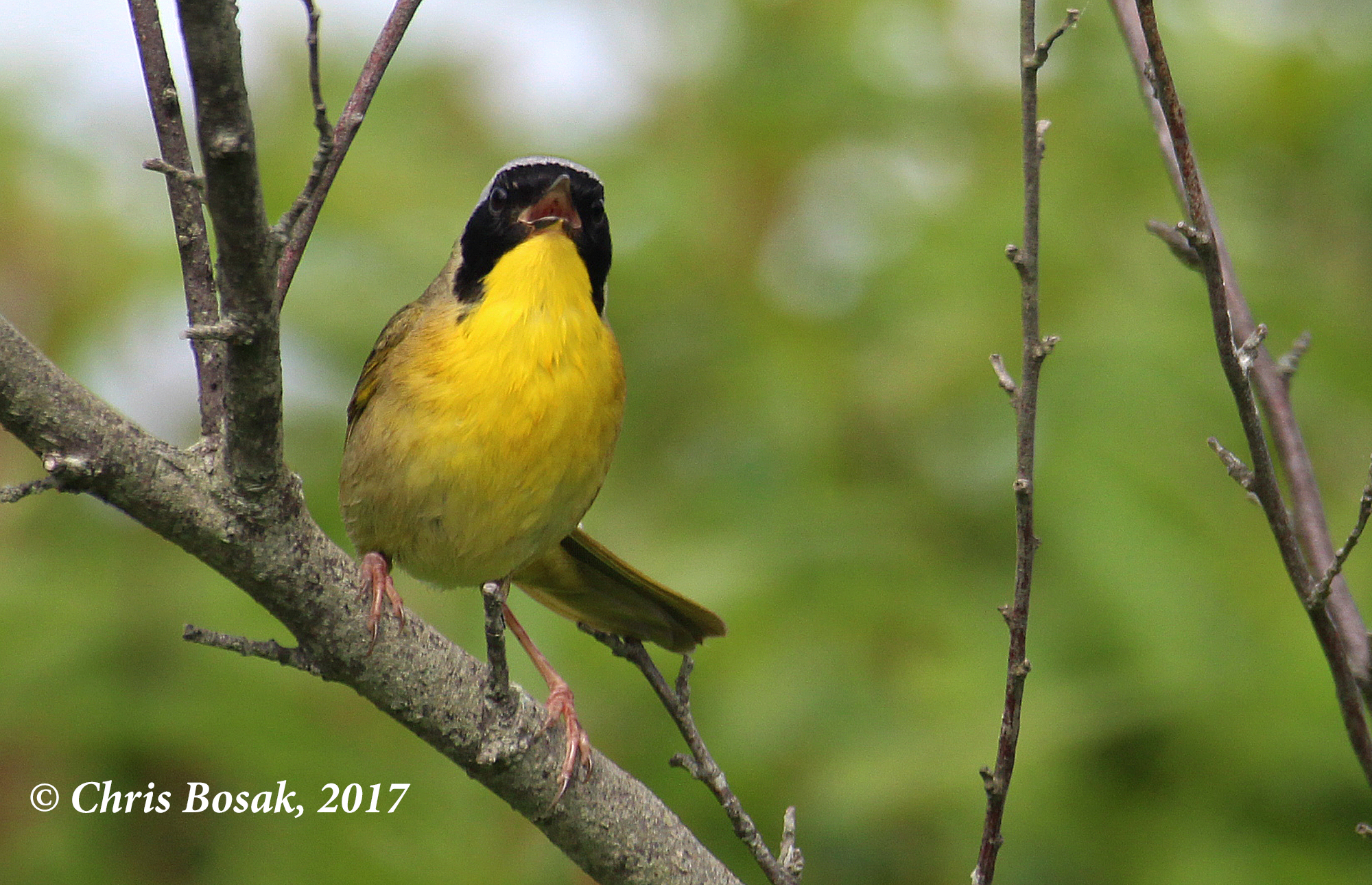
Photo by Chris Bosak A common yellowthroat sings from a perch in Brookfield, Conn., during spring 2017.

Photo by Chris Bosak
Rare bird alerts are a good way to find out when spring migrants, like this yellowthroat, are arriving.

What do we do now with spring migration winding down and birds busy with the task of continuing their species?

We still look for birds, of course, but where to find them? Resident birds make themselves scarce as they hide away in holes and on nests. We don’t want to disturb the birds at this time of year anyway.

It’s a good time to check out the rare-bird alerts to see what others are finding throughout the region. I’ve never been a big “chaser,” but it’s always fun to see what birds are around. You never know, maybe one of the rarities is in your town or in a neighboring town.

The best place to look is birding.aba.org, which is run by the American Birding Association. It is a combination of birding news and rare-bird alerts. Not all of the sightings listed are rare, but may be unusual for location or time of year. Sometimes, contributors just have a bird question for the community.

The “landing page” of the website gives users the option to click on any state. It’s fun to click on random states to see what’s showing where. If you’re traveling, you can always check to see if any unusual birds are hanging around your destination.

Some of the recent sightings in New Hampshire include nighthawks, chukar, king eider, mourning warbler and snowy owl. Yes, you read that last one correct. A snowy owl is still around the New Hampshire coast.

New Hampshire Audubon also maintains a great rare-bird alert system. Visit www.nhaudubon.organd click on “Get Outside,” then “birding.” It is updated frequently and lists rare and unusual sightings from around the state. There is also eBird, which is revolutionizing birding and bird tracking, but I’ll save that one for another day as it warrants its own story.

The lists will not let you know how the common species are doing, or where they are being seen. Cardinal and chickadee sightings are not appropriate for the rare-bird alert lists, but you can always send them to me if you feel the impulse to share. I’m always interested in knowing what people are seeing — rare and common species welcomed.

The ABA site is also good fodder for bird discussions. Many birders use the site to have questions about birds answered. A birder posted last week about a bird song she had heard and wondered if anyone could figure out what it was.

While I’ve never been a lister or chaser, it’s always good to check in occasionally with the rare-bird alerts. You’d hate to find out too late that a once-in-a-lifetime bird was right under your nose.

Continue reading

For the Birds: Readers take over again

Photo by Chris Bosak A scarlet tanager perches in an oak tree in Danbury, Conn., spring 2018.

Photo by Chris Bosak
A scarlet tanager perches in an oak tree in Danbury, Conn., spring 2018.

Here is the latest For the Birds column, which runs in several New England newspapers.

The colors just keep on coming this spring.

I’ve been lucky enough to see two indigo buntings, three rose-breasted grosbeaks (although two were males fighting each other), a scarlet tanager, at least three Baltimore orioles, a pair of ruby-throated hummingbirds and a handful of warblers in my yard so far this spring. It’s been a welcomed color bonanza after a long winter.

Now that Memorial Day has passed and we are unofficially in summer, let’s look at what some readers have seen.

Carol from the Monadnock Region sent a photo of an oddly colored hairy woodpecker. Instead of the traditional white and black, this one was black and yellowish brown. A reader from Connecticut sent me a similar photo a few years ago.

My guess is that it is a normal hairy woodpecker with a pigment abnormality. Pigment abnormalities show up in birds every so often, such as orange house finches or white robins. Leucism and albinoism are extreme forms of pigment abnormalities, but more subtle color variations occur.

Don watched as an eagle eyed a pair of common mergansers on Granite Lake. He wondered if the eagle would try to take one of the ducks, but a loud noise distracted the eagle and it flew off. Eagles, which often scavenge for food, can take birds as big as common mergansers.

Norma from Spofford had an indigo bunting visit her feeders this spring. She has been in Spofford for nearly 40 years and has seen buntings only a handful of times.

It’s also been a colorful spring for Lenny of Greenfield, who has seen orioles, rose-breasted grosbeaks and cardinals. A special treat was seeing the oriole and grosbeak at the feeder at the same time.

Dean in Marlborough reported visits from pileated woodpeckers, indigo buntings, cardinals and eastern bluebirds. Another colorful yard in the Monadnock Region.

Lida from Harrisville had a male and female oriole come to her table to feast on oranges. Another reader suggested using grape jelly to attract orioles.

I tried to attract orioles with both oranges and grape jelly this spring, to no avail.

Eric in Surry noticed the usual changing of the guard for ground-feeders as the juncos left and chipping sparrows arrived, with about a two-week overlap. He has also noticed a few warbler species, including a pine warbler carrying nesting material. The material was hair he leaves out for the birds after brushing his dog. He has also seen chickadees, phoebes and nuthatches grab some of the hair.

He had another interesting bird sighting this spring; shortly after filling in small holes in his yard, a Cooper’s hawk swooped in to grab a chipmunk. Eric has also seen a blue-gray gnatcatcher and heard an eastern whip-poor-will. It’s been years since I’ve heard a whip-poor-will so I’m glad someone is still hearing them.

Spring migration is winding down, but not over. Soon, it will give way to nesting season. Let me know what you are seeing out there in this exciting time of the year for birdwatching.

Latest For the Birds column: Another backyard first

Here is the latest For the Birds column, which runs in several New England newspapers.

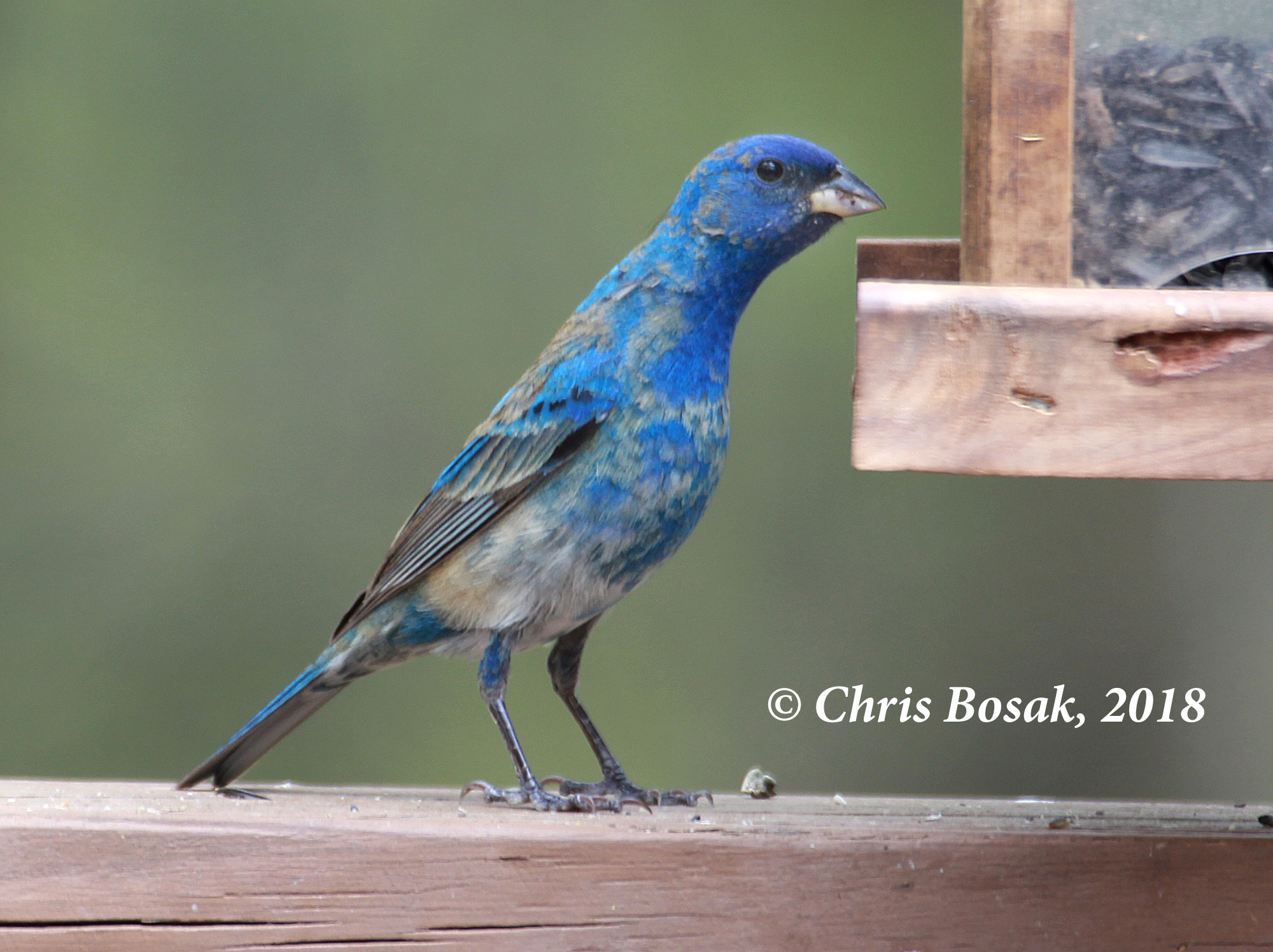
Photo by Chris Bosak An indigo bunting visits a feeder in New England, spring 2018.

Photo by Chris Bosak
An indigo bunting visits a feeder in New England, spring 2018.

No matter how long you’ve been at it, birdwatching always presents firsts.

Wait, I used that sentence to start my column a few weeks ago. Oh well, another birding first happened this week, so I’m going with it again.

This time, it was a new bird to my feeding station. I’ve been feeding birds for a long time, and I’ve seen some great birds eating seeds or suet in my backyard.

Every year I’m thrilled when the rose-breasted grosbeaks show up. This year, a male and female have paid periodic visits for the last couple days.

It took years for me to attract hummingbirds, but now — knock on wood — it seems they are annual visitors.

A few Octobers ago, a small group of pine warblers discovered my suet feeder and stuck around the yard for about three days.

The other day, a new arrival. Settling into my lounge chair on the deck, I noticed a bright blue blotch among the leaves on the branch used by “my” Continue reading